
Report Feature
Airborne Radar Market Trends and Forecast
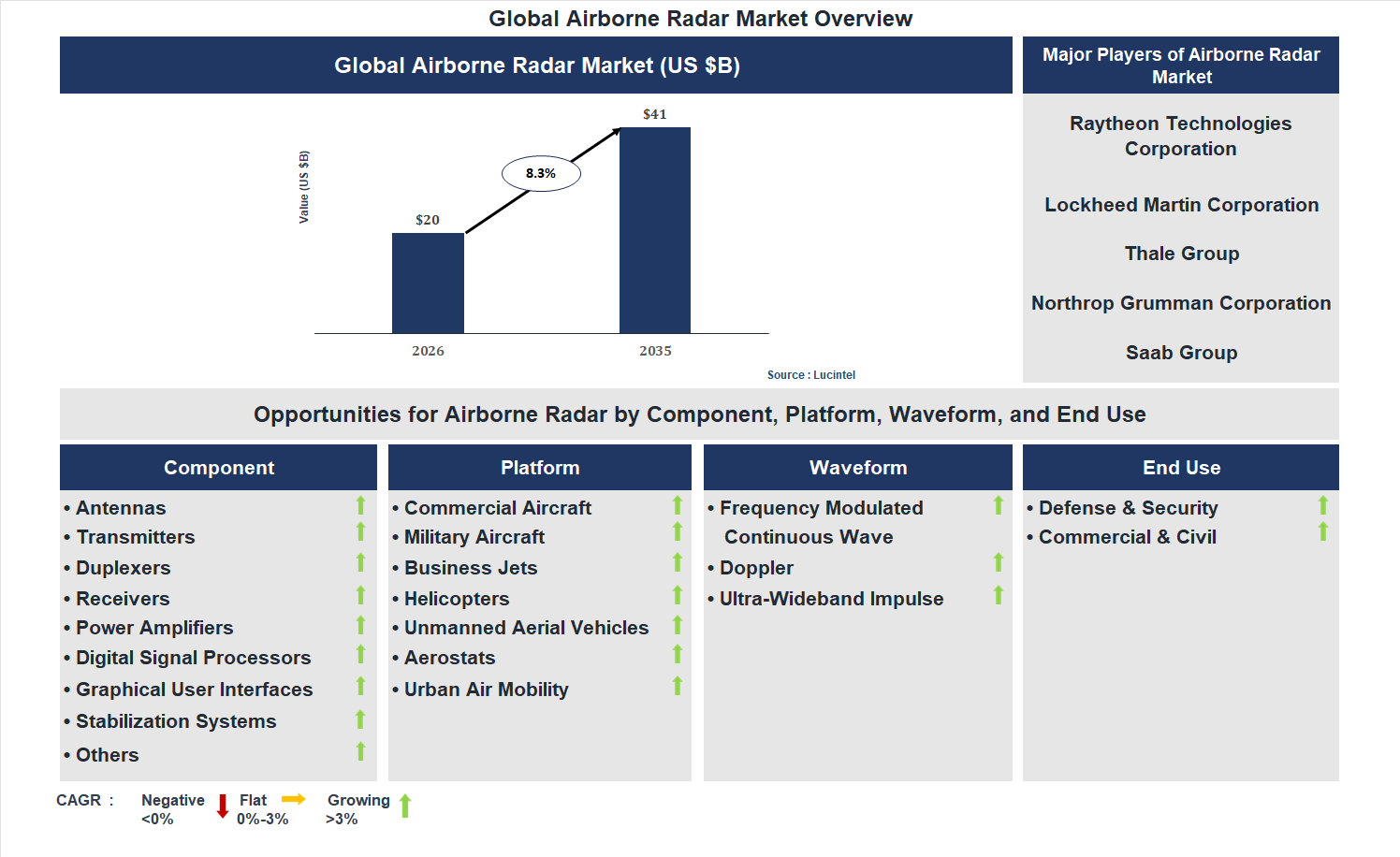
The future of the global airborne radar market looks promising with opportunities in the defense & security and commercial & civil markets. The global airborne radar market is expected to reach an estimated $41 billion by 2035 with a CAGR of 8.3% from 2026 to 2035. The major drivers for this market are the increasing adoption of advanced fighter aircraft & UAV, the growing demand for high-resolution imaging & target detection, and the rising demand for airborne radar in civil aviation safety.• Lucintel forecasts that, within the component category, transmitter is expected to witness the highest growth over the forecast period.
• Within the application category, defense & security is expected to witness the highest growth.
• In terms of region, APAC is expected to witness the highest growth over the forecast period. Gain valuable insights for your business decisions with our comprehensive 150+ page report. Sample figures with some insights are shown below.
Emerging Trends in the Airborne Radar Market
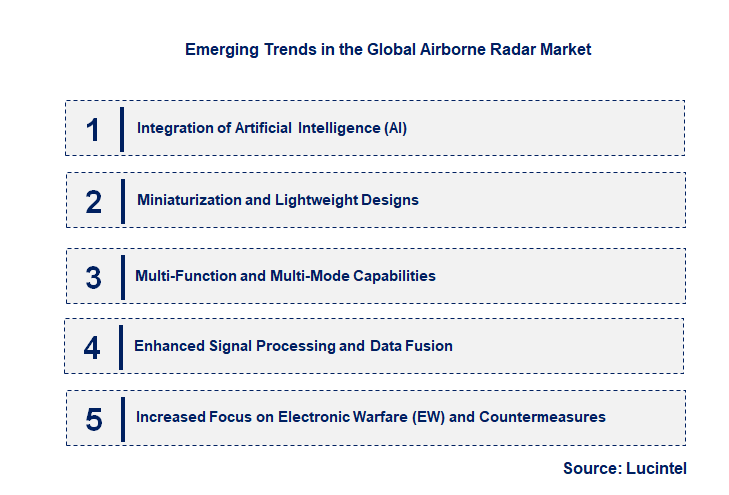
The airborne radar market is experiencing rapid evolution driven by technological advancements, increasing defense budgets, and the need for enhanced surveillance capabilities. As nations seek to improve their military and civilian surveillance systems, the market is witnessing innovative developments that improve detection, tracking, and data processing. These trends are shaping the future landscape of airborne radar technology, making systems more efficient, versatile, and integrated with other defense and civilian systems. The following key trends highlight the major shifts influencing this market, reflecting its dynamic nature and strategic importance in modern defense and surveillance operations.• Integration of Artificial Intelligence (AI): AI is increasingly integrated into airborne radar systems to enhance data analysis, target recognition, and decision-making processes. This integration allows for real-time processing of vast amounts of data, improving accuracy and response times. AI-driven algorithms can identify threats more quickly and adapt to changing environments, making radar systems more autonomous and efficient. This trend is transforming traditional radar operations into smarter, more adaptive systems capable of handling complex scenarios with minimal human intervention, thereby increasing operational effectiveness and reducing workload.
• Miniaturization and Lightweight Designs: Advances in materials and electronics have led to smaller, lighter radar systems without compromising performance. This miniaturization enables installation on a wider range of platforms, including smaller aircraft, drones, and unmanned aerial vehicles (UAVs). The impact is significant, as it broadens operational flexibility and reduces costs associated with larger, heavier systems. Lightweight radars also improve fuel efficiency and maneuverability of aircraft, making them suitable for diverse missions such as surveillance, reconnaissance, and target acquisition, especially in remote or difficult-to-access areas.
• Multi-Function and Multi-Mode Capabilities: Modern airborne radars are increasingly designed to perform multiple functions, such as surveillance, weather monitoring, and electronic warfare, within a single system. Multi-mode radars can switch between different operational modes seamlessly, providing comprehensive situational awareness. This versatility reduces the need for multiple separate systems, lowering overall costs and complexity. The ability to adapt to various mission requirements enhances operational efficiency and provides military and civilian operators with a more flexible and capable toolset for diverse scenarios.
• Enhanced Signal Processing and Data Fusion: Improvements in signal processing technology enable airborne radars to better filter noise, detect low-observable targets, and operate effectively in cluttered environments. Data fusion techniques combine information from multiple sensors and sources, creating a comprehensive picture of the operational environment. This trend significantly improves target detection accuracy and tracking capabilities, especially in complex scenarios such as electronic countermeasures or adverse weather conditions. Enhanced processing and fusion are critical for modern defense systems, providing a decisive advantage in battlefield awareness and civilian surveillance.
• Increased Focus on Electronic Warfare (EW) and Countermeasures: As threats become more sophisticated, airborne radars are increasingly integrated with electronic warfare capabilities to detect, jam, and deceive adversaries sensors. This trend involves developing radars that can operate in contested environments, resist jamming, and support electronic attack operations. The impact is a more resilient and survivable radar system that can maintain operational effectiveness against advanced threats. This focus on EW integration is vital for maintaining strategic superiority and ensuring mission success in complex, high-threat environments. These emerging trends are fundamentally reshaping the airborne radar market by making systems smarter, more adaptable, and capable of operating effectively in increasingly complex environments. The integration of AI, miniaturization, multi-functionality, advanced signal processing, and EW capabilities are driving innovation, expanding application scope, and enhancing overall operational effectiveness. These developments are positioning airborne radar technology as a critical component of modern defense and surveillance strategies, ensuring its relevance and growth in the coming years.
Recent Development in the Airborne Radar Market
The airborne radar market is experiencing rapid advancements driven by technological innovations, increasing defense budgets, and the need for enhanced surveillance capabilities. Governments and private sectors are investing heavily to improve detection, tracking, and communication systems. These developments are shaping the future of aerial security, military operations, and civilian applications. As the market evolves, key opportunities are emerging that promise to redefine operational efficiency and strategic advantages across various sectors.• Growing Demand for Advanced Surveillance Systems: The need for real-time, high-resolution imaging and tracking has led to significant investments in airborne radar technology, enhancing national security and border control capabilities. This demand is driving innovation in radar design, signal processing, and integration with other sensors, resulting in more effective and versatile systems. The market benefits from increased procurement by defense agencies and private security firms, fostering competitive growth and technological breakthroughs.
• Integration of AI and Machine Learning: Incorporating AI into airborne radar systems improves target detection, classification, and tracking accuracy. Machine learning algorithms enable systems to adapt to complex environments and reduce false alarms, increasing operational reliability. This integration enhances decision-making speed and reduces human error, making radar systems more efficient. The market sees a surge in R&D investments to develop smarter, autonomous radar solutions, which are crucial for modern military and civilian applications.
• Miniaturization and Lightweight Design: Advances in materials and electronics have led to smaller, lighter radar systems suitable for UAVs and smaller aircraft. This development expands operational flexibility, allowing for covert surveillance and rapid deployment in diverse environments. Miniaturized radars also reduce payload weight, improving fuel efficiency and flight endurance. The market benefits from increased adoption across various platforms, including commercial drones and tactical military units, broadening application scope and market reach.
• Expansion into Civilian and Commercial Sectors: Airborne radar technology is increasingly used in disaster management, environmental monitoring, and traffic control. These applications require high-resolution imaging and reliable data transmission, driving market growth beyond defense. The civilian sectors adoption fosters new revenue streams and technological diversification. As regulations evolve, the market is poised for significant expansion, with collaborations between government agencies and private companies accelerating deployment of innovative radar solutions.
• Development of Multi-Function Radar Systems: Modern airborne radars now combine surveillance, navigation, and communication functions into single platforms, optimizing operational efficiency. These multi-function systems reduce equipment costs and maintenance requirements while providing comprehensive situational awareness. They are vital for complex missions requiring versatility and rapid response. The market sees increased demand for integrated solutions, prompting manufacturers to innovate multifunctional radars that meet diverse operational needs across military and civilian domains. These developments are transforming the airborne radar market by enhancing detection capabilities, operational efficiency, and application diversity. The integration of AI, miniaturization, and multi-function systems is expanding market reach into civilian sectors and enabling smarter, more adaptable platforms. As technological innovations continue, the market is poised for sustained growth, driven by increasing security needs and evolving operational demands, ultimately shaping the future landscape of airborne surveillance and defense systems.
Strategic Growth Opportunities in the Airborne Radar Market
The airborne radar market is experiencing significant growth driven by technological advancements, increasing defense budgets, and expanding applications across military, aviation, and surveillance sectors. Innovations in radar systems, such as phased-array and multi-mode radars, are enhancing detection capabilities and operational efficiency. Growing demand for advanced surveillance, border security, and weather monitoring systems further fuels market expansion. Strategic investments by governments and private sectors are accelerating development and deployment, creating numerous opportunities for market players to innovate and capture new revenue streams in this dynamic landscape.• Enhanced Surveillance Capabilities Through Advanced Phased-Array Radars: The development of phased-array radar systems offers superior tracking, target identification, and real-time data processing, making them ideal for military and civilian applications. These radars provide rapid beam steering, high resolution, and multi-target tracking, significantly improving situational awareness. As defense agencies seek more reliable and versatile systems, the adoption of phased-array radars is expected to grow, opening new markets and driving technological innovation in airborne radar systems.
• Integration of Artificial Intelligence and Machine Learning for Improved Detection: Incorporating AI and ML algorithms into airborne radar systems enhances target recognition, reduces false alarms, and enables predictive maintenance. These technologies facilitate real-time data analysis, autonomous operation, and adaptive targeting, which are critical for modern defense and surveillance missions. As AI-driven solutions become more sophisticated, market players are investing in smart radar systems, creating opportunities for increased efficiency, reduced operational costs, and expanded application scopes across various sectors.
• Growing Demand for Maritime and Border Security Applications: Airborne radars are increasingly vital for maritime patrol, border surveillance, and anti-smuggling operations. The ability to detect small vessels, track illegal activities, and monitor large areas from the air makes radars indispensable for security agencies. Rising geopolitical tensions and the need for comprehensive border management are driving investments in specialized airborne radar systems, fostering market growth and encouraging the development of tailored solutions for maritime and border security.
• Expansion of Weather Monitoring and Disaster Management Systems: Airborne radars play a crucial role in weather forecasting, storm tracking, and disaster response. Advanced Doppler and multi-mode radars provide detailed atmospheric data, improving prediction accuracy and early warning systems. Governments and agencies are increasingly deploying airborne radar for climate monitoring and disaster preparedness, which expands market opportunities. The integration of these systems with satellite and ground-based sensors enhances overall environmental monitoring capabilities, supporting sustainable development and public safety initiatives.
• Increasing Adoption of Lightweight, Portable Radar Systems for Tactical Operations: The demand for compact, lightweight airborne radars suitable for tactical and special operations is rising. These systems offer flexibility, quick deployment, and enhanced mobility for military and law enforcement units. Advances in miniaturization and power efficiency enable integration into unmanned aerial vehicles (UAVs) and small aircraft, broadening operational scope. The trend toward portable radars is expected to accelerate, providing strategic advantages in reconnaissance, surveillance, and quick-response scenarios, thereby expanding market reach and technological innovation. These growth opportunities collectively are transforming the airborne radar market by fostering technological innovation, expanding application domains, and enhancing operational capabilities. As defense, security, weather monitoring, and tactical needs evolve, market players are poised to capitalize on these trends, driving sustained growth and competitive advantage. The integration of advanced technologies and expanding application areas will ensure the market remains dynamic and resilient in the face of emerging challenges and opportunities.
Airborne Radar Market Driver and Challenges
The airborne radar market is influenced by a variety of technological, economic, and regulatory factors that shape its growth and development. Advances in radar technology, increasing defense budgets worldwide, and evolving security threats are key drivers propelling this market forward. Conversely, challenges such as high development costs, regulatory restrictions, and technological obsolescence pose significant hurdles. Understanding these drivers and challenges is essential for stakeholders to navigate the complex landscape effectively and capitalize on emerging opportunities while mitigating risks. The factors responsible for driving the airborne radar market include:-• Technological Innovation: The continuous evolution of radar systems, including phased-array and AESA (Active Electronically Scanned Array) radars, enhances detection capabilities, range, and resolution. These advancements enable military and civilian applications to meet increasing operational demands, fostering market growth. Investment in R&D by defense contractors and governments accelerates innovation, ensuring the market remains competitive and responsive to emerging threats and requirements.
• Rising Defense Budgets: Governments worldwide are increasing their defense spending to modernize military capabilities. This surge in budgets directly impacts the procurement of advanced airborne radar systems, supporting market expansion. Countries are prioritizing air defense and surveillance, which necessitates sophisticated radar solutions, thus creating a steady demand for market players.
• Geopolitical Tensions and Security Threats: Increasing regional conflicts and terrorism threats drive demand for advanced airborne radar systems for surveillance, reconnaissance, and missile defense. These security concerns compel nations to upgrade their existing systems and invest in new technologies, fueling market growth and innovation.
• Expansion of Civil and Commercial Applications: Beyond defense, airborne radar technology is increasingly used in civil aviation, weather monitoring, and environmental surveillance. The expanding scope of applications broadens the market base, encouraging technological diversification and investment, which further propels market development. The challenges in the airborne radar market are:
• High Development and Maintenance Costs: Developing advanced radar systems requires significant capital investment in R&D, manufacturing, and testing. Maintenance and upgrades also incur substantial costs, which can limit adoption, especially among smaller defense agencies or civilian operators with constrained budgets. These financial barriers can slow market growth and restrict technological dissemination.
• Regulatory and Export Restrictions: Stringent government regulations and export controls on military technology hinder international trade and collaboration. These restrictions can delay product launches, increase compliance costs, and limit market access for global players, thereby impacting overall market expansion.
• Rapid Technological Obsolescence: The fast pace of technological innovation means that radar systems can become outdated quickly. Companies face pressure to continuously innovate and upgrade their offerings, which increases R&D costs and shortens product life cycles. This rapid obsolescence challenges manufacturers to maintain competitive advantage and profitability. The airborne radar market is driven by technological advancements, increased defense spending, geopolitical tensions, and expanding civil applications. However, high costs, regulatory hurdles, and rapid technological changes pose significant challenges. These factors collectively influence market dynamics, requiring stakeholders to adapt strategically. While opportunities for growth are substantial, addressing the challenges effectively is crucial for sustained success. Overall, the markets future will depend on balancing innovation with regulatory compliance and cost management to meet evolving security and civil needs.
List of Airborne Radar Companies
Companies in the market compete on the basis of product quality offered. Major players in this market focus on expanding their manufacturing facilities, R&D investments, infrastructural development, and leverage integration opportunities across the value chain. With these strategies airborne radar companies cater increasing demand, ensure competitive effectiveness, develop innovative products & technologies, reduce production costs, and expand their customer base. Some of the airborne radar companies profiled in this report include-• Raytheon Technologies Corporation
• Lockheed Martin Corporation
• Thale Group
• Northrop Grumman Corporation
• Saab Group
• Leonardo S.p.A.
• Aerospace Industries
Airborne Radar Market by Segment
The study includes a forecast for the global airborne radar market by component, platform, waveform, end use, and region.Airborne Radar Market by Component [Value from 2019 to 2035]:
• Antennas
• Transmitters
• Duplexers
• Receivers
• Power Amplifiers
• Digital Signal Processors
• Graphical User Interfaces
• Stabilization Systems
• Others
Airborne Radar Market by Platform [Value from 2019 to 2035]:
• Commercial Aircraft
• Military Aircraft
• Business Jets
• Helicopters
• Unmanned Aerial Vehicles
• Aerostats
• Urban Air Mobility
Airborne Radar Market by Waveform [Value from 2019 to 2035]:
• Frequency Modulated Continuous Wave
• Doppler
• Ultra-Wideband Impulse
Airborne Radar Market by End Use [Value from 2019 to 2035]:
• Defense & Security
• Commercial & Civil
Airborne Radar Market by Region [Value from 2019 to 2035]:
• North America
• Europe
• Asia Pacific
• The Rest of the World
Country Wise Outlook for the Airborne Radar Market
The airborne radar market has experienced significant technological advancements and strategic shifts across major economies, driven by increasing defense budgets, technological innovation, and evolving security threats. Countries are investing heavily in next-generation radar systems to enhance surveillance, navigation, and combat capabilities. These developments reflect a global push towards more sophisticated, reliable, and versatile airborne radar solutions, with each nation focusing on tailored innovations to meet their specific defense and security needs. The following summaries highlight recent key developments in the airborne radar market for the United States, China, Germany, India, and Japan.• United States: The US has advanced its phased-array radar technology, integrating AI for improved target detection and tracking. The deployment of AESA radars on new fighter jets and surveillance aircraft enhances multi-mission capabilities. Significant investments are also made in electronic warfare and stealth detection systems, emphasizing technological superiority and strategic dominance.
• China: China has made rapid progress in developing active electronically scanned array (AESA) radars, focusing on multi-role capabilities for its military aircraft. The country is also investing in radar systems that improve early warning and missile detection, aiming to modernize its air defense network and expand regional influence through indigenous technology.
• Germany: Germany is upgrading its airborne radar systems for its Eurofighter Typhoon fleet, incorporating advanced AESA technology for better resolution and target identification. The country emphasizes integrating radar systems with NATO allies, enhancing interoperability and joint defense capabilities within the European framework.
• India: India is focusing on indigenous radar development, including AESA and multi-mode radars for its fighter jets and surveillance aircraft. The government is investing in modernizing its air defense systems and enhancing detection range and accuracy to counter regional threats, with collaborations involving domestic and international technology partners.
• Japan: Japan is enhancing its airborne radar systems to improve maritime surveillance and missile detection, driven by regional security concerns. The country is adopting cutting-edge AESA radars and integrating them with advanced sensor networks to strengthen its self-defense capabilities and regional security posture.

Features of the Global Airborne Radar Market
Market Size Estimates: Airborne radar market size estimation in terms of value ($B). Trend and Forecast Analysis: Market trends (2019 to 2025) and forecast (2026 to 2035) by various segments and regions. Segmentation Analysis: Airborne radar market size by various segments, such as by component, platform, waveform, end use, and region in terms of value ($B). Regional Analysis: Airborne radar market breakdown by North America, Europe, Asia Pacific, and Rest of the World. Growth Opportunities: Analysis of growth opportunities in different components, platforms, waveforms, end uses, and regions for the airborne radar market. Strategic Analysis: This includes M&A, new product development, and competitive landscape of the airborne radar market. Analysis of competitive intensity of the industry based on Porter’s Five Forces model.
FAQ
Q1. What is the airborne radar market size? Answer: The global airborne radar market is expected to reach an estimated $41 billion by 2035. Q2. What is the growth forecast for airborne radar market? Answer: The global airborne radar market is expected to grow with a CAGR of 8.3% from 2026 to 2035. Q3. What are the major drivers influencing the growth of the airborne radar market? Answer: The major drivers for this market are the increasing adoption of advanced fighter aircraft & UAV, the growing demand for high-resolution imaging & target detection, and the rising demand for airborne radar in civil aviation safety. Q4. What are the major segments for airborne radar market? Answer: The future of the airborne radar market looks promising with opportunities in the defense & security and commercial & civil markets. Q5. Who are the key airborne radar market companies? Answer: Some of the key airborne radar companies are as follows:• Raytheon Technologies Corporation
• Lockheed Martin Corporation
• Thale Group
• Northrop Grumman Corporation
• Saab Group
• Leonardo S.p.A.
• Aerospace Industries Q6. Which airborne radar market segment will be the largest in future? Answer: Lucintel forecasts that, within the component category, transmitter is expected to witness the highest growth over the forecast period. Q7. In airborne radar market, which region is expected to be the largest in next 8 years? Answer: In terms of region, APAC is expected to witness the highest growth over the forecast period. Q8. Do we receive customization in this report? Answer: Yes, Lucintel provides 10% customization without any additional cost.
Table of Contents
List of Figures
List of Tables
Methodology
- In-depth interviews of the major players in this market
- Detailed secondary research from competitors’ financial statements and published data
- Extensive searches of published works, market, and database information pertaining to industry news, company press releases, and customer intentions
- A compilation of the experiences, judgments, and insights of Lucintel’s professionals, who have analyzed and tracked this market over the years.


Buy Now
Choose a license that fits your team. Instant PDF delivery.
Prices exclude taxes. Instant delivery. Custom licensing available on request.
Key Questions
- • What are some of the most promising, high-growth opportunities for the airborne radar market by component (antennas, transmitters, duplexers, receivers, power amplifiers, digital signal processors, graphical user interfaces, stabilization systems, and others), platform (commercial aircraft, military aircraft, business jets, helicopters, unmanned aerial vehicles, aerostats, and urban air mobility), waveform (frequency modulated continuous wave, doppler, and ultra-wideband impulse), end use (defense & security and commercial & civil), and region (North America, Europe, Asia Pacific, and the Rest of the World)?
- • Which segments will grow at a faster pace and why?
- • Which region will grow at a faster pace and why?
- • What are the key factors affecting market dynamics? What are the key challenges and business risks in this market?
- • What are the business risks and competitive threats in this market?
- • What are the emerging trends in this market and the reasons behind them?
- • What are some of the changing demands of customers in the market?
- • What are the new developments in the market? Which companies are leading these developments?
- • Who are the major players in this market? What strategic initiatives are key players pursuing for business growth?
- • What are some of the competing products in this market and how big of a threat do they pose for loss of market share by material or product substitution?
- • What M&A activity has occurred in the last 5 years and what has its impact been on the industry? For any questions related to Airborne Radar Market, Airborne Radar Market Size, Airborne Radar Market Growth, Airborne Radar Market Analysis, Airborne Radar Market Report, Airborne Radar Market Share, Airborne Radar Market Trends, Airborne Radar Market Forecast, Airborne Radar Companies, write Lucintel analyst at email: helpdesk@lucintel.com. We will be glad to get back to you soon.


