
Market Report · July 31, 2026

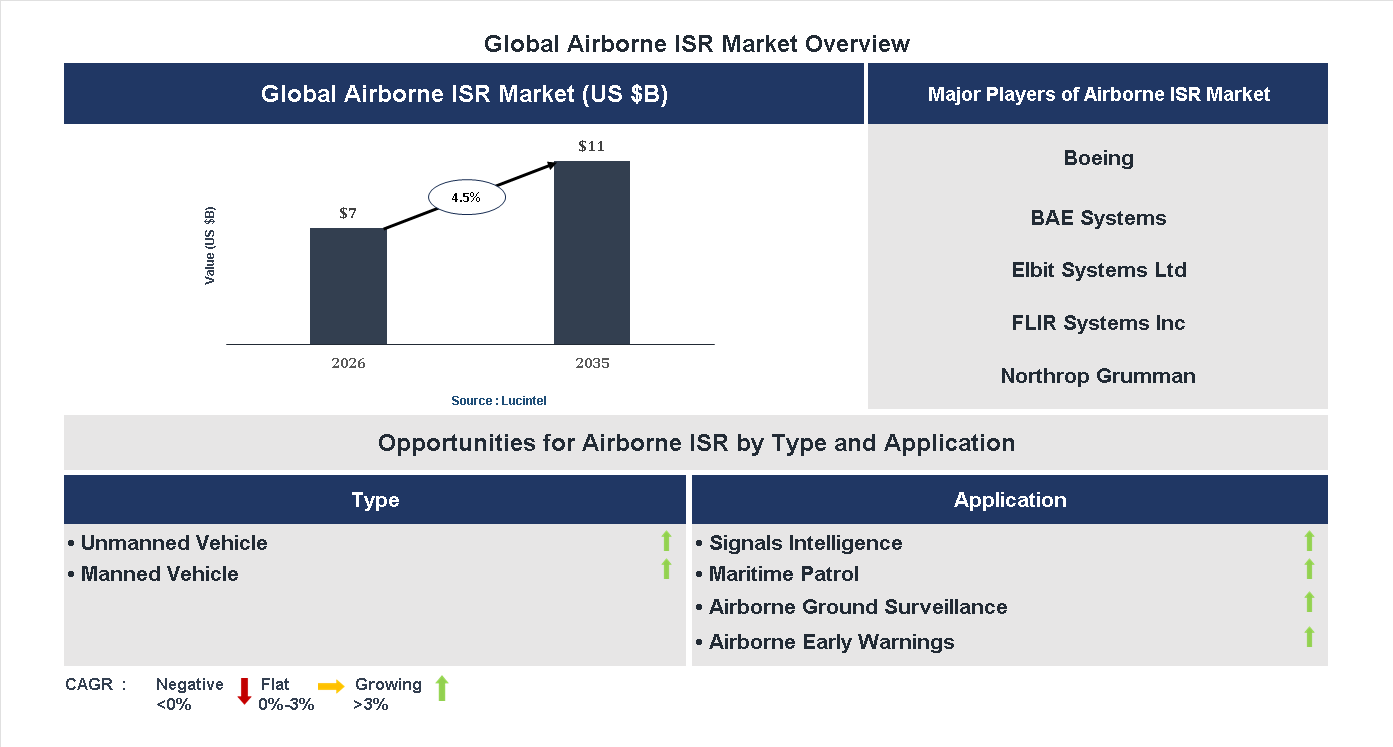
Key data points: The market size in 2035 = $11 billion, growth forecast = 4.5% annually for the next 8 years. Scroll below to get more insights. This market report covers trends, opportunities and forecasts in airborne ISR market to 2035 by type (unmanned vehicle and manned vehicle), application (signals intelligence, maritime patrol, airborne ground surveillance, and airborne early warnings), and region (North America, Europe, Asia Pacific, and the Rest of the World)
We'll send your sample report shortly.
• Lucintel forecasts that, within the type category, unmanned vehicle is expected to witness higher growth over the forecast period.
• Within the application category, signal intelligence is expected to witness the highest growth.
• In terms of region, APAC is expected to witness the highest growth over the forecast period. Gain valuable insights for your business decisions with our comprehensive 150+ page report. Sample figures with some insights are shown below.
• Integration of Artificial Intelligence and Machine Learning: The incorporation of AI and ML into airborne ISR systems is revolutionizing data processing and analysis. These technologies enable real-time pattern recognition, predictive analytics, and autonomous decision-making, significantly reducing response times and increasing operational efficiency. AI-driven systems can sift through vast amounts of data collected from sensors, providing actionable insights faster than traditional methods. This trend enhances the capability of ISR platforms to adapt to complex scenarios, improve target identification, and support autonomous operations, thereby transforming intelligence gathering and threat assessment processes.
• Rise of Multi-Role and Modular Platforms: Modern ISR aircraft are increasingly designed as multi-role platforms with modular configurations. This flexibility allows operators to customize aircraft for specific missions, such as surveillance, reconnaissance, or electronic warfare, by swapping out sensor packages and equipment. Modular designs reduce costs and deployment times while increasing operational versatility. These platforms can adapt quickly to evolving threats and mission requirements, making them more effective in diverse operational environments. The trend supports a more agile and cost-efficient approach to airborne ISR, enabling rapid response to emerging security challenges.
• Advancements in Sensor Technologies: The development of high-resolution, multi-spectral, and persistent sensors is expanding the capabilities of airborne ISR systems. Innovations include synthetic aperture radar (SAR), electro-optical/infrared (EO/IR) sensors, and signals intelligence (SIGINT) payloads that provide comprehensive situational awareness. These sensors enable detailed imaging, real-time data transmission, and enhanced target detection under various weather conditions. The integration of advanced sensors improves the accuracy, coverage, and reliability of ISR missions, supporting strategic and tactical decision-making across military and intelligence agencies.
• Growing Use of Unmanned Aerial Vehicles (UAVs): The deployment of UAVs in ISR operations is increasing due to their cost-effectiveness, risk reduction, and operational flexibility. Drones equipped with sophisticated sensors can conduct persistent surveillance over large areas without risking human lives. They are capable of operating in contested environments and providing persistent intelligence, surveillance, and reconnaissance. The miniaturization of sensors and advancements in autonomy are further enhancing UAV capabilities. This trend is transforming traditional ISR paradigms by enabling more widespread, persistent, and adaptable surveillance options.
• Emphasis on Cybersecurity and Data Management: As airborne ISR systems become more connected and data-driven, cybersecurity has become a critical concern. Protecting sensitive intelligence data from cyber threats and ensuring secure communication channels are paramount. Additionally, managing the vast volumes of data collected requires advanced data management and analytics solutions. This trend emphasizes the importance of robust cybersecurity protocols, encryption, and integrated data platforms to safeguard information and optimize its use. Strengthening cybersecurity measures ensures operational integrity and maintains trust in ISR systems amid increasing cyber threats. These emerging trends are collectively reshaping the Airborne ISR market by enhancing technological capabilities, operational flexibility, and security. They are enabling more effective, efficient, and resilient intelligence gathering, which is crucial for modern defense and security strategies. As these developments continue, the market is poised for significant growth and innovation, supporting a safer and more informed global environment.

• Growing Demand for Military Surveillance: The increasing need for real-time intelligence and surveillance in military operations is propelling the market. Countries are investing in advanced airborne ISR platforms to monitor borders, detect threats, and support combat missions. This demand is driven by geopolitical tensions and the need for enhanced national security. The deployment of unmanned aerial vehicles (UAVs) and manned aircraft with sophisticated sensors is expanding, offering improved coverage and data collection. This trend is expected to continue, boosting market growth significantly.
• Technological Innovations in Sensor and Data Analytics: Advances in sensor technology, including high-resolution electro-optical and infrared sensors, are transforming airborne ISR capabilities. Integration of AI and machine learning enables real-time data processing, pattern recognition, and predictive analytics. These innovations improve target detection, tracking, and threat assessment accuracy. Enhanced data analytics facilitate faster decision-making, making ISR platforms more effective. The adoption of these technologies is expanding across military, homeland security, and commercial sectors, creating new growth avenues and increasing operational efficiency.
• Increasing Adoption of Unmanned Aerial Vehicles (UAVs): UAVs are becoming a vital component of airborne ISR systems due to their cost-effectiveness, flexibility, and ability to access difficult terrains. They provide persistent surveillance, reconnaissance, and intelligence gathering without risking human lives. The development of autonomous UAVs with advanced sensors and communication systems is further boosting their adoption. Governments and private entities are investing in UAV fleets for border patrol, disaster response, and maritime surveillance, significantly expanding the market and enabling rapid deployment in diverse scenarios.
• Rising Focus on Data Security and Cybersecurity: As airborne ISR systems generate vast amounts of sensitive data, ensuring data security and cybersecurity is critical. The market is witnessing increased investments in secure communication channels, encryption technologies, and cyber defense solutions to protect against hacking and data breaches. This focus is essential for maintaining operational integrity and safeguarding national security interests. The development of robust cybersecurity measures is fostering trust among users and encouraging broader adoption of ISR platforms, thereby driving market expansion and technological advancement.
• Expansion into Commercial and Civil Applications: Beyond military and security, airborne ISR technology is increasingly being adopted for commercial purposes such as infrastructure monitoring, environmental surveillance, and disaster management. These applications benefit from high-resolution imaging and real-time data collection, improving response times and operational planning. The integration of ISR with smart city initiatives and environmental monitoring programs is opening new markets. This diversification is broadening the market scope, attracting investments, and fostering innovation in civilian sectors, ultimately accelerating overall market growth. The overall impact of these developments is a robust, technologically advanced market with diverse applications, increased investment, and enhanced capabilities, positioning the airborne ISR market for sustained growth and strategic importance worldwide.
• Enhanced Military Surveillance Capabilities: Developing advanced sensors, multi-spectral imaging, and real-time data processing can significantly improve military reconnaissance, target tracking, and battlefield awareness. Integration of AI and machine learning enables predictive analytics, reducing response times and increasing operational efficiency. Sub-segments like tactical drones and long-endurance aircraft are gaining prominence, offering superior coverage and intelligence gathering in complex environments.
• Expansion in Border Security and Homeland Defense: Increasing border threats and illegal activities drive demand for persistent surveillance solutions. Airborne ISR platforms equipped with high-resolution cameras, radar, and signal interception tools provide continuous monitoring over vast areas. These systems support rapid response, threat detection, and border integrity, especially in remote or inaccessible regions. Enhanced data sharing and integration with ground forces further strengthen national security measures.
• Growth in Disaster Management and Emergency Response: Airborne ISR systems play a vital role in disaster assessment, search and rescue, and environmental monitoring. Equipped with thermal imaging, LiDAR, and multispectral sensors, these platforms deliver real-time data to aid decision-making during natural calamities like floods, wildfires, and earthquakes. Their ability to operate in challenging conditions and cover large areas quickly makes them indispensable for effective disaster response and recovery efforts.
• Increasing Adoption of Unmanned Aerial Vehicles (UAVs): UAVs are transforming airborne ISR with their cost-effectiveness, flexibility, and ability to access difficult terrains. Small, medium, and large drones equipped with advanced payloads are used across military, border patrol, and commercial sectors. Innovations in autonomous flight, endurance, and payload capacity are expanding their operational scope, enabling persistent surveillance, reconnaissance, and data collection in diverse environments.
• Integration of Data Analytics and Artificial Intelligence: The convergence of ISR data with AI and big data analytics enhances intelligence accuracy and operational efficiency. Automated threat detection, pattern recognition, and predictive analytics enable faster decision-making. Cloud-based platforms facilitate seamless data sharing among agencies, improving coordination. This integration is critical for managing the increasing volume of data generated by airborne systems and extracting actionable insights for strategic planning. The overall market growth is driven by these opportunities, fostering innovation and expanding applications. Stakeholders investing in advanced technologies and integrated solutions will be better positioned to meet evolving security and surveillance needs. This dynamic environment promises sustained expansion, increased competitiveness, and the development of smarter, more capable airborne ISR systems.
• Technological Innovation: The continuous development of advanced sensors, AI-powered data analytics, and drone technology enhances the capabilities of ISR platforms. These innovations enable real-time data collection, improved target identification, and autonomous operations, which are critical for military and civilian applications. As technology becomes more sophisticated and cost-effective, adoption accelerates across defense agencies and commercial sectors, expanding market reach and operational efficiency.
• Increasing Defense Budgets: Governments worldwide are allocating substantial funds toward modernizing their military capabilities, with a focus on ISR systems. Rising geopolitical tensions and regional conflicts necessitate advanced surveillance and reconnaissance tools to ensure national security. This increased funding supports research, procurement, and deployment of airborne ISR platforms, fueling market growth and encouraging innovation in the sector.
• Rising Geopolitical Tensions: Escalating conflicts and territorial disputes in various regions heighten the demand for reliable ISR solutions. Countries seek to enhance their situational awareness and intelligence gathering to preempt threats and respond swiftly. This geopolitical landscape drives the procurement of sophisticated airborne ISR systems, fostering market expansion and technological development.
• Integration of Artificial Intelligence and Big Data: The incorporation of AI and big data analytics into ISR platforms allows for enhanced data processing, pattern recognition, and predictive analysis. These capabilities improve decision-making speed and accuracy, making ISR systems more effective. As organizations seek smarter solutions, the market experiences increased demand for integrated, AI-driven ISR platforms, promoting innovation and competitiveness.
• Growing Commercial and Civil Applications: Beyond defense, ISR technology is increasingly adopted in sectors such as disaster management, border security, environmental monitoring, and infrastructure inspection. The expanding scope of civilian applications broadens the market base, encouraging cross-sector investments and technological diversification, which further propels market growth. The challenges facing the airborne ISR market include:
• Regulatory and Airspace Restrictions: Stringent regulations governing airspace usage, data privacy, and international cooperation pose significant hurdles. Compliance with diverse regulatory standards across countries complicates deployment and increases operational costs. Additionally, restrictions on drone operations and data sharing can limit the deployment of ISR systems, hindering market expansion and technological integration.
• High Development and Maintenance Costs: Developing advanced ISR platforms involves substantial investment in research, technology, and infrastructure. Maintenance and upgrades further add to operational expenses. These high costs can restrict entry for smaller players and limit adoption among budget-constrained agencies, potentially slowing market growth and innovation.
• Cybersecurity Threats and Data Privacy Concerns: As ISR systems become more connected and reliant on data analytics, they become vulnerable to cyberattacks and data breaches. Protecting sensitive intelligence information is critical, and any compromise can have severe national security implications. These cybersecurity challenges necessitate robust security measures, increasing costs and complexity, and may impede rapid deployment or adoption of new technologies. The airborne ISR market is driven by rapid technological advancements, increased defense spending, geopolitical tensions, AI integration, and expanding civilian applications. However, regulatory restrictions, high costs, and cybersecurity threats pose significant challenges. These factors collectively influence the markets growth trajectory, requiring stakeholders to innovate while navigating complex regulatory and security landscapes. The overall impact is a dynamic, rapidly evolving market with substantial opportunities tempered by notable hurdles that must be strategically managed.
• Boeing
• BAE Systems
• Elbit Systems Ltd
• FLIR Systems Inc
• Northrop Grumman
• General Dynamics
• Thales
• Unmanned Vehicle
• Manned Vehicle
• Signals Intelligence
• Maritime Patrol
• Airborne Ground Surveillance
• Airborne Early Warnings
• North America
• Europe
• Asia Pacific
• The Rest of the World
• United States: The US continues to lead in airborne ISR technology, investing in next-generation aircraft and drone systems. Recent developments include the deployment of advanced sensors and AI-driven data analysis tools to improve real-time intelligence gathering. The US military has also increased collaborations with private aerospace firms to develop stealthy, high-altitude surveillance platforms. Additionally, efforts are underway to integrate ISR capabilities with cyber and space domains, enhancing multi-domain operations. The focus remains on maintaining technological superiority and expanding operational reach in contested environments.
• China: China has rapidly advanced its airborne ISR capabilities, emphasizing indigenous development of surveillance aircraft and drone systems. Recent progress includes the deployment of new high-altitude reconnaissance aircraft and the expansion of its drone fleet for both military and border surveillance. China is also investing in AI and big data analytics to improve data processing and decision-making. The country’s focus is on achieving strategic autonomy and countering US dominance in aerial intelligence. Its efforts are aimed at strengthening regional security and expanding influence through enhanced surveillance and intelligence-sharing capabilities.
• Germany: Germany has prioritized upgrading its airborne ISR assets within NATO frameworks, focusing on interoperability and technological modernization. Recent developments include the integration of advanced radar and sensor systems into existing aircraft and the development of unmanned aerial systems (UAS) for surveillance missions. Germany is also investing in secure data links and cyber-resilience to protect sensitive intelligence. The country emphasizes dual-use technologies that support both military and civilian applications, including border security and disaster management. Collaborative projects with European partners aim to bolster collective intelligence capabilities.
• India: India has made significant strides in enhancing its airborne ISR capabilities amid regional security challenges. Recent advancements include the induction of new surveillance aircraft equipped with advanced sensors and communication systems. India is also expanding its drone fleet for border surveillance and counter-terrorism operations. The government is investing in indigenous technology development, including stealth aircraft and UAVs, to reduce reliance on foreign suppliers. Strengthening intelligence-sharing with allied nations and modernizing existing platforms are key priorities. These efforts aim to bolster India’s strategic autonomy and regional security posture.
• Japan: Japan has focused on modernizing its airborne ISR fleet to address regional security concerns, particularly in the Indo-Pacific. Recent developments include upgrading surveillance aircraft with cutting-edge radar and sensor systems and deploying advanced unmanned aerial vehicles for reconnaissance. Japan is also enhancing its data processing and secure communication capabilities to improve operational efficiency. Collaborations with US and allied partners are ongoing to develop joint ISR platforms and share intelligence. The country’s efforts are driven by the need to monitor regional tensions and ensure maritime security, emphasizing technological innovation and strategic partnerships.


• Boeing
• BAE Systems
• Elbit Systems Ltd
• FLIR Systems Inc
• Northrop Grumman
• General Dynamics
• Thales Q6. Which airborne ISR market segment will be the largest in future? Answer: Lucintel forecasts that, within the type category, unmanned vehicle is expected to witness higher growth over the forecast period. Q7. In airborne ISR market, which region is expected to be the largest in next 8 years? Answer: In terms of region, APAC is expected to witness the highest growth over the forecast period. Q8. Do we receive customization in this report? Answer: Yes, Lucintel provides 10% customization without any additional cost.


Choose a license that fits your team. Instant PDF delivery.
Prices exclude taxes. Instant delivery. Custom licensing available on request.
Market Report · July 31, 2026
Market Report · July 31, 2026
Market Report · July 31, 2026
Trusted partner for strategic intelligence and business growth


Receive a complimentary market analysis tailored to your industry. Our analysts will identify key growth opportunities and competitive dynamics specific to your business.

Market size, growth rate, and key trend analysis for your specific sector.

Top competitor positioning and market share analysis.

Strategic recommendations backed by data-driven insights.
Get curated market intelligence and competitive moves straight to your inbox.
By subscribing, you agree to receive our monthly insights. Unsubscribe anytime.
Receive a complimentary market analysis tailored to your industry. Our analysts will identify key growth opportunities and competitive dynamics specific to your business.
Market size, growth rate, and key trend analysis for your specific sector.
Top competitor positioning and market share analysis.
Strategic recommendations backed by data-driven insights.
Get curated market intelligence, emerging trends, and competitive moves straight to your inbox each month.
By subscribing, you agree to receive our monthly insights. Unsubscribe anytime.
We'll send your sample report shortly.