
Market Report · July 31, 2026

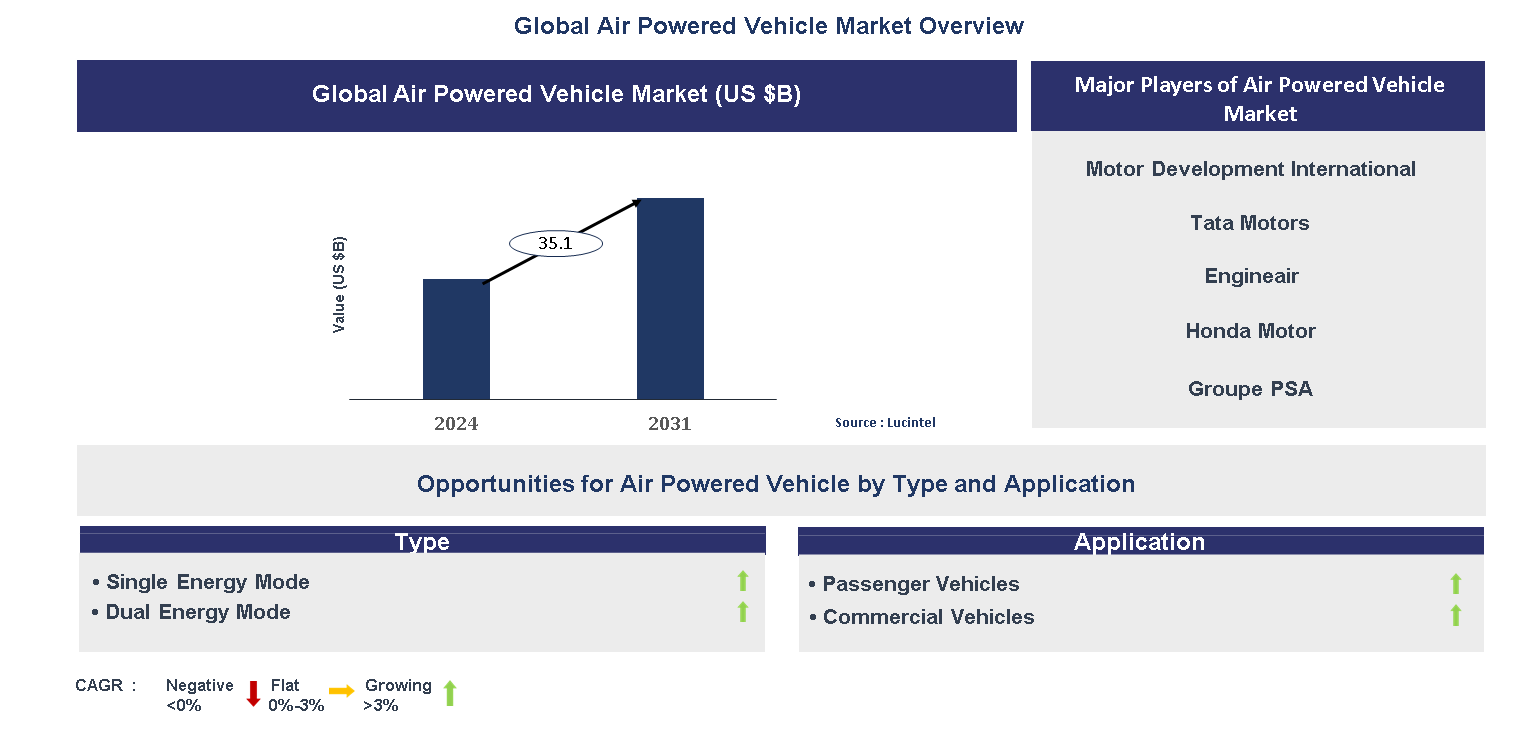
Key data points: The growth forecast = 35.1% annually for the next 7 years. Scroll below to get more insights. This market report covers trends, opportunities and forecasts in air powered vehicle market to 2031 by type (single energy mode and dual energy mode), application (passenger vehicles and commercial vehicles), and region (North America, Europe, Asia Pacific, and the Rest of the World)
We'll send your sample report shortly.
• Lucintel forecasts that, within the type category, dual energy mode is expected to witness higher growth over the forecast period.
• Within the application category, passenger vehicle is expected to witness higher growth.
• In terms of region, APAC is expected to witness the highest growth over the forecast period. Gain valuable insights for your business decisions with our comprehensive 150+ page report. Sample figures with some insights are shown below.
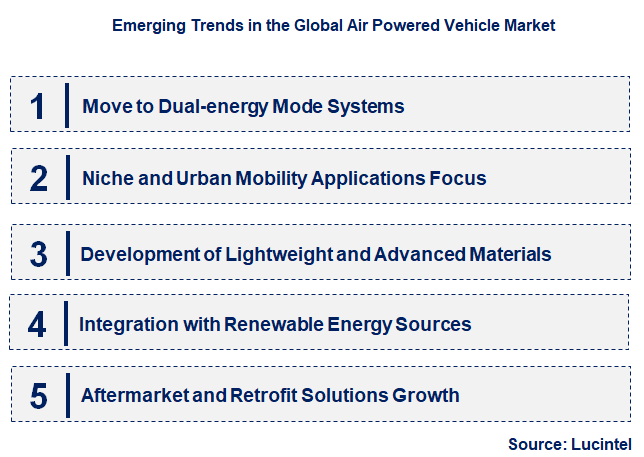
• Move to Dual-energy Mode Systems: One of the trends is moving toward dual-energy mode systems. These cars integrate a compressed air engine with an additional power source, like a small internal combustion engine or an electric motor. This is due to the necessity to address the main disadvantage of air-powered cars, which is low power and range limitation. Dual-energy systems affect the market by making air-powered vehicles more feasible for a broader range of applications and by enhancing their performance and efficiency overall.
• Niche and Urban Mobility Applications Focus: One of the biggest future trends is the emphasis on niche and urban mobility applications. Instead of competing directly with electric cars in the mass passenger car market, air-powered cars are slotting into niches like last-mile delivery, campus shuttle, and light commercial transport. This is being fueled by their zero-emission profile and applicability to short-distance, low-speed driving. This is influencing the market through the development of a niche segment where air-powered cars can do well without directly competing with mature technologies.
• Development of Lightweight and Advanced Materials: The industry is seeing a significant trend towards the creation of lightweight and advanced materials. For the purposes of optimizing the efficiency and range of air-powered vehicles, engineers are employing composite materials such as carbon fiber to construct lighter air tanks and vehicle bodies. This is driven because reducing the weight of the vehicle in turn enhances its performance and efficiency. This is affecting the market by reducing costs of production and enhancing vehicle performance.
• Integration with Renewable Energy Sources: Another new trend is the integration of air-powered vehicle technology with renewable energy sources. For instance, certain systems are being developed to utilize excess energy from solar panels or wind turbines to store energy in compressed air. This means the whole process of vehicle propulsion is becoming genuinely green and sustainable. This trend is affecting the market by offering a totally zero-carbon mode of transport, which is a big selling point for environmentally oriented consumers and governments.
• Aftermarket and Retrofit Solutions Growth: The market is witnessing a trend towards aftermarket and retrofit solutions. Certain companies are creating kits and systems that can turn existing internal combustion engine cars into air-powered or hybrid air-powered cars. This is fueled by the expense of new cars and the need to maximize the life of current vehicles. This is affecting the market by offering a cheap, renewable option to buying a new zero-emission car. These trends together are redefining the air powered vehicle market by moving it toward a more specialized, technologically sophisticated, and environmentally friendly future. The focus on hybrid systems, niche applications, and sustainable materials is turning the industry from a theoretical notion into a practical alternative for a zero-emission future.
• Launch of New Prototypes and Concept Vehicles: One major development is the widespread introduction of new prototypes and concept vehicles. Firms and research centers are unveiling cars with improved range and performance compared to earlier models. For instance, some firms have unveiled new cars that incorporate a mix of compressed air and an electric motor to extend the range and efficiency. This is affecting the market by proving the potential of the technology and bringing in new investors and collaborators.
• Advances in Air Compression and Storage Technology: One significant development is the advancement of air compression and storage technology. The engineers are creating new air tanks utilizing lighter and stronger materials like carbon fiber and composites, which have higher compression capacities for air. This is having a market impact by expanding the range and power output of air-powered cars, making them more useful for more applications. It is also assisting in overcoming a significant barrier to adoption.
• Strategic Collaborations and Partnerships: Recent trends reflect a significant emphasis on collaborations and partnerships among automotive firms, technology companies, and governments. For instance, certain automakers are collaborating with experts in compressed air technology to include air-powered mechanisms within already manufactured vehicles. This is influencing the market by speeding up the technology’s commercialization and development as well as by mitigating the cost burden of research and development.
• Concentration on Urban Logistics and Last-mile Delivery: The industry is also witnessing a major growth in its concentration on the urban logistics and last-mile delivery segment. The zero-emission capability of air-powered vehicles and their low-speed, short-distance traveling suitability make them perfectly suitable for this purpose. This is influencing the industry by establishing a high-value niche market that requires a cost-effective and sustainable solution for city deliveries.
• Development of Hybrid and Dual-Fuel Systems: The industry is seeing a significant development in the research of hybrid and dual-fuel systems. These systems employ compressed air along with another source of fuel, like electricity or hydrogen, to propel the vehicle. This is motivated by the desire to address the limited range of pure air-powered cars. This is affecting the industry by making air-powered vehicles more suitable for a broader scope of applications. These major developments are having a combined impact on the air-powered vehicle market by propelling it towards a more diversified, competitive, and sustainable sector. The demand for new prototypes and the emergence of strategic collaborations are forging new growth prospects, whereas the emphasis on high-value segments such as urban logistics is revolutionizing the market fundamentally.
• Growth into the Urban Delivery and Logistics Segment: The urban delivery and logistics segment is a major strategic growth opportunity. The very quick expansion of online shopping has provided a high demand for vehicles that are quiet, pollution-free, and inexpensive to operate at short-distances, stop-and-go travel in urban areas. Air-powered cars provide a perfect answer to this purpose. This affects the market by generating a fresh, high-volume application necessary for numerous companies, ranging from food delivery companies to retail chains.
• Targeting the Micro-mobility and Last-mile Commuting Segment: The micro-mobility and last-mile commuting segment provides a prime growth opportunity. As urban demographics expand, there is an existing demand for compact, efficient, and affordable vehicles for personal travel over short distances. Air-powered vehicles, with minimal design and zero emissions, are ideally suited for this use. This has an effect on the market by offering a stable demand source from a vital and ever-evolving sector.
• Availing of the Industrial and Fleet Vehicle Market: The industrial and fleet vehicle market is an important opportunity for growth. Air-powered vehicles are suitable for various applications in manufacturing plants, warehouses, and other industries. Their zero-emission capability makes them perfect for use indoors, and their low maintenance needs and uncomplicated design enable businesses to lower their operating expenses. This impacts the market by providing a new, high-value application that is essential for a wide range of logistics companies.
• Developing Solutions for Low-speed and Campus Shuttles: The market offers a strategic opportunity in low-speed and campus shuttles. Universities, airports, and large corporate campuses require small, quiet, and emission-free vehicles to transport people and goods. Air-powered cars are a great fit for this use, since they are not bound by the limited range and low power of a strictly electric vehicle. This affects the market by introducing a new source of revenue that is vital for a very broad array of organizations.
• Targeting Aftermarket and Retrofit Services: One of the strategic opportunities is to target aftermarket and retrofit services. As the price of a new electric vehicle continues to be on the higher side, demand for affordable means of making existing vehicles more sustainable increases. Those businesses that can provide end-to-end service packages, remote diagnostics, and predictive maintenance solutions will have an overwhelming competitive edge. This affects the market by establishing a high-margin revenue stream with less volatility than new equipment sales. These strategic growth prospects are remodeling the air-powered vehicle industry by facilitating a transition away from a commodity bulk business to one dedicated to specialty, high-value products. With a focus on high-growth markets and the trend toward sustainability, firms can open new revenue streams, differentiate themselves from industry peers, and establish a firmer market position for the future.
• Motor Development International
• Tata Motors
• Engineair
• Honda Motor
• Groupe PSA
• Single Energy Mode
• Dual Energy Mode
• Passenger Vehicles
• Commercial Vehicles
• North America
• Europe
• Asia Pacific
• The Rest of the World
• United States: The American market has witnessed few but specialized developments in air-powered cars, mainly from non-governmental companies and research centers. The emphasis is on a high-risk, high-reward strategy, with only a handful of startups and university projects investigating the technology. Although full-scale production is still not on the horizon, there are some businesses seeking to launch air-powered cars for niche uses, such as campus shuttles or last-mile delivery. The biggest challenge is competing with the established electric vehicle market and infrastructure.
• China: China is a leading force behind the development of air-powered vehicles, underpinned by its national drive against air pollution. The government’s promotion of new energy vehicles and emphasis on research and development have fostered a good climate for this technology. As electric vehicles hold the current trend, China’s market is investing in compressed air as a substitute, mainly for light commercial vehicles and urban mobility. This is also part of a larger trend to decrease dependence on foreign sources of energy.
• Germany: Germany’s market is a center of automotive innovation, and current innovation in air-powered cars revolves around dual-energy mode systems that integrate compressed air with conventional or electric powertrains. German engineers are looking at using compressed air to make conventional engines more efficient or as an urban driving, short-range, zero-emission mode. The emphasis is less on air-powered cars in and of themselves and more on using the technology as a component of existing vehicle platforms to cut emissions and enhance fuel efficiency.
• India: India’s market is the target of air-powered car development, mainly as a result of a strategic alliance between Motor Development International (MDI) and Tata Motors. Tata Motors has displayed model air-powered cars for urban travel, which fits into India’s overall bid to lower on-road pollution. The reduced cost of production and low maintenance of air-powered cars render them a viable, if not necessarily practical, solution for the Indian market, with its high fuel prices and major urban air quality problem.
• Japan: Japan’s efficiency-oriented and space-conscious market has had scant but targeted studies involving air-powered cars. Japanese car manufacturers are investigating the technology as a potential replacement for small, lightweight cars on urban city streets. The main focus is on making the technology more efficient and convenient for everyday use, with great attention placed on making it compatible with current vehicle platforms. This is all part of an overall effort to investigate several alternative and sustainable fuel technologies.


• Motor Development International
• Tata Motors
• Engineair
• Honda Motor
• Groupe PSA Q5. Which air powered vehicle market segment will be the largest in future? Answer: Lucintel forecasts that, within the type category, dual energy mode is expected to witness higher growth over the forecast period. Q6. In air powered vehicle market, which region is expected to be the largest in next 5 years? Answer: In terms of region, APAC is expected to witness the highest growth over the forecast period. Q7. Do we receive customization in this report? Answer: Yes, Lucintel provides 10% customization without any additional cost.


Choose a license that fits your team. Instant PDF delivery.
Prices exclude taxes. Instant delivery. Custom licensing available on request.
Market Report · July 31, 2026
Market Report · July 17, 2026
Market Report · May 18, 2026
Trusted partner for strategic intelligence and business growth


Receive a complimentary market analysis tailored to your industry. Our analysts will identify key growth opportunities and competitive dynamics specific to your business.

Market size, growth rate, and key trend analysis for your specific sector.

Top competitor positioning and market share analysis.

Strategic recommendations backed by data-driven insights.
Get curated market intelligence and competitive moves straight to your inbox.
By subscribing, you agree to receive our monthly insights. Unsubscribe anytime.
Receive a complimentary market analysis tailored to your industry. Our analysts will identify key growth opportunities and competitive dynamics specific to your business.
Market size, growth rate, and key trend analysis for your specific sector.
Top competitor positioning and market share analysis.
Strategic recommendations backed by data-driven insights.
Get curated market intelligence, emerging trends, and competitive moves straight to your inbox each month.
By subscribing, you agree to receive our monthly insights. Unsubscribe anytime.
We'll send your sample report shortly.