
Market Report · July 31, 2026

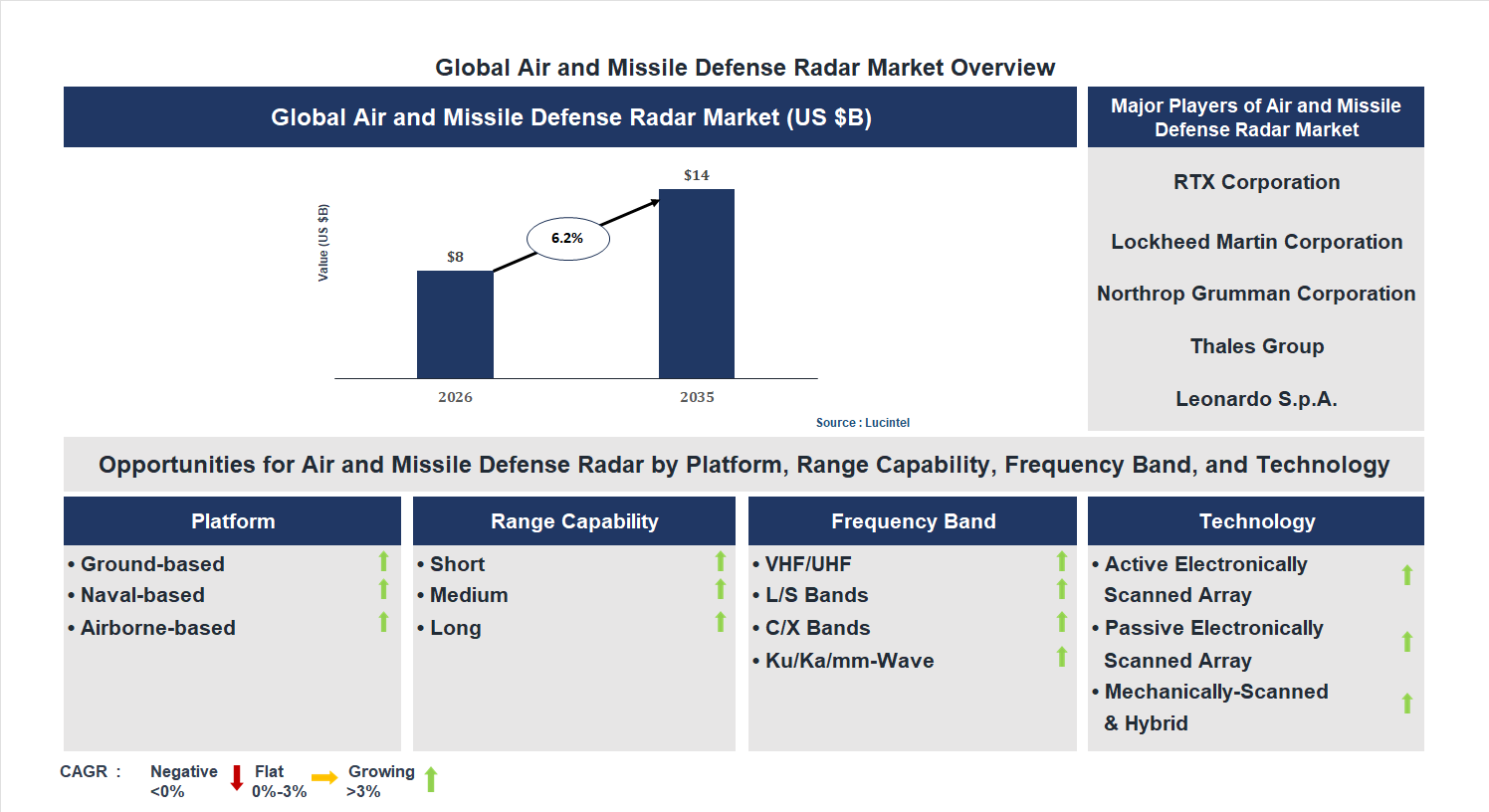
Key data points: The market size in 2035 = $14 billion, growth forecast = 6.2% annually for the next 8 years. Scroll below to get more insights. This market report covers trends, opportunities and forecasts in air and missile defense radar market to 2035 by platform (ground-based, naval-based, and airborne-based), range capability (short, medium, and long), frequency band (VHF/UHF, L/S bands, C/X bands, and Ku/Ka/mm-wave), technology (active electronically scanned array, passive electronically scanned array, and mechanically-scanned & hybrid), and region (North America, Europe, Asia Pacific, and the Rest of the World)
We'll send your sample report shortly.
• Lucintel forecasts that, within the platform category, ground-based is expected to witness the highest growth over the forecast period.
• Within the technology category, active electronically scanned array is expected to witness the highest growth.
• In terms of region, APAC is expected to witness the highest growth over the forecast period. Gain valuable insights for your business decisions with our comprehensive 150+ page report. Sample figures with some insights are shown below.
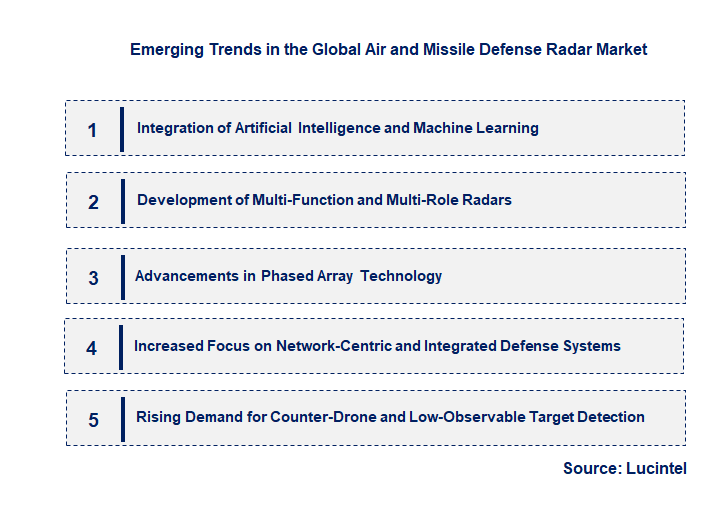
• Integration of Artificial Intelligence and Machine Learning: This trend involves embedding AI and ML algorithms into radar systems to improve target detection, tracking accuracy, and threat classification. AI-driven radars can analyze vast data streams in real-time, enabling faster decision-making and reducing false alarms. This integration enhances system responsiveness and operational efficiency, especially in complex environments with multiple threats. As AI technology matures, its adoption is expected to become standard, leading to smarter, more autonomous defense systems capable of adapting to evolving threats.
• Development of Multi-Function and Multi-Role Radars: Modern radars are increasingly designed to perform multiple functions such as surveillance, target tracking, and missile guidance within a single platform. Multi-role radars reduce the need for multiple systems, lowering costs and logistical complexities. They offer greater flexibility and faster response times, which are critical in dynamic combat scenarios. This trend is driven by the demand for versatile systems that can adapt to various operational needs, especially in integrated air defense networks, enhancing overall battlefield situational awareness.
• Advancements in Phased Array Technology: Phased array radars are becoming more sophisticated, offering rapid beam steering, high resolution, and extended detection ranges. These radars provide real-time tracking of fast-moving targets and are less vulnerable to jamming and electronic countermeasures. The miniaturization and cost reduction of phased array components are making these radars more accessible for a broader range of defense applications. Their ability to quickly adapt to changing threat environments makes them a cornerstone of modern air and missile defense strategies.
• Increased Focus on Network-Centric and Integrated Defense Systems: The trend emphasizes creating interconnected radar networks that share data seamlessly across different platforms and command centers. This integration enhances situational awareness, coordination, and response times. Network-centric systems enable real-time data sharing, collaborative target engagement, and centralized command, which are vital in modern multi-layered defense architectures. As threats become more complex, integrated systems improve resilience and operational effectiveness, allowing countries to build comprehensive and adaptive defense ecosystems.
• Rising Demand for Counter-Drone and Low-Observable Target Detection: With the proliferation of drone technology and stealthy missile systems, radars are evolving to detect low-observable and small targets effectively. This includes the development of specialized sensors and algorithms capable of identifying unconventional threats. The market is witnessing increased investments in sensors with higher resolution, multi-static configurations, and advanced signal processing techniques. This trend addresses the growing challenge of asymmetric warfare and enhances the capability of defense systems to counter emerging threats in contested environments. These emerging trends are fundamentally reshaping the air and missile defense radar market by fostering smarter, more versatile, and integrated systems. The adoption of AI and advanced phased array technologies enhances detection and response capabilities, while multi-function radars streamline operations. Network-centric approaches improve coordination and situational awareness, and specialized sensors address new threat vectors like drones and stealthy missiles. Collectively, these developments are driving innovation, reducing costs, and increasing the resilience of defense architectures. As a result, the market is becoming more dynamic, competitive, and capable of addressing the complex security challenges of the modern battlefield.
• Enhanced Detection Capabilities: Advancements in radar technology now enable earlier and more accurate detection of stealth aircraft and ballistic missiles, significantly improving defense readiness. These systems utilize multi-frequency and phased-array technologies to cover broader areas with higher resolution, reducing false alarms. The impact is a more reliable threat identification process, enabling quicker response times and better strategic planning for defense forces worldwide.
• Integration of Artificial Intelligence: Incorporating AI into radar systems allows for real-time data processing, threat classification, and autonomous decision-making. AI-driven radars can adapt to evolving threats and reduce operator workload, increasing operational efficiency. This development enhances situational awareness and response speed, especially in complex environments with multiple threats. The integration is expected to revolutionize missile defense strategies and improve interoperability among various defense platforms.
• Development of Multi-Function Radars: Modern radars now combine surveillance, tracking, and fire control functions into a single system, reducing equipment footprint and operational complexity. These multi-function radars provide comprehensive battlefield awareness and streamline command and control processes. Their deployment enhances the ability to counter multiple threats simultaneously, improving overall defense effectiveness. The impact includes cost savings and increased operational flexibility for military forces.
• Adoption of Stealth-Resistant Technologies: New radar systems incorporate stealth-resistant features such as low-probability-of-intercept (LPI) techniques and advanced signal processing to detect low-observable targets. These innovations counteract stealth technology, ensuring continued effectiveness against modern aircraft and missiles. The development boosts confidence in radar capabilities, maintaining strategic superiority. It also encourages ongoing innovation in stealth and radar technology, fostering a competitive defense technology landscape.
• Expansion of Network-Centric Defense Systems: Recent developments focus on linking radar networks with other sensors and command centers to create integrated defense ecosystems. This connectivity allows for faster data sharing, coordinated responses, and comprehensive threat management. The impact is a more resilient and adaptive defense infrastructure capable of addressing complex multi-domain threats, ultimately enhancing national security and operational agility across allied forces. The overall impact of these developments is a more sophisticated, reliable, and integrated air and missile defense system market. These innovations improve threat detection, response times, and operational efficiency, ensuring that defense forces are better prepared for emerging security challenges. As technology continues to evolve, the market is poised for sustained growth driven by increasing global security concerns and technological advancements.
• Enhanced Detection Capabilities Through Advanced Signal Processing: Developing radars with superior signal processing algorithms allows for better identification of stealth targets and low-flying threats. These advancements improve the accuracy and reliability of missile defense systems, enabling quicker response times. The integration of AI-driven analytics further refines threat assessment, reducing false alarms and increasing operational efficiency. This growth opportunity is driven by the need for more sophisticated radars capable of countering emerging threats in complex environments.
• Increasing Adoption of Network-Centric Defense Systems: The shift towards network-centric warfare emphasizes interconnected radar systems that share real-time data across multiple platforms. This integration enhances situational awareness and coordination among defense units, leading to faster decision-making and response. The deployment of integrated radar networks supports multi-layered defense strategies, including layered missile defense and airspace monitoring. Growing investments in joint command and control systems are fueling this trend, creating opportunities for scalable, interoperable radar solutions.
• Rising Demand for Mobile and Deployable Radar Systems: The need for flexible, rapidly deployable radar units is increasing in response to evolving threat landscapes and regional conflicts. Mobile radars can be quickly relocated to strategic locations, providing adaptable defense coverage. These systems are essential for border security, tactical operations, and emergency response scenarios. Advances in lightweight materials and power-efficient electronics are enabling the development of more portable radars, expanding their use in diverse operational environments.
• Integration of Artificial Intelligence and Machine Learning: Incorporating AI and machine learning into radar systems enhances threat detection, classification, and tracking accuracy. These technologies enable real-time data analysis, predictive maintenance, and autonomous operation, reducing human workload and response times. AI-driven radars can adapt to changing environments and identify new threat patterns, providing a strategic advantage. The ongoing development of intelligent radar systems is expected to revolutionize missile defense capabilities and operational efficiency.
• Growing Focus on Countering Emerging and Hypersonic Threats: As hypersonic missiles and advanced stealth technologies emerge, radar systems must evolve to detect and intercept these threats effectively. This requires higher frequency radars, improved sensitivity, and faster processing speeds. Investment in research and development aims to create next-generation radars capable of countering these sophisticated weapons. The market for such advanced systems is expanding, driven by the need for robust defense against increasingly complex and fast-moving threats. The overall market landscape is set to benefit significantly from these growth opportunities, fostering innovation and strengthening defense capabilities worldwide. As technological advancements continue and threats become more complex, the market will see increased investments, strategic collaborations, and product development, ensuring comprehensive protection and maintaining national security priorities.
• Technological Innovation: The continuous evolution of radar systems, including phased-array and AESA (Active Electronically Scanned Array) radars, enhances detection capabilities, accuracy, and response times. These advancements enable defense systems to counter sophisticated threats such as stealth aircraft and hypersonic missiles. As governments and defense agencies prioritize upgrading their existing infrastructure, the demand for cutting-edge radar technology surges. Additionally, integration with AI and machine learning improves threat analysis and decision-making, further boosting market growth. The rapid pace of technological innovation ensures that the market remains competitive and responsive to emerging defense needs.
• Increasing Defense Budgets: Governments worldwide are allocating substantial funds toward modernizing their military capabilities, with a focus on air and missile defense systems. Rising geopolitical tensions, regional conflicts, and the proliferation of advanced missile technology drive this trend. Countries like the U.S., China, and Russia are investing heavily in developing and deploying sophisticated radar systems to safeguard their airspace. This increased funding accelerates research, development, and procurement activities, creating a robust demand pipeline. As defense budgets continue to grow, the market for advanced radar systems is expected to expand correspondingly, supporting innovation and deployment at a rapid pace.
• Geopolitical Tensions and Threats: Escalating regional conflicts and the proliferation of missile technology heighten the need for reliable air and missile defense systems. Countries seek to protect critical infrastructure and military assets from emerging threats, prompting increased procurement of advanced radar systems. The threat of ballistic missile attacks and stealth aircraft necessitates sophisticated detection and tracking capabilities, fueling market growth. Moreover, international tensions often lead to strategic partnerships and defense collaborations, further expanding the market. The persistent threat environment ensures sustained demand for innovative radar solutions capable of addressing complex and evolving threats.
• Regulatory and Export Controls: Stringent government regulations and export controls influence the development and deployment of radar technology. These policies aim to prevent proliferation and ensure national security but can also restrict market access and international trade. Compliance with international standards and licensing requirements adds complexity and costs for manufacturers. Navigating these regulatory landscapes requires significant expertise and resources, potentially delaying project timelines. However, these controls also encourage domestic innovation and foster strategic partnerships within countries, shaping the competitive dynamics of the market. Overall, regulatory factors are a critical consideration for market participants.
• Strategic Partnerships and Collaborations: Collaborations between defense contractors, technology firms, and government agencies drive innovation and accelerate product development. Joint ventures and strategic alliances facilitate knowledge sharing, resource pooling, and access to new markets. These partnerships are vital for integrating emerging technologies such as AI, big data analytics, and stealth detection into radar systems. They also help mitigate risks associated with high R&D costs and technological uncertainties. As countries seek to enhance their defense capabilities, collaborative efforts become increasingly important, fostering a competitive environment that promotes technological advancement and market expansion. The challenges facing the air and missile defense radar market include:
• High Deployment and Maintenance Costs: The advanced radar systems required for effective air and missile defense are expensive to develop, produce, and maintain. The costs associated with procurement, installation, and ongoing operational support can be prohibitive, especially for smaller nations or emerging markets. These financial barriers may limit widespread adoption and delay modernization efforts. Additionally, the complexity of maintenance and the need for specialized personnel further increase total ownership costs. This financial challenge necessitates strategic budgeting and can impact the pace of market growth, especially in regions with constrained defense budgets.
• Technological Complexity and Integration Challenges: Developing radar systems that can operate seamlessly within existing defense architectures is complex. Integrating new radar technologies with legacy systems, command and control platforms, and other defense assets requires significant technical expertise. Compatibility issues, system interoperability, and cybersecurity concerns pose additional hurdles. Rapid technological advancements also mean that systems can become obsolete quickly, necessitating continuous upgrades. These challenges can lead to delays, increased costs, and potential vulnerabilities, impacting overall market development and the deployment timeline of new radar solutions.
• Regulatory and Export Restrictions: Stringent export controls and regulatory policies can hinder international sales and collaborations. Countries often restrict the transfer of sensitive radar technology to prevent proliferation, limiting market access for manufacturers. Navigating complex licensing procedures and compliance requirements can cause delays and increase costs. These restrictions may also restrict the ability of defense contractors to expand into emerging markets, thereby constraining growth opportunities. Balancing national security concerns with market expansion remains a significant challenge for industry players operating in a highly regulated environment. The air and missile defense radar market is shaped by rapid technological innovation, increasing defense investments, geopolitical tensions, regulatory frameworks, and strategic collaborations. While these drivers foster growth and technological progress, challenges such as high costs, technological complexity, and regulatory restrictions pose obstacles. The overall market outlook remains positive, driven by the urgent need for advanced defense capabilities, but success will depend on how effectively industry players navigate these complexities. Strategic adaptation and innovation will be crucial for sustained growth and competitiveness in this evolving landscape.
• RTX Corporation
• Lockheed Martin Corporation
• Northrop Grumman Corporation
• Thales Group
• Leonardo S.p.A.
• Saab AB
• Israel Aerospace Industries Ltd.
• HENSOLDT AG
• BAE Systems plc
• Rheinmetall AG
• Ground-based
• Naval-based
• Airborne-based
• Short
• Medium
• Long
• VHF/UHF
• L/S Bands
• C/X Bands
• Ku/Ka/mm-Wave
• Active Electronically Scanned Array
• Passive Electronically Scanned Array
• Mechanically-Scanned & Hybrid
• North America
• Europe
• Asia Pacific
• The Rest of the World
• United States: The US has made substantial investments in next-generation radar systems, including the development of integrated air and missile defense networks. The focus is on enhancing detection range, accuracy, and interoperability with other defense systems. Notable advancements include the deployment of the AN/SPY-6 radar and increased integration of AI for threat analysis. The US also emphasizes upgrading existing systems to counter emerging missile threats and hypersonic weapons.
• China: China has rapidly advanced its radar technology, emphasizing the development of multi-function phased array radars capable of tracking multiple targets simultaneously. The country is expanding its missile defense capabilities with domestically produced systems like the Type 055 destroyer equipped with advanced radar. China’s focus is on achieving technological self-sufficiency and deploying radars that can operate effectively in electronic warfare environments.
• Germany: Germany is investing in modernizing its air defense radar systems as part of NATO commitments. The country is upgrading its existing systems with more sophisticated phased array radars and integrating them into joint defense networks. Germany is also exploring the use of AI and machine learning to improve threat detection and response times, ensuring compatibility with European and NATO standards.
• India: India is actively developing indigenous radar systems to bolster its missile defense capabilities amid regional tensions. The DRDO has introduced advanced radars like the Rajendra and the Pune, which offer enhanced tracking and targeting capabilities. India is also collaborating with international partners to acquire cutting-edge radar technology and improve its early warning systems against missile threats.
• Japan: Japan continues to enhance its missile defense radar systems, focusing on integrating advanced phased array radars with its Aegis Ashore and Aegis Ballistic Missile Defense systems. The country is investing in radar technology that can detect and track hypersonic threats and improve interoperability with US defense systems. Japan’s efforts are driven by regional security concerns, particularly regarding North Korea and China.


• RTX Corporation
• Lockheed Martin Corporation
• Northrop Grumman Corporation
• Thales Group
• Leonardo S.p.A.
• Saab AB
• Israel Aerospace Industries Ltd.
• HENSOLDT AG
• BAE Systems plc
• Rheinmetall AG Q6. Which air and missile defense radar market segment will be the largest in future? Answer: Lucintel forecasts that, within the platform category, ground-based is expected to witness the highest growth over the forecast period. Q7. In air and missile defense radar market, which region is expected to be the largest in next 8 years? Answer: In terms of region, APAC is expected to witness the highest growth over the forecast period. Q8. Do we receive customization in this report? Answer: Yes, Lucintel provides 10% customization without any additional cost.


Choose a license that fits your team. Instant PDF delivery.
Prices exclude taxes. Instant delivery. Custom licensing available on request.
Market Report · July 31, 2026
Market Report · July 31, 2026
Market Report · July 31, 2026
Trusted partner for strategic intelligence and business growth


Receive a complimentary market analysis tailored to your industry. Our analysts will identify key growth opportunities and competitive dynamics specific to your business.

Market size, growth rate, and key trend analysis for your specific sector.

Top competitor positioning and market share analysis.

Strategic recommendations backed by data-driven insights.
Get curated market intelligence and competitive moves straight to your inbox.
By subscribing, you agree to receive our monthly insights. Unsubscribe anytime.
Receive a complimentary market analysis tailored to your industry. Our analysts will identify key growth opportunities and competitive dynamics specific to your business.
Market size, growth rate, and key trend analysis for your specific sector.
Top competitor positioning and market share analysis.
Strategic recommendations backed by data-driven insights.
Get curated market intelligence, emerging trends, and competitive moves straight to your inbox each month.
By subscribing, you agree to receive our monthly insights. Unsubscribe anytime.
We'll send your sample report shortly.