
Market Report · July 13, 2026

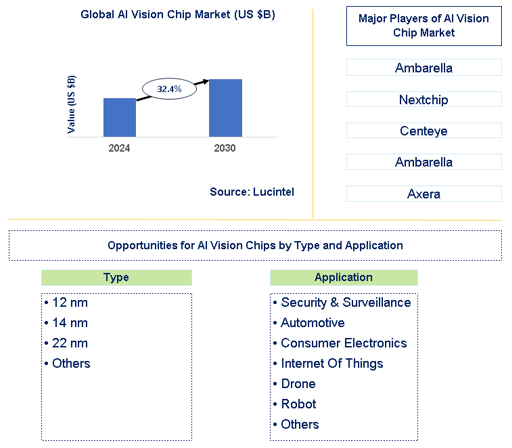
Key data points: The growth forecast = 32.4% annually for the next 6 years. Scroll below to get more insights. This market report covers trends, opportunities, and forecast in the global AI vision chip market to 2030 by type (12 nm, 14 nm, 22 nm, and others), application (security & surveillance, automotive, consumer electronics, internet of things, drone, robot, and others), and region (North America, Europe, Asia Pacific, and the Rest of the World)
We'll send your sample report shortly.
• United States: In the U.S., recent developments in AI vision chips include advancements in edge computing and integration with AI platforms for real-time image processing. Companies like Intel and NVIDIA are leading innovations with chips designed for high-performance computer vision tasks, supporting applications in autonomous vehicles, security systems, and augmented reality (AR). The focus is also on enhancing chip efficiency and processing power to meet growing demands in data-intensive applications.
• China: China is rapidly advancing in the AI vision chip market with significant investments in AI research and development. Chinese tech giants such as Huawei and Alibaba are developing vision chips that enhance capabilities in facial recognition, smart surveillance, and industrial automation. The government’s push for technological self-sufficiency and advancements in semiconductor manufacturing are accelerating the deployment of AI vision chips across various sectors, including smart cities and e-commerce.
• Germany: Germany is focusing on integrating AI vision chips with industrial automation and smart manufacturing. Companies like Bosch and Infineon are developing chips that enhance machine vision systems, enabling precision in manufacturing processes and predictive maintenance. The emphasis is on improving energy efficiency and processing speed to support Germany’s strong industrial base and its Industry 4.0 initiatives, driving innovation in smart factories and automation systems.
• India: In India, the AI vision chip market is growing with applications in security, retail, and healthcare. Indian startups and tech companies are focusing on cost-effective solutions that leverage AI vision chips for surveillance systems, automated retail checkout, and medical imaging. The market is driven by increasing urbanization and the need for advanced technology in growing sectors, along with government initiatives to promote digital transformation and innovation.
• Japan: Japan is advancing AI vision chips with applications in robotics, consumer electronics, and smart infrastructure. Companies such as Sony and Panasonic are developing chips that enhance image quality and processing capabilities for robotics and smart home devices. Japan’s focus on integrating AI with IoT technologies is driving innovations in automation and smart city applications, reflecting the country’s commitment to leading in technology and digital transformation.
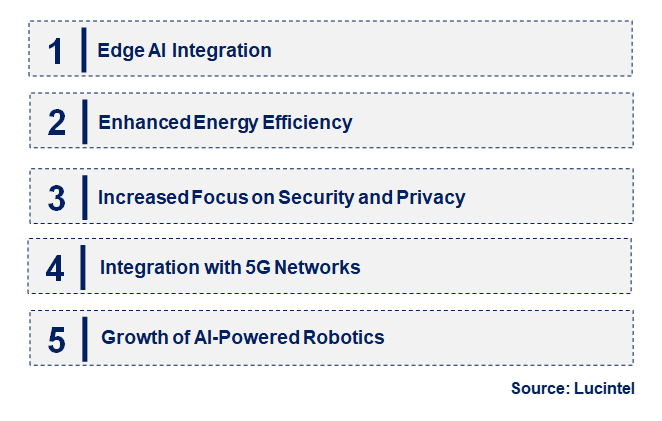
• Edge AI Integration: Edge AI integration is a significant trend, enabling AI vision chips to process data locally rather than relying on cloud computing. This reduces latency, enhances real-time processing, and improves privacy by minimizing data transmission. Edge AI chips are crucial for applications such as autonomous vehicles, smart cameras, and industrial automation, where immediate data analysis and response are essential.
• Enhanced Energy Efficiency: There is a growing emphasis on energy-efficient AI vision chips to address the increasing demand for power in high-performance computing. Advances in chip design and manufacturing technologies are leading to the development of chips that consume less power while delivering high performance. This trend supports the deployment of AI vision chips in battery-powered devices and applications where energy conservation is critical.
• Increased Focus on Security and Privacy: As AI vision chips are used in sensitive applications like surveillance and personal devices, there is an increased focus on enhancing security and privacy features. Innovations include incorporating advanced encryption and secure data processing capabilities directly into the chips. This trend aims to address concerns about data breaches and unauthorized access, ensuring the secure and reliable operation of vision systems.
• Integration with 5G Networks: The integration of AI vision chips with 5G networks is enhancing the capabilities of remote and real-time applications. 5G’s high-speed connectivity and low latency complement the processing power of AI vision chips, enabling advanced use cases such as real-time remote monitoring, smart city infrastructure, and augmented reality applications. This trend supports the growth of connected devices and applications requiring high-speed data transfer.
• Growth of AI-Powered Robotics: AI-powered robotics is a key growth area for AI vision chips, as these chips enhance the visual perception and decision-making capabilities of robots. Developments include improved object recognition, depth perception, and navigation capabilities. This trend supports advancements in various robotics applications, including manufacturing, healthcare, and service robots, driving innovation in automation and intelligent systems. These emerging trends are reshaping the AI vision chip market by enhancing performance, efficiency, and application capabilities. Edge AI integration, energy efficiency, security and privacy, 5G connectivity, and AI-powered robotics are driving innovation and adoption, leading to more advanced and versatile vision systems.
• Introduction of High-Performance Edge AI Chips: New high-performance edge AI chips are being introduced, offering advanced processing capabilities for real-time image analysis. These chips are designed to perform complex tasks locally, reducing latency and enhancing the functionality of applications such as autonomous vehicles and smart cameras. The focus is on improving processing power while maintaining low energy consumption.
• Advancements in Low-Power AI Vision Chips: Developments in low-power AI vision chips are addressing the need for energy efficiency in battery-operated devices. Innovations include optimizing chip architectures and using advanced manufacturing processes to reduce power consumption without compromising performance. These chips are essential for wearable devices, IoT applications, and portable imaging systems.
• Enhanced AI Algorithms for Vision Chips: The integration of advanced AI algorithms into vision chips is improving capabilities such as object detection, facial recognition, and scene understanding. These enhancements enable more accurate and sophisticated image processing, supporting applications in security, robotics, and augmented reality. AI-driven improvements are making vision chips more effective in diverse and complex environments.
• Expansion of AI Vision Chips in Consumer Electronics: AI vision chips are increasingly being integrated into consumer electronics, such as smartphones and smart home devices. Developments include enhancing camera systems with advanced image processing capabilities and enabling new features such as real-time image enhancement and object recognition. This trend reflects the growing demand for intelligent and feature-rich consumer products.
• Growth in AI Vision Chips for Automotive Applications: The automotive sector is experiencing growth in AI vision chips designed for advanced driver-assistance systems (ADAS) and autonomous vehicles. Innovations include chips that support features such as lane-keeping, collision avoidance, and adaptive cruise control. These developments are driving advancements in automotive safety and automation, reflecting the industry’s focus on intelligent transportation solutions. These key developments highlight the rapid advancements in the AI vision chip market. High-performance edge AI chips, low-power solutions, enhanced AI algorithms, expansion into consumer electronics, and growth in automotive applications are driving innovation and shaping the future of AI vision technologies.
• Smart Security Systems: The growth of smart security systems offers significant opportunities for AI vision chips. These chips enhance surveillance cameras and security solutions with capabilities such as facial recognition, motion detection, and anomaly detection. The demand for advanced security solutions in residential, commercial, and public sectors is driving growth in this application area.
• Autonomous Vehicles: Autonomous vehicles are a major growth area for AI vision chips, as these chips are critical for processing visual data used in navigation, obstacle detection, and driver assistance systems. The ongoing development of self-driving technology and advancements in automotive safety features are creating opportunities for AI vision chips in the automotive industry.
• Industrial Automation: AI vision chips are increasingly being used in industrial automation for applications such as quality control, predictive maintenance, and robotics. These chips improve the accuracy and efficiency of manufacturing processes, driving growth in smart factories and automated production lines. The focus on Industry 4.0 and automation is expanding this market segment.
• Healthcare and Medical Imaging: The healthcare sector presents opportunities for AI vision chips in medical imaging and diagnostics. These chips enhance imaging systems with capabilities such as improved image quality, real-time analysis, and pattern recognition. The growing demand for advanced diagnostic tools and telemedicine is driving adoption in this application area.
• Augmented Reality (AR) and Virtual Reality (VR): AI vision chips are crucial for AR and VR applications, providing the processing power needed for immersive experiences and real-time interactions. Developments in AR and VR technologies are creating opportunities for AI vision chips to support applications in gaming, training, and entertainment, enhancing user experiences and expanding market potential. These strategic growth opportunities highlight the diverse applications and potential of AI vision chips. By focusing on smart security systems, autonomous vehicles, industrial automation, healthcare, and AR/VR, companies can tap into expanding markets and address emerging needs, driving innovation and growth in the AI vision chip sector.
• Technological Advancements: Rapid advancements in AI and vision technologies are driving the AI vision chip market. Innovations in chip design, processing power, and AI algorithms are enhancing the capabilities of vision systems, enabling more sophisticated and efficient applications. These advancements support the growth of AI vision chips across multiple industries.
• Increasing Demand for Automation: The growing demand for automation in sectors such as manufacturing, automotive, and security is driving the adoption of AI vision chips. These chips enable advanced visual recognition and processing, supporting automation efforts and improving efficiency. The focus on smart factories, autonomous vehicles, and intelligent security systems fuels market growth.
• Expansion of Consumer Electronics: The integration of AI vision chips into consumer electronics, such as smartphones and smart home devices, is driving market expansion. The demand for enhanced imaging capabilities and intelligent features in consumer products is creating opportunities for AI vision chip manufacturers. This trend reflects the increasing importance of advanced vision technologies in everyday devices.
• Growth in Smart Cities and Infrastructure: The development of smart cities and infrastructure is creating demand for AI vision chips in applications such as surveillance, traffic management, and public safety. The focus on building intelligent and connected urban environments is driving the adoption of vision chips that support these initiatives, contributing to market growth.
• Advances in Edge Computing: The rise of edge computing is driving demand for AI vision chips with local processing capabilities. Edge AI chips enable real-time data analysis and response, supporting applications in autonomous vehicles, industrial automation, and smart devices. This trend reflects the growing need for efficient and low-latency computing solutions. Challenges in the AI vision chip market include:
• High Development Costs: The development and production of AI vision chips involve high costs related to research, design, and manufacturing. These expenses can be a barrier to entry for new players and impact the affordability of chips for end users. Managing development costs while maintaining competitive pricing is a key challenge for the industry.
• Integration and Compatibility Issues: Integration and compatibility issues can arise when deploying AI vision chips in diverse applications and systems. Ensuring that chips work seamlessly with different hardware and software platforms is essential for successful implementation. Addressing these challenges requires careful design and testing to achieve interoperability.
• Data Privacy and Security Concerns: As AI vision chips are used in sensitive applications such as surveillance and healthcare, data privacy and security concerns are significant challenges. Ensuring robust security measures and compliance with regulations is crucial to protect data and maintain user trust. Addressing these concerns is essential for the widespread adoption of vision technologies. The AI vision chip market is influenced by technological advancements, automation demand, consumer electronics growth, smart city development, and edge computing. However, high development costs, integration issues, and data security concerns present challenges. Balancing these drivers and challenges is crucial for the continued growth and innovation in the AI vision chip market.
• Ambarella
• Nextchip
• Centeye
• Ambarella
• Axera
• Goke Microelectronics
• PixelCore
• HiSilicon
• IMICRO
• NextVPU
• 12 nm
• 14 nm
• 22 nm
• Others
• Security & Surveillance
• Automotive
• Consumer Electronics
• Internet of Things
• Drone
• Robot
• Others
• North America
• Europe
• Asia Pacific
• The Rest of the World
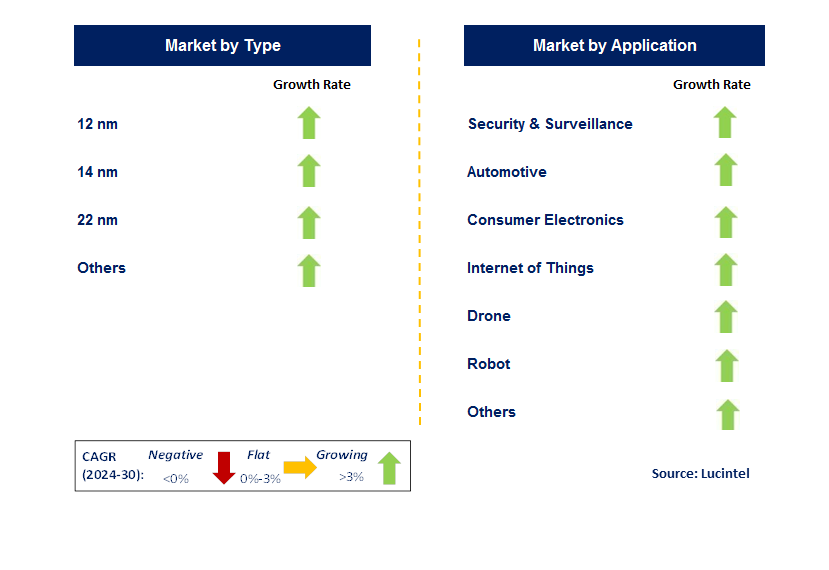
• Lucintel forecasts that, within the type category, 12 nm is expected to witness the highest growth over the forecast period.
• Within the application category, security & surveillance is expected to witness the highest growth.
• In terms of regions, APAC is expected to witness the highest growth over the forecast period.


• Ambarella
• Nextchip
• Centeye
• Ambarella
• Axera
• Goke Microelectronics
• Pixelcore
• Hisilicon
• IMICRO
• NextVPU Q5. Which AI vision chip market segment will be the largest in the future? Answer: Lucintel forecasts that 12 nm is expected to witness the highest growth over the forecast period. Q6. In the AI vision chip market, which region is expected to be the largest in the next 5 years? Answer: APAC is expected to witness the highest growth over the forecast period. Q7. Do we receive customization in this report? Answer: Yes, Lucintel provides 10% customization without any additional cost.


Choose a license that fits your team. Instant PDF delivery.
Prices exclude taxes. Instant delivery. Custom licensing available on request.
Market Report · July 13, 2026
Market Report · July 13, 2026
Market Report · July 2, 2026
Trusted partner for strategic intelligence and business growth


Receive a complimentary market analysis tailored to your industry. Our analysts will identify key growth opportunities and competitive dynamics specific to your business.

Market size, growth rate, and key trend analysis for your specific sector.

Top competitor positioning and market share analysis.

Strategic recommendations backed by data-driven insights.
Get curated market intelligence and competitive moves straight to your inbox.
By subscribing, you agree to receive our monthly insights. Unsubscribe anytime.
Receive a complimentary market analysis tailored to your industry. Our analysts will identify key growth opportunities and competitive dynamics specific to your business.
Market size, growth rate, and key trend analysis for your specific sector.
Top competitor positioning and market share analysis.
Strategic recommendations backed by data-driven insights.
Get curated market intelligence, emerging trends, and competitive moves straight to your inbox each month.
By subscribing, you agree to receive our monthly insights. Unsubscribe anytime.
We'll send your sample report shortly.