
Market Report · July 31, 2026

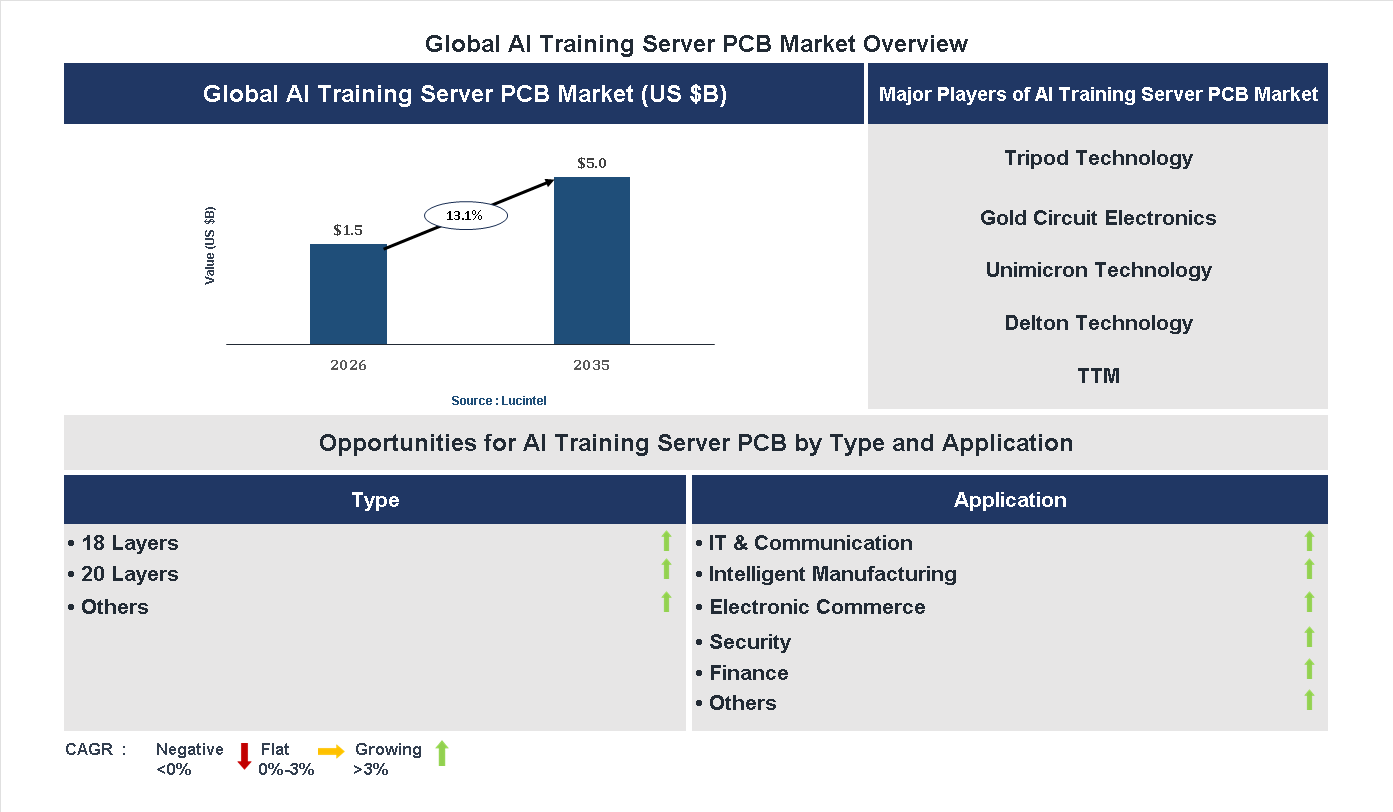
Key data points: The market size in 2035 = $5 billion, growth forecast = 13.1% annually for the next 8 years. Scroll below to get more insights. This market report covers trends, opportunities and forecasts in AI training server PCB market to 2035 by type (18 layers, 20 layers, and others), application (IT & communication, intelligent manufacturing, electronic commerce, security, finance, and others), and region (North America, Europe, Asia Pacific, and the Rest of the World)
We'll send your sample report shortly.
• Lucintel forecasts that, within the type category, 20 layer is expected to witness higher growth over the forecast period.
• Within the application category, IT & communication is expected to witness the highest growth.
• In terms of region, APAC is expected to witness the highest growth over the forecast period. Gain valuable insights for your business decisions with our comprehensive 150+ page report. Sample figures with some insights are shown below.
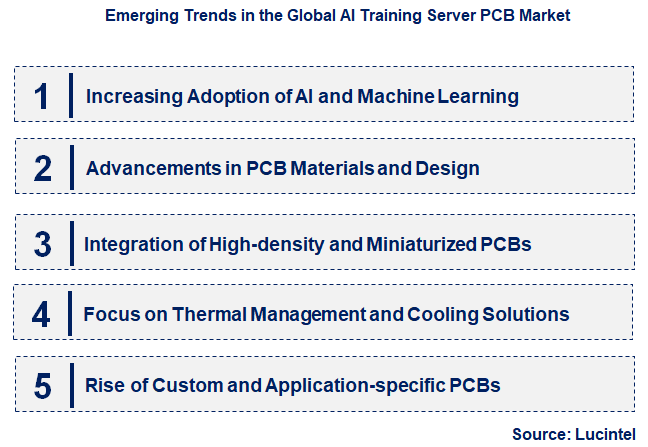
• Increasing Adoption of AI and Machine Learning: The surge in AI applications across industries such as healthcare, automotive, and finance is driving demand for powerful training servers. These servers require high-performance PCBs capable of supporting advanced processors, GPUs, and memory modules. The need for faster data processing and real-time analytics pushes manufacturers to develop more sophisticated PCB designs that can handle increased power densities and data transfer rates. This trend is expanding the market as companies seek to upgrade their infrastructure to meet AI training requirements.
• Advancements in PCB Materials and Design: Innovations in materials like high-frequency substrates and thermal management composites are improving the performance and reliability of AI training server PCBs. These materials enable better signal integrity, reduced electromagnetic interference, and enhanced heat dissipation. Additionally, multi-layer and flexible PCB designs are becoming more prevalent, allowing for compact and efficient server architectures. These technological improvements are critical for supporting the high-speed, high-capacity demands of AI workloads, thereby expanding the market’s scope and capabilities.
• Integration of High-density and Miniaturized PCBs: As data centers aim to optimize space and reduce energy consumption, there is a growing trend toward high-density, miniaturized PCBs. These designs enable more components to be packed into smaller footprints, increasing processing power without expanding physical size. This miniaturization also facilitates better thermal management and reduces material costs. The shift toward compact PCBs is reshaping server design, making AI training hardware more scalable and accessible, and driving market growth through new product innovations.
• Focus on Thermal Management and Cooling Solutions: The intense heat generated by high-performance AI components necessitates advanced thermal management strategies. Innovations include embedded cooling channels, heat spreaders, and advanced materials with superior thermal conductivity. Effective cooling solutions improve server reliability, lifespan, and performance stability. As AI workloads grow more demanding, the market is witnessing increased investment in thermal management technologies, which are crucial for maintaining optimal operation and preventing overheating, thus influencing PCB design and manufacturing processes.
• Rise of Custom and Application-specific PCBs: The demand for tailored solutions that meet specific AI training needs is fueling the development of custom PCBs. These are designed to optimize performance for particular applications, such as autonomous vehicles or large-scale data centers. Custom PCBs offer advantages like improved signal integrity, power efficiency, and integration of specialized components. This trend is enabling more efficient AI training systems, fostering innovation, and creating new market segments. The shift toward application-specific designs is reshaping the industry by emphasizing flexibility and specialization in PCB manufacturing. In summary, these emerging trends are collectively transforming the AI training server PCB market by enhancing performance, reliability, and scalability. They are enabling more powerful and efficient AI training infrastructure, which in turn accelerates AI development across various sectors. As these innovations continue, the market is poised for significant growth, driven by the increasing complexity and demand for advanced AI hardware solutions.
• Growing Demand for High-Performance Computing: The surge in AI applications and data processing needs is fueling demand for advanced server PCBs. These PCBs support higher processing speeds, better thermal management, and increased reliability, essential for AI training. This growth is expanding the market as data centers and tech companies seek more efficient hardware solutions. The increased adoption of AI across sectors like healthcare, finance, and automotive further amplifies this demand, driving innovation and market expansion.
• Technological Advancements in PCB Design: Innovations in PCB materials and design techniques are enhancing the performance of AI training servers. Use of high-frequency materials, miniaturization, and improved thermal management are enabling more powerful and compact server architectures. These advancements reduce latency, improve energy efficiency, and extend hardware lifespan. As a result, manufacturers can produce more reliable and scalable PCBs, attracting more clients and increasing market competitiveness.
• Rising Adoption of Edge Computing and Data Centers: The proliferation of edge computing and data centers is creating a significant market for specialized PCBs. These environments require robust, high-speed, and durable PCBs to handle intensive AI workloads close to data sources. The trend reduces latency and improves data processing efficiency, making AI training servers more effective. This shift is expanding the market as companies seek tailored PCB solutions to meet the demands of decentralized computing infrastructure.
• Increasing Focus on Customization and Scalability: Custom-designed PCBs tailored for specific AI training applications are gaining popularity. Scalability features allow servers to adapt to growing data and processing needs, ensuring longevity and cost-effectiveness. Manufacturers are offering modular PCB solutions that can be upgraded or expanded, appealing to enterprise clients. This focus on customization and scalability is driving market growth by enabling more flexible and efficient AI training server deployments.
• Impact of Industry 4.0 and IoT Integration: The integration of Industry 4.0 and IoT devices is boosting demand for advanced AI training servers with specialized PCBs. These applications require high-speed, reliable, and energy-efficient hardware to process vast amounts of data in real-time. The development of tailored PCBs supports the deployment of intelligent systems across manufacturing, logistics, and smart cities. This integration is expanding the market by creating new opportunities for innovative PCB solutions in diverse industrial sectors. The overall impact of these developments is significantly transforming the AI training server PCB market by fostering innovation, increasing efficiency, and expanding application scope. As demand for AI and data processing grows, the market is poised for sustained growth, driven by technological advancements and evolving industry needs. This evolution is creating competitive advantages for manufacturers and offering more sophisticated, scalable solutions for end-users.
• Market Penetration in Data Centers and Cloud Infrastructure: Expanding AI training server PCB adoption in data centers and cloud platforms offers significant growth potential. As cloud providers and enterprises seek scalable, high-performance hardware solutions, tailored PCBs enable better thermal management, higher processing speeds, and energy efficiency. This creates opportunities for manufacturers to develop customized, high-density PCBs that meet the rigorous demands of large-scale AI training, fostering increased market share and revenue streams.
• Advancements in High-Performance Hardware Design: Innovation in PCB design for AI training servers is crucial for improving computational efficiency. Incorporating advanced materials, miniaturization techniques, and multi-layer configurations enhances signal integrity and heat dissipation. These technological improvements allow for faster data processing, reduced latency, and increased reliability, enabling AI models to train more effectively. Companies investing in R&D to develop next-generation PCBs will gain a competitive edge in the rapidly evolving AI hardware landscape.
• Growing Adoption of Edge AI and IoT Applications: The proliferation of edge computing and IoT devices necessitates specialized PCBs for AI training servers at the edge. Compact, energy-efficient, and robust PCBs are essential for deploying AI models in remote or resource-constrained environments. This trend opens new markets for PCB manufacturers to design tailored solutions that support real-time data processing, low power consumption, and durability, thereby expanding the overall market scope and application diversity.
• Rising Demand for Customization and Specialized Solutions: As AI applications become more diverse, there is an increasing need for customized PCB solutions tailored to specific server configurations and workloads. This includes designing PCBs with optimized power delivery, signal routing, and thermal management features. Customization enables better performance, scalability, and integration with other hardware components, providing a strategic advantage for manufacturers to cater to niche markets and high-end clients, fueling market growth.
• Strategic Collaborations and Technological Partnerships: Collaborations between PCB manufacturers, AI hardware developers, and technology firms are vital for innovation and market expansion. Joint ventures facilitate the development of cutting-edge PCB solutions aligned with evolving AI training requirements. These partnerships can accelerate product development, reduce time-to-market, and foster knowledge sharing, ultimately strengthening market positioning and enabling companies to capitalize on emerging opportunities in the AI training server PCB sector. These growth opportunities collectively drive innovation, expand application scope, and enhance market competitiveness. Embracing technological advancements, customization, and strategic collaborations will enable industry players to meet rising demand and sustain long-term growth in the AI training server PCB market.
• Technological Innovation: The rapid evolution of AI algorithms and models necessitates advanced hardware solutions. AI training servers require high-speed, reliable PCBs capable of supporting intensive data processing and parallel computations. Innovations in PCB materials, miniaturization, and thermal management enhance performance and efficiency, enabling faster training times and reduced energy consumption. This technological progression attracts OEMs and data center operators seeking cutting-edge infrastructure, thereby expanding market demand. Continuous R&D investments ensure that PCBs keep pace with AI advancements, fostering a competitive edge for manufacturers.
• Growing Data Center Investments: The exponential increase in data generation and cloud computing adoption has led to substantial investments in data centers worldwide. These facilities require robust, high-capacity AI training servers equipped with specialized PCBs to handle complex workloads. As organizations migrate to AI-driven solutions for business intelligence, automation, and analytics, the demand for high-performance server hardware surges. Governments and the private sector are allocating significant budgets to upgrade existing infrastructure, which directly benefits the AI Training Server PCB market by expanding its customer base and driving volume sales.
• Rising Adoption of AI in Various Sectors: Industries such as healthcare, automotive, finance, and retail are increasingly integrating AI technologies to optimize operations and enhance customer experiences. This widespread adoption necessitates powerful training servers with advanced PCBs capable of supporting large-scale AI models. The diversification of AI applications fuels demand for customized PCB solutions tailored to specific industry needs. As AI becomes a core component of digital transformation strategies, the market for specialized training server PCBs experiences sustained growth, driven by the need for reliable, high-performance hardware.
• Advancements in PCB Materials and Design: Innovations in materials such as high-frequency substrates, thermal management composites, and flexible PCBs improve the performance and durability of AI training servers. Enhanced design techniques, including multi-layer and high-density interconnects, enable more compact and efficient PCBs. These technological improvements reduce manufacturing costs and improve thermal dissipation, which is critical for high-power AI training applications. As manufacturers adopt these advanced materials and designs, the overall quality and performance of AI training server PCBs improve, fostering market growth and enabling the development of next-generation AI hardware.
• Strategic Collaborations and Partnerships: Collaborations between PCB manufacturers, AI hardware developers, and cloud service providers facilitate the development of optimized solutions for AI training servers. Such partnerships enable the sharing of expertise, resources, and technological know-how, accelerating innovation. Joint ventures also help in standardizing PCB designs for AI applications, reducing time-to-market, and expanding distribution channels. These strategic alliances are vital for staying competitive in a rapidly evolving market, ensuring that companies can meet the increasing demand for high-performance, reliable PCBs tailored for AI training servers. The challenges facing the AI training server PCB market include:
• Supply Chain Disruptions: The global supply chain has faced significant disruptions due to geopolitical tensions, pandemics, and logistical issues. These disruptions affect the availability of raw materials such as high-quality substrates and electronic components essential for PCB manufacturing. Delays in procurement and manufacturing lead to longer lead times, increased costs, and potential shortages, which can hinder market growth. Companies may also face difficulties in maintaining consistent quality standards, impacting product reliability and customer satisfaction. Overcoming these supply chain challenges requires strategic sourcing, inventory management, and diversification of suppliers.
• Rapid Technological Obsolescence: The fast-paced nature of AI and hardware development results in frequent technological obsolescence of existing PCBs. Manufacturers must continuously innovate to keep up with evolving AI models and processing requirements. Failure to adapt quickly can render existing PCB designs outdated, leading to reduced competitiveness and financial losses. Additionally, investing heavily in R&D for new PCB solutions involves high costs and risks. Balancing innovation with cost-effectiveness is a persistent challenge for market players aiming to sustain growth amid rapid technological changes.
• Regulatory and Environmental Constraints: Increasing regulations related to electronic waste, hazardous materials, and energy consumption impose compliance burdens on PCB manufacturers. Environmental standards such as RoHS and WEEE require the adoption of eco-friendly materials and processes, which can increase production costs. Data security and privacy regulations also influence the design and deployment of AI hardware, necessitating additional security features. Navigating these regulatory landscapes demands significant investments in compliance and sustainable practices, potentially slowing down product development cycles and increasing operational expenses, thereby impacting market expansion. In summary, the AI training server PCB market is driven by technological innovation, expanding data center investments, widespread AI adoption across industries, advancements in PCB materials, and strategic collaborations. However, it faces challenges such as supply chain disruptions, rapid technological obsolescence, and stringent regulatory requirements. These factors collectively shape the market landscape, influencing growth trajectories and competitive dynamics. While opportunities for innovation and expansion are substantial, addressing supply chain and regulatory hurdles is essential for sustained success. Overall, the market's future hinges on balancing technological progress with effective risk management and compliance strategies.
• Tripod Technology
• Gold Circuit Electronics
• Unimicron Technology
• Delton Technology
• TTM
• Compeq Manufacturing
• Nippon Mektron
• Ibiden
• WUS Printed Circuit
• Avary Holding
• 18 Layers
• 20 Layers
• Others
• IT & Communication
• Intelligent Manufacturing
• Electronic Commerce
• Security
• Finance
• Others
• North America
• Europe
• Asia Pacific
• The Rest of the World
• United States: The United States leads in AI training server PCB development, with major tech giants investing heavily in R&D. Innovations focus on enhancing thermal management and miniaturization of PCBs to improve server performance. The U.S. government also supports AI infrastructure projects, boosting market growth. Several startups and established companies are collaborating to develop high-density, energy-efficient PCBs tailored for AI workloads. The adoption of advanced manufacturing techniques and increased demand for data centers are key drivers. Overall, the U.S. market remains at the forefront of technological advancements and strategic investments in this sector.
• China: China is rapidly expanding its AI infrastructure, with significant investments in data centers and AI research facilities. Domestic PCB manufacturers are advancing in producing high-performance, cost-effective PCBs for training servers. The government’s strategic initiatives aim to reduce reliance on imports and foster local innovation. Chinese companies are focusing on integrating AI-specific features into PCBs, such as improved signal integrity and power management. The market growth is also driven by the increasing adoption of AI in sectors like manufacturing, healthcare, and finance. Overall, China is positioning itself as a major player in the global AI training server PCB market.
• Germany: Germany's market is characterized by a focus on high-quality, reliable PCBs for AI training servers, driven by its strong industrial base. Leading electronics and automotive companies are investing in AI infrastructure, demanding advanced PCB solutions. The emphasis is on sustainability, energy efficiency, and durability of server components. German manufacturers are adopting innovative materials and manufacturing processes to meet stringent quality standards. The country's focus on Industry 4.0 and smart manufacturing further accelerates demand for sophisticated PCBs. Overall, Germany's market is marked by technological excellence and a strategic shift towards integrating AI into industrial applications.
• India: India is witnessing rapid growth in AI adoption, with increasing investments in data centers and cloud infrastructure. Local PCB manufacturers are expanding capabilities to produce high-performance PCBs suitable for training servers. Government initiatives like Digital India and Make in India are fostering innovation and infrastructure development. The market is driven by the rising adoption of AI in sectors such as banking, healthcare, and e-commerce. Indian companies are also collaborating with global players to enhance technological expertise. The focus remains on cost-effective, scalable solutions to meet the growing demand for AI training servers across the country.
• Japan: Japan's AI training server PCB market is characterized by a focus on high reliability and advanced technology integration. Leading electronics firms are developing specialized PCBs with enhanced thermal management and miniaturization features. The country emphasizes innovation in materials and manufacturing processes to improve performance and energy efficiency. Japan's strong industrial base and technological expertise support the development of cutting-edge server components. The market is also influenced by the increasing adoption of AI in robotics, automotive, and manufacturing sectors. Overall, Japan continues to innovate in high-performance PCBs, maintaining its position as a key player in the global market.


• Tripod Technology
• Gold Circuit Electronics
• Unimicron Technology
• Delton Technology
• TTM
• Compeq Manufacturing
• Nippon Mektron
• Ibiden
• WUS Printed Circuit
• Avary Holding Q6. Which AI training server PCB market segment will be the largest in future? Answer: Lucintel forecasts that, within the type category, 20 layer is expected to witness higher growth over the forecast period. Q7. In AI training server PCB market, which region is expected to be the largest in next 5 years? Answer: In terms of region, APAC is expected to witness the highest growth over the forecast period. Q8. Do we receive customization in this report? Answer: Yes, Lucintel provides 10% customization without any additional cost.


Choose a license that fits your team. Instant PDF delivery.
Prices exclude taxes. Instant delivery. Custom licensing available on request.
Market Report · July 31, 2026
Market Report · July 31, 2026
Market Report · July 31, 2026
Trusted partner for strategic intelligence and business growth


Receive a complimentary market analysis tailored to your industry. Our analysts will identify key growth opportunities and competitive dynamics specific to your business.

Market size, growth rate, and key trend analysis for your specific sector.

Top competitor positioning and market share analysis.

Strategic recommendations backed by data-driven insights.
Get curated market intelligence and competitive moves straight to your inbox.
By subscribing, you agree to receive our monthly insights. Unsubscribe anytime.
Receive a complimentary market analysis tailored to your industry. Our analysts will identify key growth opportunities and competitive dynamics specific to your business.
Market size, growth rate, and key trend analysis for your specific sector.
Top competitor positioning and market share analysis.
Strategic recommendations backed by data-driven insights.
Get curated market intelligence, emerging trends, and competitive moves straight to your inbox each month.
By subscribing, you agree to receive our monthly insights. Unsubscribe anytime.
We'll send your sample report shortly.