
Market Report · July 13, 2026

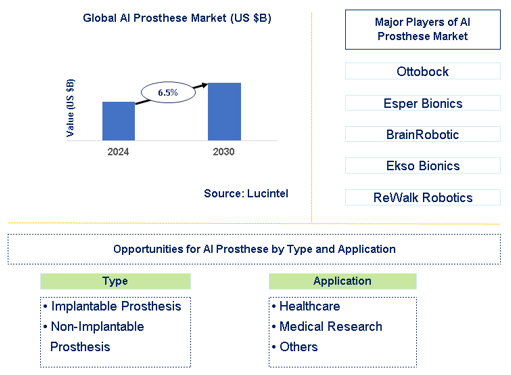
Key data points: The growth forecast = 6.5% annually for the next 6 years. Scroll below to get more insights. This market report covers trends, opportunities, and forecasts in the global AI prosthetics market to 2030 by type (implantable prosthesis and non-implantable prosthesis), application (healthcare, medical research, and others), and region (North America, Europe, Asia Pacific, and the Rest of the World)
We'll send your sample report shortly.
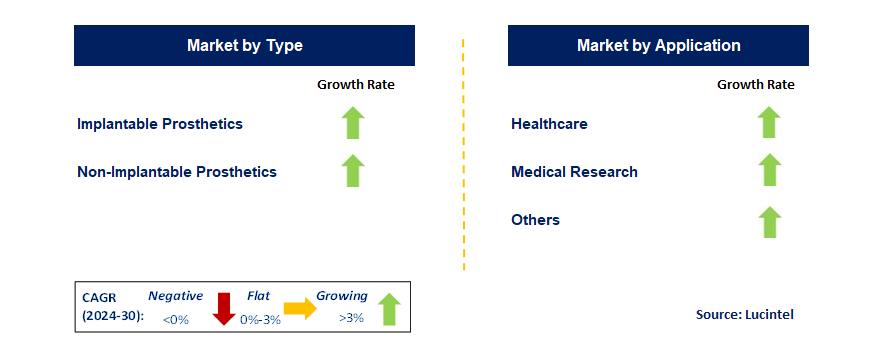
• Lucintel forecasts that, within the type category, implantable prosthesis is expected to witness higher growth over the forecast period.
• Within the application category, healthcare is expected to witness higher growth.
• In terms of regions, APAC is expected to witness the highest growth over the forecast period. Gain valuable insights for your business decisions with our comprehensive 150+ page report.
• Integration of neural interfaces: Neural interfaces enable direct brain control of prosthetics, enhancing user precision and interaction. This trend improves the overall functionality and responsiveness of prosthetic limbs.
• Adaptive AI algorithms: AI algorithms are becoming more adaptive, learning from user movements to optimize prosthetic control. This development leads to more personalized and effective prosthetic solutions.
• Enhanced material technologies: Advanced materials, such as lightweight composites, are being used in prosthetics. These materials enhance durability and comfort, making prostheses more efficient and user-friendly.
• 3D printing for customization: 3D printing is enabling the creation of customized prosthetic components. This trend allows for rapid production of bespoke solutions, improving fit and comfort for users.
• Growth in AI-powered prosthetics: The expansion of AI technology is leading to more sophisticated prosthetic solutions. This growth is driving innovations that enhance control, adaptability, and overall performance. These emerging trends are driving significant changes in the AI prosthetics market, leading to more advanced, personalized, and accessible prosthetic solutions. The integration of AI and new technologies is enhancing user experience and expanding market opportunities.
• Advanced neural interfaces: New neural interface technologies are allowing for more intuitive control of prosthetic limbs. This advancement enhances precision and responsiveness, leading to improved user satisfaction.
• AI driven motion control: AI driven motion control systems are being incorporated into prosthetic limbs. These systems adapt to the user movements, providing more natural and effective functionality.
• Enhanced customization with 3D printing: 3D printing technology is enabling the rapid production of customized prosthetic parts. This development allows for better fit and personalized solutions, improving user comfort.
• Integration of advanced materials: The use of advanced materials, such as lightweight composites, is increasing. These materials enhance the durability and performance of prosthetics, making them more efficient.
• Increased accessibility: Efforts to reduce costs and increase accessibility are expanding the reach of AI prosthetic solutions. This development is making advanced prosthetic technology available to a broader audience. These recent developments are driving innovation and growth in the AI prosthetics market, enhancing functionality, customization, and accessibility. The focus on advanced technologies and materials is reshaping the industry and improving user experiences.
• Neural interface technology: Investing in neural interface technology offers significant growth potential by enabling more intuitive control of prosthetics. This technology enhances user interaction and satisfaction, driving market expansion.
• Customized prosthetics with 3D printing: The use of 3D printing for custom prosthetics presents a growth opportunity by offering personalized solutions. This approach improves fit and comfort, addressing individual user needs.
• AI driven adaptive systems: Developing AI driven adaptive systems for prosthetics provides growth opportunities by improving functionality and responsiveness. These systems offer more natural movement and better user experience.
• Advanced material integration: Integrating advanced materials, such as lightweight composites, into prosthetics creates growth opportunities by enhancing durability and performance. This development appeals to users seeking high quality, efficient solutions.
• Affordable AI solutions: Expanding the availability of affordable AI prosthetic solutions opens new market segments. By reducing costs, companies can reach a broader audience and increase market share. These strategic growth opportunities are shaping the AI prosthetics market, driving innovation and expanding accessibility. By focusing on advanced technologies, customization, and affordability, the market is poised for significant growth and development.
• Technological Advancements: Ongoing advancements in AI and robotics drive market growth by improving prosthetic functionality and user experience. Innovations in neural interfaces and adaptive algorithms enhance prosthetic performance.
• Increased Investment: Growing investment in research and development fuels innovation in AI prosthetics. Financial support from private and public sectors accelerates the development of advanced solutions.
• Rising Demand for Personalization: The increasing demand for personalized prosthetic solutions drives growth. Customization options, such as 3D printing, address individual needs and preferences, expanding market opportunities.
• Government Initiatives: Government programs and subsidies aimed at improving the accessibility and affordability of prosthetics support market growth. These initiatives help reduce costs and increase adoption rates.
• Growing Awareness: Increased awareness of prosthetic technologies and their benefits drives demand. Educational efforts and advocacy lead to greater acceptance and utilization of advanced prosthetic solutions. Challenges in the AI prosthetics market are:
• High Costs: The high cost of advanced AI prosthetics remains a significant challenge. Despite technological advancements, affordability issues limit market access for many potential users.
• Regulatory Hurdles: Navigating complex regulatory requirements can delay product development and market entry. Compliance with diverse regulations across regions adds to the complexity of market operations.
• Technological Limitations: While AI technology is advancing, there are still limitations in achieving fully intuitive and adaptive prosthetic systems. Technical challenges continue to impact the effectiveness of AI prosthetics. The major drivers and challenges in the AI prosthetics market highlight the complexities of technological advancement, economic factors, and regulatory requirements. Addressing these factors is crucial for fostering market growth and improving access to advanced prosthetic solutions.
• Ottobock
• Esper Bionics
• BrainRobotic
• Ekso Bionics
• ReWalk Robotics
• Synchron
• Xilloc Medical
• Mobius Bionics
• Marsi Bionics
• Cyberdyne
• Implantable Prosthesis
• Non-Implantable Prosthesis
• Healthcare
• Medical Research
• Others
• North America
• Europe
• Asia Pacific
• The Rest of the World
• United States: In the US, AI prosthetics integrate advanced neural interfaces for enhanced control and responsiveness. Companies like Össur and ReWalk lead in developing prosthetic limbs with AI capabilities that improve user experience and functionality.
• Chinese: Chinese companies are focusing on making AI prosthetics more affordable and widely accessible. Innovations by companies such as Han’s Robotics incorporate AI to enhance prosthetic function while benefiting from government support to scale production.
• Germany: Germany advances AI prosthetic technology with precision engineering and sophisticated materials. Otto Bock and Fraunhofer Institute push the boundaries with AI-powered prostheses that offer improved motion control and durability.
• Indian: In Indian, startups like Tenon and Aakruti drive affordable AI prosthetic solutions. Increased government investment and health programs make advanced prosthetic technology more accessible to a broader population.
• Japan: Japan excels with AI prosthetics through companies like Cyberdyne and NEC, which focus on improving control and adaptability. Japan leverages its expertise in robotics to develop cutting-edge prosthetic solutions with advanced AI integration.


• Ottobock
• Esper Bionics
• BrainRobotic
• Ekso Bionics
• ReWalk Robotics
• Synchron
• Xilloc Medical
• Mobius Bionics
• Marsi Bionics
• Cyberdyne Q5. Which AI prosthetics market segment will be the largest in future? Answer: Lucintel forecasts that implantable prosthesis is expected to witness higher growth over the forecast period. Q6. In AI prosthetics market, which region is expected to be the largest in next 5 years? Answer: APAC is expected to witness the highest growth over the forecast period. Q.7 Do we receive customization in this report? Answer: Yes, Lucintel provides 10% customization without any additional cost.


Choose a license that fits your team. Instant PDF delivery.
Prices exclude taxes. Instant delivery. Custom licensing available on request.
Market Report · July 13, 2026
Market Report · July 13, 2026
Market Report · July 2, 2026
Trusted partner for strategic intelligence and business growth


Receive a complimentary market analysis tailored to your industry. Our analysts will identify key growth opportunities and competitive dynamics specific to your business.

Market size, growth rate, and key trend analysis for your specific sector.

Top competitor positioning and market share analysis.

Strategic recommendations backed by data-driven insights.
Get curated market intelligence and competitive moves straight to your inbox.
By subscribing, you agree to receive our monthly insights. Unsubscribe anytime.
Receive a complimentary market analysis tailored to your industry. Our analysts will identify key growth opportunities and competitive dynamics specific to your business.
Market size, growth rate, and key trend analysis for your specific sector.
Top competitor positioning and market share analysis.
Strategic recommendations backed by data-driven insights.
Get curated market intelligence, emerging trends, and competitive moves straight to your inbox each month.
By subscribing, you agree to receive our monthly insights. Unsubscribe anytime.
We'll send your sample report shortly.