
Market Report · July 13, 2026

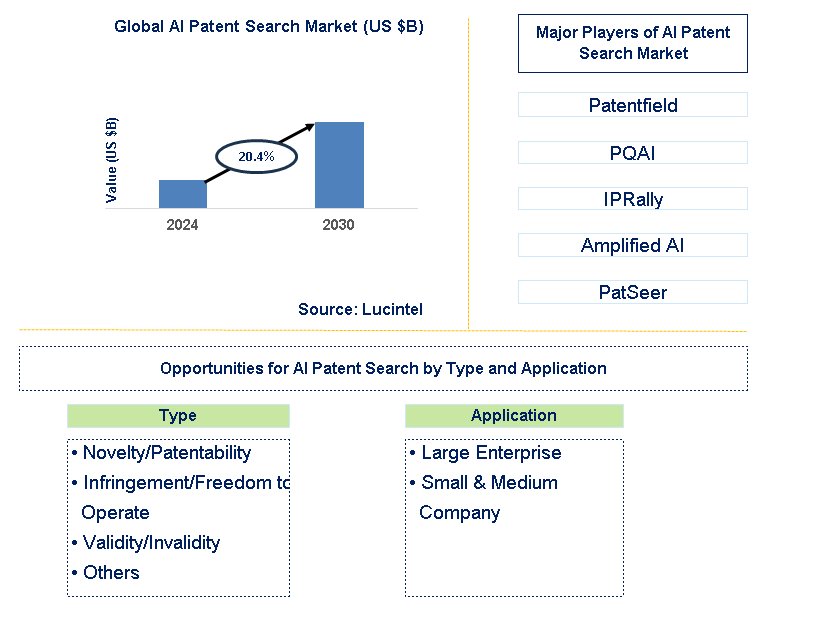
Key data points: The growth forecast = 20.4% annually for the next 6 years. Scroll below to get more insights. This market report covers trends, opportunities, and forecasts in the global AI patent search market to 2030 by type (novelty/patentability, infringement/freedom to operate, validity/invalidity, and others), application (large enterprise and small & medium company), and region (North America, Europe, Asia Pacific, and the Rest of the World)
We'll send your sample report shortly.
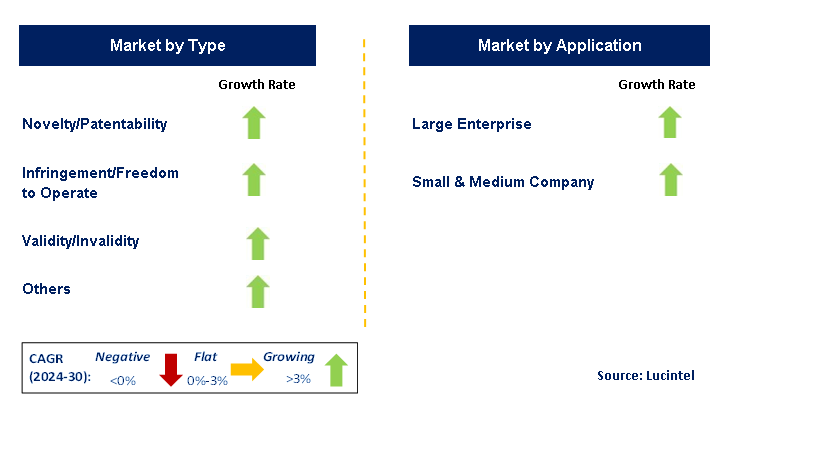
• Lucintel forecasts that, within the type category, novelty/patentability is expected to witness the highest growth over the forecast period.
• Within the application category, large enterprises will remain the larger segment.
• In terms of regions, North America is expected to witness the highest growth over the forecast period. Gain valuable insights for your business decisions with our comprehensive 150+ page report.
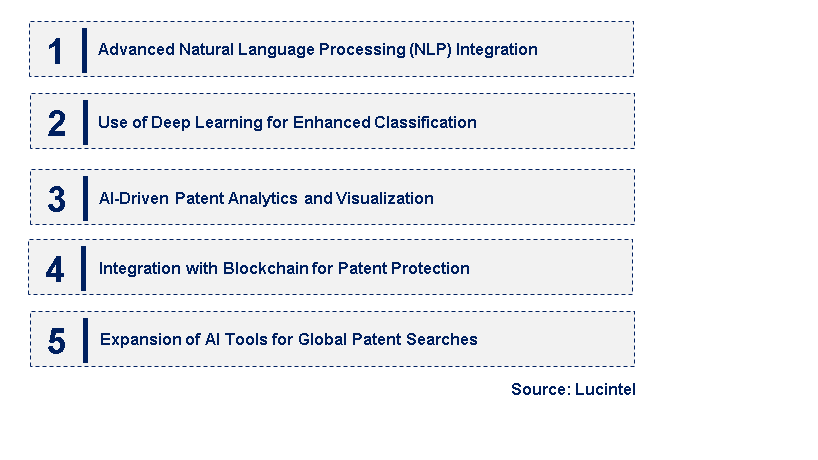
• Enhanced Natural Language Processing (NLP): The development of sophisticated NLP algorithms has made it possible to conduct more comprehensive patent searches. AI-enabled systems are capable of processing technical language, detecting relationships, and retrieving documents. As a result, more precise searches can be performed, capturing all relevant patents and ensuring that critical ones are not overlooked. Comprehending the legal jargon of patents is why this technology is essential.
• Predictive Analytics: Predictive analytics powered by AI is being used to anticipate patent activity, flag possible infringement threats, and determine the market value of a patent. AI systems can offer strategic insights for decision-making concerning patent portfolios by analyzing historical market data trends and patents. This makes it possible to adopt proactive IP strategies, enabling businesses to anticipate and mitigate future competitive challenges and technological advancements.
• Visualization Tools: The way patent information is examined and analyzed is changing due to AI-powered patent data analysis tools. These tools create IP landscape visualizations in the form of graphs, charts, and network diagrams that emphasize important attributes and relationships within patent data. This allows patent experts to comprehend complex portfolios faster than before and helps them find relevant information more easily. With visual representation, AI patent tools work to ensure that essential patterns are not missed, as text representation is inefficient.
• Integration with Workflow Platforms: Existing patent search tools are now available on popular IP management and workflow platforms, as AI makes their integration easier. This allows for the automation of patent searches, reduces the need for manual data entry, and increases collaboration among different patent bodies. By making patent research less elaborate and time-consuming, this approach ensures greater efficiency.
• Specialized AI Algorithms: There is increasing focus on the creation of industry-specific AI algorithms. These algorithms are trained on domain-specific patents, making searches in specialized fields more effective. This enables domain experts to perform searches in complex fields with greater accuracy. All of these trends are changing the AI patent search market by offering smarter and more effective resources to patent experts, resulting in improved productivity. These emerging trends provide faster and more precise solutions, which improve the effectiveness of the decision-making process in managing a patent portfolio and developing an IP strategy. The adoption of intelligent and data-driven approaches to patent searching is fostering innovation and competition, which benefits the entire economy.
• Semantic Search: AI-based semantic search is significantly increasing the understanding of the context and meaning of patent documents. It goes beyond simple keyword searching, enabling enhanced retrieval of pertinent prior art. This enhances a deeper understanding of the meaning of patents, thus making searches more accurate.
• Integration of Deep Models: Deep models, especially neural networks, are increasingly being utilized to process complicated patent data. These models can recognize complex patterns and relationships, resulting in more accurate and detailed patent searches. This enables the examination of patterns that would be too complicated for human researchers to discover.
• Emergence of AI-Based Patent Landscaping Tools: AI-based tools are now facilitating patent landscaping automatically, offering in-depth analysis of patent trends, competition, and technological evolution. This helps firms derive valuable inputs for strategic decision-making. These tools provide much quicker and more precise means of patent landscaping.
• Rise of Collaborative AI Platforms: Collaborative AI platforms are enabling patent data and search results to be shared by patent professionals. These platforms improve collaboration and automate workflows, enhancing efficiency and accuracy. This improvement in collaboration enables faster and more accurate patent searches.
• Application of AI in Predicting Prior Art: AI tools are being utilized to predict the relevance of prior art, enabling patent attorneys and examiners to spot possibly relevant patents more quickly. This accelerates the process of patent examination and enhances the quality of granted patents. This helps to speed up the patent process. These advancements are cumulatively transforming the AI patent search marketplace by streamlining patent searching, making searches more accurate and insightful. AI-driven tools are simplifying intricate activities, broadening search capabilities, and yielding deeper insights into patent landscapes, resulting in enhanced decision-making in intellectual property management. The marketplace is shifting towards a smarter, data-driven method of patent searching, driving innovation and competitiveness.
• Amplified Patent Prosecution: AI can enable prior art search automation, simplified patent drafting, and examiner reaction prediction, shortening patent prosecution time and cost by significantly large margins. This makes faster patent grants and less costly legal expenditures feasible.
• Litigation Support: AI-based technologies can scan millions of patent pieces of information to uncover infringement threats, determine the validity of patents, and supply indispensable evidence for trials. This aids legal teams in building more resilient cases and making better decisions. This facilitates smarter legal proceedings.
• Competitive Intelligence: AI can track patent landscapes to detect upcoming technologies, map competitor actions, and analyze market trends to offer significant insights for strategic decision-making. This helps organizations remain ahead of the competition and detect potential threats and opportunities. This facilitates improved business strategy.
• Technology Scouting: AI can scan patent databases to identify promising technologies and potential licensing opportunities, enabling technology transfer and open innovation. It enables quicker identification of new technologies and improves investment choices.
• Portfolio Management: AI can evaluate the value and applicability of patent portfolios, detect undervalued assets, and suggest strategic initiatives for portfolio optimization. This helps companies optimize the value of their intellectual property and align patent strategy with business strategy. This facilitates improved management of patent portfolios. These strategic growth opportunities are revolutionizing the AI patent search market by facilitating more efficient, accurate, and insightful intellectual property management. By prioritizing these key applications, stakeholders can take advantage of AI's strengths to gain a competitive edge, foster innovation, and optimize the value of their patent portfolios. The market is shifting toward a more proactive and data-driven approach to patent management.
• Technological Advancements in AI: Advancements in AI technology, such as machine learning and natural language processing, are driving the growth of AI patent search tools. These technologies enhance search accuracy and efficiency, making patent research more effective.
• Increasing Demand for Efficient Patent Management: The growing need for efficient patent management and competitive analysis is driving the adoption of AI patent search tools. Organizations are seeking solutions that can streamline patent research and provide valuable insights.
• Expansion of Global Intellectual Property Markets: The expansion of global intellectual property markets is driving demand for AI tools that support international patent searches and management. Organizations require solutions that can handle complex global patent landscapes.
• Rise in Patent Filings and Litigation: The increase in patent filings and litigation is fueling the need for advanced search tools to manage and analyze patent data. AI tools help organizations stay informed about new filings and potential infringement issues.
• Investment in AI Research and Development: Growing investment in AI research and development is supporting the creation of advanced patent search tools. Funding and resources are driving innovation and enhancing the capabilities of AI patent search solutions. Challenges in the AI Patent Search Market:
• Data Privacy and Security Concerns: Data privacy and security concerns pose challenges for AI patent search tools. Ensuring the protection of sensitive patent data and compliance with regulations is crucial for maintaining user trust and regulatory compliance.
• Integration with Existing Systems: Integrating AI patent search tools with existing intellectual property management systems can be challenging. Technical complexities and compatibility issues may affect the effectiveness and adoption of AI tools.
• Addressing Ethical and Bias Issues: Ethical and bias issues in AI algorithms pose challenges for patent search tools. Ensuring fairness and accuracy in search results while avoiding biases is essential for responsible AI development and use. Drivers and challenges shape the AI patent search market by influencing technology development, market demand, and operational considerations. Addressing challenges while leveraging drivers for innovation can lead to successful market growth and effective intellectual property management.
• Patentfield
• PQAI
• IPRally
• Amplified AI
• PatSeer
• Intergator Patent Search
• Ambercite
• Novelty/Patentability
• Infringement/Freedom to Operate
• Validity/Invalidity
• Others
• Large Enterprise
• Small & Medium Company
• North America
• Europe
• Asia Pacific
• The Rest of the World
• United States: In the US, AI patent search tools are increasingly leveraging natural language processing (NLP) and machine learning to improve search accuracy and relevancy. Companies like IBM and Google are integrating these technologies into their patent search platforms, enabling more precise retrieval of relevant patents and supporting innovation management. Enhanced AI algorithms are also assisting legal and R&D teams in identifying potential patent infringements and new opportunities.
• China: China's AI patent search market is expanding rapidly, with advancements in AI-driven patent analytics. Major players such as Baidu and Alibaba are developing sophisticated tools that enhance patent searches by utilizing deep learning and AI-based classification systems. These tools are increasingly used to support China's growing innovation ecosystem and improve patent filing strategies by providing more accurate and comprehensive search results.
• Germany: In Germany, the focus is on integrating AI with patent databases to streamline the patent search process. Companies like Siemens and Bosch are incorporating AI-driven tools to enhance their patent analysis capabilities. These tools are improving search efficiency and helping organizations manage their intellectual property portfolios more effectively by providing insights into patent trends and competitive intelligence.
• India: India's AI patent search market is witnessing growth as startups and tech companies develop AI-based solutions tailored to local needs. These tools are being used to support innovation in various sectors, including pharmaceuticals and technology. By leveraging AI for patent searches, Indian firms are improving their research capabilities and navigating the complexities of global patent landscapes more effectively.
• Japan: In Japan, AI patent search tools are being advanced by companies like NEC and Fujitsu to enhance the precision of patent searches. These tools integrate AI and machine learning to analyze patent data and support the country’s strong focus on technology and innovation. The integration of AI is helping Japanese companies better manage their patent portfolios and gain insights into technological advancements.


• Patentfield
• PQAI
• IPRally
• Amplified AI
• PatSeer
• Intergator Patent Search
• Ambercite Q5. Which AI patent search market segment will be the largest in future? Answer: Lucintel forecasts that, within the type category, novelty/patentability is expected to witness the highest growth over the forecast period. Q6. In AI patent search market, which region is expected to be the largest in next 5 years? Answer: In terms of regions, North America is expected to witness the highest growth over the forecast period. Q7. Do we receive customization in this report? Answer: Yes, Lucintel provides 10% customization without any additional cost.


Choose a license that fits your team. Instant PDF delivery.
Prices exclude taxes. Instant delivery. Custom licensing available on request.
Market Report · July 13, 2026
Market Report · July 13, 2026
Market Report · July 2, 2026
Trusted partner for strategic intelligence and business growth


Receive a complimentary market analysis tailored to your industry. Our analysts will identify key growth opportunities and competitive dynamics specific to your business.

Market size, growth rate, and key trend analysis for your specific sector.

Top competitor positioning and market share analysis.

Strategic recommendations backed by data-driven insights.
Get curated market intelligence and competitive moves straight to your inbox.
By subscribing, you agree to receive our monthly insights. Unsubscribe anytime.
Receive a complimentary market analysis tailored to your industry. Our analysts will identify key growth opportunities and competitive dynamics specific to your business.
Market size, growth rate, and key trend analysis for your specific sector.
Top competitor positioning and market share analysis.
Strategic recommendations backed by data-driven insights.
Get curated market intelligence, emerging trends, and competitive moves straight to your inbox each month.
By subscribing, you agree to receive our monthly insights. Unsubscribe anytime.
We'll send your sample report shortly.