
Market Report · July 13, 2026

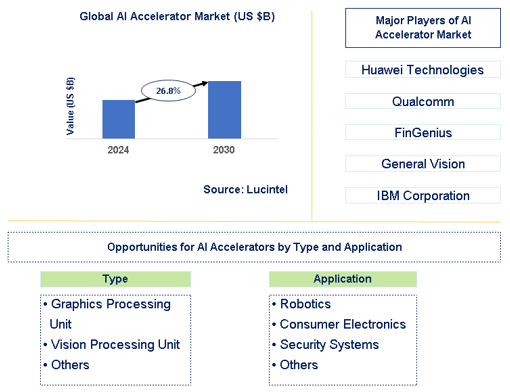
Key data points: The growth forecast = 26.8% annually next 6 years. Scroll below to get more insights. This market report covers trends, opportunities, and forecast in the global ai accelerator market to 2030 by type (graphics processing unit, vision processing unit, and others), application (robotics, consumer electronics, security systems, and others), and region (North America, Europe, Asia Pacific, and the Rest of the World)
We'll send your sample report shortly.
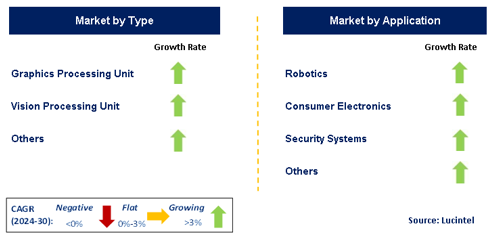
• Lucintel forecasts that graphics processing unit is expected to witness higher growth over the forecast period.
• Within this market, robotic will remain the largest segment.
• APAC is expected to witness the highest growth over the forecast period. A more than 150-page report is developed to help in your business decisions.
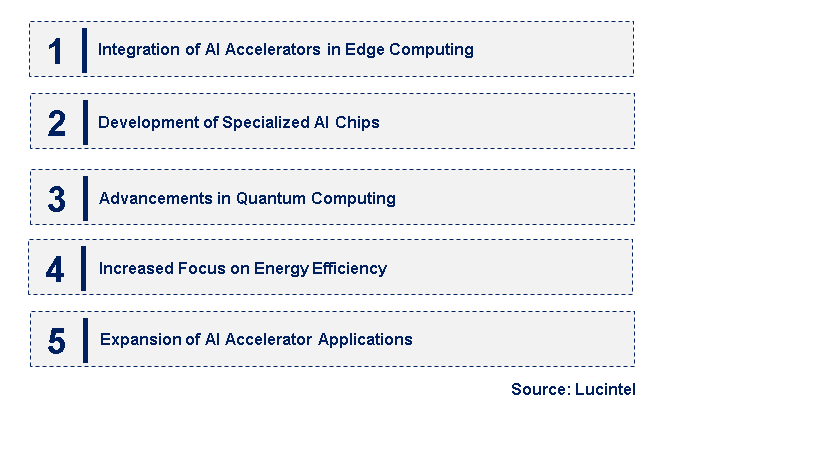
• Integration of AI Accelerators in Edge Computing: AI accelerators are increasingly being integrated into edge computing devices to enable real-time data processing and decision-making. This trend supports the growing demand for low-latency applications and IoT devices that require high-performance computing at the edge, thereby reducing the need for data transfer to centralized servers.
• Development of Specialized AI Chips: Companies are developing specialized AI chips tailored to specific applications, such as autonomous driving, natural language processing, and image recognition. These custom-designed accelerators offer enhanced performance and efficiency for targeted tasks, driving innovation in specialized fields and improving overall AI capabilities.
• Advancements in Quantum Computing: Quantum computing is emerging as a significant trend, with the potential to revolutionize AI acceleration. Research and development in quantum processors could lead to breakthroughs in computational power and speed, enabling more complex AI models and applications that were previously impractical with classical computing technologies.
• Increased Focus on Energy Efficiency: There is a growing emphasis on developing energy-efficient AI accelerators to address the high power consumption associated with AI computations. Innovations in chip design and manufacturing are focusing on reducing energy usage while maintaining high performance, aligning with global sustainability goals and reducing operational costs.
• Expansion of AI Accelerator Applications: The range of applications for AI accelerators is expanding beyond traditional data centers and cloud computing. New use cases include AI-driven healthcare diagnostics, financial analytics, and smart cities. This trend reflects the broader adoption of AI technology across diverse sectors and the need for high-performance computing solutions. These trends are reshaping the AI accelerator market by driving advancements in edge computing, specialized chip design, and energy efficiency. The integration of quantum computing and the expansion of applications are further enhancing the capabilities and scope of AI accelerators, leading to broader adoption and innovation across various industries.
• Launch of Next-Generation GPUs: Major tech companies have introduced next-generation GPUs with enhanced AI acceleration capabilities. These GPUs offer improved processing power and efficiency, supporting advanced machine learning models and deep learning applications while setting new benchmarks for AI performance.
• Emergence of Custom AI Chips: Companies are increasingly developing custom AI chips designed specifically for targeted applications. These chips, tailored for tasks such as image recognition and natural language processing, provide optimized performance and energy efficiency, driving innovation in various AI-driven fields.
• Growth of AI Chip Startups: A surge in AI chip startups is diversifying the market with innovative solutions. These startups are exploring novel architectures and applications, contributing to a more competitive landscape and accelerating the development of new AI acceleration technologies.
• Integration with Cloud Platforms: AI accelerators are being integrated into major cloud computing platforms, offering scalable and high-performance computing resources for AI workloads. This integration enables organizations to leverage powerful AI capabilities without investing in on-premises infrastructure, facilitating broader adoption.
• Advancements in AI for Autonomous Vehicles: Significant progress has been made in developing AI accelerators for autonomous vehicles. These advancements include the creation of specialized chips for real-time data processing and decision-making, enhancing the safety and performance of self-driving technologies. These developments are driving growth and innovation in the AI accelerator market. The introduction of advanced GPUs, custom AI chips, and the rise of AI chip startups are expanding capabilities and applications. Integration with cloud platforms and advancements in autonomous vehicles are further influencing market dynamics and adoption.
• Cloud Computing: The integration of AI accelerators into cloud computing platforms presents significant growth potential. This allows organizations to access high-performance computing resources for AI workloads on demand, supporting scalability and flexibility in AI applications and driving market expansion.
• Healthcare: AI accelerators are increasingly being used in healthcare for applications such as medical imaging and diagnostics. By enhancing the processing power of AI algorithms, these accelerators can improve diagnostic accuracy and treatment efficiency, presenting a substantial growth opportunity in the healthcare sector.
• Autonomous Vehicles: The development of AI accelerators for autonomous vehicles represents a major growth opportunity. Specialized accelerators are crucial for processing data from sensors and making real-time driving decisions, advancing the capabilities and safety of self-driving technologies and expanding market prospects.
• Financial Services: In the financial services industry, AI accelerators are being used for high-frequency trading, fraud detection, and risk management. The ability to process large volumes of data quickly and accurately provides a competitive edge, driving demand for AI acceleration in this sector.
• Smart Cities: AI accelerators are essential for implementing smart city technologies, including traffic management, energy efficiency, and public safety. The ability to process and analyze data from various sensors and devices in real time supports the development of intelligent urban systems, offering significant growth opportunities. These strategic growth opportunities highlight the diverse applications and potential of AI accelerators. By focusing on cloud computing, healthcare, autonomous vehicles, financial services, and smart cities, stakeholders can capitalize on emerging trends and drive substantial advancements in the AI accelerator market.
• Rapid Technological Advancements: Advances in semiconductor technology and AI algorithms are driving the AI accelerator market. Innovations in chip design, such as increased processing power and efficiency, enable more complex and efficient AI computations, fueling market growth.
• Growing Demand for AI Applications: The increasing adoption of AI across various industries, including healthcare, finance, and automotive, is driving demand for AI accelerators. The need for high-performance computing to support advanced AI applications is a key factor contributing to market expansion.
• Investment in R&D: Significant investment in research and development is propelling the AI accelerator market. Both the public and private sectors are funding advancements in AI technology, leading to the development of new and improved accelerators that drive market growth.
• Expansion of Cloud Computing: The growth of cloud computing services is boosting the demand for AI accelerators. Cloud providers are integrating AI accelerators into their infrastructure to offer scalable and high-performance computing solutions for AI workloads, contributing to market growth.
• Increasing Use of AI in Edge Computing: The integration of AI accelerators into edge computing devices is expanding the market. Edge computing requires high-performance processing at the local level, driving demand for accelerators that can handle real-time data processing and analysis. Challenges in the AI accelerator market include:
• High Development Costs: The high costs associated with developing advanced AI accelerators can be a challenge for market players. Research and development expenses, coupled with manufacturing costs, can impact profitability and limit access to cutting-edge technology.
• Supply Chain Disruptions: Supply chain issues, such as semiconductor shortages, can affect the availability and production of AI accelerators. Disruptions in the supply chain can lead to delays and increased costs, impacting market growth and stability.
• Regulatory and Compliance Challenges: Navigating regulatory and compliance requirements can be challenging for AI accelerator manufacturers. Ensuring that products meet various standards and regulations across different regions requires significant resources and can affect market entry and expansion. The AI accelerator market is shaped by technological advancements, increasing demand for AI applications, and investment in R&D, which are driving growth. However, challenges such as high development costs, supply chain disruptions, and regulatory hurdles must be addressed. Understanding these drivers and challenges is essential for navigating the market and capitalizing on growth opportunities.
• Huawei Technologies
• Qualcomm
• FinGenius
• General Vision
• IBM Corporation
• NVIDIA Corporation
• Intel Corporation
• MediaTek
• Inbenta Technologies
• Cerebras Systems
• Graphics Processing Unit
• Vision Processing Unit
• Others
• Robotics
• Consumer Electronics
• Security Systems
• Others
• North America
• Europe
• Asia Pacific
• The Rest of the World
• United States: In the US, leading tech companies are making significant strides in developing next-generation AI accelerators. Innovations include the introduction of more powerful GPUs and custom-designed AI chips that offer higher performance and efficiency. Companies like NVIDIA and Google are pushing boundaries with their latest hardware, enhancing capabilities for AI and machine learning applications.
• China: China is aggressively investing in AI accelerator technology, with state-backed initiatives and significant contributions from local tech giants. Companies like Huawei and Alibaba are advancing AI chip designs and production, focusing on integrating AI accelerators into cloud computing and data centers to support the country’s growing digital economy.
• Germany: Germany is focusing on integrating AI accelerators into industrial applications and automotive technologies. Companies and research institutions are developing specialized AI chips for autonomous vehicles and Industry 4.0 solutions. Germany’s emphasis on precision engineering and high-quality manufacturing is driving advancements in AI accelerator technology.
• India: In India, there is growing interest in AI accelerators driven by the need for enhanced computing power in startups and technology hubs. Indian companies are exploring cost-effective AI accelerator solutions and collaborating with international firms to bring advanced technologies to local markets, aiming to boost AI research and development.
• Japan: Japan is making significant investments in AI accelerators, particularly in robotics and consumer electronics. Japanese firms are developing advanced AI chips to improve performance in robotics and smart devices, reflecting the country’s focus on integrating AI into various aspects of daily life and industry.
• Huawei Technologies
• Qualcomm
• FinGenius
• General Vision
• IBM Corporation
• NVIDIA Corporation
• Intel Corporation
• MediaTek
• Inbenta Technologies
• Cerebras Systems Q5. Which AI accelerator market segment will be the largest in future? Answer: Lucintel forecasts that graphics processing unit is expected to witness higher growth over the forecast period. Q6. In AI accelerator market, which region is expected to be the largest in next 5 years? Answer: APAC is expected to witness the highest growth over the forecast period. Q7. Do we receive customization in this report? Answer: Yes, Lucintel provides 10% customization without any additional cost.


Choose a license that fits your team. Instant PDF delivery.
Prices exclude taxes. Instant delivery. Custom licensing available on request.
Market Report · July 13, 2026
Market Report · July 13, 2026
Market Report · July 2, 2026
Trusted partner for strategic intelligence and business growth


Receive a complimentary market analysis tailored to your industry. Our analysts will identify key growth opportunities and competitive dynamics specific to your business.

Market size, growth rate, and key trend analysis for your specific sector.

Top competitor positioning and market share analysis.

Strategic recommendations backed by data-driven insights.
Get curated market intelligence and competitive moves straight to your inbox.
By subscribing, you agree to receive our monthly insights. Unsubscribe anytime.
Receive a complimentary market analysis tailored to your industry. Our analysts will identify key growth opportunities and competitive dynamics specific to your business.
Market size, growth rate, and key trend analysis for your specific sector.
Top competitor positioning and market share analysis.
Strategic recommendations backed by data-driven insights.
Get curated market intelligence, emerging trends, and competitive moves straight to your inbox each month.
By subscribing, you agree to receive our monthly insights. Unsubscribe anytime.
We'll send your sample report shortly.