
Report Feature
Aerosol Propellant Market Trends and Forecast
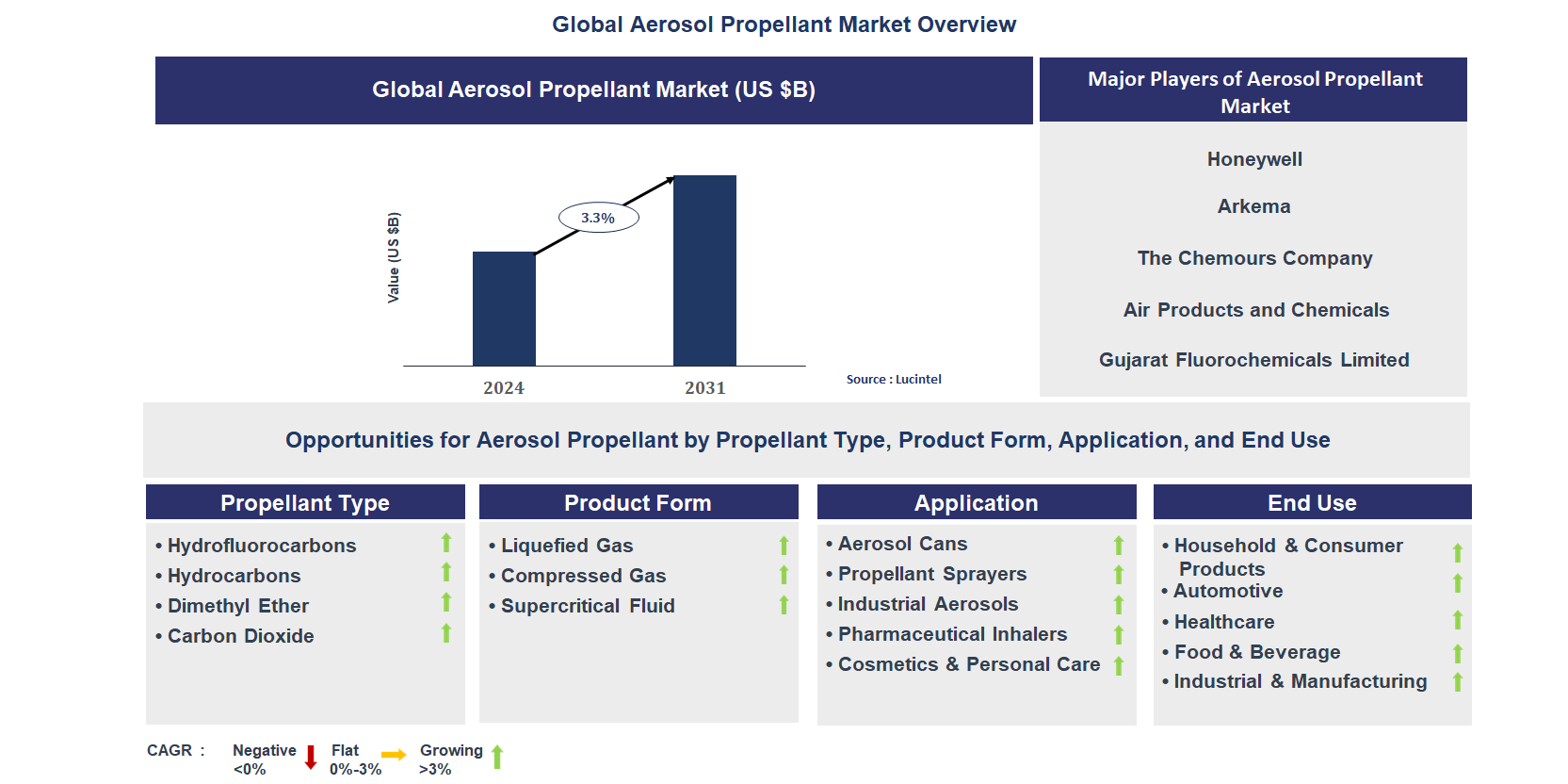
The future of the global aerosol propellant market looks promising with opportunities in the household & consumer product, automotive, healthcare, food & beverage, and industrial & manufacturing markets. The global aerosol propellant market is expected to grow with a CAGR of 3.3% from 2025 to 2031. The major drivers for this market are the increasing demand in personal care products, the rising use in household cleaning solutions, and the growing adoption in automotive industry applications.• Lucintel forecasts that, within the propellant type category, hydrocarbon is expected to witness the highest growth over the forecast period.
• Within the end use category, household & consumer product is expected to witness the highest growth.
• In terms of region, APAC is expected to witness the highest growth over the forecast period. Gain valuable insights for your business decisions with our comprehensive 150+ page report. Sample figures with some insights are shown below.
Emerging Trends in the Aerosol Propellant Market
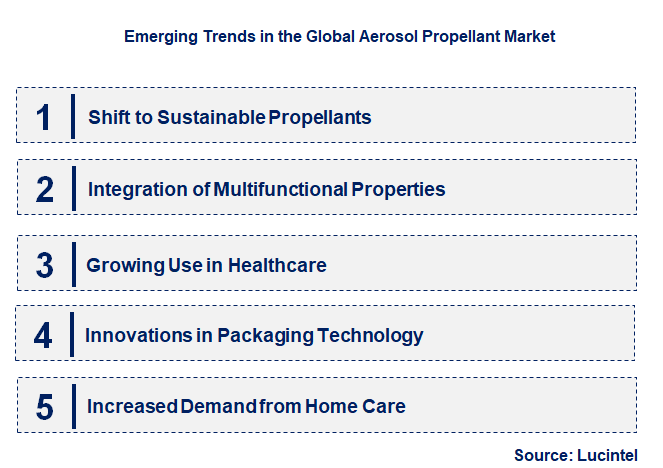
The aerosol propellant market is being reshaped by several key trends that are pushing the industry toward greater specialization, sustainability, and efficiency. These trends are a direct response to global demands for safer, more effective, and environmentally friendly products, which are influencing product formulations and manufacturing practices across the industry.• Shift to Sustainable Propellants: A significant trend is the shift toward sustainable and eco-friendly propellants like compressed air and nitrogen. Driven by growing environmental concerns and stricter regulations on greenhouse gases, manufacturers are moving away from traditional hydrocarbons. This trend is impacting the market by offering eco-friendly alternatives and aligning with corporate sustainability goals.
• Integration of Multifunctional Properties: A major emerging trend is the development of aerosol propellants that offer additional benefits beyond just dispensing. For example, some propellants are being developed to also act as solvents or cooling agents. This trend is reshaping product formulations by providing a more comprehensive solution for applications in personal care and industrial products, enhancing efficiency.
• Growing Use in Healthcare: The market is seeing a major trend in the use of aerosol propellants in the medical and healthcare sectors. This is driven by the need for precise and hygienic delivery of medications and disinfectants. The COVID-19 pandemic accelerated this trend, highlighting the importance of aerosols in delivering medical-grade products like sanitizers and inhalers.
• Innovations in Packaging Technology: The industry is trending toward using innovative packaging technologies like Bag-on-Valve (BoV) systems. These systems separate the product from the propellant, allowing for 360-degree dispensing and the use of compressed air as a propellant. This trend is impacting the market by improving product performance, safety, and sustainability.
• Increased Demand from Home Care: A key emerging trend is the growing application of aerosol propellants in the home care sector. This is driven by heightened consumer awareness of cleanliness and the need for convenient cleaning and sanitizing products. This trend is creating new, high-volume market segments for propellants used in air fresheners and disinfectants. These emerging trends are fundamentally reshaping the aerosol propellant market by pushing it toward greater specialization, sustainability, and technological integration. The increasing demand for natural, multifunctional, and high-performance products, coupled with a focus on green production, is creating new value propositions and expanding the markets overall potential.
Recent Development in the Aerosol Propellant Market
The aerosol propellant market is experiencing several key developments that are shaping its growth and strategic direction. These changes are a result of evolving industrial demands, strategic corporate maneuvers, and a global pivot toward enhanced performance and sustainability across various applications.• Shift to Low-GWP Propellants: A significant recent development is the move towards low-Global Warming Potential (GWP) propellants. This is driven by international agreements and national regulations aimed at phasing out substances harmful to the climate. This development is pushing manufacturers to invest in new research and development to create next-generation propellants that are both effective and environmentally friendly.
• Strategic Mergers and Acquisitions: The market has seen strategic consolidations, with companies engaging in mergers and acquisitions to streamline operations and strengthen their market position. Such corporate activities are aimed at expanding product portfolios, enhancing manufacturing capabilities, and gaining a competitive edge in a highly fragmented market.
• Innovations in Product Formulations: Companies are developing innovative product formulations to meet the needs of specific applications. These advancements, which include more durable and effective blends, are critical for sensitive industries like medical and automotive, where performance and reliability are paramount, and are driving a focus on high-purity propellants.
• Focus on Sustainable Solutions: There is a notable development of increasing research into and production of bio-based propellants. This is a direct response to global environmental regulations and consumer demand for eco-friendly products. This development is pushing the market toward a more sustainable and greener chemical industry, offering new growth avenues.
• Growing Application in Medical Products: The medical sector is seeing a recent development of increased adoption of aerosol propellants for products like metered-dose inhalers (MDIs) and medical-grade disinfectants. This is driven by a focus on quality and safety in the healthcare industry, creating a high-value niche for specialized propellants. These recent developments are collectively steering the aerosol propellant market toward greater efficiency and specialization. The market is becoming more responsive to specific industrial needs and is increasingly shaped by strategic corporate decisions and a global push for sustainability, all while navigating the complexities of innovation.
Strategic Growth Opportunities in the Aerosol Propellant Market
Strategic growth opportunities in the aerosol propellant market are centered on leveraging its versatile properties in high-value applications. By focusing on specific end-use sectors, companies can capitalize on the unique benefits of new propellant technologies to create new market segments, enhance profitability, and secure a competitive advantage in a dynamic global market.• Expansion into Healthcare and Medical: A key growth opportunity lies in the rapidly expanding healthcare and medical sector. The need for high-quality, precise, and sterile propellants for the production of medical inhalers and disinfectants is driving demand. This presents a high-margin, specialized market that is less susceptible to commodity price volatility and is driven by safety regulations.
• Targeting High-Performance Automotive: There is a significant growth opportunity in developing and marketing aerosol propellants for the automotive industry. Their application in the production of high-performance lubricants, coatings, and cleaners can enhance durability and efficiency. As consumer demand for advanced safety and maintenance products grows, this high-value market segment will offer substantial returns.
• Penetration in Industrial and Specialty Sprays: A major strategic opportunity is to expand into the industrial and specialty spray market. With the growth of industries like manufacturing and construction, the demand for specialized lubricants, cleaning agents, and paints is increasing. This segment offers a high-volume market with significant growth potential for specialized propellants.
• Diversification into Food and Beverage: The aerosol propellant market can find growth by diversifying into the food and beverage sector. The use of compressed gases like nitrogen and carbon dioxide in products like whipped cream and cooking sprays offers a new, stable revenue stream, driven by the global demand for convenient and easy-to-use food products.
• Development of Sustainable Solutions: A long-term strategic opportunity involves focusing on the development of bio-based and eco-friendly aerosol propellants. This aligns with global sustainability trends and can attract environmentally conscious customers and regulatory approval, providing a competitive edge and meeting future demands. These strategic growth opportunities are poised to reshape the aerosol propellant market by pushing it into higher-value, specialized applications. By moving beyond traditional uses and focusing on innovation in sectors like healthcare, automotive, and food and beverage, the market can achieve sustainable and robust growth.
Aerosol Propellant Market Driver and Challenges
The aerosol propellant market is influenced by a complex interplay of drivers and challenges. The primary drivers are fueled by increasing consumer demand from high-growth industries and a global shift toward performance and sustainability, while key challenges stem from economic factors and stringent regulatory frameworks. The factors responsible for driving the aerosol propellant market include: 1. Growing Personal Care Industry: A major driver is the increasing global demand for personal care products like deodorants, hairsprays, and shaving creams. The convenience and ease of use of aerosol packaging for these products directly contribute to the markets growth, especially in emerging economies with rising disposable incomes. 2. Rising Demand for Household Products: The expansion of the household care market, including air fresheners, disinfectants, and cleaners, is a significant driver. The COVID-19 pandemic heightened consumer awareness of hygiene, leading to a surge in demand for aerosol-based products that offer easy and effective application. 3. Technological Advancements: Innovations in propellant technologies, such as the development of more effective and safer blends, are driving market growth. These advancements, including the introduction of Bag-on-Valve (BoV) systems, improve product performance and open new application possibilities, making aerosol products more appealing to consumers. 4. Expansion of Pharmaceutical Sector: The pharmaceutical industrys growing reliance on metered-dose inhalers (MDIs) for respiratory treatments is a key driver. The need for precise and consistent drug delivery is fueling the demand for high-purity and stable medical-grade propellants. 5. Increasing Demand for Paints and Coatings: The automotive and industrial sectors are seeing a rise in the use of aerosol paints and coatings. This is driven by the need for quick and easy application for touch-ups and maintenance, which in turn boosts the consumption of aerosol propellants. Challenges in the aerosol propellant market are: 1. Strict Environmental Regulations: The market faces a significant challenge from complex and often differing environmental regulations, particularly concerning greenhouse gases. The phase-out of certain high-GWP propellants is forcing manufacturers to invest heavily in new research and development to find compliant and effective alternatives, which can be costly. 2. Price Volatility of Raw Materials: The market faces a significant challenge from the price volatility of key raw materials like hydrocarbons. Fluctuations in these prices, often linked to the oil and gas market, can impact production costs and profitability, making it difficult for manufacturers to maintain stable pricing and long-term planning. 3. Safety and Flammability Concerns: Concerns regarding the safety and flammability of certain propellants, particularly hydrocarbons, pose a major challenge. These concerns can lead to stricter transportation and storage regulations, increasing operational costs and potentially limiting the market for some products. The aerosol propellant market is being propelled forward by powerful drivers, including a growing demand from key industries and a global push for convenience and safety. However, it must also overcome significant challenges, such as stringent regulations, raw material price volatility, and safety concerns. The markets ability to innovate and adapt will be key to its continued growth.List of Aerosol Propellant Companies
Companies in the market compete on the basis of product quality offered. Major players in this market focus on expanding their manufacturing facilities, R&D investments, infrastructural development, and leverage integration opportunities across the value chain. With these strategies aerosol propellant companies cater increasing demand, ensure competitive effectiveness, develop innovative products & technologies, reduce production costs, and expand their customer base. Some of the aerosol propellant companies profiled in this report include-• Honeywell
• Arkema
• The Chemours Company
• Air Products and Chemicals
• Gujarat Fluorochemicals Limited
• Shinho Chemical
• Daikin Industries
• Solvay
• Messer Group
• Taiyo Nippon Sanso Corporation
Aerosol Propellant Market by Segment
The study includes a forecast for the global aerosol propellant market by propellant type, product form, application, end use, and region.Aerosol Propellant Market by Propellant Type [Value from 2019 to 2031]:
• Hydrofluorocarbons
• Hydrocarbons
• Dimethyl Ether
• Carbon Dioxide
Aerosol Propellant Market by Product Form [Value from 2019 to 2031]:
• Liquefied Gas
• Compressed Gas
• Supercritical Fluid
Aerosol Propellant Market by Application [Value from 2019 to 2031]:
• Aerosol Cans
• Propellant Sprayers
• Industrial Aerosols
• Pharmaceutical Inhalers
• Cosmetics & Personal Care
Aerosol Propellant Market by End Use [Value from 2019 to 2031]:
• Household & Consumer Products
• Automotive
• Healthcare
• Food & Beverage
• Industrial & Manufacturing
Aerosol Propellant Market by Region [Value from 2019 to 2031]:
• North America
• Europe
• Asia Pacific
• The Rest of the World
Country Wise Outlook for the Aerosol Propellant Market
The aerosol propellant market is experiencing significant developments, driven by its essential role in a wide range of consumer and industrial products. These changes are shaped by a rising global demand for personal care and household goods, along with a strong push towards more sustainable and environmentally friendly propellants due to stricter regulations and consumer preferences.• United States: The U.S. market is witnessing steady growth, fueled by the cosmetics and personal care sectors. Recent developments include a shift away from traditional hydrocarbons towards eco-friendlier alternatives. This is in response to tightening environmental regulations and a growing consumer focus on sustainable products, driving innovation in product formulation.
• China: China is a dominant force in the global aerosol propellant market due to its massive manufacturing and consumer base. Recent developments are marked by a rapid expansion in the use of aerosols in personal care and household products. The market is also seeing a shift towards localized production to meet soaring demand and a growing preference for compressed gases like nitrogen and CO₂ to align with environmental goals.
• Germany: As a key player in Europe, Germanys aerosol propellant market is focused on high-quality and high-performance products. Recent developments show a strong demand for low-GWP (Global Warming Potential) propellants like dimethyl ether (DME) and compressed air. This is driven by strict EU F-Gas regulations and a commitment to sustainability, influencing both product formulation and manufacturing practices.
• India: Indias aerosol propellant market is expanding rapidly, fueled by increasing urbanization and rising disposable incomes. Recent developments highlight a significant increase in demand for aerosol-based deodorants, air fresheners, and disinfectants. The market is also seeing investments in domestic manufacturing to reduce import dependence and a growing consumer awareness of sustainable and hygienic packaging.
• Japan: The Japanese aerosol propellant market is mature and stable, with a strong demand from its advanced personal care and industrial sectors. Recent developments indicate a consistent need for high-quality propellants in specialized products like medical inhalers and precision sprays. The market is also focused on innovation to create more durable and high-performing aerosol solutions that align with the nations stringent quality standards.

Features of the Global Aerosol Propellant Market
Market Size Estimates: Aerosol propellant market size estimation in terms of value ($B). Trend and Forecast Analysis: Market trends (2019 to 2024) and forecast (2025 to 2031) by various segments and regions. Segmentation Analysis: Aerosol propellant market size by various segments, such as by propellant type, product form, application, end use, and region in terms of value ($B). Regional Analysis: Aerosol propellant market breakdown by North America, Europe, Asia Pacific, and Rest of the World. Growth Opportunities: Analysis of growth opportunities in different propellant types, product forms, applications, end uses, and regions for the aerosol propellant market. Strategic Analysis: This includes M&A, new product development, and competitive landscape of the aerosol propellant market. Analysis of competitive intensity of the industry based on Porter’s Five Forces model.
FAQ
Q1. What is the growth forecast for aerosol propellant market? Answer: The global aerosol propellant market is expected to grow with a CAGR of 3.3% from 2025 to 2031. Q2. What are the major drivers influencing the growth of the aerosol propellant market? Answer: The major drivers for this market are the increasing demand in personal care products, the rising use in household cleaning solutions, and the growing adoption in automotive industry applications. Q3. What are the major segments for aerosol propellant market? Answer: The future of the aerosol propellant market looks promising with opportunities in the household & consumer product, automotive, healthcare, food & beverage, and industrial & manufacturing markets. Q4. Who are the key aerosol propellant market companies? Answer: Some of the key aerosol propellant companies are as follows:• Honeywell
• Arkema
• The Chemours Company
• Air Products and Chemicals
• Gujarat Fluorochemicals Limited
• Shinho Chemical
• Daikin Industries
• Solvay
• Messer Group
• Taiyo Nippon Sanso Corporation Q5. Which aerosol propellant market segment will be the largest in future? Answer: Lucintel forecasts that, within the propellant type category, hydrocarbon is expected to witness the highest growth over the forecast period. Q6. In aerosol propellant market, which region is expected to be the largest in next 5 years? Answer: In terms of region, APAC is expected to witness the highest growth over the forecast period. Q7. Do we receive customization in this report? Answer: Yes, Lucintel provides 10% customization without any additional cost.
Table of Contents
List of Figures
List of Tables
Methodology
- In-depth interviews of the major players in this market
- Detailed secondary research from competitors’ financial statements and published data
- Extensive searches of published works, market, and database information pertaining to industry news, company press releases, and customer intentions
- A compilation of the experiences, judgments, and insights of Lucintel’s professionals, who have analyzed and tracked this market over the years.


Buy Now
Choose a license that fits your team. Instant PDF delivery.
Prices exclude taxes. Instant delivery. Custom licensing available on request.
Key Questions
- • What are some of the most promising, high-growth opportunities for the aerosol propellant market by propellant type (hydrofluorocarbons, hydrocarbons, dimethyl ether, and carbon dioxide), product form (liquefied gas, compressed gas, and supercritical fluid), application (aerosol cans, propellant sprayers, industrial aerosols, pharmaceutical inhalers, and cosmetics & personal care), end use (household & consumer products, automotive, healthcare, food & beverage, and industrial & manufacturing), and region (North America, Europe, Asia Pacific, and the Rest of the World)?
- • Which segments will grow at a faster pace and why?
- • Which region will grow at a faster pace and why?
- • What are the key factors affecting market dynamics? What are the key challenges and business risks in this market?
- • What are the business risks and competitive threats in this market?
- • What are the emerging trends in this market and the reasons behind them?
- • What are some of the changing demands of customers in the market?
- • What are the new developments in the market? Which companies are leading these developments?
- • Who are the major players in this market? What strategic initiatives are key players pursuing for business growth?
- • What are some of the competing products in this market and how big of a threat do they pose for loss of market share by material or product substitution?
- • What M&A activity has occurred in the last 5 years and what has its impact been on the industry? For any questions related to Aerosol Propellant Market, Aerosol Propellant Market Size, Aerosol Propellant Market Growth, Aerosol Propellant Market Analysis, Aerosol Propellant Market Report, Aerosol Propellant Market Share, Aerosol Propellant Market Trends, Aerosol Propellant Market Forecast, Aerosol Propellant Companies, write Lucintel analyst at email: helpdesk@lucintel.com. We will be glad to get back to you soon.


