
Market Report · May 18, 2026

This market report covers trends, opportunities, and forecasts in the global advanced recycling technologies market to 2031 by technology (pyrolysis/cracking, gasification, depolymerization, microwave, and others), end use industry (food and beverage packaging, non-food packaging, consumer electronics, infrastructure and construction, automotive, and others), and region (North America, Europe, Asia Pacific, and the Rest of the World)
We'll send your sample report shortly.
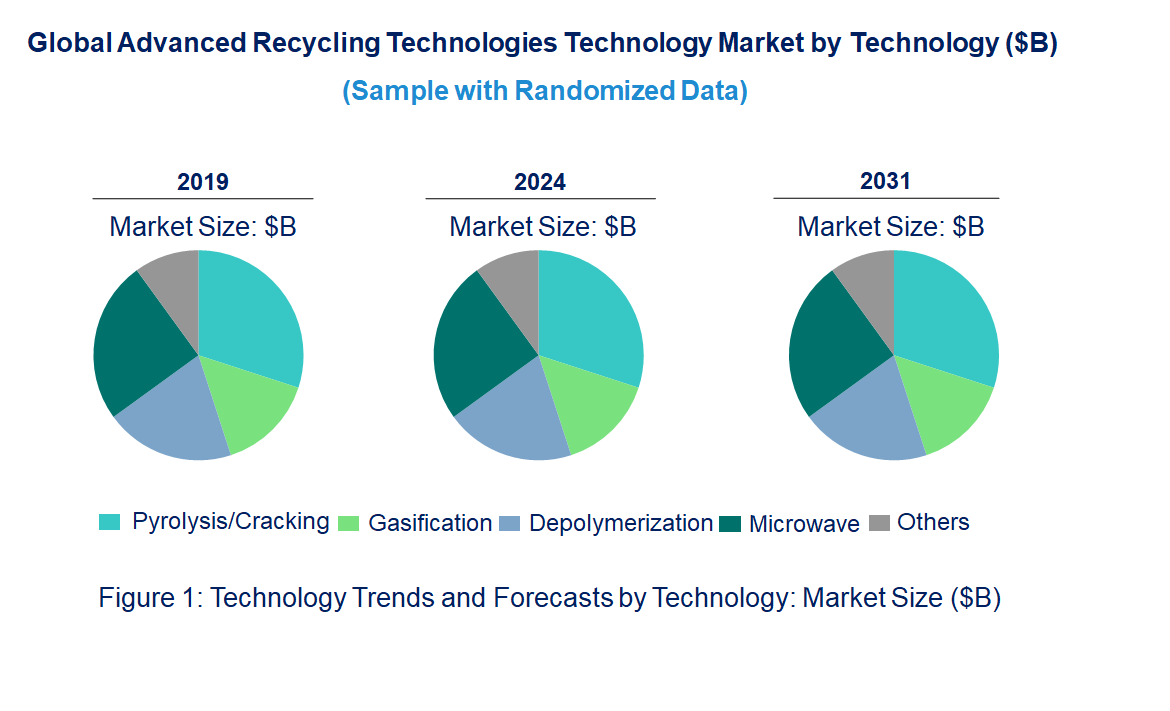
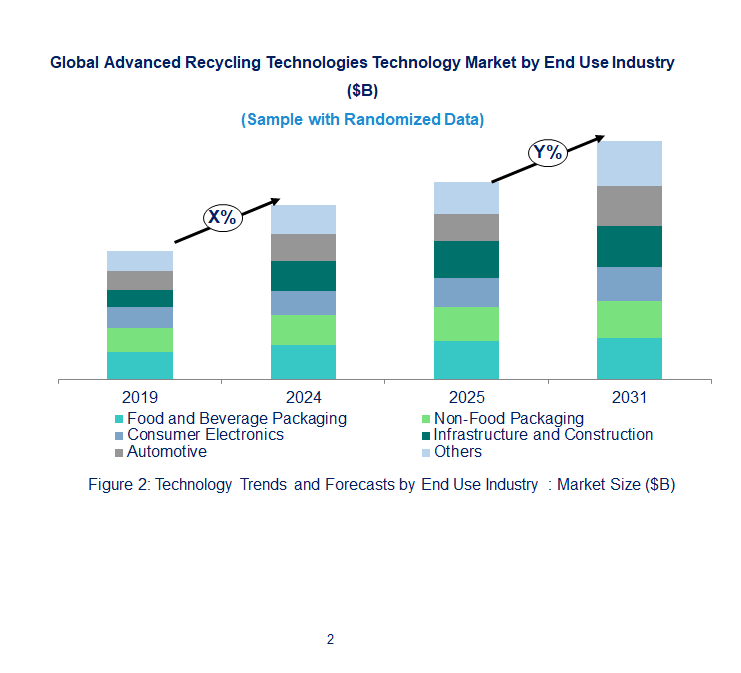
• Adoption of Chemical Recycling Technologies: Chemical recycling, also known as advanced or molecular recycling, is gaining traction as a method to break down complex plastics and other materials into their fundamental components, which can then be reused to create new products. Unlike traditional mechanical recycling, which often downgrades material quality, chemical recycling has the potential to process a wider range of materials, including contaminated or mixed plastics, and restore them to high-quality polymers.
• Integration of AI and Machine Learning in Sorting Processes: The use of Artificial Intelligence (AI) and Machine Learning (ML) in sorting and separating recyclable materials is becoming increasingly common. These technologies allow for the automation of material identification and sorting at much higher speeds and accuracy compared to traditional methods. AI can analyze data from cameras, sensors, and robotic systems to improve efficiency and reduce human error in recycling facilities.
• Development of Biodegradable and Compostable Materials: The demand for sustainable materials is driving innovation in biodegradable and compostable products that can be more easily processed through advanced recycling systems. Companies are increasingly focusing on designing products with life cycles that prioritize recyclability and environmental responsibility, including alternatives to single-use plastics.
• Upcycling and Closed-Loop Recycling Systems: Upcycling refers to the process of transforming waste materials into products of higher value. In closed-loop recycling systems, materials are continually reused within a cycle, minimizing waste and preserving resources. Companies are increasingly investing in technologies that can support both upcycling and closed-loop models, allowing for continuous reuse of materials like plastics, metals, and textiles without degradation in quality.
• Collaboration and Investment in Recycling Infrastructure: As global recycling rates lag behind targets, there is growing recognition that scaling up recycling efforts requires substantial investment in both technology and infrastructure. Governments, private sectors, and research organizations are increasingly collaborating to develop scalable, state-of-the-art recycling facilities. In particular, new partnerships are focusing on building recycling systems that are better integrated into the global supply chain and capable of handling a diverse range of materials more efficiently. The emerging trends in the advanced recycling technologies market underscore a transformative shift towards more efficient, sustainable, and circular recycling processes. Key advancements like chemical recycling, AI integration, biodegradable materials, upcycling, and enhanced recycling infrastructure are enabling industries to reduce waste, conserve resources, and lower environmental impact. As these technologies continue to evolve, they are likely to create new opportunities for both environmental and economic benefits, reshaping the future of global recycling practices. The momentum behind these trends signals a promising direction towards more sustainable waste management and resource recovery systems in the years to come.
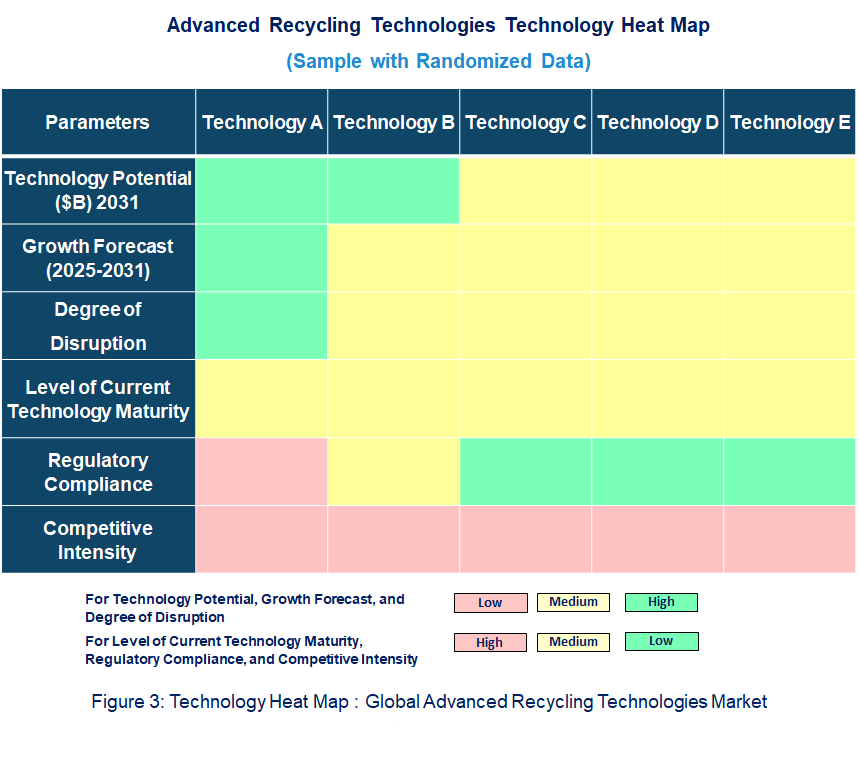
• Technology Potential: Advanced recycling technologies, such as chemical recycling, pyrolysis, and biotechnological processes, have immense potential to improve the circular economy. These technologies can break down complex materials like plastics into their original monomers, allowing them to be reused for new products. They also promise higher recovery rates and the ability to recycle non-recyclable waste, making them critical for industries aiming for zero-waste production.
• Degree of Disruption: ART has the potential to disrupt traditional recycling methods by enabling a more scalable, efficient, and sustainable solution. These technologies can address issues like contamination, material degradation, and the limitations of mechanical recycling, offering significant improvements in waste management and resource recovery.
• Level of Current Technology Maturity: While some ARTs, such as pyrolysis, are already in commercial use, others, like chemical recycling, are still under development or at pilot stages. The maturity level varies, with the technology still needing refinement in terms of efficiency, cost-effectiveness, and scalability.
• Regulatory Compliance: The ART market faces evolving regulatory scrutiny, with increasing focus on environmental impact, waste diversion targets, and safety standards. Regulatory frameworks are being developed to guide the integration of ARTs, with compliance required to ensure safety and sustainability.
• Agilyx: Agilyx has been making significant strides in the development of chemical recycling technologies, particularly its proprietary pyrolysis process. In 2024, the company announced a new collaboration with ExxonMobil to build a large-scale facility that will process mixed plastics and convert them into high-quality synthetic crude oil. This partnership is expected to scale up Agilyx’s capabilities to recycle difficult-to-recycle plastics, such as multi-layer films and certain types of polystyrene, which are typically discarded in landfills. Agilyx’s expansion is poised to further enhance the circular economy by providing an alternative to traditional plastic disposal methods and advancing the commercialization of chemical recycling.
• Stena Metall: Stena Metall, a leader in the recycling industry, has made notable advancements with its efforts to develop more efficient systems for recycling plastics and metals. In 2024, the company launched a new pilot plant that integrates both mechanical and advanced recycling methods. This facility will focus on improving the recovery of plastic materials from complex waste streams, particularly post-consumer plastics. By using a combination of pyrolysis and sorting technologies, Stena Metall aims to reduce the environmental impact of plastic waste while providing higher-quality recycled materials for the production of new goods, thereby supporting the shift toward a more sustainable recycling ecosystem.
• Chevron Phillips Chemical: Chevron Phillips Chemical has continued to innovate in the chemical recycling space, particularly with its Rewind™ Advanced Recycling process. In 2024, the company expanded its collaboration with several plastics manufacturers to launch a commercial-scale plant in the U.S. that uses catalytic pyrolysis to convert mixed plastic waste into feedstock for new plastic production. The technology is designed to handle contaminated plastics that are difficult to recycle through traditional methods, making it a crucial development for addressing the growing plastic waste problem. Chevron Phillips Chemical’s work aims to close the loop on plastic production, creating a more circular system for plastic use and disposal.
• Honeywell International: Honeywell International’s UOP division has made significant progress with its UpCycle process, which uses chemical recycling to break down plastics into their basic components for reuse in the production of virgin-quality plastics. In 2024, Honeywell partnered with several global brands to launch a new, full-scale recycling facility in Europe that will use the UpCycle technology. This move marks a significant step toward reducing plastic waste in Europe and will help companies achieve their sustainability goals by sourcing recycled materials rather than relying on virgin plastics. Honeywell’s technology is expected to play a critical role in helping the industry transition to a circular economy by enabling the recycling of mixed plastics and reducing reliance on fossil fuels.
• Plastic Energy: Plastic Energy is making substantial advancements with its proprietary Thermal Anaerobic Conversion (TAC) technology, which converts end-of-life plastic waste into high-quality oil that can be refined into new plastics. In 2024, the company broke ground on its new facility in Spain, which will be capable of processing 33,000 tons of plastic waste annually. This facility is expected to help close the loop on plastic waste in Europe and supply feedstock to plastic producers. Plastic Energy’s expansion exemplifies the growing trend of using chemical recycling to address global plastic waste challenges and is a key part of the effort to scale up sustainable recycling technologies.
• Enerkem: Enerkem continues to push the boundaries of waste-to-chemicals technology with its proprietary waste-to-biofuels and chemicals process. In 2024, Enerkem announced a new partnership with a major North American municipal waste management company to build a facility that will convert non-recyclable plastic waste into biofuels and chemicals. The facility is expected to be a model for future waste-to-resource technologies and will help address the growing demand for sustainable, low-carbon alternatives to conventional fuels and chemicals. Enerkem’s ability to turn waste into valuable products presents an important opportunity to combat plastic waste while reducing greenhouse gas emissions.
• Loop Industries: Loop Industries has made significant progress in the development of its chemical recycling technology, which breaks down waste plastics into their basic building blocks for the production of new plastics. In 2024, Loop secured major partnerships with leading consumer goods companies to build a new commercial-scale recycling plant in the U.S. that will use its patented technology to create high-quality PET (polyethylene terephthalate) resin from waste plastics. This innovation will help close the loop on plastic production by enabling the recycling of plastic materials into new packaging and other products, significantly reducing the need for virgin plastic production.
• Gr3n Recycling: Gr3n Recycling has made a breakthrough in the chemical recycling of PET plastics, utilizing its innovative microwave-assisted pyrolysis technology to decompose PET waste into its core components. In 2024, Gr3n secured funding to expand its pilot plant in Italy and is working on scaling up the technology to commercial levels. Gr3n’s technology is particularly advantageous because it enables the recycling of contaminated PET waste and can be applied to a wide range of plastic waste streams. The company’s developments promise to significantly enhance PET recycling rates and help meet the global demand for recycled plastics.
• Carbios: Carbios, known for its pioneering enzymatic recycling technology, continues to innovate in the field of plastics recycling. In 2024, the company made significant progress by completing a full-scale pilot project in France to demonstrate the viability of its enzyme-based recycling process for PET plastics. The technology can break down PET into its building blocks, which can then be repolymerized into new, high-quality plastics. Carbios’ work represents a breakthrough in sustainable plastics recycling and offers the potential for truly circular PET recycling, reducing the environmental impact of plastic waste.
• Pyrowave: Pyrowave has advanced its microwave-induced depolymerization technology for the recycling of polystyrene plastics. In 2024, the company launched its first commercial-scale plant in Canada, which will process polystyrene waste into its monomers, which can then be reused to create new polystyrene products. Pyrowave’s innovation addresses one of the major challenges of recycling polystyrene, a material that has been historically difficult to recycle. The company’s technology opens up new possibilities for recycling a material that has a large environmental footprint, offering a sustainable solution to reduce polystyrene waste. The developments in the Advanced Recycling Technologies market reflect a concerted effort by industry leaders to create more sustainable solutions for plastic waste. From chemical recycling processes to enzymatic innovations and waste-to-chemical technologies, these companies are advancing the circular economy by offering scalable and efficient methods to recycle materials that have traditionally been difficult to process. As these technologies continue to mature and scale, the impact on reducing global plastic waste and improving sustainability in plastic production is expected to be profound.
• Environmental Sustainability Demand: As global concerns over climate change and resource depletion intensify, ART offers a promising solution to reduce landfill waste and carbon emissions. Advanced recycling technologies can process a wider range of materials, contributing to a circular economy by creating sustainable products from waste.
• Government Regulations and Policies: Government incentives, subsidies, and stringent environmental regulations are stimulating investments in advanced recycling technologies. Policies like extended producer responsibility (EPR) and waste-to-resource programs encourage companies to adopt ART solutions to meet sustainability goals and regulatory mandates.
• Technological Innovation and Efficiency Gains: Advancements in recycling technologies, such as chemical recycling and AI-driven sorting systems, improve the efficiency and cost-effectiveness of recycling processes. These innovations make it possible to recycle a broader spectrum of materials, including those traditionally considered non-recyclable, thus driving further market growth.
• Corporate Sustainability Commitments: With increasing pressure on businesses to meet sustainability targets, many large corporations are incorporating ART into their operations. By using advanced recycling technologies, businesses can reduce waste and lower their carbon footprint, helping them align with both consumer demands and global environmental goals.
• Supply Chain and Raw Material Shortages: The ongoing global shortage of raw materials and the volatility of supply chains are pushing industries to explore alternative sources, including recycled materials. Advanced recycling technologies provide a viable solution to address material shortages by recovering valuable resources from waste, which can reduce dependency on virgin materials. Challenges in the advanced recycling technologies (ART) market are:
• Technological Scalability and Cost: While ART offers significant potential, the high upfront capital costs and technological complexities associated with scaling these processes can deter widespread adoption. Commercializing advanced recycling methods on a global scale requires substantial investment and infrastructure development.
• Quality and Contamination Issues: Advanced recycling technologies, particularly chemical recycling, face challenges in ensuring the quality of recycled products and dealing with contamination in waste materials. The effectiveness of recycling processes can be hindered by contaminants, making it harder to produce high-quality, marketable products.
• Regulatory and Standardization Gaps: The lack of uniform regulations and standards across countries complicates the development and implementation of advanced recycling technologies. Regulatory uncertainty can create barriers to investment and slow the market’s growth, as companies face challenges in navigating varying policies.
• Consumer and Industry Skepticism: Despite the growing focus on sustainability, there remains skepticism within both consumer markets and industries regarding the effectiveness and reliability of advanced recycling technologies. Overcoming doubts related to the scalability and efficacy of ART is key to its widespread adoption. The advanced recycling technologies market is experiencing substantial growth driven by key opportunities such as increasing environmental awareness, government regulations, technological advancements, and a shift in corporate sustainability practices. However, challenges related to scalability, cost, quality control, and regulatory consistency must be addressed to fully realize its potential. These opportunities and challenges are shaping a market that promises to play a significant role in the future of waste management and resource recovery.
• Agilyx
• Stena Metall
• Chevron Phillips Chemical
• Honeywell International
• Plastic Energy
• Enerkem
• Technology Readiness by Technology Type: In terms of technology readiness, pyrolysis/cracking and gasification are the most mature, with several commercial plants already operational worldwide. Pyrolysis has been well-integrated into the energy sector, while gasification is often used for waste-to-energy applications. Depolymerization is still in the development stage but shows significant promise for high-quality plastic recycling, attracting investments from both startups and established companies. Microwave recycling, while innovative, is in the experimental phase and faces challenges around scalability and energy efficiency. Other technologies, such as enzymatic and solvent-based recycling, are in the early research phase but could offer breakthroughs in material recovery and sustainability. Competitive dynamics are driven by ongoing technological advancements, with regulatory bodies gradually aligning to support innovation in waste management and circular economy initiatives.
• Competitive Intensity and Regulatory Compliance: The competitive intensity within the advanced recycling market is high, with several players investing heavily in technology development. Pyrolysis/cracking and gasification dominate the market due to their proven scalability and widespread use, although they face regulatory hurdles around emissions and environmental impacts. Depolymerization technologies are gaining momentum due to growing interest in closed-loop recycling for high-value plastics, with regulatory support in regions focused on reducing plastic waste. Microwave technologies are still emerging, with regulatory concerns over safety and energy consumption. Overall, regulatory compliance varies by region, but environmental standards and waste management policies are shaping the adoption of these technologies.
• Disruption Potential by Technology Type: Pyrolysis/cracking, gasification, depolymerization, microwave, and other technologies are each positioned to disrupt the recycling industry in unique ways. Pyrolysis/cracking is particularly promising for converting mixed plastics into valuable fuels or chemicals, while gasification can transform waste into synthetic gas for energy production. Depolymerization shows potential for breaking down complex polymers into reusable monomers, making it ideal for recycling high-value plastics. Microwave-assisted recycling can enhance efficiency by using electromagnetic waves to break down materials, offering faster processing times. Other emerging technologies, including enzymatic recycling and solvent-based processes, are still in early stages but offer future disruption potential by improving material purity and recovery rates.
• Pyrolysis/Cracking
• Gasification
• Depolymerization
• Microwave
• Others
• Food and Beverage Packaging
• Non-Food Packaging
• Consumer Electronics
• Infrastructure and Construction
• Automotive
• Others
• North America
• Europe
• Asia Pacific
• The Rest of the World
• Latest Developments and Innovations in the Advanced Recycling Technologies Technologies
• Companies / Ecosystems
• Strategic Opportunities by Technology Type


Choose a license that fits your team. Instant PDF delivery.
Prices exclude taxes. Instant delivery. Custom licensing available on request.
Market Report · May 18, 2026
Market Report · May 18, 2026
Market Report · May 18, 2026
Trusted partner for strategic intelligence and business growth


Receive a complimentary market analysis tailored to your industry. Our analysts will identify key growth opportunities and competitive dynamics specific to your business.

Market size, growth rate, and key trend analysis for your specific sector.

Top competitor positioning and market share analysis.

Strategic recommendations backed by data-driven insights.
Get curated market intelligence and competitive moves straight to your inbox.
By subscribing, you agree to receive our monthly insights. Unsubscribe anytime.
Receive a complimentary market analysis tailored to your industry. Our analysts will identify key growth opportunities and competitive dynamics specific to your business.
Market size, growth rate, and key trend analysis for your specific sector.
Top competitor positioning and market share analysis.
Strategic recommendations backed by data-driven insights.
Get curated market intelligence, emerging trends, and competitive moves straight to your inbox each month.
By subscribing, you agree to receive our monthly insights. Unsubscribe anytime.
We'll send your sample report shortly.