
Report Feature
Advanced Persistent Threat Protection Market Trends and Forecast
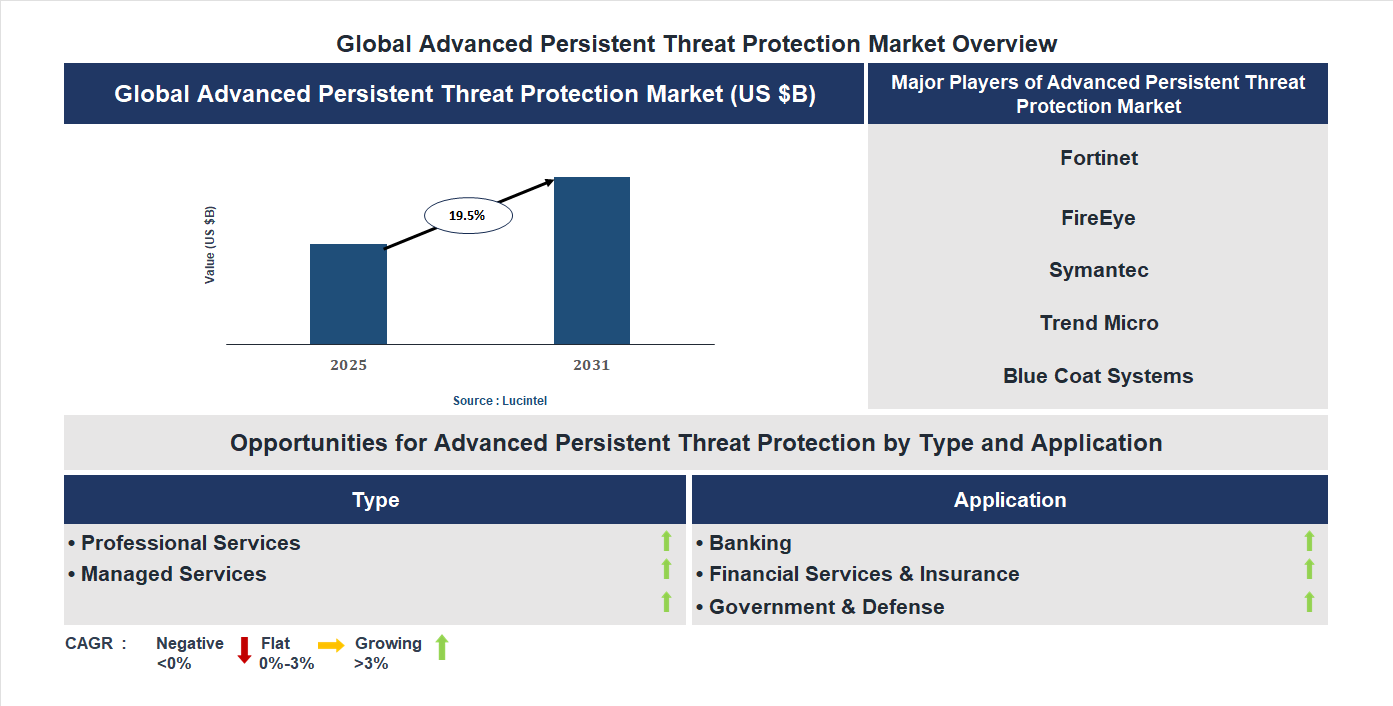
The future of the global advanced persistent threat protection market looks promising with opportunities in the banking, financial service & insurance, and government & defense markets. The global advanced persistent threat protection market is expected to grow with a CAGR of 19.5% from 2025 to 2031. The major drivers for this market are the increasing need for advanced threat visibility, the rising adoption of multi-layered security solutions, and the growing incidents of targeted cyberattacks.• Lucintel forecasts that, within the type category, managed service is expected to witness higher growth over the forecast period.
• Within the application category, government & defense is expected to witness the highest growth.
• In terms of region, APAC is expected to witness the highest growth over the forecast period. Gain valuable insights for your business decisions with our comprehensive 150+ page report. Sample figures with some insights are shown below.
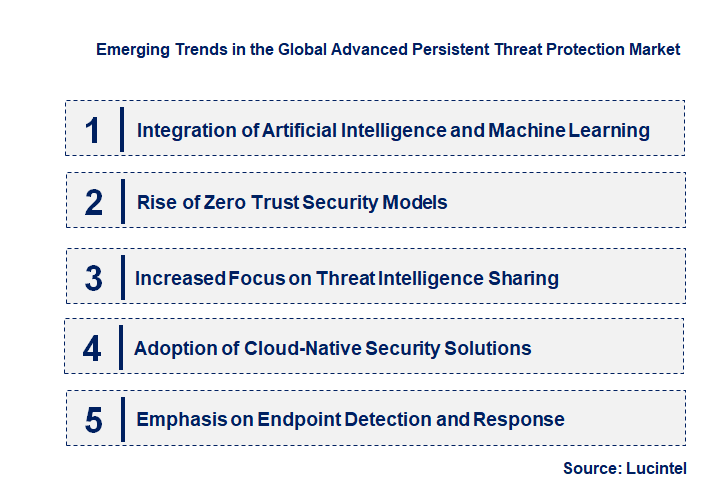
Emerging Trends in the Advanced Persistent Threat Protection Market
The advanced persistent threat protection market is experiencing rapid evolution driven by the increasing sophistication of cyber threats and the growing need for robust security solutions. Organizations across various sectors are prioritizing advanced defense mechanisms to safeguard sensitive data and maintain operational integrity. As cyber attackers develop more complex tactics, the market is adapting with innovative technologies and strategic approaches. These emerging trends reflect a shift towards more proactive, integrated, and intelligent security systems, shaping the future landscape of cybersecurity. Understanding these key developments is essential for stakeholders aiming to stay ahead in this dynamic environment.• Integration of Artificial Intelligence and Machine Learning: The market is increasingly adopting AI and ML to enhance threat detection and response capabilities. These technologies enable real-time analysis of vast data sets, identifying anomalies and potential threats faster than traditional methods. AI-driven systems can adapt to new attack patterns, reducing false positives and improving accuracy. This integration allows organizations to proactively defend against sophisticated APTs, minimizing damage and downtime. As AI and ML become more advanced, their role in predictive analytics and automated response will further strengthen, making security systems more intelligent and autonomous.
• Rise of Zero Trust Security Models: Zero Trust architecture is gaining prominence as organizations move away from perimeter-based security. This model assumes no implicit trust within the network, requiring continuous verification of user identities and device integrity. It minimizes lateral movement of threats and limits access to sensitive data, even for internal users. The adoption of Zero Trust enhances security posture by reducing attack surfaces and improving visibility across the network. As cyber threats become more targeted and persistent, Zero Trust frameworks are becoming essential for effective APT protection, especially in cloud and hybrid environments.
• Increased Focus on Threat Intelligence Sharing: Collaboration among organizations, government agencies, and cybersecurity firms is on the rise to combat APTs effectively. Threat intelligence sharing enables the rapid dissemination of attack indicators, tactics, and vulnerabilities, facilitating quicker response and mitigation. Platforms and alliances are being established to foster real-time information exchange, improving collective defense. This trend enhances situational awareness and helps organizations anticipate and prepare for emerging threats. As cyber adversaries share techniques and tools, collaborative intelligence becomes a critical component of comprehensive APT defense strategies.
• Adoption of Cloud-Native Security Solutions: As businesses migrate to cloud environments, the demand for cloud-native security tools is surging. These solutions are designed to protect cloud workloads, applications, and data without disrupting operations. They offer scalability, flexibility, and seamless integration with cloud platforms, enabling continuous monitoring and automated threat detection. Cloud-native security enhances agility and reduces latency in threat response, which is vital for defending against persistent threats targeting cloud infrastructure. This trend signifies a shift from traditional on-premises security to more dynamic, scalable, and integrated cloud security frameworks.
• Emphasis on Endpoint Detection and Response (EDR): The proliferation of remote work and IoT devices has expanded the attack surface, making endpoint security more critical. EDR solutions provide continuous monitoring, detection, and response capabilities at the device level. They enable organizations to identify malicious activities early, contain threats, and perform forensic analysis. EDR tools are increasingly integrated with other security systems to provide a unified defense mechanism. The focus on endpoint security reflects the need for comprehensive protection against sophisticated APTs that often target endpoints as entry points into networks. In summary, these trends are fundamentally transforming the advanced persistent threat protection market by fostering more intelligent, collaborative, and adaptable security strategies. The integration of AI, Zero Trust models, threat intelligence sharing, cloud-native solutions, and enhanced endpoint security are collectively creating a more resilient and proactive cybersecurity landscape. These developments are enabling organizations to better anticipate, detect, and respond to evolving cyber threats, ensuring stronger protection in an increasingly complex digital environment.
Recent Development in the Advanced Persistent Threat Protection Market
The advanced persistent threat protection market has experienced significant growth driven by increasing cyber threats targeting critical infrastructure, financial institutions, and government agencies. As cybercriminals become more sophisticated, organizations are investing heavily in advanced security solutions to detect, prevent, and respond to persistent threats. Recent developments reflect technological innovations, strategic partnerships, and evolving regulatory requirements, shaping the future landscape of APT protection. These advancements are crucial for safeguarding sensitive data and maintaining operational integrity in an increasingly digital world. The following are five key recent developments in this market that highlight its dynamic evolution.• Integration of Artificial Intelligence and Machine Learning: AI and ML are now central to APT protection solutions, enabling real-time threat detection and automated response. These technologies improve accuracy by analyzing vast data sets to identify subtle malicious activities, reducing false positives. Organizations benefit from faster threat identification and mitigation, enhancing overall security posture. This integration also allows for predictive analytics, helping organizations anticipate future threats and adapt defenses proactively.
• Expansion of Threat Intelligence Sharing Platforms: Collaborative platforms for threat intelligence sharing have gained prominence, allowing organizations to exchange information about emerging threats and attack techniques. This collective approach enhances situational awareness and accelerates response times. Governments and private sector entities are increasingly participating in these platforms, fostering a unified defense against persistent threats. Such sharing reduces the time attackers have to exploit vulnerabilities, strengthening overall security resilience.
• Adoption of Zero Trust Security Models: The shift towards Zero Trust architectures emphasizes strict access controls and continuous verification of user identities and device integrity. This approach minimizes the attack surface and limits lateral movement within networks. Organizations adopting Zero Trust see a significant reduction in successful APT intrusions, as malicious actors find it harder to maintain persistence. The model also aligns with regulatory requirements for data protection, making it a strategic priority for many enterprises.
• Development of Specialized APT Detection Tools: Vendors are launching tailored solutions designed specifically to detect and neutralize advanced persistent threats. These tools incorporate behavioral analytics, endpoint detection, and threat hunting capabilities. Their deployment enhances the ability to identify sophisticated attack vectors that traditional security measures might miss. As threats evolve, these specialized tools provide organizations with a critical advantage in early detection and rapid response.
• Regulatory and Compliance Enhancements: Governments worldwide are implementing stricter cybersecurity regulations and standards, compelling organizations to upgrade their APT defenses. Compliance requirements such as GDPR, NIST frameworks, and sector-specific mandates drive investments in advanced protection solutions. These regulations also promote transparency and accountability, encouraging organizations to adopt best practices. Enhanced regulatory frameworks are fostering a more secure environment, reducing the risk and impact of persistent cyber threats. In summary, these recent developments are transforming the APT protection market by integrating advanced technologies, fostering collaboration, and emphasizing proactive security strategies. The adoption of AI, threat intelligence sharing, Zero Trust models, specialized detection tools, and stricter regulations collectively enhance organizations ability to defend against sophisticated cyber threats. As a result, the market is becoming more robust, adaptive, and resilient, ensuring better protection of critical assets in an increasingly complex cyber landscape.
Strategic Growth Opportunities in the Advanced Persistent Threat Protection Market
The advanced persistent threat protection market is experiencing rapid growth driven by increasing cyber threats targeting critical infrastructure, financial institutions, healthcare, government agencies, and enterprises. As cyber attackers become more sophisticated, organizations are seeking advanced solutions to detect, prevent, and respond to persistent threats. This evolving landscape presents numerous opportunities across key applications, enabling providers to innovate and expand their market share. The following five growth opportunities highlight the most promising areas within this market, reflecting the shifting priorities of organizations aiming to safeguard their digital assets effectively.• Financial Services: Enhanced Security for Transaction Integrity : Financial institutions face constant threats from cybercriminals aiming to compromise transactions and customer data. Advanced persistent threat protection solutions help detect and mitigate sophisticated attacks, ensuring transaction integrity and customer trust. This growth opportunity drives increased adoption of real-time monitoring and AI-driven threat detection, strengthening the financial sector’s resilience against cyber threats.
• Healthcare Sector: Protecting Sensitive Patient Data : Healthcare organizations are prime targets for persistent threats due to the value of patient data. Implementing advanced threat protection enhances data security, prevents ransomware attacks, and ensures compliance with regulations like HIPAA. This opportunity promotes the deployment of integrated security solutions tailored to healthcare environments, reducing data breaches and safeguarding patient privacy.
• Government and Defense: Securing Critical Infrastructure : Governments and defense agencies require robust protection for critical infrastructure such as power grids, communication networks, and transportation systems. Advanced persistent threat protection offers real-time threat detection and response capabilities, minimizing operational disruptions. This growth opportunity emphasizes the importance of specialized security frameworks to defend national security assets against sophisticated cyber espionage and sabotage.
• Enterprise IT: Strengthening Corporate Security Posture : Large enterprises are investing in advanced threat protection to secure their IT environments from persistent threats that can cause data loss and operational downtime. These solutions enable continuous monitoring, threat hunting, and automated response, enhancing overall security posture. This opportunity supports digital transformation initiatives while maintaining robust defenses against evolving cyber risks.
• Cloud and Hybrid Environments: Securing Distributed Infrastructure : As organizations migrate to cloud and hybrid environments, securing these distributed infrastructures becomes critical. Advanced persistent threat protection solutions tailored for cloud platforms help detect lateral movements and insider threats. This growth opportunity facilitates secure cloud adoption, ensuring data integrity and compliance across diverse environments. In summary, these growth opportunities are significantly impacting the advanced persistent threat protection market by expanding its scope across vital sectors. They drive innovation, increase adoption of sophisticated security solutions, and enhance organizations ability to defend against persistent cyber threats. As a result, the market is poised for continued growth, with a focus on tailored, sector-specific security strategies that address evolving cyber risks.
Advanced Persistent Threat Protection Market Driver and Challenges
The advanced persistent threat protection market is influenced by a variety of technological, economic, and regulatory factors. Rapid technological advancements in cybersecurity tools, increasing cyber threats, and evolving regulatory standards are shaping the market landscape. Organizations are investing heavily in sophisticated security solutions to safeguard sensitive data against persistent and targeted attacks. Economic factors such as rising cybercrime costs and the need for compliance drive demand, while regulatory frameworks compel organizations to adopt advanced security measures. However, challenges such as high implementation costs, evolving threat complexity, and regulatory compliance hurdles also impact market growth. Understanding these drivers and challenges is essential for stakeholders to navigate this dynamic environment effectively. The factors responsible for driving the advanced persistent threat protection market include:-• Increasing Cyber Threats: The surge in sophisticated cyber-attacks, including APTs, has heightened the need for advanced protection solutions. Organizations across sectors face persistent threats targeting critical infrastructure, financial data, and intellectual property. This escalation compels enterprises to invest in robust security measures, fueling market growth. The complexity and persistence of these threats demand continuous innovation in security technologies, making APT protection solutions indispensable. As cybercriminals develop more advanced tactics, the market for specialized threat detection and mitigation tools expands rapidly, creating significant opportunities for vendors and service providers.
• Technological Advancements: Rapid innovations in cybersecurity technologies, such as AI, machine learning, and behavioral analytics, are transforming APT protection. These advancements enable real-time threat detection, automated response, and predictive analytics, significantly enhancing security efficacy. As organizations seek smarter, more adaptive solutions, vendors are continuously developing sophisticated tools that leverage these technologies. The integration of cloud-based security platforms and threat intelligence sharing further accelerates market growth. These technological innovations not only improve detection accuracy but also reduce response times, making advanced threat protection more accessible and effective across various industries.
• Increasing Regulatory and Compliance Requirements: Governments and regulatory bodies worldwide are implementing stringent cybersecurity standards to protect critical infrastructure and sensitive data. Regulations such as GDPR, HIPAA, and NIST guidelines compel organizations to adopt advanced threat protection measures. Compliance requirements drive investments in APT defense solutions to avoid penalties and reputational damage. This regulatory landscape encourages organizations to prioritize cybersecurity budgets and adopt comprehensive protection strategies. As compliance becomes more complex, the demand for specialized APT protection tools that facilitate regulatory adherence continues to grow, further propelling the market.
• Growing Adoption of Cloud and IoT Technologies: The proliferation of cloud computing and Internet of Things (IoT) devices has expanded the attack surface for cyber threats. Organizations are increasingly deploying cloud-based solutions and IoT devices, which are often vulnerable to targeted attacks. This trend necessitates advanced threat protection solutions tailored for cloud environments and IoT ecosystems. The need to secure distributed and interconnected systems drives market expansion, as traditional security measures are insufficient against sophisticated APTs targeting these platforms. Vendors are developing specialized tools to address these challenges, fostering growth in the APT protection market. The challenges facing this advanced persistent threat protection market include:-
• High Implementation and Maintenance Costs: Deploying advanced APT protection solutions often involves significant financial investment, including hardware, software, and skilled personnel. Small and medium-sized enterprises may find these costs prohibitive, limiting market penetration. Additionally, ongoing maintenance, updates, and staff training add to the total cost of ownership. These financial barriers can slow down adoption rates, especially in regions with limited budgets for cybersecurity. As a result, vendors need to balance advanced features with affordability to expand their customer base and ensure widespread adoption.
• Evolving and Complex Threat Landscape: Cyber adversaries continuously develop new tactics, techniques, and procedures to bypass existing security measures. The dynamic nature of APTs makes it challenging for organizations to keep their defenses up-to-date. Threat actors often employ stealthy, multi-vector attacks that are difficult to detect and mitigate. This evolving threat landscape requires constant innovation and adaptation of security solutions, which can be resource-intensive. Organizations face the ongoing challenge of staying ahead of sophisticated attackers, which can hinder the effectiveness of current protection measures and slow market growth.
• Regulatory Compliance Challenges: While regulations drive demand for advanced security solutions, they also pose compliance challenges. Organizations must interpret and implement complex standards, which can be resource-intensive and require specialized expertise. Non-compliance can result in hefty fines and reputational damage, incentivizing organizations to invest in compliance-driven security measures. However, the rapidly changing regulatory environment can create uncertainty and increase operational costs. Vendors must continuously update their solutions to meet evolving standards, adding complexity and cost to the deployment process, which can act as a barrier for some organizations. In summary, the advanced persistent threat protection market is shaped by technological innovations, increasing cyber threats, and regulatory pressures, which collectively drive growth. However, high costs, the complexity of evolving threats, and compliance challenges pose significant hurdles. These factors create a dynamic environment where continuous innovation and strategic investments are essential for market participants. Overall, the markets growth prospects remain strong, driven by the increasing need for sophisticated cybersecurity solutions to combat persistent and evolving cyber threats.
List of Advanced Persistent Threat Protection Companies
Companies in the market compete on the basis of product quality offered. Major players in this market focus on expanding their manufacturing facilities, R&D investments, infrastructural development, and leverage integration opportunities across the value chain. With these strategies advanced persistent threat protection companies cater increasing demand, ensure competitive effectiveness, develop innovative products & technologies, reduce production costs, and expand their customer base. Some of the advanced persistent threat protection companies profiled in this report include-• Fortinet
• FireEye
• Symantec
• Trend Micro
• Blue Coat Systems
• Intel Security
• Webroot, Inc.
• Palo Alto Networks
• Websense, Inc.
• Dell Secureworks
Advanced Persistent Threat Protection Market by Segment
The study includes a forecast for the global advanced persistent threat protection market by type, application, and region.Advanced Persistent Threat Protection Market by Type [Value from 2019 to 2031]:
• Professional Services
• Managed Services
Advanced Persistent Threat Protection Market by Application [Value from 2019 to 2031]:
• Banking
• Financial Services & Insurance
• Government & Defense
Advanced Persistent Threat Protection Market by Region [Value from 2019 to 2031]:
• North America
• Europe
• Asia Pacific
• The Rest of the World
Country Wise Outlook for the Advanced Persistent Threat Protection Market
The advanced persistent threat protection market has seen significant growth driven by increasing cyber threats and the need for robust security solutions worldwide. As cyberattacks become more sophisticated, countries are investing heavily in advanced security technologies to safeguard critical infrastructure, government, and corporate data. Innovations in AI, machine learning, and threat intelligence are shaping the landscape, with governments and private sectors prioritizing proactive defense strategies. The markets evolution reflects a global push towards enhanced cybersecurity resilience, with regional differences influenced by technological adoption, regulatory frameworks, and threat landscapes.• United States: The U.S. market has experienced rapid growth, driven by high-profile cyberattacks and increased government funding for cybersecurity initiatives. Major tech firms are integrating AI-driven threat detection tools, and there is a rising adoption of cloud-based APT protection solutions. Regulatory bodies like CISA are emphasizing proactive threat mitigation, leading to increased demand for advanced security platforms across industries.
• China: China is rapidly expanding its cybersecurity infrastructure, focusing on domestic solutions due to geopolitical tensions and data sovereignty concerns. The government is investing heavily in indigenous APT protection technologies, with a focus on integrating AI and big data analytics. The market is also witnessing increased collaboration between state agencies and private firms to develop comprehensive threat defense systems.
• Germany: Germanys market is characterized by a strong emphasis on compliance with EU regulations such as GDPR, which has spurred demand for advanced threat protection solutions. The adoption of AI and automation in cybersecurity is growing, especially among financial institutions and critical infrastructure providers. Public-private partnerships are also playing a vital role in enhancing national cybersecurity resilience.
• India: India is witnessing a surge in cyber threats, prompting government initiatives like the National Cyber Security Policy. The market is expanding with increased adoption of AI-powered APT protection tools by government agencies and private enterprises. The focus is on building indigenous solutions to address unique regional threats, alongside collaborations with global cybersecurity firms to enhance capabilities.
• Japan: Japans cybersecurity market is evolving with a focus on protecting critical infrastructure and financial sectors. The government is investing in advanced threat detection systems, including AI and machine learning-based solutions. There is a growing trend of integrating APT protection with broader cybersecurity frameworks, supported by public-private partnerships and regulatory initiatives aimed at strengthening national security.

Features of the Global Advanced Persistent Threat Protection Market
Market Size Estimates: Advanced persistent threat protection market size estimation in terms of value ($B). Trend and Forecast Analysis: Market trends (2019 to 2024) and forecast (2025 to 2031) by various segments and regions. Segmentation Analysis: Advanced persistent threat protection market size by type, application, and region in terms of value ($B). Regional Analysis: Advanced persistent threat protection market breakdown by North America, Europe, Asia Pacific, and Rest of the World. Growth Opportunities: Analysis of growth opportunities in different types, applications, and regions for the advanced persistent threat protection market. Strategic Analysis: This includes M&A, new product development, and competitive landscape of the advanced persistent threat protection market. Analysis of competitive intensity of the industry based on Porter’s Five Forces model.
FAQ
Q1. What is the growth forecast for advanced persistent threat protection market? Answer: The global advanced persistent threat protection market is expected to grow with a CAGR of 19.5% from 2025 to 2031. Q2. What are the major drivers influencing the growth of the advanced persistent threat protection market? Answer: The major drivers for this market are the increasing need for advanced threat visibility, the rising adoption of multi-layered security solutions, and the growing incidents of targeted cyberattacks. Q3. What are the major segments for advanced persistent threat protection market? Answer: The future of the advanced persistent threat protection market looks promising with opportunities in the banking, financial service & insurance, and government & defense markets. Q4. Who are the key advanced persistent threat protection market companies? Answer: Some of the key advanced persistent threat protection companies are as follows:• Fortinet
• FireEye
• Symantec
• Trend Micro
• Blue Coat Systems
• Intel Security
• Webroot, Inc.
• Palo Alto Networks
• Websense, Inc.
• Dell Secureworks Q5. Which advanced persistent threat protection market segment will be the largest in future? Answer: Lucintel forecasts that, within the type category, managed service is expected to witness higher growth over the forecast period. Q6. In advanced persistent threat protection market, which region is expected to be the largest in next 5 years? Answer: In terms of region, APAC is expected to witness the highest growth over the forecast period. Q7. Do we receive customization in this report? Answer: Yes, Lucintel provides 10% customization without any additional cost.
Table of Contents
List of Figures
List of Tables
Methodology
- In-depth interviews of the major players in this market
- Detailed secondary research from competitors’ financial statements and published data
- Extensive searches of published works, market, and database information pertaining to industry news, company press releases, and customer intentions
- A compilation of the experiences, judgments, and insights of Lucintel’s professionals, who have analyzed and tracked this market over the years.


Buy Now
Choose a license that fits your team. Instant PDF delivery.
Prices exclude taxes. Instant delivery. Custom licensing available on request.
Key Questions
- • What are some of the most promising, high-growth opportunities for the advanced persistent threat protection market by type (professional services and managed services), application (banking, financial services & insurance, and government & defense), and region (North America, Europe, Asia Pacific, and the Rest of the World)?
- • Which segments will grow at a faster pace and why?
- • Which region will grow at a faster pace and why?
- • What are the key factors affecting market dynamics? What are the key challenges and business risks in this market?
- • What are the business risks and competitive threats in this market?
- • What are the emerging trends in this market and the reasons behind them?
- • What are some of the changing demands of customers in the market?
- • What are the new developments in the market? Which companies are leading these developments?
- • Who are the major players in this market? What strategic initiatives are key players pursuing for business growth?
- • What are some of the competing products in this market and how big of a threat do they pose for loss of market share by material or product substitution?
- • What M&A activity has occurred in the last 5 years and what has its impact been on the industry? For any questions related to Advanced Persistent Threat Protection Market, Advanced Persistent Threat Protection Market Size, Advanced Persistent Threat Protection Market Growth, Advanced Persistent Threat Protection Market Analysis, Advanced Persistent Threat Protection Market Report, Advanced Persistent Threat Protection Market Share, Advanced Persistent Threat Protection Market Trends, Advanced Persistent Threat Protection Market Forecast, Advanced Persistent Threat Protection Companies, write Lucintel analyst at email: helpdesk@lucintel.com. We will be glad to get back to you soon.


