
Report Feature
ADME Toxicology Testing Market Trends and Forecast
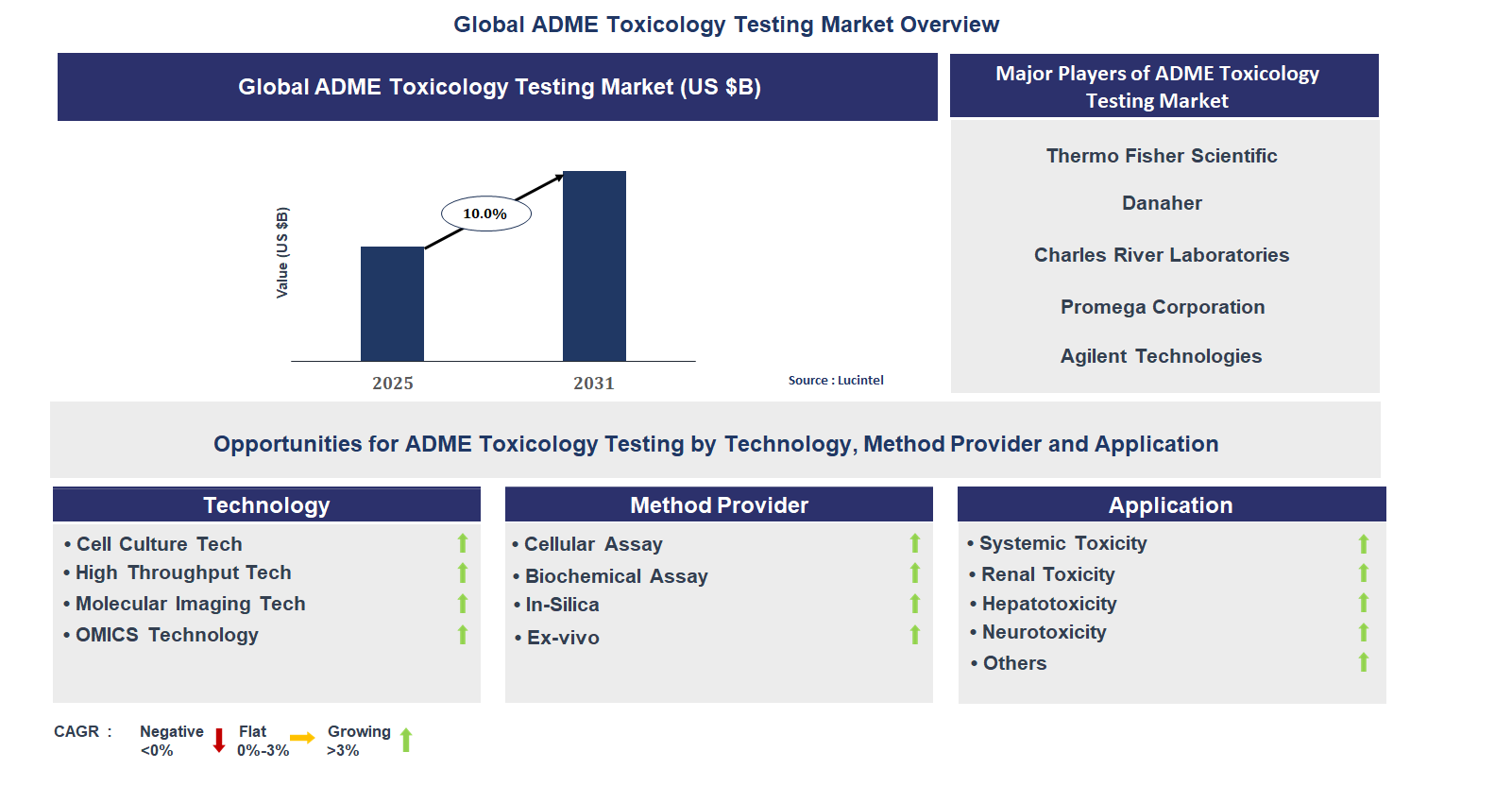
The future of the global ADME toxicology testing market looks promising with opportunities in the systemic toxicity, renal toxicity, hepatotoxicity, and neurotoxicity markets. The global ADME toxicology testing market is expected to grow with a CAGR of 10% from 2025 to 2031. The major drivers for this market are the increasing focus on drug safety assessment, the rising investment in pharmaceutical R&D activities, and the growing demand for predictive toxicology testing.• Lucintel forecasts that, within the technology category, cell culture tech is expected to witness the highest growth over the forecast period.
• Within the application category, systemic toxicity is expected to witness the highest growth.
• In terms of region, APAC is expected to witness the highest growth over the forecast period. Gain valuable insights for your business decisions with our comprehensive 150+ page report. Sample figures with some insights are shown below.
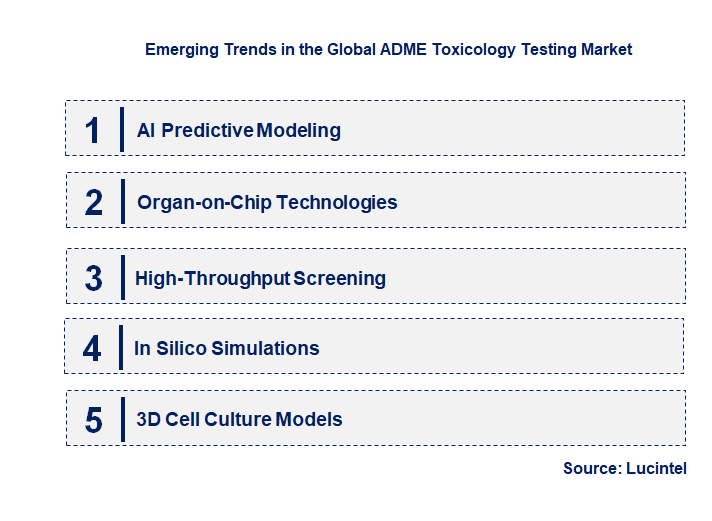
Emerging Trends in the ADME Toxicology Testing Market
Emerging trends in the ADME toxicology testing market highlight technological integration and ethical shifts toward non-animal models. AI and in silico tools dominate, alongside 3D cultures for precise predictions. These evolutions address regulatory pressures, reduce costs, and accelerate drug pipelines, fostering sustainable and efficient safety assessments globally.• AI Predictive Modeling: AI algorithms analyze vast datasets for accurate ADME forecasts, minimizing experimental needs. This streamlines early drug screening, cutting development timelines.
• Organ-on-Chip Technologies: Microfluidic chips mimic human organ functions for realistic ADME simulations. They replace traditional models with dynamic, multi-organ systems.
• High-Throughput Screening: Automated platforms enable rapid evaluation of compound libraries for absorption and metabolism profiles. Integrates robotics for scalable assays.
• In Silico Simulations: Computational models predict drug interactions without physical testing, leveraging big data and machine learning. Covers distribution and excretion pathways comprehensively.
• 3D Cell Culture Models: Advanced spheroids and organoids replicate tissue microenvironments for superior toxicity insights. Enhances metabolic enzyme representation. These trends reshape the ADME toxicology testing market by prioritizing predictive accuracy and ethical innovation. They diminish reliance on animal models, expedite pipelines, and align with precision medicine demands. Overall, they cultivate a resilient ecosystem, slashing costs and enhancing global drug safety standards.
Recent Development in the ADME Toxicology Testing Market
Recent developments in the ADME toxicology testing market emphasize AI launches, acquisitions, and regulatory adaptations. These innovations tackle late-stage failures and ethical testing concerns. They fortify drug safety evaluations, expanding applications in biologics and personalized therapies across diverse sectors.• AI-Driven Platforms Launch: Companies introduce machine learning tools for predictive toxicity modeling, integrating real-time data analytics. Speeds up ADME profiling in preclinical stages.
• Lab Acquisitions Expansion: Strategic buys of specialized ADME facilities in Asia-Pacific bolster global CRO networks. Focuses on high-throughput in vitro services.
• Organ-on-Chip Advancements: New rigid chip models improve drug absorption simulations, minimizing discrepancies in metabolic studies. Enables multi-organ assessments.
• High-Content Screening Upgrades: Enhanced imaging platforms with AI analysis refine cellular cytotoxicity evaluations. Increases throughput for compound libraries.
• Regulatory Proposal Amendments: EU updates to REACH laws mandate advanced ADME data for chemical safety, promoting in silico alternatives. Aligns with global standards. These developments impact the ADME toxicology testing market by integrating cutting-edge tools and compliance measures. They mitigate risks, enhance predictive power, and promote ethical practices. Collectively, they propel efficiency, broaden accessibility, and solidify the market‘s role in safer drug innovation.
Strategic Growth Opportunities in the ADME Toxicology Testing Market
Strategic growth opportunities in the ADME toxicology testing market leverage diverse applications, from oncology to neurotoxicity. Rising chronic diseases and precision medicine demands fuel tailored testing solutions. These areas offer revenue potential through innovative assays and regulatory alignments.• Systemic Toxicity Assessment: Comprehensive organ-wide evaluations using 3D models predict broad drug impacts. Vital for multi-target therapies.
• Renal Toxicity Screening: Specialized assays detect kidney-specific risks in chronic disease drugs, employing advanced biomarkers. Accelerates nephrotoxic compound identification.
• Hepatotoxicity Evaluation: Liver-focused in vitro platforms simulate metabolic pathways for early liver damage detection. Integrates OMICS for precision.
• Neurotoxicity Profiling: Brain barrier models assess CNS drug penetration and neuronal effects, crucial for neurodegenerative treatments. Uses AI for predictive insights.
• Oncology Drug Safety: High-throughput assays evaluate tumor-specific ADME for personalized cancer therapies. Focuses on immuno-oncology compounds. These opportunities impact the ADME toxicology testing market by targeting high-burden applications with specialized innovations. They drive diversification and partnerships. Ultimately, they reinforce the market‘s pivotal role in advancing safe, effective therapeutics globally.
ADME Toxicology Testing Market Driver and Challenges
Major drivers and challenges in the ADME toxicology testing market arise from technological progress, economic investments, and evolving regulations. Drivers capitalize on predictive tools for efficiency gains. Challenges necessitate adaptive strategies to sustain innovation amid complexities. The factors responsible for driving the adme toxicology testing market include: 1. Rising Drug Discovery Needs: Surge in novel therapeutics demands robust ADME profiles to mitigate failures. Fuels R&D investments in predictive assays. 2. Regulatory Safety Mandates: Stringent FDA and EMA guidelines require comprehensive toxicity data early in development. Promotes advanced in vitro compliance. 3. Technological Innovations: AI and organ-on-chip advancements enable precise, high-throughput simulations. Lowers costs over traditional methods. 4. Outsourcing to CROs: Pharma firms leverage specialized providers for scalable ADME services. Expands access to expertise. 5. Chronic Disease Prevalence: Growing oncology and metabolic disorders necessitate safer drug profiles. Heightens testing volumes. Challenges in the adme toxicology testing market are: 1. High Testing Costs: Upfront expenses for advanced platforms deter smaller firms. Limits broad adoption. 2. Regulatory Complexity: Evolving global standards vary, complicating harmonization. Delays approvals. 3. Ethical Model Limitations: Transition from in vivo to alternatives faces reproducibility issues. Challenges validation. Drivers propel the ADME toxicology testing market through innovation and demand, outweighing challenges via strategic adaptations. They yield safer drugs and economic efficiencies. Overall, balanced progress ensures sustained expansion and enhanced global health outcomes.List of ADME Toxicology Testing Companies
Companies in the market compete on the basis of product quality offered. Major players in this market focus on expanding their manufacturing facilities, R&D investments, infrastructural development, and leverage integration opportunities across the value chain. With these strategies ADME toxicology testing companies cater increasing demand, ensure competitive effectiveness, develop innovative products & technologies, reduce production costs, and expand their customer base. Some of the ADME toxicology testing companies profiled in this report include-• Thermo Fisher Scientific
• Danaher
• Charles River Laboratories
• Promega Corporation
• Agilent Technologies
• Curia Global
• Dassault Systèmes
• Catalent
• Labcorp
• Eurofins Scientific
ADME Toxicology Testing Market by Segment
The study includes a forecast for the global ADME toxicology testing market by technology, method provider, application, and region.ADME Toxicology Testing Market by Technology [Value from 2019 to 2031]:
• Cell Culture Tech
• High Throughput Tech
• Molecular Imaging Tech
• OMICS Technology
ADME Toxicology Testing Market by Method Provider [Value from 2019 to 2031]:
• Cellular Assay
• Biochemical Assay
• In-Silica
• Ex-vivo
ADME Toxicology Testing Market by Application [Value from 2019 to 2031]:
• Systemic Toxicity
• Renal Toxicity
• Hepatotoxicity
• Neurotoxicity
• Others
ADME Toxicology Testing Market by Region [Value from 2019 to 2031]:
• North America
• Europe
• Asia Pacific
• The Rest of the World
Country Wise Outlook for the ADME Toxicology Testing Market
The ADME toxicology testing market expands amid rising drug discovery demands, stringent safety regulations, and advancements in predictive technologies. Focus on absorption, distribution, metabolism, and excretion profiles ensures safer pharmaceuticals. Key countries advance innovations like AI integration and in vitro models, enhancing efficiency and reducing late-stage failures across global R&D pipelines.• United States: The U.S. dominates with robust pharmaceutical R&D investments driving AI-enhanced ADME platforms and expanded toxicology labs. High-throughput cellular assays accelerate preclinical safety assessments, minimizing drug failures. Outsourcing to CROs surges for cost-effective testing, bolstering oncology and biologics pipelines while aligning with FDA guidelines for precision medicine advancements.
• China: China‘s market surges through rapid CRO expansion and adoption of in silico models for cost-efficient ADME evaluations. Pharmaceutical giants invest in high-throughput screening for novel small molecules, supporting biologics development. Government-backed R&D initiatives foster international collaborations, enhancing export capabilities and accelerating domestic drug approvals in oncology and chronic disease sectors.
• Germany: Germany leads European innovation with advanced OMICS technologies and regulatory-aligned in vitro assays for systemic toxicity. Collaborations between pharma firms and research institutes refine predictive modeling, reducing animal testing. Precision medicine focus drives hepatotoxicity and neurotoxicity applications, supporting EU REACH amendments and fostering sustainable drug development practices.
• India: India‘s growth stems from outsourcing hubs and affordable in vitro ADME services for global pharma. Surge in lab establishments boosts renal and hepatotoxicity testing for generics and biosimilars. Government incentives for R&D partnerships enhance high-throughput capabilities, positioning India as a key player in cost-effective early-stage screening for emerging therapeutics.
• Japan: Japan advances AI-integrated predictive ADME for precision oncology drugs, addressing regulatory compliance needs. Focus on organ-on-chip models improves metabolic profiling accuracy. Collaborative R&D with international firms accelerates biologics testing, enhancing efficiency in chronic disease pipelines and supporting Japan‘s innovation-driven healthcare ecosystem.

Features of the Global ADME Toxicology Testing Market
Market Size Estimates: Adme toxicology testing market size estimation in terms of value ($B). Trend and Forecast Analysis: Market trends (2019 to 2024) and forecast (2025 to 2031) by various segments and regions. Segmentation Analysis: Adme toxicology testing market size by technology, method provider, application, and region in terms of value ($B). Regional Analysis: Adme toxicology testing market breakdown by North America, Europe, Asia Pacific, and Rest of the World. Growth Opportunities: Analysis of growth opportunities in different technologies, method providers, applications, and regions for the ADME toxicology testing market. Strategic Analysis: This includes M&A, new product development, and competitive landscape of the ADME toxicology testing market. Analysis of competitive intensity of the industry based on Porter’s Five Forces model.
FAQ
Q1. What is the growth forecast for ADME toxicology testing market? Answer: The global ADME toxicology testing market is expected to grow with a CAGR of 10% from 2025 to 2031. Q2. What are the major drivers influencing the growth of the ADME toxicology testing market? Answer: The major drivers for this market are the increasing focus on drug safety assessment, the rising investment in pharmaceutical R&D activities, and the growing demand for predictive toxicology testing. Q3. What are the major segments for ADME toxicology testing market? Answer: The future of the ADME toxicology testing market looks promising with opportunities in the systemic toxicity, renal toxicity, hepatotoxicity, and neurotoxicity markets. Q4. Who are the key ADME toxicology testing market companies? Answer: Some of the key ADME toxicology testing companies are as follows:• Thermo Fisher Scientific
• Danaher
• Charles River Laboratories
• Promega Corporation
• Agilent Technologies
• Curia Global
• Dassault Systèmes
• Catalent
• Labcorp
• Eurofins Scientific Q5. Which ADME toxicology testing market segment will be the largest in future? Answer: Lucintel forecasts that, within the technology category, cell culture tech is expected to witness the highest growth over the forecast period. Q6. In ADME toxicology testing market, which region is expected to be the largest in next 5 years? Answer: In terms of region, APAC is expected to witness the highest growth over the forecast period. Q7. Do we receive customization in this report? Answer: Yes, Lucintel provides 10% customization without any additional cost.
Table of Contents
List of Figures
List of Tables
Methodology
- In-depth interviews of the major players in this market
- Detailed secondary research from competitors’ financial statements and published data
- Extensive searches of published works, market, and database information pertaining to industry news, company press releases, and customer intentions
- A compilation of the experiences, judgments, and insights of Lucintel’s professionals, who have analyzed and tracked this market over the years.


Buy Now
Choose a license that fits your team. Instant PDF delivery.
Prices exclude taxes. Instant delivery. Custom licensing available on request.
Key Questions
- • What are some of the most promising, high-growth opportunities for the ADME toxicology testing market by technology (cell culture tech, high throughput tech, molecular imaging tech, and OMICS technology), method provider (cellular assay, biochemical assay, in-silica, and ex-vivo), application (systemic toxicity, renal toxicity, hepatotoxicity, neurotoxicity, and others), and region (North America, Europe, Asia Pacific, and the Rest of the World)?
- • Which segments will grow at a faster pace and why?
- • Which region will grow at a faster pace and why?
- • What are the key factors affecting market dynamics? What are the key challenges and business risks in this market?
- • What are the business risks and competitive threats in this market?
- • What are the emerging trends in this market and the reasons behind them?
- • What are some of the changing demands of customers in the market?
- • What are the new developments in the market? Which companies are leading these developments?
- • Who are the major players in this market? What strategic initiatives are key players pursuing for business growth?
- • What are some of the competing products in this market and how big of a threat do they pose for loss of market share by material or product substitution?
- • What M&A activity has occurred in the last 5 years and what has its impact been on the industry? For any questions related to ADME Toxicology Testing Market, ADME Toxicology Testing Market Size, ADME Toxicology Testing Market Growth, ADME Toxicology Testing Market Analysis, ADME Toxicology Testing Market Report, ADME Toxicology Testing Market Share, ADME Toxicology Testing Market Trends, ADME Toxicology Testing Market Forecast, ADME Toxicology Testing Companies, write Lucintel analyst at email: helpdesk@lucintel.com. We will be glad to get back to you soon.


