
Market Report · July 22, 2026

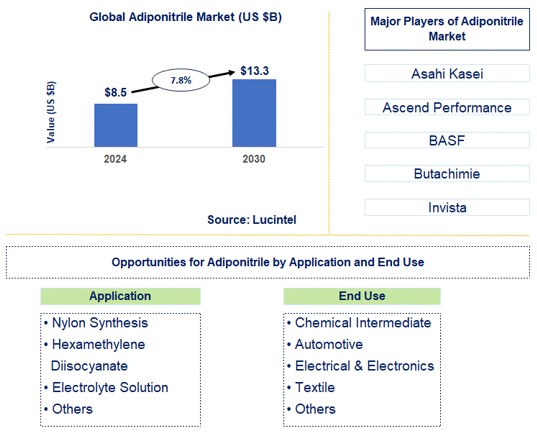
Key data points: The market size in 2030 = $13.3 billion, growth forecast = 7.8% annually for the next 6 years. Scroll below to get more insights. This market report covers trends, opportunities, and forecasts in the global adiponitrile market to 2030 by application (nylon synthesis, hexamethylene diisocyanate, electrolyte solution, and others), end use (chemical intermediate, automotive, electrical & electronics, textile, and others), and region (North America, Europe, Asia Pacific, and the Rest of the World)
We'll send your sample report shortly.
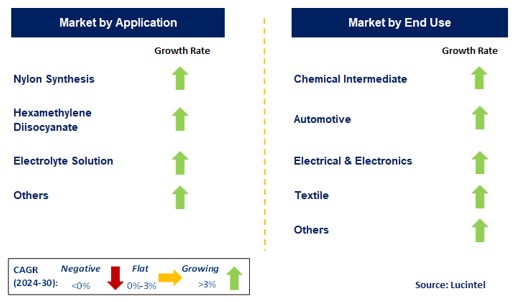
• Lucintel forecasts that, within the application category, nylon synthesis will remain the largest segment over the forecast period due to its remarkable tensile strength and abrasion resistance, which make it appropriate for a variety of applications.
• Within the end-use category, automotive will remain the largest segment due to the widespread use of adiponitrile in this sector for enhancing vehicle comfort and safety as well as producing lightweight, fuel-efficient components.
• In terms of regions, APAC will remain the largest region over the forecast period due to continuous population growth, rapid industrialization, and continual rise of manufacturing base in the region. Gain valuable insights for your business decisions with our comprehensive 150+ page report.
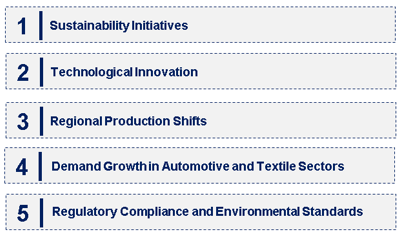
• Sustainability Initiatives: A main trend in the adiponitrile market is sustainability, where there is increased adoption of green chemistry practices by firms with the integration of renewable energy sources for production. It is driven by regulatory pressures and increasing consumer demand for environmentally friendly products. Companies are investing significantly in R&D to reduce the environmental impact of Adiponitrile production, including reducing carbon emissions, waste minimization, and improving the recyclability of nylon 6,6.
• Technological Innovation: In the adiponitrile market, technological innovation has emerged as a key driver with recent advancements towards catalytic processes and efficient production methods. They have brought about improved yields, leading to energy savings and lower costs of production. Moreover, firms are also expanding into other applications, such as electronics or automotive products, using adiponitrile. This trend assists in promoting market growth and preserving competitiveness among the leading producers within an industry that changes at a fast pace.
• Regional Production Shifts: Production centers for adiponitrile have been shifting from one region to another, with countries such as China and India just being among them who are increasing their capacities. These regions are putting up new facilities and entering strategic alliances to reduce import dependence and satisfy local demand. As a result, emerging economies now play a much more important role in the global supply chains, which challenge the world’s traditional producers like Europe or America.
• Demand Growth in Automotive and Textile Sectors: The major factor driving the adiponitrile market is its growing consumption in the making sector and textiles industries. Nylon 6,6, which exhibits high durability along with strength, is becoming extremely popular, especially because adiponitrile plays a crucial precursor role here. These sectors’ expansion, particularly within developing economies, is behind this push for more adiponitrile, hence setting up new plants while enhancing capacity.
• Regulatory Compliance and Environmental Standards: The Adiponitrile market is significantly influenced by these two factors as the regulatory compliance and environmental standards are tightening. By adopting cleaner technology and improved waste management practices, business organizations have adjusted to this stricter regulation. The international environmental standards requirement has made companies innovative as well as invest in sustainable technologies if they are to remain competitive amid a tightening market scope on ecological conservation. These trends emerging within the adiponitrile market shape it, inspire innovation, and result in global shifts in supply chains. As businesses adjust to these alterations, growth momentum will still prevail with emphasis on sustainability, technological progress as well as regional diversification.
• Expansion of Production Capacities: In response to increasing global demands for nylon 6,6, several companies are expanding their Adiponitrile productions, which include the establishment of new facilities while upgrading others. Notably, this is the case where demand is propelled by the textile industry or automotive sector, particularly in countries like China or the US. This development aims at streamlining the supply chain with an assurance of a sufficient supply of Adiponitrile, thus reducing bottlenecks therein.
• Going Green: Green chemistry is gaining more acceptance in the market of Adiponitrile. Firms are embracing procedures that minimize carbon dioxide emissions, waste as well as energy consumption. Legal restrictions and consumer demand for a greener option are driving this change. The adoption of such practices is not just limiting its environmental impacts of production on adiponitrile; it equally improves cost-effectiveness and efficiency in the manufacturing process.
• Technological Innovations in Catalysis: Innovation technology, particularly catalysis, has had the most impact on the Adiponitrile market. Newer catalytic processes have improved production efficiency yield and reduced the environmental impact of Adiponitrile production. This transformation is being propelled by RD efforts among major chemical producers who aim to maintain a competitive edge in an increasingly technologically driven marketplace.
• Strategic Partnerships and Collaborations: Strategic partnerships and collaborations are being witnessed in the adiponitrile market at higher rates. The formation of alliances between firms helps them share resources, technology as well as markets. Various pacts are crucial, for instance, among Chinese and Indian local players partnering with global leaders to enhance their production capacity and meet domestic needs. With this trend poised to continue, organizations will keep exploiting their interconnecting competencies against the backdrop of globalization.
• Focus on Recycling and Circular Economy: Incidences that build around recycling- nylon 6,6, otherwise known as the cyclic economy, have been picking pace within the Adiponitrile industry setting. Companies have started looking at ways through which nylon 6,6 can be recycled alongside other related products to minimize wastage while promoting sustainability. One way has been creating closed-loop systems where materials can be continuously reused within themselves. These measures align well with the overall global sustainability objectives towards what they expect from the future Adiponitrile Market. These developments are driving significant changes in the adiponitrile market, impacting production processes, sustainability, and global supply chains. With more innovation and adjustments by industries to these developments, there is a potential for growth and transformation of this industry.
• Automotive Applications: Nylon 6,6 is a major component used in manufacturing various parts of an engine, such as fuel lines or airbags, among other things related to motor vehicles. As weight becomes more critical in vehicle manufacture coupled with durability requirement increases, further growth shall be witnessed under Adinotrle’s sector. If any company can develop superior nylon 6,6 products specifically designed for automotive purposes, it has the opportunity to fully exploit this trend, especially when one considers the fact that the auto industry is moving towards electric cars and sustainable manufacturing practices.
• Expansion of Textile Industry: The textile industry is another major application sector for the Adiponitrile market, where nylon 6,6 is used in the making of fibers and fabrics. This opens up a huge market for highly durable textile fiber with high performance requirements both for fashion and industrial use. Companies that invest in developing innovative and sustainable nylon 6,6 products for the textile industry can tap into this expanding market, particularly as consumers and manufacturers increasingly prioritize sustainability and performance.
• Electronics & Electrical Components: Nylon 6, 6 finds usage in connectors, switches, and insulation materials production within electronics and electrical sectors because of its excellent thermal and mechanical properties. The reason behind the increased demand for Adiponitrile lies within advanced electronic devices' demand growth together with components miniaturization. As a result of this growing demand, companies that specialize in high-performance nylon 6,6 products for electronics as well as electrical applications will benefit from it.
• Additive Manufacturing &3D Printing: The rise of additive manufacturing (AM), simply known as three-dimensional printing, presents a new growth opportunity for the Adiponitrile market. Nylon 6,6 is increasingly being used as a material in 3D printing due to its strength, durability, and flexibility. High-quality nylon 66 will be demanded more as various industries continue to adopt AM technology to meet their diverse production needs. By investing in specialized grades of nylon 66 specifically designed for AM, companies can take advantage of this emerging market.
• Sustainability and Recycling Initiatives: The growing focus on sustainability and recycling presents a significant growth opportunity for the Adiponitrile market. There are increasing requests from Buyers working with sustainable procurement policies regarding closed-loop production systems accompanied by innovative recycling processes developed around PA666 such developments will ensure sustainable products generated by firms that would like to enter this field. EN Additionally, these initiatives are in line with global sustainability targets that aim at reducing waste and making nylon 66 more recyclable, thus ensuring the future growth of the adiponitrile market. These strategic growth opportunities highlight the diverse applications of adiponitrile and the potential for companies to expand their market presence by focusing on high-demand industries. Through harnessing these opportunities, companies can ensure innovation, sustainable improvement, and competitive edge within the Adiponitrile market.
• Asahi Kasei
• Ascend Performance Materials
• BASF
• Butachimie
• INVISTA
• Kishida Chemical
• Spectrum Chemical
• Nylon Synthesis
• Hexamethylene Diisocyanate
• Electrolyte Solution
• Others
• Chemical Intermediate
• Automotive
• Electrical & Electronics
• Textile
• Others
• North America
• Europe
• Asia Pacific
• The Rest of the World
• United States: the United States remains a significant player in the adiponitrile market with ongoing investments geared towards expanding its production capability. Therefore, recent developments have included sustainable initiatives using advanced manufacturing techniques to reduce carbon emissions. Besides, there are also partnerships between government agencies and industry giants that aim at bringing about innovations, thus making America competitive in global markets. It should be noted that this is done to meet growing domestic demand for nylon 6,6 as well.
• China: China's adiponitrile market is growing fast due to the rapid industrial expansion of China and the increasing need for high-performance materials. Recently, there has been the establishment of new production plants and strategic alliances with global companies. Furthermore, research work on how to improve energy efficiency is being carried out by China with an emphasis on reducing the environmental impact of production activities. These local surged productions aim at reducing imports depending on other countries, hence positioning China as a top exporter of adiponitrile.
• Germany: In Germany, they strive for sustainability as well as innovation in producing adiponitrile. Thus far, green chemistry practices have been adopted while renewable energy sources have been integrated into their production processes. At the same time, German companies explore advanced recycling methods aimed at reducing waste generation among. All these steps comply with the strict environmental policies of the European Union because they position Germany as a leader in the sustainable chemical industry, with more focus given on cutting down greenhouse gas emissions during the production process of adiponitrile.
• India: India's adiponitrile industry is growing as a result of increased demand in the automobile and textile sectors. Recently, new production plants have been established through joint ventures between global chemical firms and Indian companies. The intention behind these collaborations has been to strengthen India’s manufacturing capacity while meeting the increasing domestic demand for nylon 6,6. Also, India looks forward to improving manufacturing efficiency in terms of cost competitiveness as one way to compete with other international players in the adiponitrile market.
• Japan: Technological innovation characterizes Japan’s adiponitrile market and produces high-quality goods. These days, advanced catalytic processes that improve yields and minimize energy consumption are being introduced. Alternatively, research work on the use of adiponitrile, especially in electronic and automotive industries, is currently being conducted by various Japanese companies. Consequently, these inventions help Japan maintain its reputation for quality adiponitrile as well as address the growing need for more sustainable production methods.


• Asahi Kasei
• Ascend Performance Materials
• BASF
• Butachimie
• INVISTA
• Kishida Chemical
• Spectrum Chemical Q6. Which adiponitrile market segment will be the largest in future? Answer: Lucintel forecasts that nylon synthesis will remain the largest segment over the forecast period due to it's remarkable tensile strength and abrasion resistance, which make it appropriate for a variety of applications. Q7. In adiponitrile market, which region is expected to be the largest in next 5 years? Answer: APAC will remain the largest region over the forecast period due to continuous population growth, rapid industrialization, and continual rise of manufacturing base in the region. Q.8 Do we receive customization in this report? Answer: Yes, Lucintel provides 10% customization without any additional cost.


Choose a license that fits your team. Instant PDF delivery.
Prices exclude taxes. Instant delivery. Custom licensing available on request.
Market Report · July 22, 2026
Market Report · July 22, 2026
Market Report · July 22, 2026
Trusted partner for strategic intelligence and business growth


Receive a complimentary market analysis tailored to your industry. Our analysts will identify key growth opportunities and competitive dynamics specific to your business.

Market size, growth rate, and key trend analysis for your specific sector.

Top competitor positioning and market share analysis.

Strategic recommendations backed by data-driven insights.
Get curated market intelligence and competitive moves straight to your inbox.
By subscribing, you agree to receive our monthly insights. Unsubscribe anytime.
Receive a complimentary market analysis tailored to your industry. Our analysts will identify key growth opportunities and competitive dynamics specific to your business.
Market size, growth rate, and key trend analysis for your specific sector.
Top competitor positioning and market share analysis.
Strategic recommendations backed by data-driven insights.
Get curated market intelligence, emerging trends, and competitive moves straight to your inbox each month.
By subscribing, you agree to receive our monthly insights. Unsubscribe anytime.
We'll send your sample report shortly.