
Report Feature
8K Display Resolution Market Trends and Forecast
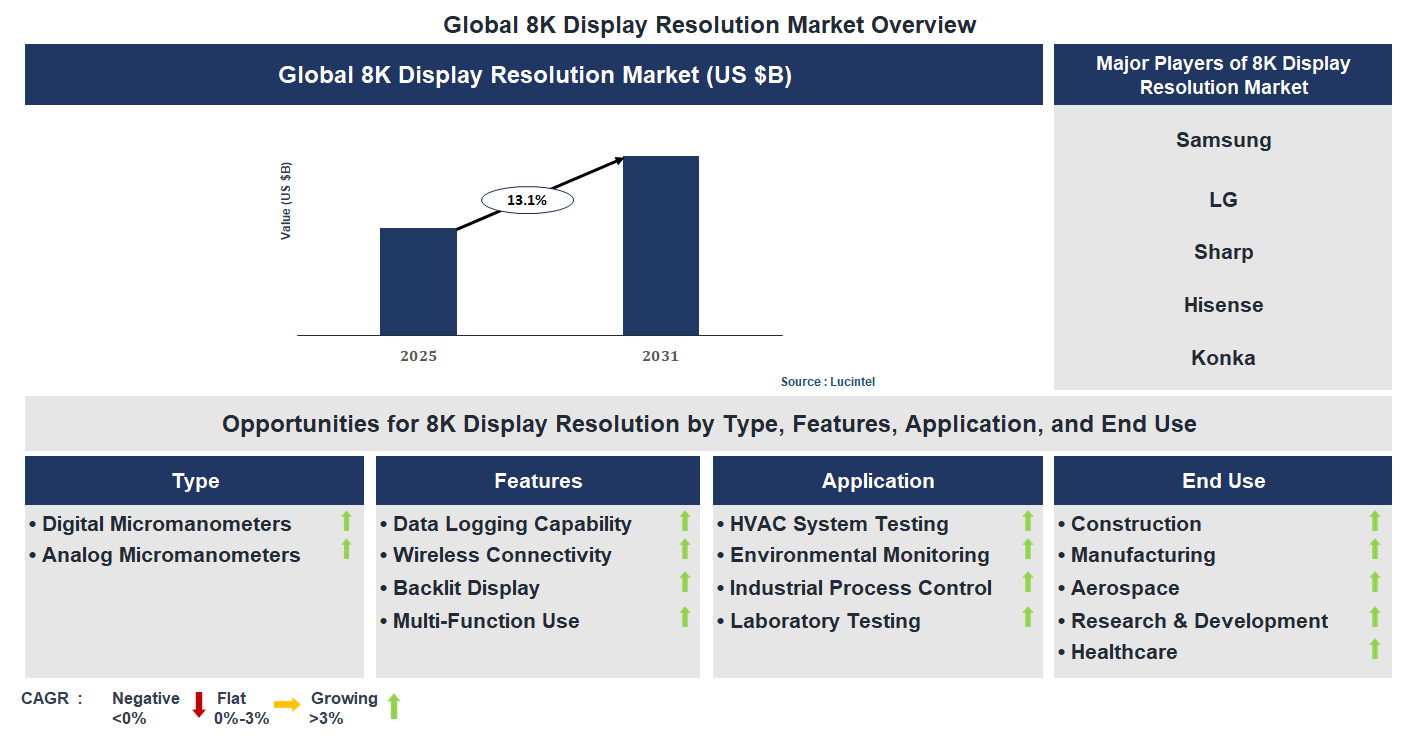
The future of the global 8K display resolution market looks promising with opportunities in the construction, manufacturing, aerospace, research & development, and healthcare markets. The global 8K display resolution market is expected to grow with a CAGR of 13.1% from 2025 to 2031. The major drivers for this market are the increasing demand for high-resolution displays, the rising popularity of immersive viewing experiences, and the growing adoption of 8K-enabled devices.• Lucintel forecasts that, within the type category, digital micromanometer is expected to witness higher growth over the forecast period.
• Within the end use category, aerospace is expected to witness the highest growth.
• In terms of region, APAC is expected to witness the highest growth over the forecast period. Gain valuable insights for your business decisions with our comprehensive 150+ page report. Sample figures with some insights are shown below.
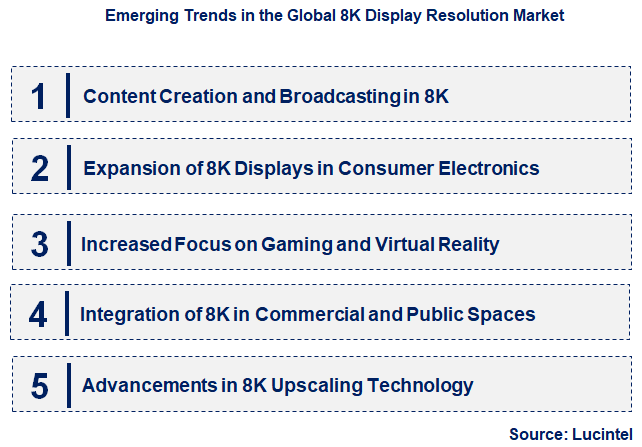
Emerging Trends in the 8K Display Resolution Market
The 8K display resolution market is evolving rapidly, driven by new trends that shape the way the technology is adopted and integrated into various sectors. These trends indicate how 8K technology is becoming more accessible and mainstream while creating new opportunities for innovation.• Content Creation and Broadcasting in 8K: With the increasing availability of 8K televisions, there is growing demand for 8K content, especially in broadcasting and media. Streaming platforms, television networks, and sports broadcasters are exploring ways to deliver 8K content to consumers, particularly for live events, sports, and special programming. The development of 8K-capable cameras and editing tools has made content creation more feasible. This trend will drive the production of more 8K content, making it a major focus for the media and entertainment industries.
• Expansion of 8K Displays in Consumer Electronics: 8K displays are becoming more mainstream in consumer electronics, particularly in high-end televisions. Major companies like Samsung, LG, and Sony have launched a variety of 8K TV models that are slowly becoming more affordable to middle-income consumers. With improvements in upscaling technology, older content is being converted to 8K resolution, further driving consumer adoption. The integration of 8K displays into consumer electronics beyond TVs, such as in laptops, monitors, and digital signage, will accelerate growth in this sector.
• Increased Focus on Gaming and Virtual Reality: The gaming industry is increasingly embracing 8K technology, with high-end gaming consoles, PCs, and gaming monitors pushing the boundaries of display resolution. The introduction of next-generation gaming systems such as the PlayStation 5 and Xbox Series X, which support 8K output, is driving demand for 8K displays. Additionally, virtual reality (VR) and augmented reality (AR) applications are starting to leverage 8K technology to create highly immersive experiences. The increasing use of 8K in gaming and VR will continue to boost the market, especially as 8K content becomes more prevalent in gaming ecosystems.
• Integration of 8K in Commercial and Public Spaces: The use of 8K displays is expanding beyond consumer electronics into commercial and public spaces. Digital signage, retail, and advertising sectors are adopting 8K resolution to provide ultra-clear visuals that capture the attention of consumers. These displays are used in high-end retail environments, airports, and museums to create engaging experiences. As the demand for more immersive, high-definition displays grows, commercial sectors are embracing 8K technology to stand out and offer an elevated customer experience.
• Advancements in 8K Upscaling Technology: Advancements in artificial intelligence (AI) and machine learning are playing a key role in the adoption of 8K technology. Upscaling technologies are now allowing lower-resolution content, including 4K and even HD, to be enhanced to near-8K quality. AI-driven upscaling technology is helping bridge the gap by offering consumers a more accessible 8K experience, even before 8K content becomes ubiquitous. This trend is making it easier for consumers to transition to 8K displays, even as the availability of native 8K content remains limited. Emerging trends such as content creation in 8K, the rise of 8K displays in consumer electronics, advancements in gaming and VR, the expansion of 8K in public spaces, and the development of AI-driven upscaling technology are significantly shaping the 8K display resolution market. As these trends continue to develop, 8K will become more integrated into various industries and everyday consumer use, driving demand and technological innovation.
Recent Development in the 8K Display Resolution Market
The 8K display resolution market has been shaped by key technological developments, new product launches, and increased investments from major players. These developments are contributing to the rapid expansion of the market, particularly in consumer electronics, broadcasting, and commercial applications.• Product Launches by Major Brands: Several high-end television manufacturers, including Samsung, LG, and Sony, have launched their own 8K television models, incorporating cutting-edge display technologies such as OLED and QLED. These televisions offer an exceptional viewing experience with stunning clarity, color accuracy, and contrast. The introduction of 8K TVs has made the technology more accessible to premium consumers and pushed the market forward as more brands enter the space.
• Growth in 8K Content Production: As demand for 8K displays grows, content production for 8K resolution is also increasing. Major broadcasting networks, such as Japan’s NHK and the BBC, have begun producing 8K content for special events, documentaries, and sports. The development of 8K cameras, post-production tools, and editing software is enabling the creation of high-quality content tailored for 8K displays. As 8K content becomes more widely available, it will fuel further adoption of 8K display technologies globally.
• Investment in 8K Broadcasting Infrastructure: Countries like Japan have heavily invested in 8K broadcasting infrastructure, setting up specialized 8K television stations and testing 8K satellite broadcasting. In 2020, Japan’s NHK became the first public broadcaster to offer 8K content on a regular basis, showcasing the potential of this technology for live events and sports coverage. Other countries are following suit by developing the necessary infrastructure to support 8K broadcasting, which will encourage further consumer adoption of 8K displays.
• Advances in 8K Upscaling Technology: The continued improvement of 8K upscaling technology, driven by AI and machine learning, has made it possible for consumers to watch non-8K content on 8K displays. This advancement has addressed one of the major concerns about 8K adoption: the lack of native 8K content. AI upscaling algorithms are now able to enhance 4K and even lower-resolution content to a near-8K quality, enabling users to fully enjoy their 8K displays even when 8K content is limited.
• Adoption of 8K Displays in Commercial Applications: 8K displays are finding increased use in commercial applications, particularly in digital signage, advertising, and public installations. Companies are investing in large-scale 8K displays to create immersive experiences for consumers in retail environments, museums, and public spaces. The sharpness and clarity of 8K displays make them an ideal solution for high-traffic areas where attention-grabbing visuals are required. This expansion of 8K technology into commercial applications is helping drive the market’s growth. Recent developments in the 8K display resolution market, including product launches, advances in content production, broadcasting infrastructure, and AI upscaling, are driving the adoption of 8K technology. As 8K content becomes more accessible and the infrastructure to support it grows, the market is poised for continued expansion, with applications in both consumer electronics and commercial sectors.
Strategic Growth Opportunities in the 8K Display Resolution Market
The 8K display resolution market is witnessing significant growth, driven by both technological advancements and the increasing demand for ultra-high-definition screens. As consumers and industries look for enhanced visual experiences, 8K technology is expected to play a key role in transforming various sectors, including consumer electronics, broadcasting, gaming, digital signage, and commercial applications. The rapid pace of innovation, combined with the increasing affordability and accessibility of 8K displays, presents numerous growth opportunities. Below, we examine five key growth opportunities by application that are poised to shape the future of the 8K display market.• Consumer Electronics: The consumer electronics segment, particularly high-end televisions and home displays, is one of the most significant opportunities for the 8K display market. As brands like Samsung, LG, and Sony introduce affordable 8K televisions with superior picture quality, demand for 8K TVs is rising. These advancements include improvements in display technology, such as OLED and QLED panels, that offer richer colors and better contrast. With increasing disposable income and growing consumer interest in home entertainment, the 8K display market is poised to see substantial growth in households worldwide, especially among early adopters and premium consumers.
• Broadcasting and Media Production: Broadcasting and media production are key drivers for the adoption of 8K displays. The production of 8K content, including live sports, movies, and special events, is gradually expanding. Japan’s NHK (Japan Broadcasting Corporation) has been a pioneer in 8K broadcasting, offering 8K content through satellite channels and test broadcasts for large events. As 8K content becomes more available and production technologies become more cost-effective, broadcasters worldwide will invest in 8K resolution to stay competitive in delivering the best visual experiences to consumers. This presents a major growth opportunity for the display and content production industries.
• Gaming and Virtual Reality: The gaming and virtual reality (VR) sectors are rapidly adopting 8K technology to provide immersive and visually stunning experiences. With the next-generation gaming consoles (e.g., PlayStation 5 and Xbox Series X) supporting 8K resolution, consumers are demanding 8K-capable gaming monitors and televisions. This is driving the growth of the gaming hardware market, as players seek cutting-edge visuals and enhanced immersion. Similarly, VR headsets that support 8K resolution are transforming the gaming experience. As 8K gaming content becomes more widespread, this sector will represent a significant growth opportunity for 8K displays in the coming years.
• Digital Signage and Advertising: 8K displays are increasingly being used in digital signage and advertising due to their ability to provide ultra-high-definition visuals that attract attention. Retail stores, airports, museums, and public spaces are adopting 8K screens for advertisements, promotions, and immersive displays. With the increasing demand for attention-grabbing digital billboards and public displays, 8K technology is becoming a premium solution for companies looking to deliver unparalleled visual experiences. As businesses recognize the benefits of 8K displays for improving brand visibility and customer engagement, this segment is expected to see rapid growth in both commercial and public applications.
• Healthcare and Medical Imaging: Healthcare and medical imaging are emerging as critical applications for 8K display resolution. Medical professionals use high-resolution displays for diagnostic imaging, surgical procedures, and telemedicine. 8K displays provide the clarity and precision needed for accurate analysis of medical images such as MRIs, CT scans, and X-rays. The high pixel density and color accuracy of 8K technology enable healthcare providers to make better-informed decisions and offer improved patient care. As the healthcare sector increasingly adopts advanced technologies, 8K displays will play an integral role in the next generation of medical imaging systems. The 8K display resolution market is poised for significant growth, driven by various key applications such as consumer electronics, broadcasting, gaming, digital signage, and healthcare. Each of these sectors presents unique opportunities for innovation and market expansion, as the demand for high-definition, immersive, and cutting-edge display technologies continues to rise. The advancements in 8K technology are paving the way for new possibilities, reshaping how content is created, displayed, and experienced across industries. As 8K content becomes more prevalent and affordable, these opportunities will contribute to the market’s future growth.
8K Display Resolution Market Driver and Challenges
The 8K display resolution market is influenced by a combination of drivers and challenges, ranging from technological advancements to economic and regulatory factors. While the market is experiencing growth due to innovations in display technology and content production, there are several hurdles that need to be overcome. These drivers and challenges will determine the trajectory of the market as stakeholders in various industries—consumer electronics, broadcasting, gaming, and advertising—prepare for the widespread adoption of 8K technology. Below, we examine the key drivers and challenges that are shaping the future of the 8K display market. The factors responsible for driving the 8k display resolution market include: 1. Technological Advancements in Display Technology: One of the primary drivers of the 8K display market is the continuous improvement in display technologies such as OLED, QLED, and mini-LED. These technologies enable higher resolutions, better color reproduction, and improved contrast ratios, which are essential for delivering the full benefits of 8K displays. The development of AI-driven upscaling technologies, which enhance lower-resolution content to 8K quality, further drives consumer adoption by making it easier to enjoy content on 8K displays, even before native 8K content is widely available. 2. Increasing Consumer Demand for High-Quality Visuals: With consumers increasingly prioritizing visual quality in home entertainment, there is a growing demand for 8K resolution in televisions and monitors. This demand is fueled by the rise of streaming services that offer 4K and 8K content, as well as next-generation gaming consoles and VR platforms. Consumers are willing to pay a premium for the best possible viewing experience, driving the expansion of the 8K display market, particularly in high-end consumer electronics. 3. Expansion of 8K Content Production: As the availability of 8K content increases, the adoption of 8K displays will naturally rise. Broadcast networks, media companies, and content creators are investing in 8K production to meet the growing consumer demand for ultra-high-definition visuals. Major events such as sports tournaments, concerts, and film productions are being filmed and broadcast in 8K. The production of more 8K content will provide the necessary foundation for the growth of the 8K display market, creating a feedback loop where the display technology and content production feed into each other’s growth. 4. Falling Prices of 8K Displays: The cost of producing 8K displays has been decreasing, making them more accessible to a wider consumer base. Initially, 8K displays were extremely expensive, but with advancements in manufacturing processes, economies of scale, and competition among manufacturers, prices are becoming more competitive. As the cost of 8K televisions and monitors continues to fall, more consumers will be able to afford these displays, leading to broader adoption and an increase in market demand. 5. Growth in Commercial Applications: 8K displays are gaining traction not only in consumer electronics but also in commercial applications such as digital signage, advertising, and medical imaging. As businesses look for ways to engage customers and enhance user experiences in public spaces, 8K displays are being used for high-quality advertising and interactive displays. Additionally, the healthcare sector is adopting 8K displays for medical imaging, benefiting from the superior clarity and detail offered by 8K resolution. Challenges in the 8k display resolution market are: 1. Lack of Native 8K Content: While 8K displays offer remarkable clarity, the availability of native 8K content remains limited. Most content available today is still in 4K or lower resolutions, and producing high-quality 8K content is expensive and resource-intensive. The lack of 8K content poses a challenge for the mass adoption of 8K displays, as consumers may be hesitant to invest in a technology without a sufficient library of content to enjoy. This challenge can be mitigated with the development of AI-driven upscaling technologies and increased investment in 8K production. 2. High Initial Costs of 8K Displays: Despite falling prices, 8K displays are still relatively expensive compared to 4K and HD displays, which limits their adoption in price-sensitive markets. The high initial investment required for 8K technology presents a barrier, particularly in emerging markets where consumers may not be willing or able to pay a premium for 8K products. While prices are expected to decrease over time, the affordability of 8K displays will remain a challenge for mass-market adoption. 3. Limited Infrastructure for 8K Broadcasting and Streaming: The infrastructure required to support 8K broadcasting and streaming is still in the early stages of development. Broadcasting in 8K resolution requires specialized equipment, bandwidth, and content distribution channels that are not yet widely available. While major broadcasters and streaming services are beginning to experiment with 8K content, the lack of widespread infrastructure for delivering 8K content remains a challenge. This will need to be addressed for 8K adoption to reach its full potential. The 8K display resolution market is being driven by technological advancements, increasing consumer demand, the growth of 8K content, decreasing display costs, and expanding commercial applications. However, challenges such as the lack of native 8K content, high costs, and limited infrastructure for 8K broadcasting must be addressed to unlock the full potential of the market. As these issues are gradually resolved, the 8K display market will continue to grow and evolve, offering exciting opportunities for both consumers and industries across the globe.List of 8K Display Resolution Companies
Companies in the market compete on the basis of product quality offered. Major players in this market focus on expanding their manufacturing facilities, R&D investments, infrastructural development, and leverage integration opportunities across the value chain. With these strategies 8K display resolution companies cater increasing demand, ensure competitive effectiveness, develop innovative products & technologies, reduce production costs, and expand their customer base. Some of the 8K display resolution companies profiled in this report include-• Samsung
• LG
• Sharp
• Hisense
• Konka
• Changhong
• Skyworth
8K Display Resolution Market by Segment
The study includes a forecast for the global 8K display resolution market by type, features, application, end use, and region.8K Display Resolution Market by Type [Value from 2019 to 2031]:
• Digital Micromanometers
• Analog Micromanometers
8K Display Resolution Market by Features [Value from 2019 to 2031]:
• Data Logging Capability
• Wireless Connectivity
• Backlit Display
• Multi-Function Use
8K Display Resolution Market by Application [Value from 2019 to 2031]:
• HVAC System Testing
• Environmental Monitoring
• Industrial Process Control
• Laboratory Testing
8K Display Resolution Market by End Use [Value from 2019 to 2031]:
• Construction
• Manufacturing
• Aerospace
• Research & Development
• Healthcare
8K Display Resolution Market by Region [Value from 2019 to 2031]:
• North America
• Europe
• Asia Pacific
• The Rest of the World
Country Wise Outlook for the 8K Display Resolution Market
The 8K display resolution market is rapidly growing due to advancements in display technology and increasing consumer demand for ultra-high-definition screens. With four times the resolution of 4K and sixteen times that of Full HD, 8K displays offer unparalleled picture quality and are revolutionizing industries such as entertainment, gaming, broadcasting, and consumer electronics. As global markets push for next-generation visual experiences, countries like the United States, China, Germany, India, and Japan are leading the way in innovation and adoption. Below, we examine the key developments and trends in the 8K display resolution market in these regions.• United States: In the United States, the 8K display market has made significant strides, driven by technological innovations from major electronics companies like Samsung, LG, and Sony. The rise of 8K televisions, especially in the premium segment, is a key development, with brands unveiling models that cater to high-end consumers. The U.S. is also witnessing increased adoption in broadcasting and digital media, with 8K video content being produced for special events and sports. Moreover, the U.S. government and private sectors are exploring 8K technology for use in military, healthcare, and research applications, which further boosts market growth.
• China: China has become a key player in the 8K display resolution market, with local manufacturers such as TCL and Hisense leading the charge. The Chinese government has heavily invested in 8K development, particularly focusing on local production of 8K displays and content creation. The country has launched 8K-enabled broadcasting trials and is encouraging the adoption of the technology in public spaces like shopping malls and airports. With growing disposable incomes and an expanding middle class, China is expected to see continued demand for 8K televisions and commercial applications, positioning itself as a leader in the market.
• Germany: Germany has been at the forefront of adopting 8K technology in Europe, particularly in the fields of media, entertainment, and automotive industries. Companies like Fraunhofer Society and broadcasters like ZDF have been working on producing 8K content. Additionally, Germany’s automotive industry is leveraging 8K technology for high-resolution displays in vehicles, enhancing driver experience and safety features. The German market is also seeing increasing interest in the adoption of 8K in digital signage and public broadcasting, driven by both consumer demand and technological advancements in 8K production and display systems.
• India: India’s 8K display resolution market is still in its early stages but is witnessing rapid growth as consumer interest in high-quality display technology increases. Major electronics brands, such as Samsung and LG, are making 8K TVs available in select urban markets, although the technology is still considered a premium product. Indias growing entertainment industry, including OTT platforms and sports broadcasting, is starting to explore 8K content. As infrastructure and network speeds improve, particularly with 5G rollout, there is significant potential for expanding 8K usage in Indian households and commercial spaces, albeit with some price sensitivity.
• Japan: Japan is one of the pioneers in 8K display technology, with the country being the first to broadcast 8K content through its NHK (Japan Broadcasting Corporation) network. Japan has been driving the development of 8K technology in both the consumer electronics and broadcasting sectors. Major Japanese companies, including Sharp, Sony, and Panasonic, have introduced advanced 8K TVs and displays. Additionally, Japan has been testing 8K broadcasting for events like the Olympics, showcasing the countrys leadership in 8K content creation. The countrys advanced technological infrastructure, coupled with strong consumer interest, makes Japan a critical hub for the 8K market.

Features of the Global 8K Display Resolution Market
Market Size Estimates: 8K display resolution market size estimation in terms of value ($B). Trend and Forecast Analysis: Market trends (2019 to 2024) and forecast (2025 to 2031) by various segments and regions. Segmentation Analysis: 8K display resolution market size by various segments, such as by type, features, application, end use, and region in terms of value ($B). Regional Analysis: 8K display resolution market breakdown by North America, Europe, Asia Pacific, and Rest of the World. Growth Opportunities: Analysis of growth opportunities in different types, features, applications, end uses, and regions for the 8K display resolution market. Strategic Analysis: This includes M&A, new product development, and competitive landscape of the 8K display resolution market. Analysis of competitive intensity of the industry based on Porter’s Five Forces model.
FAQ
Q1. What is the growth forecast for 8K display resolution market? Answer: The global 8K display resolution market is expected to grow with a CAGR of 13.1% from 2025 to 2031. Q2. What are the major drivers influencing the growth of the 8K display resolution market? Answer: The major drivers for this market are the increasing demand for high-resolution displays, the rising popularity of immersive viewing experiences, and the growing adoption of 8K-enabled devices. Q3. What are the major segments for 8K display resolution market? Answer: The future of the 8K display resolution market looks promising with opportunities in the construction, manufacturing, aerospace, research & development, and healthcare markets. Q4. Who are the key 8K display resolution market companies? Answer: Some of the key 8K display resolution companies are as follows:• Samsung
• LG
• Sharp
• Hisense
• Konka
• Changhong
• Skyworth Q5. Which 8K display resolution market segment will be the largest in future? Answer: Lucintel forecasts that, within the type category, digital micromanometer is expected to witness higher growth over the forecast period. Q6. In 8K display resolution market, which region is expected to be the largest in next 5 years? Answer: In terms of region, APAC is expected to witness the highest growth over the forecast period. Q7. Do we receive customization in this report? Answer: Yes, Lucintel provides 10% customization without any additional cost.
Table of Contents
List of Figures
List of Tables
Methodology
- In-depth interviews of the major players in this market
- Detailed secondary research from competitors’ financial statements and published data
- Extensive searches of published works, market, and database information pertaining to industry news, company press releases, and customer intentions
- A compilation of the experiences, judgments, and insights of Lucintel’s professionals, who have analyzed and tracked this market over the years.


Buy Now
Choose a license that fits your team. Instant PDF delivery.
Prices exclude taxes. Instant delivery. Custom licensing available on request.
Key Questions
- • What are some of the most promising, high-growth opportunities for the 8K display resolution market by type (digital micromanometers and analog micromanometers), features (data logging capability, wireless connectivity, backlit display, and multi-function use), application (HVAC system testing, environmental monitoring, industrial process control, and laboratory testing), end use (construction, manufacturing, aerospace, research & development, and healthcare), and region (North America, Europe, Asia Pacific, and the Rest of the World)?
- • Which segments will grow at a faster pace and why?
- • Which region will grow at a faster pace and why?
- • What are the key factors affecting market dynamics? What are the key challenges and business risks in this market?
- • What are the business risks and competitive threats in this market?
- • What are the emerging trends in this market and the reasons behind them?
- • What are some of the changing demands of customers in the market?
- • What are the new developments in the market? Which companies are leading these developments?
- • Who are the major players in this market? What strategic initiatives are key players pursuing for business growth?
- • What are some of the competing products in this market and how big of a threat do they pose for loss of market share by material or product substitution?
- • What M&A activity has occurred in the last 5 years and what has its impact been on the industry? For any questions related to 8K Display Resolution Market, 8K Display Resolution Market Size, 8K Display Resolution Market Growth, 8K Display Resolution Market Analysis, 8K Display Resolution Market Report, 8K Display Resolution Market Share, 8K Display Resolution Market Trends, 8K Display Resolution Market Forecast, 8K Display Resolution Companies, write Lucintel analyst at email: helpdesk@lucintel.com. We will be glad to get back to you soon.


