
Market Report · July 29, 2026

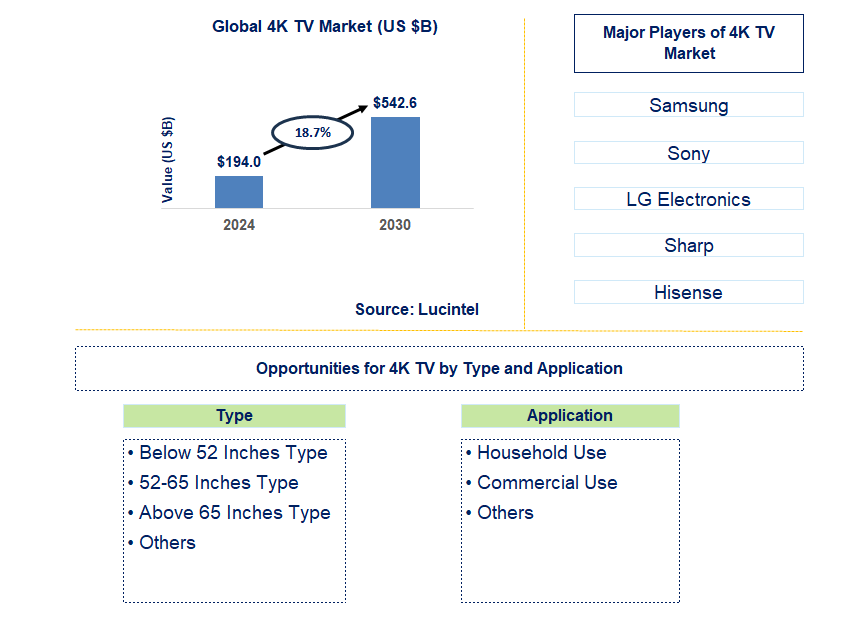
Key data points: The market size in 2030 = $542.6 billion, growth forecast = 18.7% annually next 6 years. Scroll below to get more insights. This market report covers trends, opportunities, and forecast in the global 4k tv market to 2030 by type (below 52 inches type, 52-65 inches type, above 65 inches type, and others), application (household use, commercial use, and others), and region (North America, Europe, Asia Pacific, and the Rest of the World)
We'll send your sample report shortly.
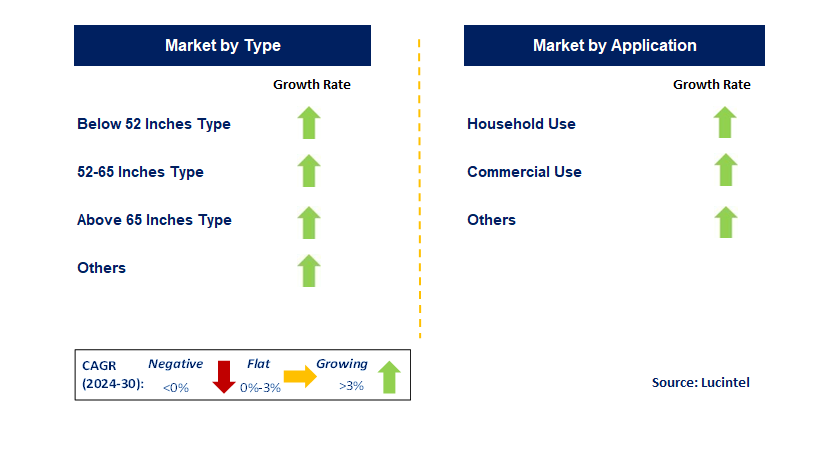
• Lucintel forecasts that below 52 inches type will remain the largest segment over the forecast period.
• North America will remain the largest region over the forecast period due to increasing research and development efforts in preparation for the release of superior UHD TVs. A more than 150-page report is developed to help in your business decisions.
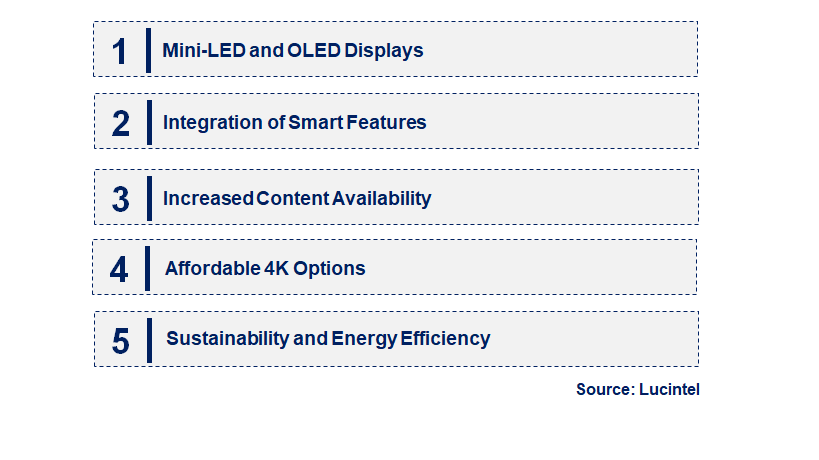
• Mini-LED and OLED Displays: Mini-LED and OLED technologies are revolutionizing display quality in 4K TVs. Mini-LED offers improved brightness and contrast ratios compared to traditional LED, while OLED provides deeper blacks and more vibrant colors. These advancements enhance viewing experiences, making them popular among premium consumers. As production costs decrease, these technologies are becoming more accessible, driving higher adoption rates. The competition between these technologies is also pushing further innovation in the display industry.
• Integration of Smart Features: The integration of smart features, including voice assistants and AI-driven recommendations, has become standard in 4K TVs. Smart TVs now offer seamless connectivity with other smart home devices and enhanced user interfaces. This trend caters to the growing demand for integrated entertainment systems and personalized content. Enhanced features like app ecosystems and voice control are increasingly influencing consumer purchasing decisions, driving the demand for more connected and interactive viewing experiences.
• Increased Content Availability: The growth of streaming platforms and digital content libraries is significantly impacting the 4K TV market. Services like Netflix, Amazon Prime Video, and Disney+ are expanding their 4K content offerings, encouraging consumers to upgrade to 4K TVs to fully enjoy high-resolution content. The increased availability of 4K content is a critical factor driving consumer demand and influencing the purchasing decisions of those looking to optimize their home entertainment experiences.
• Affordable 4K Options: As competition among manufacturers intensifies, the price of 4K TVs has become more affordable. Companies are introducing budget-friendly models without compromising essential features. This trend is making 4K technology accessible to a broader audience, including price-sensitive consumers. The availability of affordable 4K options is helping to accelerate market penetration and expand the customer base for high-definition televisions.
• Sustainability and Energy Efficiency: There is a growing emphasis on sustainability and energy efficiency within the 4K TV market. Manufacturers are increasingly focusing on creating energy-efficient models that meet environmental standards and reduce carbon footprints. This trend aligns with global concerns about climate change and resource conservation. Consumers are also becoming more environmentally conscious, and energy-efficient 4K TVs are becoming a preferred choice for those looking to reduce their ecological impact. The 4K TV market is experiencing dynamic growth driven by several emerging trends, including the increasing availability of high-resolution content and the expansion of streaming services that cater to 4K viewing. Advancements in display technologies, such as OLED and QLED, are enhancing picture quality and color accuracy, further attracting consumers. Additionally, features like smart connectivity, voice control, and integration with home automation systems are becoming standard, elevating the user experience. As prices continue to decline and consumer awareness grows, the demand for 4K TVs is expected to surge, positioning this market for robust expansion in the coming years.
• Home Entertainment: The home entertainment sector remains a dominant growth opportunity for 4K TVs. With increasing consumer demand for immersive viewing experiences, there is a strong push for TVs that offer superior picture quality, enhanced color accuracy, and larger screen sizes. Advancements in display technology, such as OLED and Mini-LED, cater to this demand by providing exceptional contrast and brightness. Additionally, the proliferation of 4K content from streaming services drives consumer interest in upgrading to high-resolution TVs, further fueling growth in this application.
• Gaming: The gaming industry represents a significant growth opportunity for 4K TVs due to the increasing popularity of high-definition gaming consoles and PC setups. Gamers seek televisions with high refresh rates, low input lag, and enhanced graphics capabilities to maximize their gaming experience. The integration of features like HDMI 2.1 support and Variable Refresh Rate (VRR) in 4K TVs caters to these needs. As gaming technology continues to advance, the demand for 4K TVs that deliver crisp, responsive gameplay will drive market growth in this segment.
• Commercial Displays: In the commercial sector, 4K TVs are increasingly being used for digital signage, presentations, and advertising. High-resolution displays provide clear, engaging visuals that capture attention and enhance communication. Businesses are investing in 4K TVs to improve the quality of their visual content and create impactful customer experiences. The growing adoption of digital signage in retail, corporate environments, and public spaces presents a substantial opportunity for 4K TV manufacturers to supply high-quality, reliable displays for various commercial applications.
• Smart Home Integration: The integration of 4K TVs into smart home ecosystems is an emerging growth opportunity. As consumers seek more connected and automated living environments, 4K TVs equipped with smart features, such as voice control and seamless connectivity with other smart devices, become increasingly appealing. TVs that support smart home platforms like Amazon Alexa or Google Assistant enhance the convenience and functionality of home automation. This trend drives demand for 4K TVs that offer not just superior visual quality but also enhanced smart capabilities.
• Healthcare and Education: 4K TVs are gaining traction in healthcare and education due to their ability to deliver high-resolution images for medical diagnostics and educational content. In healthcare, 4K TVs are used for detailed imaging and telemedicine applications, providing clear and precise visuals for medical professionals. In education, they enhance learning experiences by delivering high-quality video content and interactive lessons. The increasing adoption of digital tools in these sectors presents a growing market for 4K TVs tailored to meet specific needs in healthcare and educational environments. The 4K TV market's strategic growth opportunities across home entertainment, gaming, commercial displays, smart home integration, and healthcare/education illustrate a dynamic landscape driven by technological advancements and shifting consumer preferences. Each application offers unique growth potential, from enhancing visual experiences in home settings to supporting complex needs in commercial and professional environments. By focusing on these key applications, companies can effectively position themselves to capitalize on emerging trends and expand their market presence, ultimately contributing to the overall growth and evolution of the 4K TV industry.
• Home Entertainment: The home entertainment sector remains a dominant growth opportunity for 4K TVs. With increasing consumer demand for immersive viewing experiences, there is a strong push for TVs that offer superior picture quality, enhanced color accuracy, and larger screen sizes. Advancements in display technology, such as OLED and Mini-LED, cater to this demand by providing exceptional contrast and brightness. Additionally, the proliferation of 4K content from streaming services drives consumer interest in upgrading to high-resolution TVs, further fueling growth in this application.
• Gaming: The gaming industry represents a significant growth opportunity for 4K TVs due to the increasing popularity of high-definition gaming consoles and PC setups. Gamers seek televisions with high refresh rates, low input lag, and enhanced graphics capabilities to maximize their gaming experience. The integration of features like HDMI 2.1 support and Variable Refresh Rate (VRR) in 4K TVs caters to these needs. As gaming technology continues to advance, the demand for 4K TVs that deliver crisp, responsive gameplay will drive market growth in this segment.
• Commercial Displays: In the commercial sector, 4K TVs are increasingly being used for digital signage, presentations, and advertising. High-resolution displays provide clear, engaging visuals that capture attention and enhance communication. Businesses are investing in 4K TVs to improve the quality of their visual content and create impactful customer experiences. The growing adoption of digital signage in retail, corporate environments, and public spaces presents a substantial opportunity for 4K TV manufacturers to supply high-quality, reliable displays for various commercial applications.
• Smart Home Integration: The integration of 4K TVs into smart home ecosystems is an emerging growth opportunity. As consumers seek more connected and automated living environments, 4K TVs equipped with smart features, such as voice control and seamless connectivity with other smart devices, become increasingly appealing. TVs that support smart home platforms like Amazon Alexa or Google Assistant enhance the convenience and functionality of home automation. This trend drives demand for 4K TVs that offer not just superior visual quality but also enhanced smart capabilities.
• Healthcare and Education: 4K TVs are gaining traction in healthcare and education due to their ability to deliver high-resolution images for medical diagnostics and educational content. In healthcare, 4K TVs are used for detailed imaging and telemedicine applications, providing clear and precise visuals for medical professionals. In education, they enhance learning experiences by delivering high-quality video content and interactive lessons. The increasing adoption of digital tools in these sectors presents a growing market for 4K TVs tailored to meet specific needs in healthcare and educational environments. The 4K TV market's strategic growth opportunities across home entertainment, gaming, commercial displays, smart home integration, and healthcare/education illustrate a dynamic landscape driven by technological advancements and shifting consumer preferences. Each application offers unique growth potential, from enhancing visual experiences in home settings to supporting complex needs in commercial and professional environments. By focusing on these key applications, companies can effectively position themselves to capitalize on emerging trends and expand their market presence, ultimately contributing to the overall growth and evolution of the 4K TV industry.
• Technological Advancements: Continuous technological advancements are a major driver in the 4K TV market. Innovations such as OLED, Mini-LED, and Quantum Dot technologies improve display quality, offering better contrast, brightness, and color accuracy. These advancements enhance the overall viewing experience, making 4K TVs more appealing to consumers. Additionally, features like HDMI 2.1 and support for high dynamic range (HDR) content contribute to the growing demand for cutting-edge TV models, driving market expansion.
• Growth of Streaming Services: The expansion of streaming services has significantly impacted the 4K TV market. Platforms like Netflix, Amazon Prime Video, and Disney+ offer a growing library of 4K content, driving consumer demand for compatible televisions. As more content becomes available in 4K resolution, consumers are increasingly motivated to upgrade their TVs to fully enjoy high-quality streaming experiences. This trend supports the continued growth of the 4K TV market by creating a strong demand for high-resolution displays.
• Decreasing Costs of 4K Technology: The decreasing costs of 4K technology are making high-definition TVs more affordable and accessible to a broader audience. As production costs for 4K panels decrease and competition among manufacturers intensifies, prices for 4K TVs have dropped, allowing more consumers to upgrade from HD to 4K. This trend accelerates market penetration and broadens the consumer base, contributing to the growth of the 4K TV market.
• Rising Consumer Preference for High-Resolution Displays: Increasing consumer preference for high-resolution displays is driving demand for 4K TVs. As consumers become more accustomed to superior image quality and immersive viewing experiences, they are seeking televisions that offer the best possible resolution. This shift in consumer expectations is pushing manufacturers to prioritize 4K technology and innovate to meet the evolving demands of the market.
• Integration with Smart Home Ecosystems: The integration of 4K TVs with smart home ecosystems is a growing driver in the market. As consumers seek more connected and automated living environments, TVs with smart features and compatibility with voice assistants become increasingly popular. This trend not only enhances the functionality of 4K TVs but also aligns with the broader shift towards smart home technology, driving further adoption and market growth. Challenges in the 4K TV market include:
• High Production Costs: Despite decreasing costs, the production of advanced 4K display technologies, such as OLED and Mini-LED, remains expensive. High production costs can limit the affordability of premium models and affect profit margins for manufacturers. This challenge requires companies to balance cost and pricing strategies while maintaining quality and innovation to stay competitive in the market.
• Market Saturation: The 4K TV market is experiencing saturation as many consumers have already upgraded to 4K technology. With a significant portion of the market owning 4K TVs, growth opportunities are increasingly focused on replacement purchases rather than first-time buyers. This saturation can lead to slower growth rates and heightened competition among manufacturers to attract and retain customers.
• Regulatory and Compliance Issues: Regulatory and compliance issues, including energy efficiency standards and environmental regulations, pose challenges for 4K TV manufacturers. Adhering to these regulations requires investments in technology and processes to ensure products meet required standards. Non-compliance can lead to penalties and affect market access, making it crucial for manufacturers to navigate regulatory landscapes effectively. The 4K TV market is shaped by a range of drivers and challenges, each influencing growth and development. Technological advancements, the expansion of streaming services, decreasing costs, rising consumer preferences, and smart home integration are key drivers fueling market expansion. However, challenges such as high production costs, market saturation, and regulatory compliance issues present obstacles that manufacturers must address. By understanding and adapting to these factors, companies can navigate the complexities of the market, capitalize on opportunities, and mitigate potential risks, ultimately shaping the future of the 4K TV industry.
• Samsung
• Sony
• LG Electronics
• Sharp
• Hisense
• Xiaomi
• TCL
• Philips
• Changhong
• Panasonic
• Below 52 Inches Type
• 52-65 Inches Type
• Above 65 Inches Type
• Others
• Household Use
• Commercial Use
• Others
• North America
• Europe
• Asia Pacific
• The Rest of the World
• United States: In the U.S., the 4K TV market has been buoyed by rapid advancements in display technology and a strong push from streaming services. Major brands have introduced models featuring Mini-LED and OLED displays, offering superior brightness and contrast. Additionally, the growth of 4K content from platforms like Netflix and Amazon Prime Video has driven consumer demand. The integration of smart features and voice assistants has also become standard, catering to tech-savvy consumers. As a result, 4K TVs have become increasingly accessible and attractive to a broader audience.
• China: China has experienced significant growth in the 4K TV sector, with local manufacturers like TCL and Hisense leading the charge. The adoption of Quantum Dot technology and 8K-ready displays are setting new benchmarks. The Chinese market is characterized by high competition, driving innovation and affordability. Government initiatives to promote smart home technology and the rapid expansion of content offerings have further accelerated 4K TV adoption. Moreover, the rise of online retail platforms has made it easier for consumers to access the latest models.
• Germany: In Germany, the 4K TV market is growing steadily, with a focus on energy efficiency and sustainability. German consumers are increasingly drawn to brands that offer eco-friendly technologies and high build quality. OLED and QLED technologies are popular for their superior picture quality and lower power consumption. The market is also benefiting from the country's strong infrastructure for digital broadcasting, which supports high-quality 4K content. German manufacturers are emphasizing durability and long-term value, aligning with local consumer preferences for high-quality and reliable products.
• India: India's 4K TV market is rapidly expanding due to rising disposable incomes and increased access to digital content. Local and international brands are competing to offer affordable 4K options, often with features tailored to local preferences. Innovations such as smart TV integration and support for regional languages are becoming more common. The growth of streaming platforms like Disney+ Hotstar and Amazon Prime Video has also contributed to the increased demand for 4K TVs. Despite price sensitivity, consumers are showing a willingness to invest in advanced display technologies.
• Japan: Japan's 4K TV market is characterized by a strong emphasis on cutting-edge technology and high-quality displays. Major Japanese brands such as Sony and Panasonic are leading in developing advanced features like high dynamic range (HDR) and wide color gamut displays. The market benefits from Japan's robust digital infrastructure and early adoption of 4K content. Japanese consumers prioritize precision and reliability, which drives demand for high-end models with superior picture quality and innovative features. The market is also seeing increased integration with smart home ecosystems.


• Samsung
• Sony
• LG Electronics
• Sharp
• Hisense
• Xiaomi
• TCL
• Philips
• Changhong
• Panasonic Q6. Which 4K TV market segment will be the largest in future? Answer: Lucintel forecasts that below 52 inches type will remain the largest segment over the forecast period. Q7. In 4K TV market, which region is expected to be the largest in next 5 years? Answer: North America will remain the largest region over the forecast period due to increasing research and development efforts in preparation for the release of superior UHD TVs. Q.8 Do we receive customization in this report? Answer: Yes, Lucintel provides 10% customization without any additional cost.


Choose a license that fits your team. Instant PDF delivery.
Prices exclude taxes. Instant delivery. Custom licensing available on request.
Market Report · July 29, 2026
Market Report · July 15, 2026
Market Report · July 13, 2026
Trusted partner for strategic intelligence and business growth


Receive a complimentary market analysis tailored to your industry. Our analysts will identify key growth opportunities and competitive dynamics specific to your business.

Market size, growth rate, and key trend analysis for your specific sector.

Top competitor positioning and market share analysis.

Strategic recommendations backed by data-driven insights.
Get curated market intelligence and competitive moves straight to your inbox.
By subscribing, you agree to receive our monthly insights. Unsubscribe anytime.
Receive a complimentary market analysis tailored to your industry. Our analysts will identify key growth opportunities and competitive dynamics specific to your business.
Market size, growth rate, and key trend analysis for your specific sector.
Top competitor positioning and market share analysis.
Strategic recommendations backed by data-driven insights.
Get curated market intelligence, emerging trends, and competitive moves straight to your inbox each month.
By subscribing, you agree to receive our monthly insights. Unsubscribe anytime.
We'll send your sample report shortly.