
Report Feature
405nm Laser Diode Trends and Forecast
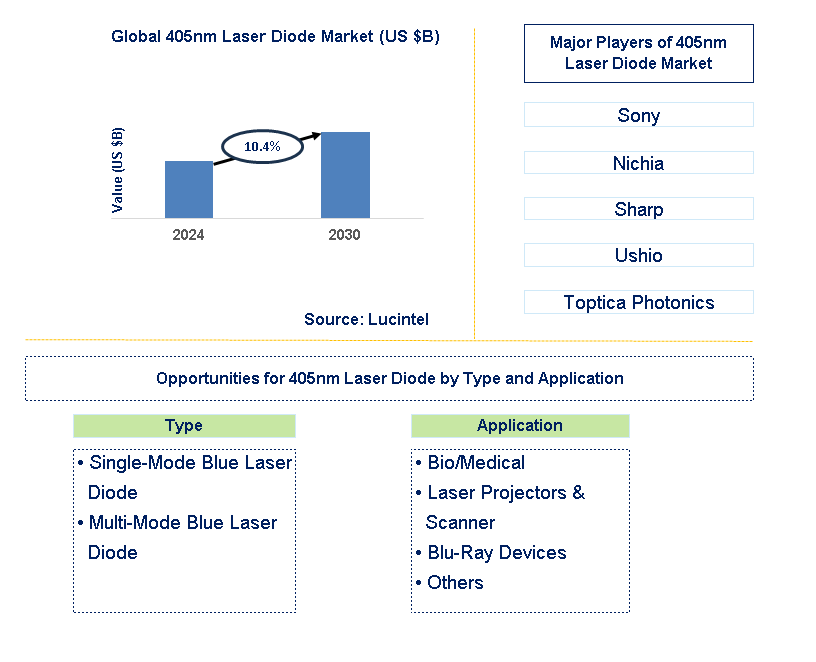
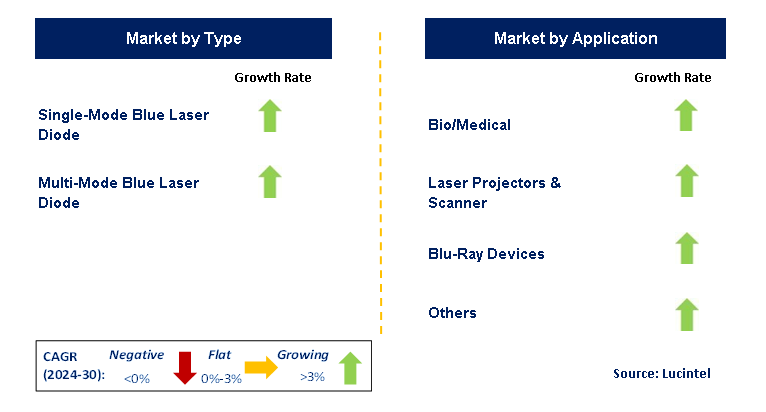
The future of the global 405nm laser diode market looks promising with opportunities in the bio/medical, laser projector & scanner, and blu-ray device markets. The global 405nm laser diode market is expected to grow with a CAGR of 10.4% from 2024 to 2030. The major drivers for this market are increasing demand for fluorescence microscopy & biomedical applications, growth in blu-ray disc technology & optical storage solutions, and rising integration of this product into high-definition displays & printing technologies.• Lucintel forecasts that, within the type category, the single-mode blue laser diode is expected to witness a higher growth over the forecast period.
• Within the application category, bio/medical is expected to witness the highest growth.
• In terms of regions, APAC is expected to witness the highest growth over the forecast period. Gain valuable insights for your business decisions with our comprehensive 150+ page report.
Emerging Trends in the 405nm Laser Diode Market
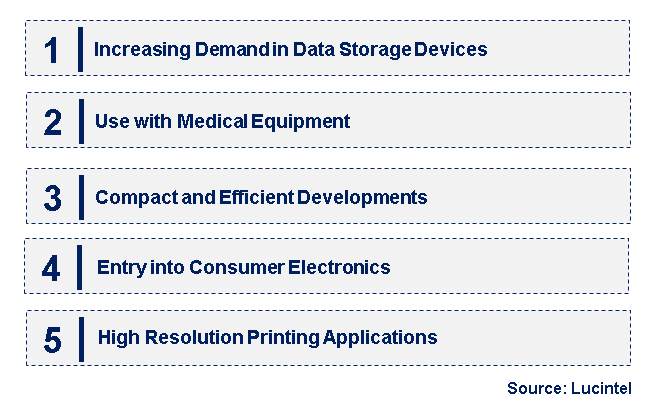
The 405nm laser diode market is constantly evolving and encompasses several key trends that testify to its growth in technology and increasing demand across various applications. These trends are changing the industry, encouraging innovation, and expanding the use of 405nm laser diodes in all sectors.• Increasing Demand in Data Storage Devices: The 405nm laser diode is increasingly used in Blu-ray discs, for instance, in next-generation data storage systems, while advancements in laser technology ensure better usability in terms of storability and speedy read/write functions to meet demands for high-definition content and data preservation.
• Use with Medical Equipment: The trend for 405nm laser diodes is strong, with surging applications in medical imaging and diagnostics. They are used in high-resolution endoscopy and other diagnostic tools for precise imaging capabilities, thereby contributing to better patient care and increased accuracy of diagnosis.
• Compact and Efficient Developments: There is interest in reducing the size of 405nm laser diodes to make them small enough to fit into tight spaces within electronic devices. Innovations in design and manufacturing aim to make diodes significantly more efficient and smaller, which is a goal for current-generation consumer electronics and wearable technology.
• Entry into Consumer Electronics: The use of 405nm laser diodes is dominated by high-definition projectors and optical drives, while rising requirements for higher resolution and performance in consumer products encourage the adoption of leading-edge laser diode technologies.
• High-Resolution Printing Applications: There is an upsurge in the use of 405nm laser diodes for high-resolution printing applications. Greater control over the printing process results in higher print resolution and quality for various industrial and commercial applications. All these trends are changing the 405nm laser diode market through new technological advancements and extended applications. These trends will influence market growth and innovation, focusing on data storage, medical devices, consumer electronics, compact designs, and printing applications.
Recent Developments in the 405nm Laser Diode Market
Recent developments in the market have had tremendous impacts on technological enhancements and increased usage of 405nm laser diodes in various applications, thereby enhancing product performance, efficiency, and versatility.• Effective Storage Solutions: Recent developments in 405nm laser diodes have improved data storage capabilities and read/write speeds, particularly for Blu-ray and optical disc technologies. These advancements support growing demands for high-definition content storage and efficient data management.
• Advancements in Medical Imaging: The employment of 405nm laser diodes has led to tremendous innovation in medical imaging systems. Developments include improvements in precision and resolution in diagnostic tools that assure better patient outcomes and more valid medical conclusions.
• Miniaturization and Efficiency Improvements: Over the years, technological advancements have resulted in the production of smaller and more energy-efficient laser diodes in the 405nm spectrum. These developments can be integrated into compact consumer electronics and wearable devices, enhancing overall performance and usability.
• Advancements in Consumer Electronics: The application of 405nm laser diodes has expanded into consumer electronics, including projectors and optical drives. Current innovations in this area are directed towards enhancing device performance and achieving higher resolution and quality for consumer applications.
• Introduction into High-Resolution Printing: Recent developments have indeed improved the use of 405nm laser diodes in high-resolution applications such as printing. Innovations in printing technology offer better control and precision, further improving print quality for industrial and commercial usage. These changes have been reshaping the 405nm laser diode market by significantly improving performance, broadening applications, and driving innovation. Focus on the following areas is shaping the market and supporting growth in the 405nm laser diode market: data storage, medical imaging, miniaturization, consumer electronics, and printing.
Strategic Growth Opportunities for 405nm Laser Diode Market
Diverse strategic growth opportunities are present in the 405nm laser diode market across key application areas. The technologies are becoming so advanced that new emerging areas are being explored for VCSELs as well, with increasing demand in high-performance components.• Data Storage Technologies: Demand for high-capacity and high-speed data storage solutions represents the highest growth opportunity for 405nm laser diodes. Their application in next-generation optical disc systems and data storage devices drives advancements in storage technology, meeting consumer demands for high-definition media.
• Medical Imaging and Diagnostics: Many growth opportunities will emerge from integrating 405nm laser diodes into medical imaging and diagnostic instruments. Their precision and resolution capabilities enhance imaging quality, supporting the development of endoscopy and other diagnostic tools that promote better healthcare.
• Consumer Electronics: One of the biggest market drivers for 405nm laser diodes is the increasing demand for high-resolution projectors, optical drives, and other consumer electronics. Innovations in applications for consumer electronics equipment, including new display technologies and compact integration within devices, provide numerous market opportunities.
• High-Resolution Printing: The 405nm laser diodes have growth prospects in high-resolution printing applications. They offer better control mechanisms with high-quality prints, making them valuable in the industrial and commercial printing markets. Improvements in print technology and print quality depend primarily on developments related to laser diodes.
• Wearable Technology: Opportunities for 405nm laser diodes are increasing in applications for smartwatches and fitness trackers as wearable technology rises. Wearable devices with health monitoring functionality and gesture control are driving innovation and expanding market potential for these types of applications. These strategic growth opportunities are revolutionizing the 405nm laser diode market by expanding applications and driving technological advancement. Focus on data storage, medical imaging, consumer electronics, printing, and wearable technology is shaping the market and supporting its growth.
405nm Laser Diode Market Driver and Challenges
Technological advancements, economic factors, and regulatory considerations are the primary drivers and challenges identified for the 405nm laser diode market. These factors are essential for guiding the market's maneuvering to penetrate further into its growth potential. The factors driving the 405nm laser diode market include:• Technological advancement: Innovations in 405nm laser diode technology improve performance and open up new application lines. Continuous research and development activities enhance efficiency, precision, and functionality, pushing the market forward and creating new use cases.
• Growing Demand for High-Resolution Applications: Demand for 405nm laser diodes arises from the need for higher resolution in data storage, imaging, and consumer electronics. The demand for high-performance quality increases as more consumers seek high-quality systems.
• Progression in Medical Imaging: Utilization in medical imaging and diagnostics develops the market. Precision and resolution capabilities contribute to advancements in health technology and improve diagnosis accuracy.
• Growing Demand in the Consumer Electronics Market: The increasing use of 405nm laser diodes in consumer electronics applications, including projectors and optical drives, drives the market forward. Innovation brings better resolution and performance to electronic devices.
• Continued Growth in Printing Technology: Increasing demand is seen in high-resolution printing, which incorporates 405nm laser diodes. Precision and control in printing applications advance industrial and commercial printing technologies. Challenges in the 405nm laser diode market include:
• High Manufacturing Cost: The cost of producing 405nm laser diodes is high due to advanced technology and materials. This restricts market development and limits adaptability in price-sensitive applications.
• Advanced Technology: The development and implementation of 405nm laser diodes involve sophisticated technology, making their adoption and integration into new applications challenging.
• Large Number of Players: The proliferation of players in the market for 405nm laser diodes increases competitive pressure. Market saturation can cause pricing issues and lower profitability for manufacturers. Key drivers for the 405nm laser diode market include technological advancements, high-resolution demand in applications, and expansion in medical imaging and consumer electronics. Challenges are associated with high production costs, technological complexity, and competition from various OEMs. Overcoming these challenges and utilizing growth opportunities will propel further growth and success in the 405nm laser diode market.
List of 405nm Laser Diode Companies
Companies in the market compete on the basis of product quality offered. Major players in this market focus on expanding their manufacturing facilities, R&D investments, infrastructural development, and leverage integration opportunities across the value chain. through these strategies 405nm laser diode companies cater increasing demand, ensure competitive effectiveness, develop innovative products & technologies, reduce production costs, and expand their customer base. Some of the 405nm laser diode companies profiled in this report include-• Sony
• Nichia
• Sharp
• Ushio
• Toptica Photonics
405nm Laser Diode by Segment
The study includes a forecast for the global 405nm laser diode market by type, application, and region.405nm Laser Diode Market by Type [Analysis by Value from 2018 to 2030]:
• Single-Mode Blue Laser Diode
• Multi-Mode Blue Laser Diode
405nm Laser Diode Market by Application [Analysis by Value from 2018 to 2030]:
• Bio/Medical
• Laser Projectors & Scanner
• Blu-Ray Devices
• Others
405nm Laser Diode Market by Region [Analysis by Value from 2018 to 2030]:
• North America
• Europe
• Asia Pacific
• The Rest of the World
Country Wise Outlook for the 405nm Laser Diode Market
The 405nm laser diode market has experienced critical trends where technological breakthroughs combine with increasing demand in many fields, including data storage, medical devices, and consumer electronics. Performance, efficiency, and application have newly become market dynamics in major regions like the United States, China, Germany, India, and Japan.• United States: Recent research on the 405nm laser diode in America has aimed to enhance data storage solutions and high-resolution imaging systems in high-definition optical drives and medical imaging applications.
• China: The market for 405nm laser diodes in China is growing rapidly, as the product is increasingly adopted in consumer electronics and telecommunications systems. Recent years have seen scaling up of production capacities and cost reductions through technological advancements. China's focus on integrating these diodes into advanced manufacturing processes and developing their usage in digital storage and projection systems is significant for the market landscape in the country.
• Germany: Advances in the use of 405nm laser diodes have been observed in Germany. Industrial and medical applications have improved due to enhancements in precision and reliability for high-resolution printing and medical diagnostics. Innovations are also emerging from German companies with R&D investments into new applications and performance in sectors that utilize 405nm laser diodes.
• India: The Indian laser diode market is rapidly developing at 405nm, with increasing applications in consumer electronics and telecommunications. These developments involve collaborations with worldwide firms to enhance local production capabilities and efficiency. Demand for high-quality optical devices and improvements in local manufacturing propel market growth and technological advancement in the region.
• Japan: Japan remains a leader in the 405nm laser diode market, focusing on developing high-performance applications for consumer electronics and industrial uses. Research efforts include increasing efficiency and miniaturizing these laser diodes to integrate them into compact devices and high-resolution imaging systems. Japanese companies are at the forefront of integrating 405nm laser diodes into advanced technologies.

Features of the Global 405nm Laser Diode Market
Market Size Estimates: 405nm laser diode market size estimation in terms of value ($B). Trend and Forecast Analysis: Market trends (2018 to 2023) and forecast (2024 to 2030) by various segments and regions. Segmentation Analysis: 405nm laser diode market size by type, application, and region in terms of value ($B). Regional Analysis: 405nm laser diode market breakdown by North America, Europe, Asia Pacific, and Rest of the World. Growth Opportunities: Analysis of growth opportunities in different types, applications, and regions for the 405nm laser diode market. Strategic Analysis: This includes M&A, new product development, and competitive landscape of the 405nm laser diode market. Analysis of competitive intensity of the industry based on Porter’s Five Forces model.If you are looking to expand your business in this or adjacent markets, then contact us. We have done hundreds of strategic consulting projects in market entry, opportunity screening, due diligence, supply chain analysis, M & A, and more.

FAQ
Q1. What is the growth forecast for 405nm laser diode market? Answer: The global 405nm laser diode market is expected to grow with a CAGR of 10.4% from 2024 to 2030. Q2. What are the major drivers influencing the growth of the 405nm laser diode market? Answer: The major drivers for this market are increasing demand for fluorescence microscopy & biomedical applications, growth in blu-ray disc technology & optical storage solutions, and rising integration of this product into high-definition displays & printing technologies. Q3. What are the major segments for 405nm laser diode market? Answer: The future of the 405nm laser diode market looks promising with opportunities in the bio/medical, laser projector & scanner, and blu-ray device markets. Q4. Who are the key 405nm laser diode market companies? Answer: Some of the key 405nm laser diode companies are as follows:• Sony
• Nichia
• Sharp
• Ushio
• Toptica Photonics Q5. Which 405nm laser diode market segment will be the largest in future? Answer: Lucintel forecasts that single-mode blue laser diode is expected to witness a higher growth over the forecast period. Q6. In 405nm laser diode market, which region is expected to be the largest in next 5 years? Answer: APAC is expected to witness the highest growth over the forecast period. Q.7 Do we receive customization in this report? Answer: Yes, Lucintel provides 10% customization without any additional cost.
Table of Contents
Methodology
- In-depth interviews of the major players in this market
- Detailed secondary research from competitors’ financial statements and published data
- Extensive searches of published works, market, and database information pertaining to industry news, company press releases, and customer intentions
- A compilation of the experiences, judgments, and insights of Lucintel’s professionals, who have analyzed and tracked this market over the years.


Buy Now
Choose a license that fits your team. Instant PDF delivery.
Prices exclude taxes. Instant delivery. Custom licensing available on request.
Key Questions
- • What are some of the most promising, high-growth opportunities for the 405nm laser diode market by type (single-mode blue laser diode and multi-mode blue laser diode), application (bio/medical, laser projectors & scanner, blu-ray devices, and others), and region (North America, Europe, Asia Pacific, and the Rest of the World)?
- • Which segments will grow at a faster pace and why?
- • Which region will grow at a faster pace and why?
- • What are the key factors affecting market dynamics? What are the key challenges and business risks in this market?
- • What are the business risks and competitive threats in this market?
- • What are the emerging trends in this market and the reasons behind them?
- • What are some of the changing demands of customers in the market?
- • What are the new developments in the market? Which companies are leading these developments?
- • Who are the major players in this market? What strategic initiatives are key players pursuing for business growth?
- • What are some of the competing products in this market and how big of a threat do they pose for loss of market share by material or product substitution?
- • What M&A activity has occurred in the last 5 years and what has its impact been on the industry? For any questions related to 405nm Laser Diode Market, 405nm Laser Diode Market Size, 405nm Laser Diode Market Growth, 405nm Laser Diode Market Analysis, 405nm Laser Diode Market Report, 405nm Laser Diode Market Share, 405nm Laser Diode Market Trends, 405nm Laser Diode Market Forecast, 405nm Laser Diode Market Companies, write Lucintel analyst at email: helpdesk@lucintel.com. We will be glad to get back to you soon.


