
Report Feature
3D Secure 2.0 Payer Authentication Market Trends and Forecast
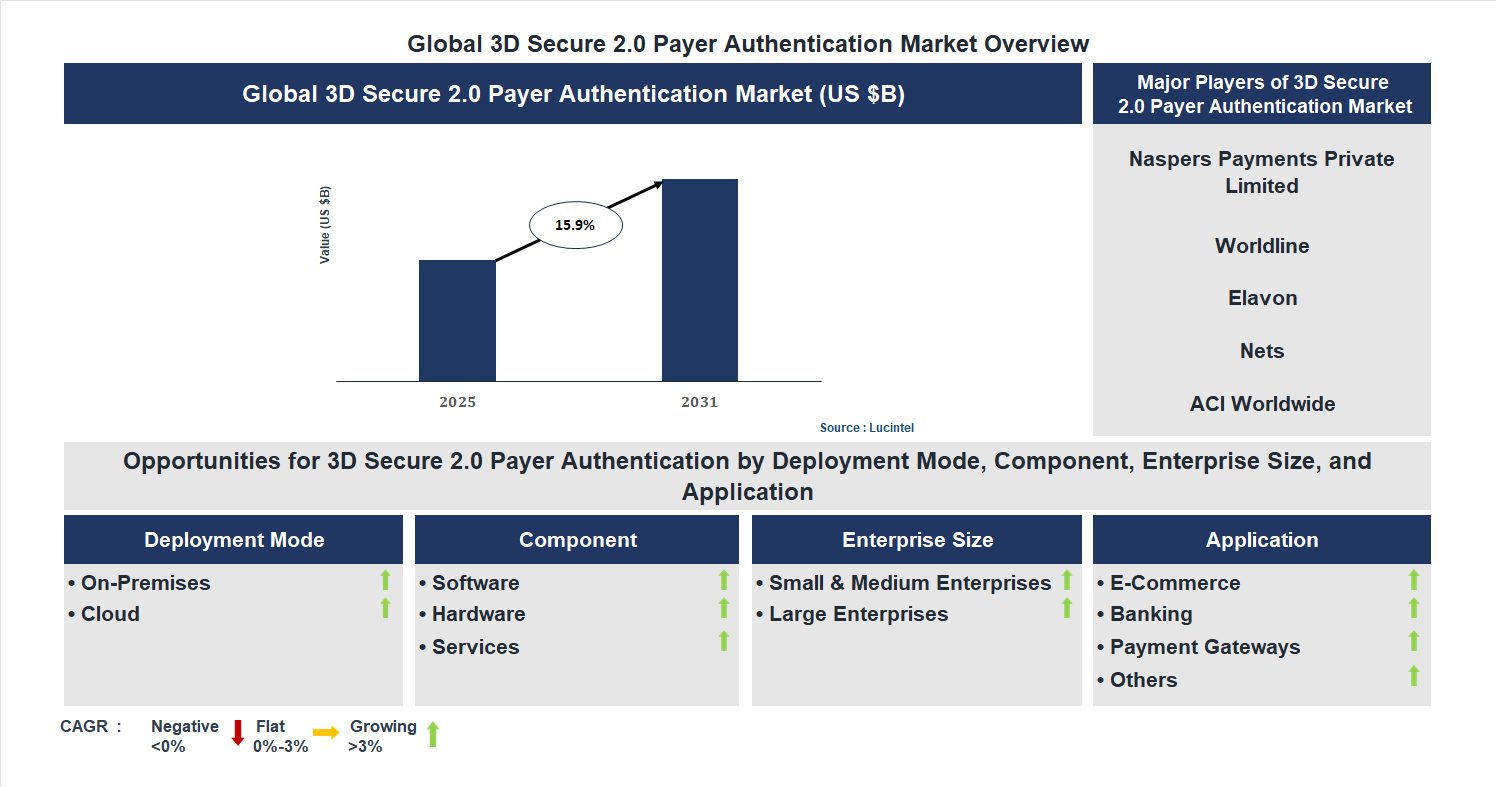
The future of the global 3D secure 2.0 payer authentication market looks promising with opportunities in the E-commerce, banking, and payment gateway markets. The global 3D secure 2.0 payer authentication market is expected to grow with a CAGR of 15.9% from 2025 to 2031. The major drivers for this market are the increasing online payment security requirements, the rising adoption of digital banking solutions, and the growing implementation of strong customer authentication.• Lucintel forecasts that, within the deployment mode category, cloud is expected to witness higher growth over the forecast period.
• Within the application category, banking is expected to witness the highest growth.
• In terms of region, APAC is expected to witness the highest growth over the forecast period. Gain valuable insights for your business decisions with our comprehensive 150+ page report. Sample figures with some insights are shown below.
Emerging Trends in the 3D Secure 2.0 Payer Authentication Market
The 3D secure 2.0 payer authentication market is experiencing rapid evolution driven by technological advancements, increasing online transaction volumes, and the need for enhanced security measures. As digital payments become more prevalent, stakeholders are seeking innovative solutions to reduce fraud, improve user experience, and comply with regulatory standards. The adoption of 3D Secure 2.0 is transforming how merchants, issuers, and consumers interact in the payment ecosystem. These developments are not only improving security but also influencing market dynamics, competitive strategies, and consumer trust. The following key trends highlight the major shifts shaping this market landscape.• Increased Adoption of 3D Secure 2.0: The market is witnessing widespread adoption of 3D Secure 2.0 due to its enhanced security features and improved user experience. Unlike its predecessor, it offers frictionless authentication options, reducing cart abandonment rates. Merchants and banks are increasingly integrating this protocol to comply with PSD2 regulations and to mitigate fraud risks. The shift is driven by the need for stronger security measures without compromising customer convenience, making 3D Secure 2.0 a standard in online payment authentication.
• Integration of Biometric Authentication: Biometric methods such as fingerprint, facial recognition, and voice authentication are becoming integral to 3D Secure 2.0. This trend enhances security by providing a seamless, user-friendly experience that reduces reliance on static passwords. Financial institutions and merchants are investing in biometric technology to facilitate quick, secure, and frictionless transactions. The integration of biometrics is also addressing privacy concerns and regulatory requirements, making authentication more robust and personalized, thereby increasing consumer trust and reducing fraud.
• Rise of Mobile and Contactless Payments: The proliferation of smartphones and contactless payment methods is significantly impacting the 3D Secure 2.0 market. Mobile devices are now primary channels for online transactions, necessitating adaptable authentication solutions. 3D Secure 2.0 is optimized for mobile, offering smoother authentication processes that cater to on-the-go consumers. This trend is expanding the market reach, encouraging merchants to adopt mobile-friendly security protocols, and fostering a more secure environment for contactless payments, which are increasingly preferred for their convenience and speed.
• Enhanced Data Analytics and Risk-Based Authentication: Advanced data analytics and machine learning algorithms are being integrated into 3D Secure 2.0 systems to enable risk-based authentication. This approach assesses transaction risk in real-time, allowing low-risk transactions to be authenticated seamlessly while requiring additional verification for high-risk activities. The impact is a more efficient, secure payment process that minimizes false declines and enhances customer experience. Financial institutions are leveraging these insights to better detect fraud patterns, optimize security measures, and reduce operational costs.
• Growing Regulatory Compliance and Standardization: Regulatory frameworks such as PSD2 in Europe are driving the adoption of 3D Secure 2.0 by mandating strong customer authentication (SCA). Standardization efforts are ensuring interoperability across different payment systems and regions, fostering a more unified security landscape. This trend compels market participants to upgrade their authentication protocols, invest in compliant solutions, and stay ahead of evolving regulatory requirements. The result is a more secure, transparent, and trustworthy online payment environment that benefits consumers, merchants, and financial institutions alike. In summary, these trends are collectively reshaping the 3D secure 2.0 payer authentication market by enhancing security, improving user experience, and ensuring regulatory compliance. They are fostering innovation, expanding market opportunities, and strengthening trust in digital payments, ultimately driving the growth and maturity of the online transaction ecosystem.

Recent Development in the 3D Secure 2.0 Payer Authentication Market
The 3D secure 2.0 payer authentication market has experienced significant advancements driven by the increasing need for secure online transactions and evolving fraud prevention measures. As digital payments become more prevalent, stakeholders are focusing on enhancing authentication protocols to improve user experience while maintaining security. Recent developments reflect technological innovations, regulatory changes, and strategic collaborations aimed at reducing fraud and increasing transaction approval rates. These trends are shaping the future landscape of online payment security, influencing merchants, financial institutions, and consumers alike. The following are five key recent developments in this dynamic market.• Adoption of EMV 3-D Secure Protocol: The shift from 3D Secure 1.0 to 2.0 has accelerated adoption of the EMV 3-D Secure protocol, which offers a frictionless, seamless authentication experience. This development reduces cart abandonment rates and enhances customer satisfaction by enabling frictionless authentication methods such as biometrics and device fingerprinting. Financial institutions and merchants are increasingly integrating EMV 3-D Secure to meet evolving security standards and improve transaction approval rates, thereby strengthening overall fraud prevention strategies.
• Integration of Biometric Authentication: The incorporation of biometric methods such as fingerprint scans, facial recognition, and voice authentication into 3D Secure 2.0 has gained momentum. This development enhances user convenience and security, reducing reliance on static passwords and one-time passcodes. The impact is a smoother checkout process, higher authentication success rates, and a significant reduction in fraud-related losses. Financial service providers are investing heavily in biometric technology to stay competitive and meet consumer demand for secure, effortless payment experiences.
• Regulatory Compliance and Standardization: Governments and industry bodies are implementing stricter regulations and standards for online payment security, including updates to PSD2 in Europe and similar initiatives worldwide. These regulations mandate strong customer authentication (SCA) and promote the adoption of 3D Secure 2.0. The development ensures a more uniform security framework across markets, reducing fraud and increasing consumer trust. Compliance requirements are prompting merchants and banks to upgrade their authentication systems, fostering widespread adoption of 3D Secure 2.0.
• Enhanced Fraud Detection and Risk-Based Authentication: Advances in AI and machine learning are enabling real-time risk assessment during transactions. 3D Secure 2.0 now incorporates sophisticated fraud detection algorithms that analyze transaction data to determine the level of authentication required. This development allows for dynamic, risk-based authentication, minimizing friction for legitimate customers while blocking fraudulent activities. The impact is a more efficient, secure payment ecosystem that adapts to emerging threats and improves overall transaction security.
• Strategic Collaborations and Platform Integrations: Major payment networks, technology providers, and financial institutions are forming strategic alliances to develop integrated authentication solutions. These collaborations facilitate seamless integration of 3D Secure 2.0 into existing payment platforms, expanding its reach and functionality. The development accelerates market penetration, enhances user experience, and promotes innovation in payer authentication. As a result, the market is witnessing increased adoption rates and a broader ecosystem of secure online payment solutions. In summary, these recent developments are significantly transforming the 3D secure 2.0 payer authentication market by improving security, user experience, and compliance. The integration of biometric authentication, advanced fraud detection, and strategic collaborations are driving higher adoption rates. These trends are fostering a more secure, efficient, and user-friendly online payment environment, ultimately boosting consumer confidence and reducing fraud-related losses across the digital payments landscape.
Strategic Growth Opportunities in the 3D Secure 2.0 Payer Authentication Market
The 3D secure 2.0 payer authentication market is experiencing rapid growth driven by increasing online transactions, rising fraud concerns, and the need for enhanced security measures. As digital payments become more prevalent across various sectors, the adoption of advanced authentication solutions like 3D Secure 2.0 is crucial for reducing fraud, improving customer experience, and complying with regulatory standards. This market's evolution is creating significant opportunities across key applications, enabling stakeholders to innovate and expand their offerings. The following are five key growth opportunities by application that are shaping the future of this market.• E-commerce Retail: Enhanced Security and Customer Trust : The surge in online shopping demands secure payment methods. 3D Secure 2.0 offers frictionless authentication, reducing cart abandonment and increasing customer confidence, thereby boosting sales and loyalty for e-commerce platforms.
• Financial Services: Fraud Reduction and Regulatory Compliance : Banks and financial institutions leverage 3D Secure 2.0 to meet stringent regulatory requirements and minimize fraud-related losses. This application enhances transaction security, fostering trust and enabling expansion into new digital banking services.
• Travel and Hospitality: Seamless Payment Experience : The travel industry benefits from 3D Secure 2.0 by providing quick, secure payments for bookings and transactions. This improves customer satisfaction, reduces chargebacks, and supports the growth of online travel services.
• Digital Wallets and Mobile Payments: Enhanced User Authentication : Integration of 3D Secure 2.0 with digital wallets ensures secure, frictionless transactions on mobile devices. This boosts user adoption, reduces fraud, and accelerates the shift toward cashless payments.
• B2B Payments and Enterprise Transactions: Secure Business Transactions : The adoption of 3D Secure 2.0 in B2B payments ensures secure, compliant transactions between enterprises. It reduces fraud risk, streamlines approval processes, and supports global business expansion. In summary, these growth opportunities across various applications are significantly impacting the 3D secure 2.0 payer authentication market by driving adoption, enhancing security, and improving user experience. This evolution is enabling market players to capitalize on digital transformation trends, foster customer trust, and meet regulatory demands, ultimately fueling market expansion and innovation.
3D Secure 2.0 Payer Authentication Market Driver and Challenges
The 3D secure 2.0 payer authentication market is influenced by a variety of technological, economic, and regulatory factors. Advancements in digital payment technologies and increasing online transaction volumes are driving demand for more secure authentication methods. Regulatory frameworks aimed at reducing fraud and enhancing consumer protection also play a significant role. Additionally, economic shifts such as the growth of e-commerce and mobile banking contribute to market expansion. However, challenges such as technological complexities, regulatory compliance costs, and consumer privacy concerns pose hurdles. Understanding these drivers and challenges is essential for stakeholders to navigate the evolving landscape effectively. The factors responsible for driving the 3D secure 2.0 payer authentication market include:• Technological Innovation: The rapid development of secure, user-friendly authentication solutions like 3D Secure 2.0 enhances transaction security and reduces fraud. This technology supports seamless, frictionless customer experiences while maintaining high security standards, encouraging merchants and financial institutions to adopt it. The integration of biometric authentication and AI-driven fraud detection further boosts its effectiveness, making online payments safer and more reliable. As digital payment methods proliferate, the demand for advanced security protocols like 3D Secure 2.0 continues to grow, fostering market expansion.
• Increasing Online Transactions: The surge in e-commerce, mobile banking, and digital wallets has significantly increased online payment volumes worldwide. This growth necessitates robust authentication mechanisms to prevent fraud and ensure consumer trust. 3D Secure 2.0 offers a scalable solution that adapts to the rising transaction load, providing enhanced security without compromising user experience. As consumers and merchants seek reliable payment authentication, the market benefits from this increased transaction activity, driving adoption and technological improvements.
• Regulatory Compliance and Standards: Governments and financial authorities worldwide are implementing strict regulations to combat online fraud and protect consumer data. Frameworks such as PSD2 in Europe mandate strong customer authentication (SCA), which 3D Secure 2.0 facilitates. Compliance with these standards compels financial institutions and merchants to adopt advanced authentication solutions, fueling market growth. Additionally, regulatory pressures encourage innovation in authentication methods, ensuring the market remains dynamic and responsive to evolving legal requirements.
• Growing Adoption of Contactless Payments: The COVID-19 pandemic accelerated the adoption of contactless and digital payment methods, emphasizing the need for secure authentication. 3D Secure 2.0 supports contactless transactions by providing frictionless yet secure authentication processes, aligning with consumer preferences for quick and safe payments. This trend boosts market demand as merchants seek to implement secure contactless solutions that comply with regulatory standards, ensuring customer confidence and reducing fraud risks.
• Consumer Demand for Enhanced Security: Increasing awareness of online fraud and data breaches has heightened consumer demand for secure payment methods. 3D Secure 2.0 addresses these concerns by offering improved security features, such as biometric authentication and risk-based analysis. As consumers prioritize safety, merchants and financial institutions are motivated to adopt these solutions to maintain trust and loyalty, thereby expanding the market. The challenges facing this 3D secure 2.0 payer authentication market include:
• Technological Complexity and Integration Issues: Implementing 3D Secure 2.0 involves complex integration with existing payment systems and infrastructure. Compatibility issues, technical glitches, and the need for ongoing updates can hinder adoption. Smaller merchants and financial institutions may lack the technical expertise or resources to seamlessly integrate these solutions, leading to delays and increased costs. Overcoming these challenges requires significant investment in technology and staff training, which can slow market growth and limit widespread adoption.
• Regulatory Compliance Costs: While regulations drive adoption, they also impose substantial compliance costs on financial institutions and merchants. Ensuring adherence to standards like PSD2 and GDPR involves investing in new systems, staff training, and ongoing audits. These costs can be prohibitive, especially for small and medium-sized enterprises, potentially limiting market penetration. Additionally, evolving regulatory landscapes require continuous updates, adding to operational expenses and complexity.
• Privacy and Data Security Concerns: The deployment of advanced authentication methods raises concerns about consumer privacy and data security. Collecting biometric data and behavioral analytics increases the risk of data breaches and misuse. Consumers may be hesitant to adopt new authentication methods if they perceive privacy risks, which can impede market growth. Ensuring robust data protection measures and transparent privacy policies is essential but challenging, requiring ongoing investment and compliance efforts. In summary, the 3D secure 2.0 payer authentication market is driven by technological advancements, increasing online transactions, regulatory mandates, and consumer demand for security. However, technological complexities, compliance costs, and privacy concerns pose significant challenges. These factors collectively influence the pace and scope of market growth, requiring stakeholders to balance innovation with risk management. Overall, the market is poised for expansion, provided that these challenges are effectively addressed through strategic investments and regulatory cooperation.
List of 3D Secure 2.0 Payer Authentication Companies
Companies in the market compete on the basis of product quality offered. Major players in this market focus on expanding their manufacturing facilities, R&D investments, infrastructural development, and leverage integration opportunities across the value chain. With these strategies 3D secure 2.0 payer authentication companies cater increasing demand, ensure competitive effectiveness, develop innovative products & technologies, reduce production costs, and expand their customer base. Some of the 3D secure 2.0 payer authentication companies profiled in this report include-• Naspers Payments Private Limited
• Worldline
• Elavon
• Nets
• ACI Worldwide
• Marqeta
• CardConnect
• GMO Payment Gateway
• UnionPay International
• BlueSnap
3D Secure 2.0 Payer Authentication Market by Segment
The study includes a forecast for the global 3D secure 2.0 payer authentication market by deployment mode, component, enterprise size, application, and region.3D Secure 2.0 Payer Authentication Market by Deployment Mode [Value from 2019 to 2031]:
• On-Premises
• Cloud
3D Secure 2.0 Payer Authentication Market by Component [Value from 2019 to 2031]:
• Software
• Hardware
• Services
3D Secure 2.0 Payer Authentication Market by Enterprise Size [Value from 2019 to 2031]:
• Small & Medium Enterprises
• Large Enterprises
3D Secure 2.0 Payer Authentication Market by Application [Value from 2019 to 2031]:
• E-Commerce
• Banking
• Payment Gateways
• Others
3D Secure 2.0 Payer Authentication Market by Region [Value from 2019 to 2031]:
• North America
• Europe
• Asia Pacific
• The Rest of the World
Country Wise Outlook for the 3D Secure 2.0 Payer Authentication Market
The 3D secure 2.0 payer authentication market has experienced significant growth driven by increasing online transactions, rising fraud concerns, and technological advancements in digital payment security. As e-commerce expands globally, countries are adopting enhanced authentication protocols to protect consumers and merchants. The market's evolution reflects a shift towards more seamless, secure, and user-friendly payment experiences, with regulatory pressures and consumer demand fueling innovation. Key players are investing in AI, biometric authentication, and mobile integration to stay competitive. This dynamic landscape varies across regions, influenced by local regulations, technological infrastructure, and consumer behavior.• United States: The U.S. market has seen rapid adoption of 3D Secure 2.0, driven by major card networks and financial institutions implementing EMV 3DS standards. Increased focus on fraud prevention and compliance with PCI DSS has accelerated deployment. Fintech companies are integrating biometric authentication and mobile-friendly solutions to enhance user experience. Regulatory initiatives like the FFIEC guidelines further promote secure online payments. The market is also witnessing collaborations between banks and technology providers to develop advanced fraud detection systems, boosting overall security and customer confidence.
• China: China’s market is characterized by a high volume of digital payments through platforms like Alipay and WeChat Pay, which have integrated 3D Secure 2.0 to improve transaction security. The government’s push for digital economy development and anti-fraud measures have accelerated adoption. Mobile-first strategies dominate, with biometric authentication becoming standard. Local regulations emphasize data security and consumer protection, encouraging financial institutions to upgrade their authentication systems. The market is also influenced by the rapid growth of cross-border e-commerce, requiring robust security protocols to facilitate international transactions.
• Germany: Germany’s adoption of 3D Secure 2.0 is driven by strict EU regulations such as PSD2 and Strong Customer Authentication (SCA) requirements. Banks and payment service providers are investing in seamless authentication solutions that balance security with user convenience. The market benefits from a mature digital infrastructure and high consumer awareness of online security risks. Innovations include biometric and token-based authentication methods. Collaboration between banks and fintech firms is common to develop integrated, secure payment solutions. The focus remains on reducing fraud while maintaining a smooth customer experience in compliance with European standards.
• India: India’s rapidly growing digital payment ecosystem, led by UPI and mobile wallets, is increasingly adopting 3D Secure 2.0 to enhance transaction security amid rising digital fraud. The government’s Digital India initiative and demonetization efforts have accelerated digital adoption. Financial institutions are deploying biometric authentication and AI-driven fraud detection tools. The market faces challenges related to infrastructure and digital literacy but is rapidly evolving with innovative security measures. Regulatory bodies are encouraging the adoption of secure authentication protocols to foster trust and facilitate the expansion of digital payments across urban and rural areas.
• Japan: Japan’s market is advancing with the integration of 3D Secure 2.0, supported by a strong emphasis on consumer protection and regulatory compliance under the Payment Services Act. Banks and payment providers are adopting biometric and token-based authentication to improve security and user experience. The market benefits from high digital literacy and a tech-savvy population, which drives demand for seamless, secure online transactions. Collaborations between financial institutions and technology firms are common to develop innovative security solutions. The focus remains on reducing fraud, complying with local regulations, and maintaining Japan’s reputation for secure financial services.

Features of the Global 3D Secure 2.0 Payer Authentication Market
Market Size Estimates: 3D secure 2.0 payer authentication market size estimation in terms of value ($B). Trend and Forecast Analysis: Market trends (2019 to 2024) and forecast (2025 to 2031) by various segments and regions. Segmentation Analysis: 3D secure 2.0 payer authentication market size by various segments, such as by deployment mode, component, enterprise size, application, and region in terms of value ($B). Regional Analysis: 3D secure 2.0 payer authentication market breakdown by North America, Europe, Asia Pacific, and Rest of the World. Growth Opportunities: Analysis of growth opportunities in different deployment mode, components, enterprise sizes, applications, and regions for the 3D secure 2.0 payer authentication market. Strategic Analysis: This includes M&A, new product development, and competitive landscape of the 3D secure 2.0 payer authentication market. Analysis of competitive intensity of the industry based on Porter’s Five Forces model.
FAQ
Q1. What is the growth forecast for 3D secure 2.0 payer authentication market? Answer: The global 3D secure 2.0 payer authentication market is expected to grow with a CAGR of 15.9% from 2025 to 2031. Q2. What are the major drivers influencing the growth of the 3D secure 2.0 payer authentication market? Answer: The major drivers for this market are the increasing online payment security requirements, the rising adoption of digital banking solutions, and the growing implementation of strong customer authentication. Q3. What are the major segments for 3D secure 2.0 payer authentication market? Answer: The future of the 3D secure 2.0 payer authentication market looks promising with opportunities in the E-commerce, banking, and payment gateway markets. Q4. Who are the key 3D secure 2.0 payer authentication market companies? Answer: Some of the key 3D secure 2.0 payer authentication companies are as follows:• Naspers Payments Private Limited
• Worldline
• Elavon
• Nets
• ACI Worldwide
• Marqeta
• CardConnect
• GMO Payment Gateway
• UnionPay International
• BlueSnap Q5. Which 3D secure 2.0 payer authentication market segment will be the largest in future? Answer: Lucintel forecasts that, within the deployment mode category, cloud is expected to witness higher growth over the forecast period. Q6. In 3D secure 2.0 payer authentication market, which region is expected to be the largest in next 5 years? Answer: In terms of region, APAC is expected to witness the highest growth over the forecast period. Q7. Do we receive customization in this report? Answer: Yes, Lucintel provides 10% customization without any additional cost.
Table of Contents
List of Figures
List of Tables
Methodology
- In-depth interviews of the major players in this market
- Detailed secondary research from competitors’ financial statements and published data
- Extensive searches of published works, market, and database information pertaining to industry news, company press releases, and customer intentions
- A compilation of the experiences, judgments, and insights of Lucintel’s professionals, who have analyzed and tracked this market over the years.


Buy Now
Choose a license that fits your team. Instant PDF delivery.
Prices exclude taxes. Instant delivery. Custom licensing available on request.
Key Questions
- • What are some of the most promising, high-growth opportunities for the 3D secure 2.0 payer authentication market by deployment mode (on-premises and cloud), component (software, hardware, and services), enterprise size (small & medium enterprises and large enterprises), application (E-commerce, banking, payment gateways, and others), and region (North America, Europe, Asia Pacific, and the Rest of the World)?
- • Which segments will grow at a faster pace and why?
- • Which region will grow at a faster pace and why?
- • What are the key factors affecting market dynamics? What are the key challenges and business risks in this market?
- • What are the business risks and competitive threats in this market?
- • What are the emerging trends in this market and the reasons behind them?
- • What are some of the changing demands of customers in the market?
- • What are the new developments in the market? Which companies are leading these developments?
- • Who are the major players in this market? What strategic initiatives are key players pursuing for business growth?
- • What are some of the competing products in this market and how big of a threat do they pose for loss of market share by material or product substitution?
- • What M&A activity has occurred in the last 5 years and what has its impact been on the industry? For any questions related to 3D Secure 2.0 Payer Authentication Market, 3D Secure 2.0 Payer Authentication Market Size, 3D Secure 2.0 Payer Authentication Market Growth, 3D Secure 2.0 Payer Authentication Market Analysis, 3D Secure 2.0 Payer Authentication Market Report, 3D Secure 2.0 Payer Authentication Market Share, 3D Secure 2.0 Payer Authentication Market Trends, 3D Secure 2.0 Payer Authentication Market Forecast, 3D Secure 2.0 Payer Authentication Companies, write Lucintel analyst at email: helpdesk@lucintel.com. We will be glad to get back to you soon.


