
Report Feature
3D Printed Orthoses Market Trends and Forecast
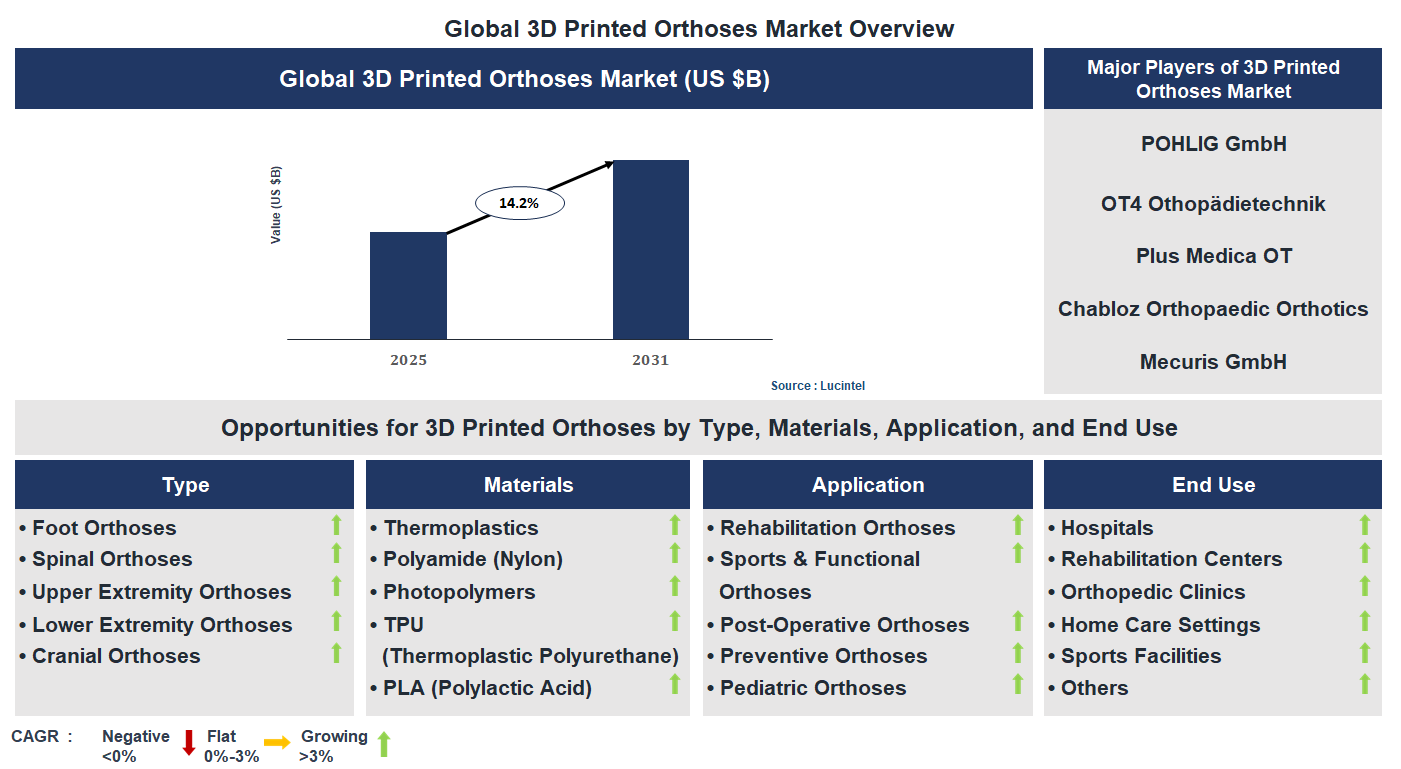
The future of the global 3D printed orthoses market looks promising with opportunities in the hospital, rehabilitation center, orthopedic clinic, home care setting, and sport facility markets. The global 3D printed orthoses market is expected to grow with a CAGR of 14.2% from 2025 to 2031. The major drivers for this market are the increasing demand for personalized medical solutions, the rising adoption of 3D printing technologies in healthcare, and the growing preference for cost-effective orthotic treatments.• Lucintel forecasts that, within the type category, lower extremity orthoses is expected to witness the highest growth over the forecast period.
• Within the end use category, rehabilitation center is expected to witness the highest growth.
• In terms of region, North America is expected to witness the highest growth over the forecast period. Gain valuable insights for your business decisions with our comprehensive 150+ page report. Sample figures with some insights are shown below.
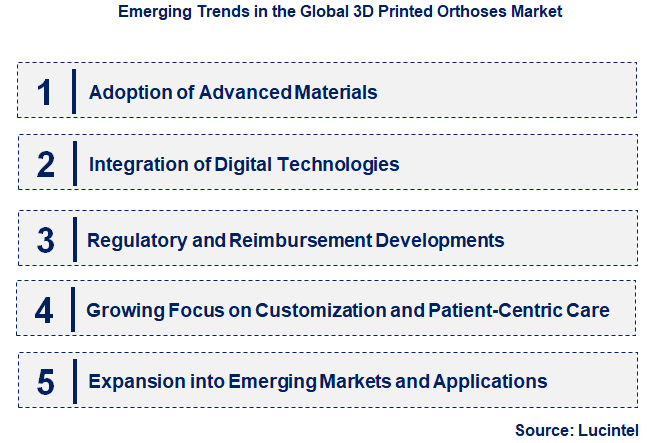
Emerging Trends in the 3D Printed Orthoses Market
The 3D printed orthoses market is experiencing rapid growth driven by technological advancements, increasing demand for personalized healthcare solutions, and a shift towards more efficient manufacturing processes. As healthcare providers seek innovative ways to improve patient outcomes, 3D printing offers customizable, cost-effective, and rapid production options. This market is also influenced by regulatory developments and the integration of digital health technologies, which are transforming traditional orthotic manufacturing. The following key trends highlight the evolving landscape of this industry, illustrating how technological, regulatory, and consumer preferences are shaping its future trajectory.• Adoption of Advanced Materials: The market is witnessing a shift towards innovative materials such as biocompatible plastics, composites, and flexible filaments. These materials enhance the durability, comfort, and functionality of orthoses, enabling better patient outcomes. The use of advanced materials also allows for lighter, more ergonomic designs, which are crucial for patient compliance and satisfaction. As material science progresses, manufacturers can produce more sophisticated and tailored orthotic devices, expanding the scope of 3D printing applications in healthcare.
• Integration of Digital Technologies: Digital workflows, including CAD design, 3D scanning, and virtual modeling, are becoming standard in orthoses manufacturing. These technologies streamline the customization process, reduce production time, and improve accuracy. The integration of digital tools also facilitates remote consultations and telemedicine, allowing clinicians to design and modify orthoses without physical contact. This trend enhances efficiency, reduces costs, and improves patient engagement, making personalized orthoses more accessible and timely.
• Regulatory and Reimbursement Developments: Evolving regulatory frameworks are increasingly recognizing 3D printed orthoses as safe and effective medical devices. Clearer guidelines and standards are being established, which facilitate market entry and adoption. Additionally, reimbursement policies are gradually adapting to cover 3D printed solutions, encouraging healthcare providers to adopt this technology. These developments reduce barriers to market growth and foster innovation, ensuring that patients benefit from advanced, personalized orthotic devices.
• Growing Focus on Customization and Patient-Centric Care: The ability to produce highly personalized orthoses tailored to individual anatomy and needs is a major driver. 3D printing allows for rapid prototyping and modifications, leading to better fit, comfort, and functionality. This trend aligns with the broader shift towards patient-centric healthcare, emphasizing improved quality of life and satisfaction. As consumers become more aware of personalized options, demand for custom orthoses is expected to rise, encouraging manufacturers to innovate further in design and material use.
• Expansion into Emerging Markets and Applications: The market is expanding beyond traditional healthcare settings into emerging regions and new application areas such as sports medicine, pediatric care, and prosthetics. The cost-effectiveness and scalability of 3D printing make it suitable for resource-limited environments, increasing access to orthotic solutions. Additionally, innovations are enabling the development of lightweight, durable, and aesthetically appealing devices, broadening their use cases. This expansion is driving market growth and diversifying the range of products available to different patient populations. In summary, these trends are collectively transforming the 3D printed orthoses market by making devices more personalized, accessible, and efficient. Technological innovations, regulatory clarity, and expanding applications are fostering a more dynamic and patient-focused industry. As these developments continue, the market is poised for significant growth, ultimately improving healthcare outcomes and patient quality of life worldwide.
Recent Development in the 3D Printed Orthoses Market
The 3D printed orthoses market has experienced rapid growth driven by technological advancements, increasing demand for personalized healthcare solutions, and a shift towards cost-effective manufacturing processes. As healthcare providers seek innovative ways to improve patient outcomes, 3D printing offers customizable, lightweight, and durable orthoses that enhance comfort and functionality. Recent developments reflect a focus on material innovation, regulatory approvals, and expanding applications across various medical fields. These trends are transforming the landscape of orthotic manufacturing, making treatments more accessible and tailored to individual needs. The following are five key recent developments shaping this dynamic market.• Material Innovation: Development of biocompatible and lightweight materials such as thermoplastics and composites has improved orthoses durability and comfort, leading to better patient compliance and outcomes.
• Regulatory Approvals: Increased approvals from health authorities for 3D printed orthoses have accelerated market adoption, ensuring safety and efficacy, and encouraging manufacturers to innovate further.
• Customization Technologies: Advances in imaging and CAD software enable precise customization of orthoses, resulting in better fit, enhanced functionality, and reduced manufacturing time.
• Cost Reduction: Automation and streamlined production processes have significantly lowered manufacturing costs, making 3D printed orthoses more affordable and accessible to a broader patient base.
• Expansion of Applications: The use of 3D printing has expanded beyond traditional orthoses to include prosthetics, surgical planning models, and rehabilitation devices, broadening market scope and opportunities. These developments are collectively driving the growth of the 3D printed orthoses market by improving product quality, reducing costs, and expanding application areas. As a result, patient outcomes are improving, healthcare providers are adopting innovative solutions more rapidly, and the overall market is experiencing sustained growth and diversification.
Strategic Growth Opportunities in the 3D Printed Orthoses Market
The 3D printed orthoses market is experiencing rapid growth driven by technological advancements, increasing demand for personalized healthcare solutions, and a shift towards minimally invasive treatments. As healthcare providers seek innovative ways to improve patient outcomes, 3D printing offers customizable, cost-effective, and rapid production options. This evolving landscape presents numerous opportunities across various applications, enabling manufacturers to address specific patient needs and expand their market reach. The following key growth opportunities highlight the potential for innovation and expansion within this dynamic industry, shaping the future of orthotic care and improving the quality of life for patients worldwide.• Customization and Personalization: The ability to create tailored orthoses enhances patient comfort and effectiveness. 3D printing allows precise customization based on individual anatomy, leading to better fit, improved compliance, and faster recovery times. This personalization is particularly impactful in pediatric and complex cases, driving demand and market growth.
• Rapid Prototyping and Production: 3D printing significantly reduces manufacturing time and costs, enabling quick turnaround from design to delivery. This agility benefits hospitals and clinics by providing timely solutions for acute injuries and urgent needs, thereby expanding the application scope and increasing market penetration.
• Cost-Effective Manufacturing: The technology lowers production costs by minimizing material waste and reducing labor requirements. Cost savings make orthoses more accessible to a broader patient demographic, including those in developing regions, thus broadening market reach and fostering inclusivity.
• Innovation in Material Use: Advances in biocompatible and lightweight materials expand the functional capabilities of 3D printed orthoses. These innovations improve durability, comfort, and aesthetic appeal, attracting more healthcare providers and patients to adopt this technology.
• Integration with Digital Health Technologies: Combining 3D printed orthoses with sensors and IoT devices enables real-time monitoring and adjustments. This integration enhances treatment efficacy, promotes remote patient management, and opens new revenue streams for manufacturers, further accelerating market growth. In summary, these growth opportunities are transforming the 3D printed orthoses market by enabling highly personalized, cost-effective, and innovative solutions. They are expanding application possibilities, improving patient outcomes, and driving industry expansion across diverse healthcare settings. As these trends continue, the market is poised for sustained growth and technological evolution.
3D Printed Orthoses Market Driver and Challenges
The 3D printed orthoses market is influenced by a variety of technological, economic, and regulatory factors that shape its growth trajectory. Advances in 3D printing technology have revolutionized the production of custom orthoses, making them more accessible and affordable. Economic factors such as increasing healthcare expenditure and rising prevalence of musculoskeletal disorders drive demand. Regulatory frameworks around medical device safety and approval processes impact market entry and innovation. Additionally, technological innovations in materials and design software enhance product customization and efficiency. These combined drivers and challenges create a dynamic environment that influences market expansion, innovation, and adoption rates across different regions. The factors responsible for driving the 3D printed orthoses market include:• Technological Advancements: The rapid development of 3D printing technology has enabled the production of highly customized, lightweight, and durable orthoses. Innovations in additive manufacturing allow for complex geometries and rapid prototyping, reducing production time and costs. This technological progress enhances patient outcomes and increases adoption among healthcare providers. As materials improve and printing speeds increase, the market benefits from more efficient and personalized solutions, fostering growth and expanding application areas.
• Rising Prevalence of Musculoskeletal Disorders: The increasing incidence of conditions such as arthritis, osteoporosis, and sports injuries globally is a significant driver. These disorders often require orthotic support for mobility and pain management. The aging population further amplifies this demand, as older adults are more susceptible to musculoskeletal issues. The ability to produce customized orthoses quickly and cost-effectively with 3D printing addresses this growing need, making treatment more accessible and improving the quality of life for patients.
• Cost-Effectiveness and Reduced Manufacturing Time: 3D printing significantly lowers production costs by minimizing material waste and reducing labor requirements. Traditional manufacturing methods are often time-consuming and expensive, especially for custom devices. 3D printing streamlines the process, enabling rapid production and on-demand manufacturing, which reduces inventory costs. This cost efficiency makes orthoses more affordable for patients and healthcare providers, encouraging wider adoption and expanding market reach, especially in emerging economies.
• Increasing Adoption in Hospitals and Clinics: The integration of 3D printing technology into clinical settings is accelerating. Hospitals and clinics are adopting in-house 3D printing facilities to produce custom orthoses tailored to individual patient needs. This trend improves treatment outcomes, shortens wait times, and reduces dependency on external suppliers. The ease of customization and quick turnaround times make 3D printed orthoses a preferred choice, fostering market growth through increased clinical acceptance and utilization.
• Regulatory Approvals and Standards: The development of clear regulatory pathways and standards for 3D printed medical devices is crucial. Approval processes ensure safety, efficacy, and quality, which build trust among healthcare providers and patients. Regulatory bodies are increasingly providing guidelines specific to additive manufacturing in healthcare, facilitating market entry for innovative products. However, navigating these regulations can be complex and time-consuming, potentially hindering rapid market expansion and innovation. The challenges facing this 3D printed orthoses market include:
• Regulatory Uncertainty: The lack of comprehensive and standardized regulatory frameworks for 3D printed orthoses creates uncertainty. Variations in approval processes across regions can delay product launches and increase compliance costs. Ensuring safety and efficacy while fostering innovation remains a delicate balance, and evolving regulations may require continuous adaptation by manufacturers. This uncertainty can hinder market growth and discourage investment in new technologies.
• Material Limitations and Biocompatibility Concerns: Although advancements have been made, suitable materials that are biocompatible, durable, and easy to print are still limited. Some materials may not meet the long-term performance requirements or may pose risks of allergic reactions. The development of new, safe, and cost-effective materials is essential but challenging, impacting the quality and reliability of orthoses and potentially limiting market expansion.
• High Initial Investment and Technical Expertise: Implementing 3D printing technology in healthcare settings requires significant capital investment in equipment and software. Additionally, skilled personnel are needed to operate and maintain the printers and design custom orthoses. These barriers can be prohibitive for smaller clinics or emerging markets, restricting widespread adoption. Overcoming these financial and technical hurdles is vital for broader market penetration. In summary, the 3D printed orthoses market is driven by technological innovations, increasing healthcare needs, cost efficiencies, and clinical adoption, while facing challenges related to regulation, material development, and high initial costs. These factors collectively influence the pace and scope of market growth. Continued advancements and regulatory clarity are essential to overcoming barriers and unlocking the full potential of 3D printing in orthotic solutions, ultimately improving patient care and expanding market opportunities globally.
List of 3D Printed Orthoses Companies
Companies in the market compete on the basis of product quality offered. Major players in this market focus on expanding their manufacturing facilities, R&D investments, infrastructural development, and leverage integration opportunities across the value chain. With these strategies 3D printed orthoses companies cater increasing demand, ensure competitive effectiveness, develop innovative products & technologies, reduce production costs, and expand their customer base. Some of the 3D printed orthoses companies profiled in this report include-• POHLIG GmbH
• OT4 Othopädietechnik
• Plus Medica OT
• Chabloz Orthopaedic Orthotics
• Mecuris GmbH
• Shapeways
• ScientiFeet
• Invent Medical
• Xkelet Easy Life SL
• 8sole
3D Printed Orthoses Market by Segment
The study includes a forecast for the global 3D printed orthoses market by type, materials, application, end use, and region.3D Printed Orthoses Market by Type [Value from 2019 to 2031]:
• Foot Orthoses
• Spinal Orthoses
• Upper Extremity Orthoses
• Lower Extremity Orthoses
• Cranial Orthoses
3D Printed Orthoses Market by Materials [Value from 2019 to 2031]:
• Thermoplastics
• Polyamide (Nylon)
• Photopolymers
• TPU (Thermoplastic Polyurethane)
• PLA (Polylactic Acid)
3D Printed Orthoses Market by Application [Value from 2019 to 2031]:
• Rehabilitation Orthoses
• Sports & Functional Orthoses
• Post-Operative Orthoses
• Preventive Orthoses
• Pediatric Orthoses
3D Printed Orthoses Market by End Use [Value from 2019 to 2031]:
• Hospitals
• Rehabilitation Centers
• Orthopedic Clinics
• Home Care Settings
• Sports Facilities
• Others
3D Printed Orthoses Market by Region [Value from 2019 to 2031]:
• North America
• Europe
• Asia Pacific
• The Rest of the World
Country Wise Outlook for the 3D Printed Orthoses Market
The 3D-printed orthoses market has experienced significant global growth, driven by technological advancements, increasing demand for personalized healthcare solutions, and the rising prevalence of musculoskeletal disorders. Countries are adopting innovative manufacturing techniques to improve patient outcomes and reduce costs. The markets evolution reflects a shift towards more efficient, customizable, and accessible orthotic devices, with key players investing in research and development. As healthcare systems adapt to these changes, regional differences in adoption rates and technological integration are becoming increasingly evident, shaping the future landscape of 3D-printed orthoses worldwide.• United States: The US market has seen rapid adoption of 3D printed orthoses, driven by technological innovation and a focus on personalized medicine. Major healthcare providers and startups are investing in 3D printing labs to develop custom solutions for patients with complex needs. Regulatory frameworks are evolving to accommodate new manufacturing methods, facilitating faster approval processes. Additionally, collaborations between tech companies and healthcare institutions are fostering advancements in materials and design. The COVID-19 pandemic accelerated telehealth and remote manufacturing, further boosting market growth. Overall, the US remains a leader in integrating 3D printing into clinical practice.
• China: China is rapidly expanding its 3D printed orthoses market, supported by government initiatives promoting healthcare innovation and manufacturing. The country benefits from a large domestic market, increasing healthcare expenditure, and a growing number of orthopedic clinics adopting 3D printing technology. Local companies are focusing on cost-effective solutions and scalable production methods to meet rising demand. R&D efforts are concentrated on developing lightweight, durable, and biocompatible materials. The government’s "Made in China 2025" plan emphasizes advanced manufacturing, including 3D printing, which further propels market growth. China aims to become a global hub for 3D printed medical devices.
• Germany: Germanys market is characterized by a strong emphasis on quality, precision, and regulatory compliance. The country’s robust healthcare infrastructure and focus on innovation have led to increased adoption of 3D printed orthoses, especially in hospitals and specialized clinics. German companies are investing in research collaborations with universities to develop advanced materials and design techniques. The integration of 3D printing with digital health records enhances customization and efficiency. Regulatory standards, such as CE marking, ensure safety and efficacy, fostering trust among practitioners. Germany’s commitment to sustainable manufacturing practices also influences material selection and production processes in this sector.
• India: India is witnessing a burgeoning market for 3D printed orthoses, driven by rising awareness, increasing orthopedic cases, and cost-effective manufacturing solutions. The government’s initiatives to promote healthcare innovation and digital health are supporting market growth. Local startups and small-scale manufacturers are adopting 3D printing to provide affordable, customized orthoses, especially in rural and semi-urban areas. The availability of low-cost materials and desktop 3D printers has democratized access to this technology. Additionally, collaborations with international firms are enhancing R&D capabilities. The market is expected to expand rapidly as healthcare infrastructure improves and awareness increases about personalized treatment options.
• Japan: Japan’s market for 3D printed orthoses is characterized by technological sophistication and a focus on aging population needs. The country’s advanced healthcare system and high adoption of digital health technologies facilitate integration of 3D printing. Japanese companies are developing innovative materials that are lightweight, durable, and biocompatible. The government supports research through grants and partnerships with academic institutions. There is a strong emphasis on improving quality of life for elderly patients, with customized orthoses tailored to individual requirements. Regulatory pathways are well-established, enabling faster commercialization. Japan continues to lead in integrating cutting-edge 3D printing solutions into clinical practice.

Features of the Global 3D Printed Orthoses Market
Market Size Estimates: 3D printed orthoses market size estimation in terms of value ($B). Trend and Forecast Analysis: Market trends (2019 to 2024) and forecast (2025 to 2031) by various segments and regions. Segmentation Analysis: 3D printed orthoses market size by various segments, such as by type, materials, application, end use, and region in terms of value ($B). Regional Analysis: 3D printed orthoses market breakdown by North America, Europe, Asia Pacific, and Rest of the World. Growth Opportunities: Analysis of growth opportunities in different types, materials, applications, end uses, and regions for the 3D printed orthoses market. Strategic Analysis: This includes M&A, new product development, and competitive landscape of the 3D printed orthoses market. Analysis of competitive intensity of the industry based on Porter’s Five Forces model.
FAQ
Q1. What is the growth forecast for 3D printed orthoses market? Answer: The global 3D printed orthoses market is expected to grow with a CAGR of 14.2% from 2025 to 2031. Q2. What are the major drivers influencing the growth of the 3D printed orthoses market? Answer: The major drivers for this market are the increasing demand for personalized medical solutions, the rising adoption of 3D printing technologies in healthcare, and the growing preference for cost-effective orthotic treatments. Q3. What are the major segments for 3D printed orthoses market? Answer: The future of the 3D printed orthoses market looks promising with opportunities in the hospital, rehabilitation center, orthopedic clinic, home care setting, and sport facility markets. Q4. Who are the key 3D printed orthoses market companies? Answer: Some of the key 3D printed orthoses companies are as follows:• POHLIG GmbH
• OT4 Othopädietechnik
• Plus Medica OT
• Chabloz Orthopaedic Orthotics
• Mecuris GmbH
• Shapeways
• ScientiFeet
• Invent Medical
• Xkelet Easy Life SL
• 8sole Q5. Which 3D printed orthoses market segment will be the largest in future? Answer: Lucintel forecasts that, within the type category, lower extremity orthoses is expected to witness the highest growth over the forecast period. Q6. In 3D printed orthoses market, which region is expected to be the largest in next 5 years? Answer: In terms of region, North America is expected to witness the highest growth over the forecast period. Q7. Do we receive customization in this report? Answer: Yes, Lucintel provides 10% customization without any additional cost.
Table of Contents
List of Figures
List of Tables
Methodology
- In-depth interviews of the major players in this market
- Detailed secondary research from competitors’ financial statements and published data
- Extensive searches of published works, market, and database information pertaining to industry news, company press releases, and customer intentions
- A compilation of the experiences, judgments, and insights of Lucintel’s professionals, who have analyzed and tracked this market over the years.


Buy Now
Choose a license that fits your team. Instant PDF delivery.
Prices exclude taxes. Instant delivery. Custom licensing available on request.
Key Questions
- • What are some of the most promising, high-growth opportunities for the 3D printed orthoses market by type (foot orthoses, spinal orthoses, upper extremity orthoses, lower extremity orthoses, and cranial orthoses), materials (thermoplastics, polyamide (nylon), photopolymers, TPU (thermoplastic polyurethane), and PLA (polylactic acid)), application (rehabilitation orthoses, sports & functional orthoses, post-operative orthoses, preventive orthoses, and pediatric orthoses), end use (hospitals, rehabilitation centers, orthopedic clinics, home care settings, sports facilities, and others), and region (North America, Europe, Asia Pacific, and the Rest of the World)?
- • Which segments will grow at a faster pace and why?
- • Which region will grow at a faster pace and why?
- • What are the key factors affecting market dynamics? What are the key challenges and business risks in this market?
- • What are the business risks and competitive threats in this market?
- • What are the emerging trends in this market and the reasons behind them?
- • What are some of the changing demands of customers in the market?
- • What are the new developments in the market? Which companies are leading these developments?
- • Who are the major players in this market? What strategic initiatives are key players pursuing for business growth?
- • What are some of the competing products in this market and how big of a threat do they pose for loss of market share by material or product substitution?
- • What M&A activity has occurred in the last 5 years and what has its impact been on the industry? For any questions related to 3D Printed Orthoses Market, 3D Printed Orthoses Market Size, 3D Printed Orthoses Market Growth, 3D Printed Orthoses Market Analysis, 3D Printed Orthoses Market Report, 3D Printed Orthoses Market Share, 3D Printed Orthoses Market Trends, 3D Printed Orthoses Market Forecast, 3D Printed Orthoses Companies, write Lucintel analyst at email: helpdesk@lucintel.com. We will be glad to get back to you soon.


