
Market Report · July 15, 2026

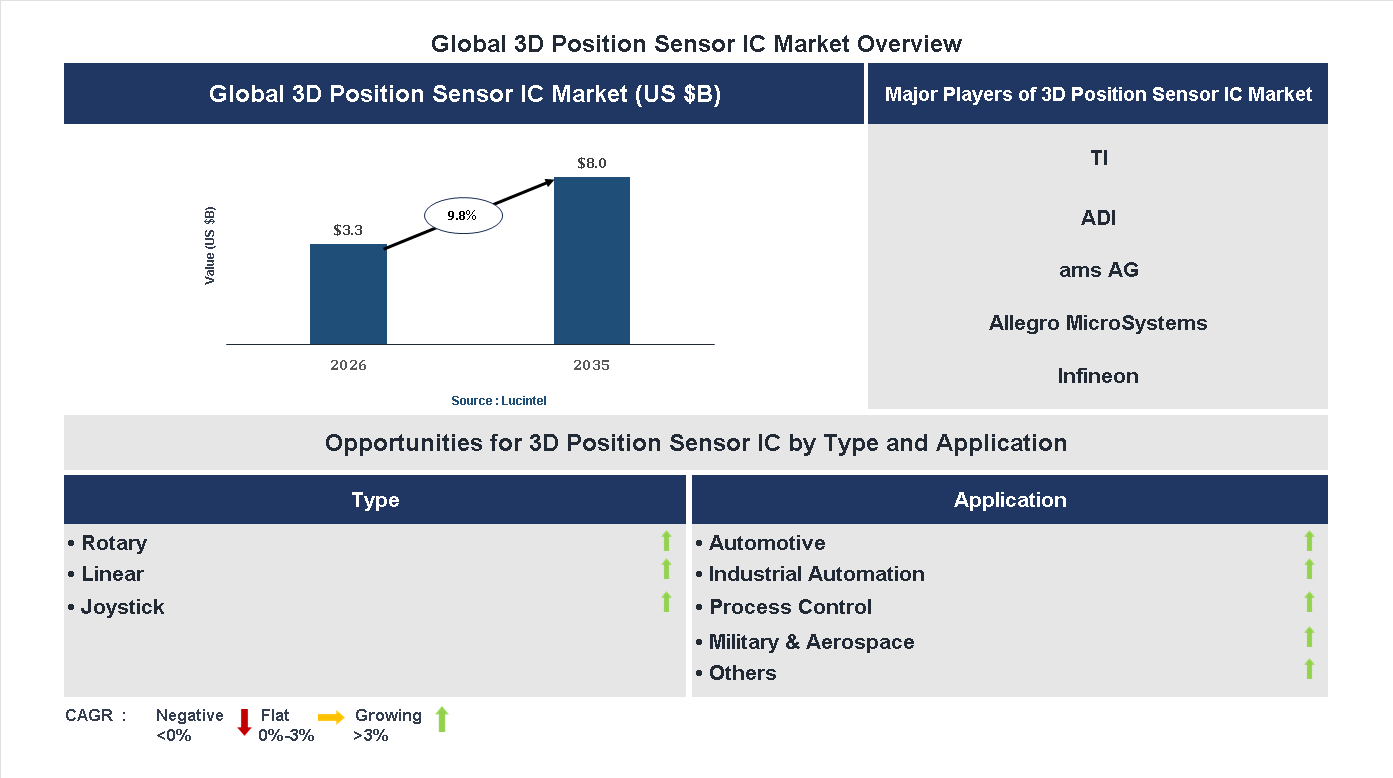
Key data points: The market size in 2035 = $8 billion, growth forecast = 9.8% annually for the next 8 years. Scroll below to get more insights. This market report covers trends, opportunities and forecasts in 3D position sensor IC market to 2035 by type (rotary, linear, and joystick), application (automotive, industrial automation, process control, military & aerospace, and others), and region (North America, Europe, Asia Pacific, and the Rest of the World)
We'll send your sample report shortly.
• Lucintel forecasts that, within the type category, rotary is expected to witness the highest growth over the forecast period.
• Within the application category, automotive is expected to witness the highest growth.
• In terms of region, APAC is expected to witness the highest growth over the forecast period. Gain valuable insights for your business decisions with our comprehensive 150+ page report. Sample figures with some insights are shown below.
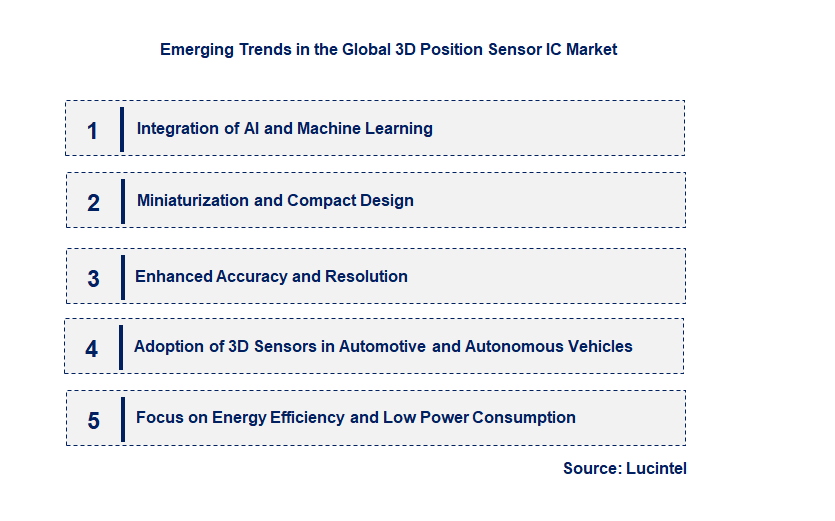
• Integration of AI and Machine Learning: The incorporation of AI and machine learning algorithms into 3D sensors enhances data processing capabilities, enabling real-time analysis and improved accuracy. This trend allows for smarter systems in robotics, autonomous vehicles, and augmented reality applications, leading to more adaptive and efficient solutions. As AI integration becomes more prevalent, sensors can predict movements, optimize performance, and reduce errors, significantly impacting the market by enabling advanced functionalities and expanding application scope.
• Miniaturization and Compact Design: Advances in semiconductor technology are driving the development of smaller, more compact 3D position sensors. This miniaturization facilitates integration into portable devices, wearables, and embedded systems, broadening their application range. Smaller sensors also reduce system weight and power consumption, making them ideal for space-constrained environments. The trend toward miniaturization is crucial for industries like consumer electronics and healthcare, where device size and portability are critical, thus fueling market growth.
• Enhanced Accuracy and Resolution: Innovations in sensor materials and design are leading to higher accuracy and resolution in 3D position sensing. Improved precision is vital for applications requiring detailed spatial information, such as surgical navigation, industrial robotics, and virtual reality. Enhanced accuracy reduces errors and increases reliability, which is essential for safety-critical applications. This trend boosts market competitiveness by enabling sensors to meet stringent industry standards and customer expectations for performance.
• Adoption of 3D Sensors in Automotive and Autonomous Vehicles: The automotive sector is increasingly adopting 3D position sensors for applications like collision avoidance, parking assistance, and autonomous driving. These sensors provide critical spatial data for vehicle perception systems, improving safety and navigation. The trend is driven by the push toward autonomous vehicles and smart transportation systems, significantly expanding the market. As automotive manufacturers prioritize safety and automation, the demand for advanced 3D sensors is expected to grow substantially.
• Focus on Energy Efficiency and Low Power Consumption: As sensors are integrated into battery-powered devices and IoT systems, energy efficiency becomes a key consideration. Manufacturers are developing low-power 3D position sensors that maintain high performance while reducing power consumption. This trend supports the proliferation of wireless, portable, and remote sensing applications, enabling longer device operation and reducing energy costs. The emphasis on energy efficiency is vital for sustainable growth and expanding the market into new, power-sensitive applications. These trends are collectively transforming the 3D position sensor IC market by enhancing sensor capabilities, enabling new applications, and improving integration with emerging technologies. They are driving innovation, increasing adoption across diverse sectors, and shaping a more intelligent, efficient, and versatile market landscape.
• Miniaturization and Integration: Advancements in sensor design have led to smaller, more integrated 3D position sensor ICs, enabling their use in compact devices and wearables. This miniaturization reduces manufacturing costs and power consumption, making sensors more accessible across various industries. Enhanced integration also simplifies system design, improving reliability and performance. As a result, manufacturers can develop more sophisticated, space-efficient products, expanding the market reach and application scope of 3D position sensors.
• Improved Accuracy and Resolution: Recent innovations focus on increasing the precision and resolution of 3D position sensors, allowing for more detailed spatial data collection. Enhanced accuracy benefits applications in robotics, medical imaging, and industrial automation, where precise positioning is critical. These improvements reduce errors and increase system reliability, fostering greater adoption in high-demand sectors. As accuracy advances, the technology becomes more competitive, opening new markets and driving overall industry growth.
• Cost Reduction Through Manufacturing Innovations: New manufacturing techniques, such as advanced semiconductor fabrication and mass production, have significantly lowered the costs of 3D position sensor ICs. Cost-effective sensors enable broader adoption in consumer electronics, automotive, and IoT devices. Reduced prices also encourage innovation and experimentation, leading to diverse product offerings. This trend democratizes access to 3D sensing technology, fueling market expansion and encouraging new applications across various sectors.
• Expansion Into New Application Areas: The versatility of 3D position sensors is leading to their integration into emerging fields like autonomous vehicles, augmented reality, and smart infrastructure. These sensors provide critical spatial awareness, enhancing safety, user experience, and operational efficiency. As applications diversify, demand increases, prompting further technological development. This expansion broadens the market landscape, creating opportunities for new entrants and fostering cross-industry collaborations that accelerate innovation.
• Integration With AI and Machine Learning: Combining 3D position sensors with AI and machine learning algorithms enhances data processing and interpretation. This integration enables real-time, intelligent decision-making in robotics, surveillance, and industrial automation. Improved data analytics lead to more accurate and adaptive systems, increasing their effectiveness and reliability. As AI integration becomes more prevalent, the value of 3D sensors rises, driving market growth and encouraging the development of smarter, more autonomous solutions. These recent developments are significantly transforming the 3D position sensor IC market by improving performance, reducing costs, and expanding application areas. Enhanced accuracy, miniaturization, and integration with AI are making sensors more versatile and accessible. The market is poised for substantial growth as these innovations open new opportunities across industries, fostering technological progress and competitive advantages. Overall, these developments are shaping a dynamic, innovative landscape that will drive future market expansion and technological breakthroughs.
• Integration of 3D Position Sensor ICs in Autonomous Vehicles: The automotive industry is increasingly adopting 3D position sensors for autonomous driving systems, enabling precise object detection, navigation, and collision avoidance. These sensors improve safety and reliability, making them essential for self-driving cars. As vehicle automation advances, demand for high-performance, miniaturized 3D sensors will surge, creating substantial growth opportunities for sensor manufacturers and technology providers.
• Adoption in Industrial Automation and Robotics: Industrial automation relies heavily on accurate spatial positioning for robotic arms, conveyor systems, and automated guided vehicles. 3D Position Sensor ICs enhance precision, efficiency, and safety in manufacturing processes. The push towards smart factories and Industry 4.0 initiatives accelerates adoption, encouraging innovation in sensor design and integration. This trend offers manufacturers opportunities to expand their product portfolios and capture a larger share of the industrial automation market.
• Expansion in Consumer Electronics and Augmented Reality Devices: Consumer electronics, including smartphones, gaming consoles, and AR/VR headsets, are increasingly integrating 3D position sensors to enable immersive experiences and precise gesture recognition. The demand for compact, high-resolution sensors drives technological advancements. As consumer expectations for enhanced interactivity grow, companies investing in sensor innovation can tap into lucrative markets, fostering growth in both hardware and software solutions.
• Growth in Healthcare and Medical Imaging Applications: 3D Position Sensor ICs are increasingly used in medical imaging, surgical navigation, and rehabilitation devices, providing accurate spatial data for diagnostics and treatment. The need for minimally invasive procedures and real-time imaging boosts demand for advanced sensors. This sector offers significant opportunities for innovation, with companies developing specialized sensors to improve patient outcomes and expand the scope of medical applications.
• Rising Demand for 3D Sensors in Drones and Aerial Surveillance: Drones utilize 3D position sensors for obstacle avoidance, terrain mapping, and precise navigation in complex environments. The expanding use of drones in agriculture, security, and environmental monitoring fuels market growth. Enhanced sensor accuracy and miniaturization are critical for expanding drone capabilities. This trend presents opportunities for sensor manufacturers to develop specialized, lightweight ICs tailored for aerial applications, driving market expansion and technological progress. These growth opportunities collectively position the 3D Position Sensor IC market for substantial expansion across diverse sectors. Advancements in sensor technology, miniaturization, and integration are enabling new applications and improving existing ones. As industries prioritize automation, safety, and immersive experiences, the market is set to benefit from increased innovation and investment, fostering a dynamic environment for growth and competitive advantage.
• Technological Innovation: The rapid development of advanced sensor technologies enhances accuracy and reliability, enabling applications in robotics, automotive, and consumer electronics. Innovations such as miniaturization and integration with IoT devices expand market potential. As technology evolves, manufacturers can offer more sophisticated, cost-effective solutions, fueling market growth and opening new application avenues.
• Increasing Automation and Industry 4.0 Adoption: The global shift towards automation in manufacturing, automotive, and healthcare sectors drives demand for precise 3D positioning. Industry 4.0 initiatives emphasize smart factories and interconnected systems, requiring advanced sensors for real-time data collection and control, thereby boosting the adoption of 3D Position Sensor ICs.
• Growing Automotive and Aerospace Applications: The automotive industry’s focus on autonomous vehicles and advanced driver-assistance systems (ADAS) relies heavily on accurate 3D positioning sensors. Similarly, aerospace applications demand high-precision sensors for navigation and control systems. This expanding application base significantly propels market growth.
• Rising Investment in R&D: Increased investments by key players and governments in research and development foster innovation in 3D sensor technologies. R&D efforts lead to improved sensor performance, reduced costs, and new functionalities, which collectively accelerate market expansion and competitiveness. The challenges in the 3D position sensor IC market are:
• High Manufacturing Costs: Developing and producing high-precision 3D sensors involves complex fabrication processes and expensive materials, leading to elevated costs. These costs can limit market penetration, especially in price-sensitive segments, and hinder widespread adoption despite technological benefits.
• Technological Complexity and Integration Issues: The integration of 3D Position Sensor ICs into various systems requires sophisticated design and compatibility considerations. Technological complexity can result in longer development cycles, increased R&D expenses, and potential reliability issues, which may slow market growth.
• Regulatory and Standardization Barriers: Evolving regulatory standards for safety, electromagnetic compatibility, and data security pose compliance challenges. Navigating diverse international regulations can delay product launches and increase costs, thereby impacting market expansion and innovation. The 3D position sensor IC market is driven by rapid technological advancements, increasing automation, and expanding application areas in the automotive and aerospace sectors. However, high manufacturing costs, technological complexities, and regulatory hurdles present significant challenges. These factors collectively influence the market’s growth potential, requiring stakeholders to innovate continuously and adapt to evolving standards to capitalize on emerging opportunities. The overall impact suggests a dynamic market with substantial growth prospects tempered by notable barriers that must be strategically managed.
• TI
• ADI
• ams AG
• Allegro MicroSystems
• Infineon
• Monolithic Power Systems
• Melexis
• ABLIC (MinebeaMitsumi)
• Renesas
• Honeywell
• Rotary
• Linear
• Joystick
• Automotive
• Industrial Automation
• Process Control
• Military & Aerospace
• Others
• North America
• Europe
• Asia Pacific
• The Rest of the World
• United States: The US market has seen increased adoption of 3D Position Sensor ICs in autonomous vehicles and industrial automation. Leading tech companies are developing advanced sensors with improved resolution and integration capabilities, supported by government funding for innovation. Startups and established firms are collaborating to create smarter, more compact sensors, boosting applications in healthcare and consumer electronics. The focus remains on enhancing sensor performance and reducing costs to accelerate market penetration.
• China: China has rapidly expanded its 3D sensor manufacturing capacity, driven by the automotive and consumer electronics sectors. Major companies are investing in R&D to develop high-precision sensors suitable for smart cities and robotics. The government’s strategic initiatives promote domestic innovation, leading to increased patent filings and technological advancements. The market is also witnessing a surge in applications for facial recognition, augmented reality, and industrial automation, with local firms gaining competitive advantages.
• Germany: Germany’s market emphasizes high-quality, precision 3D Position Sensor ICs for automotive and industrial machinery. Renowned for engineering excellence, German companies are innovating in sensor miniaturization and energy efficiency. Collaborations between academia and industry are fostering cutting-edge research, especially in automotive safety systems and factory automation. The focus on sustainability and reliability is driving the development of durable sensors suitable for harsh environments.
• India: India is witnessing rapid growth in the adoption of 3D Position Sensor ICs across automotive, healthcare, and consumer electronics sectors. Domestic manufacturers are expanding their R&D efforts to develop cost-effective sensors tailored for local markets. Government initiatives supporting electronics manufacturing are facilitating market growth. Startups are exploring innovative applications such as smart agriculture and low-cost robotics, contributing to the diversification of the market landscape.
• Japan: Japan continues to lead in sensor technology innovation, with a focus on high-performance 3D Position Sensor ICs for robotics, automotive, and industrial automation. Japanese firms are investing in advanced materials and fabrication techniques to improve sensor sensitivity and durability. The integration of AI and IoT with sensor systems is a key trend, enabling smarter automation solutions. The market benefits from strong government support for technological advancement and export-oriented growth strategies.


• TI
• ADI
• ams AG
• Allegro MicroSystems
• Infineon
• Monolithic Power Systems
• Melexis
• ABLIC (MinebeaMitsumi)
• Renesas
• Honeywell Q6. Which 3D position sensor IC market segment will be the largest in future? Answer: Lucintel forecasts that, within the type category, rotary is expected to witness the highest growth over the forecast period. Q7. In 3D position sensor IC market, which region is expected to be the largest in next 5 years? Answer: In terms of region, APAC is expected to witness the highest growth over the forecast period. Q8. Do we receive customization in this report? Answer: Yes, Lucintel provides 10% customization without any additional cost.


Choose a license that fits your team. Instant PDF delivery.
Prices exclude taxes. Instant delivery. Custom licensing available on request.
Market Report · July 15, 2026
Market Report · July 13, 2026
Market Report · July 13, 2026
Trusted partner for strategic intelligence and business growth


Receive a complimentary market analysis tailored to your industry. Our analysts will identify key growth opportunities and competitive dynamics specific to your business.

Market size, growth rate, and key trend analysis for your specific sector.

Top competitor positioning and market share analysis.

Strategic recommendations backed by data-driven insights.
Get curated market intelligence and competitive moves straight to your inbox.
By subscribing, you agree to receive our monthly insights. Unsubscribe anytime.
Receive a complimentary market analysis tailored to your industry. Our analysts will identify key growth opportunities and competitive dynamics specific to your business.
Market size, growth rate, and key trend analysis for your specific sector.
Top competitor positioning and market share analysis.
Strategic recommendations backed by data-driven insights.
Get curated market intelligence, emerging trends, and competitive moves straight to your inbox each month.
By subscribing, you agree to receive our monthly insights. Unsubscribe anytime.
We'll send your sample report shortly.