
Report Feature
3D Neuroscience Market Trends and Forecast
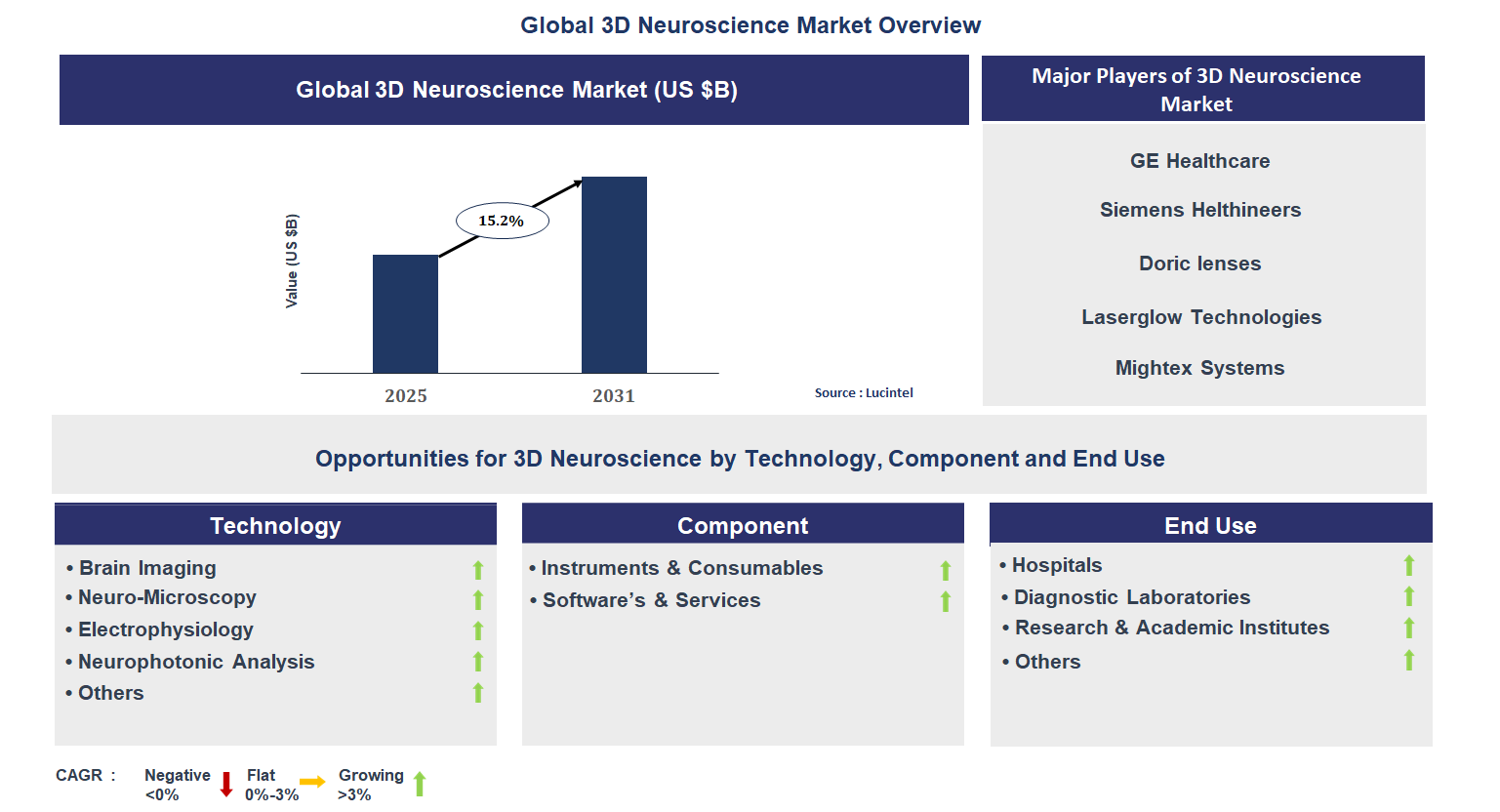
The future of the global 3D neuroscience market looks promising with opportunities in the hospital, diagnostic laboratory, and research & academic institute markets. The global 3D neuroscience market is expected to grow with a CAGR of 15.2% from 2025 to 2031. The major drivers for this market are the increasing demand for advanced brain imaging, the rising funding in neuroscience research initiatives, and the growing adoption of 3D technology in healthcare.• Lucintel forecasts that, within the technology category, neurophotonic analysis is expected to witness the highest growth over the forecast period.
• Within the end use category, research & academic institute is expected to witness the highest growth.
• In terms of region, APAC is expected to witness the highest growth over the forecast period. Gain valuable insights for your business decisions with our comprehensive 150+ page report. Sample figures with some insights are shown below.
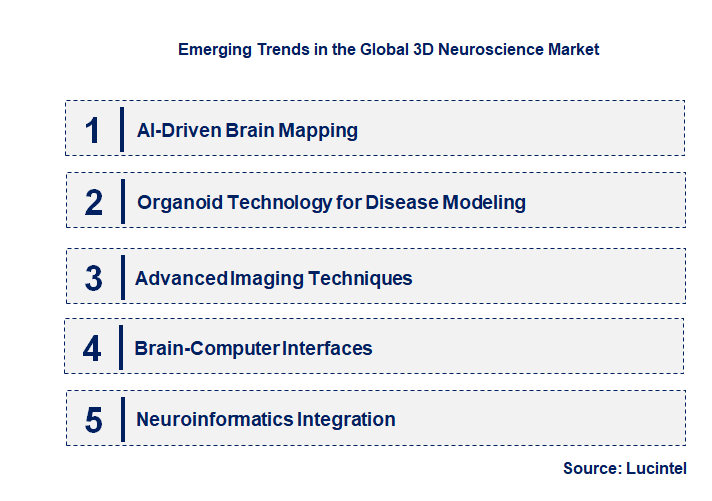
Emerging Trends in the 3D Neuroscience Market
The 3D neuroscience market is undergoing rapid transformation with key trends emerging in areas like AI, brain simulation, and disease modeling. These trends are accelerating the development of new tools and applications, opening up new therapeutic possibilities for treating neurological disorders and enhancing brain research.• AI-Driven Brain Mapping: AI is revolutionizing 3D brain mapping by improving neural network simulations. It enhances accuracy in understanding brain function and disease progression, enabling faster, more personalized treatments. By analyzing massive brain datasets, AI helps to identify patterns that are critical for drug discovery and clinical applications, advancing personalized medicine.
• Organoid Technology for Disease Modeling: 3D brain organoids are becoming a vital tool for studying neurological diseases. These miniaturized, lab-grown brains replicate human brain functions more accurately than traditional methods. They offer new insights into conditions like Alzheimer’s and Parkinson’s, allowing researchers to test drug efficacy in a realistic, human-like environment, speeding up treatment discovery.
• Advanced Imaging Techniques: Advanced imaging technologies, like multi-photon microscopy, are enabling high-resolution, 3D brain visualizations. These techniques allow for a deeper understanding of neural circuits, providing more precise diagnostics and enhancing our ability to detect brain abnormalities early. Their potential to reveal previously unseen brain activity is transforming both research and clinical practices.
• Brain-Computer Interfaces: BCIs are evolving to enable direct communication between the brain and devices. These systems, which combine neuroscience, engineering, and AI, are improving neuroprosthetics and aiding rehabilitation for those with neurological disabilities. By offering greater precision, BCIs are pushing the boundaries of brain-machine interactions, promising life-changing applications in medical and consumer technologies.
• Neuroinformatics Integration: The growing use of neuroinformatics platforms is transforming how brain data is stored, shared, and analyzed. By integrating 3D models of the brain with large datasets, researchers can collaborate more effectively, accelerating discoveries in brain science. Standardizing data formats and increasing accessibility ensures global participation in advancing neuroscience research. Emerging trends in the 3D neuroscience market, including AI-driven brain mapping, organoid technology, and BCIs, are reshaping our understanding of the brain and transforming the landscape of neurological disease treatment. These innovations are opening up new frontiers for personalized medicine, brain research, and therapeutic interventions.
Recent Development in the 3D Neuroscience Market
Recent developments in 3D neuroscience reflect the convergence of technology and healthcare, driving new innovations in brain research and treatment. These advancements are allowing for more accurate disease models, earlier diagnoses, and personalized treatments, significantly impacting the way we approach neurological health.• 3D Brain Organoids for Drug Testing: Brain organoids are revolutionizing drug discovery by simulating human brain tissue more accurately than traditional cell cultures. These 3D models allow researchers to test potential treatments for neurological diseases like Alzheimer’s and Parkinson’s, accelerating drug development and improving treatment efficacy before clinical trials.
• High-Resolution Brain Imaging: Recent advancements in brain imaging technologies, such as functional MRI and multi-photon microscopy, have enabled high-resolution 3D visualizations of the brain’s structure and activity. These techniques provide unprecedented insights into neural networks and brain function, offering enhanced diagnostic capabilities for neurological conditions and supporting personalized treatment approaches.
• AI-Enhanced Brain Simulation: Artificial intelligence is becoming integral to brain simulation, allowing researchers to predict brain activity and simulate neurological disorders. AI-driven models help identify biomarkers for diseases and optimize treatment strategies, particularly in conditions like epilepsy and neurodegeneration, where early diagnosis is crucial for effective intervention.
• Neuroprosthetics and Brain-Machine Interfaces: Neuroprosthetics are advancing through 3D neuroscience innovations, allowing individuals with neurological disabilities to control external devices with their minds. Brain-machine interfaces are improving the functionality of prosthetics, and these technologies are offering transformative solutions in both medical treatments and rehabilitation, enhancing patients’ quality of life.
• Collaborative Research Initiatives: International collaborations between academic institutions, research organizations, and the private sector are accelerating 3D neuroscience developments. These partnerships foster innovation by pooling resources and expertise, creating opportunities to develop standardized brain models, improve disease treatments, and push the boundaries of neuroscience research. Key developments in 3D neuroscience, from organoids to AI-enhanced simulations, are driving breakthroughs in brain health. These innovations are transforming how we model, understand, and treat neurological diseases, offering new hope for patients and advancing scientific understanding of the brain.
Strategic Growth Opportunities in the 3D Neuroscience Market
The 3D neuroscience market offers numerous growth opportunities across various applications, driven by technological innovations and increasing demand for personalized healthcare. These opportunities span disease modeling, neuroimaging, and brain-computer interfaces, presenting potential for growth in both research and medical applications.• Disease Modeling and Drug Discovery: 3D brain organoids are becoming essential tools for drug testing and disease modeling. These models provide a more accurate representation of human brain conditions, enabling researchers to test drugs with greater precision. The growth of this application is accelerating the development of treatments for complex neurological diseases.
• Brain-Computer Interfaces for Neuroprosthetics: BCIs are poised for growth as they enable direct brain control over devices. This technology is particularly promising for patients with spinal cord injuries or neurological disorders, offering new solutions for motor function restoration and cognitive rehabilitation. As the technology matures, BCIs will play a central role in neuroprosthetics and brain-machine interaction.
• Neuroimaging for Early Diagnosis: Advanced neuroimaging techniques offer growth opportunities in the early diagnosis of neurological diseases. With improved resolution and non-invasive imaging methods, these technologies can detect brain abnormalities before symptoms appear. This enables earlier interventions and personalized treatments, significantly improving patient outcomes and reducing healthcare costs.
• Personalized Medicine in Neuroscience: Personalized medicine, driven by advancements in neuroimaging and genetic data, is creating new growth opportunities. By combining 3D brain models with individual genetic profiles, treatments can be tailored to each patient’s unique neurological makeup, providing more effective therapies for diseases like Alzheimer’s and epilepsy.
• Collaboration Between Academia and Industry: Collaborative research between universities, tech companies, and healthcare providers is accelerating innovation in 3D neuroscience. These partnerships are vital for advancing neuroinformatics, AI-driven simulations, and neuroprosthetics. Increased collaboration is fostering new business models, driving market expansion, and creating a more robust pipeline for product development. Strategic growth opportunities in disease modeling, BCIs, and personalized medicine are driving the 3D neuroscience market forward. Collaborative research, technological advancements, and the growing demand for targeted treatments are opening up new avenues for companies and research institutions to innovate and expand in this field.
3D Neuroscience Market Driver and Challenges
The 3D neuroscience market is shaped by several key drivers, such as technological advances and increased research funding, alongside challenges in regulation, cost, and data security. Navigating these factors is crucial to unlocking the market’s potential for improving brain health and treatment options. The factors responsible for driving the 3D neuroscience market include: 1. Technological Advancements in Imaging: Technological advancements in imaging, such as high-resolution MRI and optogenetics, are driving the 3D neuroscience market. These innovations allow for more detailed and accurate brain visualization, improving diagnostics, treatment planning, and research into brain diseases, offering significant growth opportunities in both clinical and research applications. 2. Growing Investment in Neuroscience Research: Growing investment from governments and private companies is accelerating developments in 3D neuroscience. Increased funding supports research in neuroimaging, brain modeling, and drug discovery, leading to faster breakthroughs and the development of new tools for studying and treating neurological disorders. 3. Demand for Personalized Medicine: The shift toward personalized healthcare is a major driver in the 3D neuroscience market. With better brain models and genetic insights, treatments can be customized for individual patients, improving outcomes in conditions like Alzheimer’s, Parkinson’s, and epilepsy. This demand is pushing forward innovations in precision medicine and targeted therapies. 4. Interdisciplinary Collaborations and Partnerships: Collaboration across disciplines, including neuroscience, AI, and engineering, is accelerating progress in 3D neuroscience. These partnerships are crucial for advancing brain-computer interfaces, neuroprosthetics, and disease modeling, allowing for faster translation of research into practical, clinical applications. 5. Rising Prevalence of Neurological Disorders: The growing global prevalence of neurological disorders, particularly due to aging populations, is driving the demand for advanced research tools and treatments. This increasing burden is fueling investments and innovations in the 3D neuroscience market to address conditions like Alzheimer’s, Parkinson’s, and various mental health disorders. Challenges in the 3D neuroscience market are: 1. Regulatory and Ethical Concerns: Ethical issues around 3D brain models, particularly organoids, pose challenges in the research and commercialization of these technologies. Regulatory frameworks are still evolving, and there is a need for clear guidelines to address the use of brain tissue models in research and testing, ensuring safety and ethical compliance. 2. High Cost of Advanced Technologies: The high cost of cutting-edge technologies, such as neuroimaging equipment and brain organoid systems, limits access to these tools. This creates disparities in research capabilities between institutions and regions, slowing the widespread adoption of advanced neuroscience techniques. 3. Data Privacy and Security: The growing amount of sensitive neuroimaging data used in 3D neuroscience research raises concerns about data privacy and security. Protecting patient information and complying with regulations like HIPAA is critical for the continued development of AI-driven neuroscience tools and the sharing of brain data across institutions. Technological advancements, increased funding, and the growing demand for personalized treatments are key drivers of the 3D neuroscience market. However, challenges related to regulation, cost, and data security need to be addressed for the market to reach its full potential. Overcoming these barriers will unlock new possibilities for brain research and therapeutic interventions.List of 3D Neuroscience Companies
Companies in the market compete on the basis of product quality offered. Major players in this market focus on expanding their manufacturing facilities, R&D investments, infrastructural development, and leverage integration opportunities across the value chain. With these strategies 3D neuroscience companies cater increasing demand, ensure competitive effectiveness, develop innovative products & technologies, reduce production costs, and expand their customer base. Some of the 3D neuroscience companies profiled in this report include-• GE Healthcare
• Siemens Helthineers
• Doric lenses
• Laserglow Technologies
• Mightex Systems
• Kendall Research Systems
• Bruker
• Neuronexus Technologies
• Prixmatic
• Noldus Information Technology
3D Neuroscience Market by Segment
The study includes a forecast for the global 3D neuroscience market by technology, component, end use, and region.3D Neuroscience Market by Technology [Value from 2019 to 2031]:
• Brain Imaging
• Neuro-Microscopy
• Electrophysiology
• Neurophotonic Analysis
• Others
3D Neuroscience Market by Component [Value from 2019 to 2031]:
• Instruments & Consumables
• Software’s & Services
3D Neuroscience Market by End Use [Value from 2019 to 2031]:
• Hospitals
• Diagnostic Laboratories
• Research & Academic Institutes
• Others
3D Neuroscience Market by Region [Value from 2019 to 2031]:
• North America
• Europe
• Asia Pacific
• The Rest of the World
Country Wise Outlook for the 3D Neuroscience Market
The 3D neuroscience market is rapidly evolving, fueled by technological breakthroughs, expanding applications, and increasing funding. Innovations in imaging, AI, and brain modeling are reshaping our understanding of the brain, enabling new treatments for neurological disorders. This progress spans several regions, each making unique contributions to the field, from disease modeling to precision medicine.• United States: The U.S. leads in 3D neuroscience, with breakthroughs in brain imaging and organoid technologies. Key players focus on enhancing drug development through 3D brain models, offering more accurate disease simulations. Public and private sector collaborations push advancements in brain mapping, enabling more effective therapies for neurological conditions and accelerating personalized medicine.
• China: China has rapidly advanced in 3D neuroscience, leveraging AI and brain simulation technologies to enhance brain disease research. The government is heavily investing in advanced neural networks, with a focus on developing models for mental health treatment and neurodegenerative diseases. Growing support from both public and private sectors is driving China‘s position in this field.
• Germany: Germany‘s 3D neuroscience market thrives on innovations in neuroimaging and neuroinformatics. Researchers are enhancing brain tissue modeling and visualization of neural pathways, offering better diagnostics for diseases like Alzheimer‘s. Collaborative efforts within the EU and local institutions promote advancements in brain mapping and precision medicine, positioning Germany as a key player in Europe.
• India: India‘s 3D neuroscience field is gaining momentum, with growing interest in neuroimaging and brain mapping for personalized healthcare. Collaborations between research institutions and the private sector are enabling the development of affordable tools for neuroscience research. Challenges remain in terms of accessibility and funding, but India‘s emerging market holds great promise for future advancements.
• Japan: Japan is at the forefront of integrating 3D neuroscience with robotics and AI, focusing on neuroprosthetics and brain-machine interfaces. The country‘s research is revolutionizing treatments for mental health and neurodegenerative diseases, using 3D models to understand neural dynamics better. Japan’s strong technological infrastructure supports the growth of these cutting-edge applications in neuroscience.

Features of the Global 3D Neuroscience Market
Market Size Estimates: 3D neuroscience market size estimation in terms of value ($B). Trend and Forecast Analysis: Market trends (2019 to 2024) and forecast (2025 to 2031) by various segments and regions. Segmentation Analysis: 3D neuroscience market size by technology, component, end use, and region in terms of value ($B). Regional Analysis: 3D neuroscience market breakdown by North America, Europe, Asia Pacific, and Rest of the World. Growth Opportunities: Analysis of growth opportunities in different technologies, components, end uses, and regions for the 3D neuroscience market. Strategic Analysis: This includes M&A, new product development, and competitive landscape of the 3D neuroscience market. Analysis of competitive intensity of the industry based on Porter’s Five Forces model.
FAQ
Q1. What is the growth forecast for 3D neuroscience market? Answer: The global 3D neuroscience market is expected to grow with a CAGR of 15.2% from 2025 to 2031. Q2. What are the major drivers influencing the growth of the 3D neuroscience market? Answer: The major drivers for this market are the increasing demand for advanced brain imaging, the rising funding in neuroscience research initiatives, and the growing adoption of 3D technology in healthcare. Q3. What are the major segments for 3D neuroscience market? Answer: The future of the 3D neuroscience market looks promising with opportunities in the hospital, diagnostic laboratory, and research & academic institute markets. Q4. Who are the key 3D neuroscience market companies? Answer: Some of the key 3D neuroscience companies are as follows:• GE Healthcare
• Siemens Helthineers
• Doric lenses
• Laserglow Technologies
• Mightex Systems
• Kendall Research Systems
• Bruker
• Neuronexus Technologies
• Prixmatic
• Noldus Information Technology Q5. Which 3D neuroscience market segment will be the largest in future? Answer: Lucintel forecasts that, within the technology category, neurophotonic analysis is expected to witness the highest growth over the forecast period. Q6. In 3D neuroscience market, which region is expected to be the largest in next 5 years? Answer: In terms of region, APAC is expected to witness the highest growth over the forecast period. Q7. Do we receive customization in this report? Answer: Yes, Lucintel provides 10% customization without any additional cost.
Table of Contents
List of Figures
List of Tables
Methodology
- In-depth interviews of the major players in this market
- Detailed secondary research from competitors’ financial statements and published data
- Extensive searches of published works, market, and database information pertaining to industry news, company press releases, and customer intentions
- A compilation of the experiences, judgments, and insights of Lucintel’s professionals, who have analyzed and tracked this market over the years.


Buy Now
Choose a license that fits your team. Instant PDF delivery.
Prices exclude taxes. Instant delivery. Custom licensing available on request.
Key Questions
- • What are some of the most promising, high-growth opportunities for the 3D neuroscience market by technology (brain imaging, neuro-microscopy, electrophysiology, neurophotonic analysis, and others), component (instruments & consumables and software’s & services), end use (hospitals, diagnostic laboratories, research & academic institutes, and others), and region (North America, Europe, Asia Pacific, and the Rest of the World)?
- • Which segments will grow at a faster pace and why?
- • Which region will grow at a faster pace and why?
- • What are the key factors affecting market dynamics? What are the key challenges and business risks in this market?
- • What are the business risks and competitive threats in this market?
- • What are the emerging trends in this market and the reasons behind them?
- • What are some of the changing demands of customers in the market?
- • What are the new developments in the market? Which companies are leading these developments?
- • Who are the major players in this market? What strategic initiatives are key players pursuing for business growth?
- • What are some of the competing products in this market and how big of a threat do they pose for loss of market share by material or product substitution?
- • What M&A activity has occurred in the last 5 years and what has its impact been on the industry? For any questions related to 3D Neuroscience Market, 3D Neuroscience Market Size, 3D Neuroscience Market Growth, 3D Neuroscience Market Analysis, 3D Neuroscience Market Report, 3D Neuroscience Market Share, 3D Neuroscience Market Trends, 3D Neuroscience Market Forecast, 3D Neuroscience Companies, write Lucintel analyst at email: helpdesk@lucintel.com. We will be glad to get back to you soon.


