
Report Feature
3D Camera Market Trends and Forecast
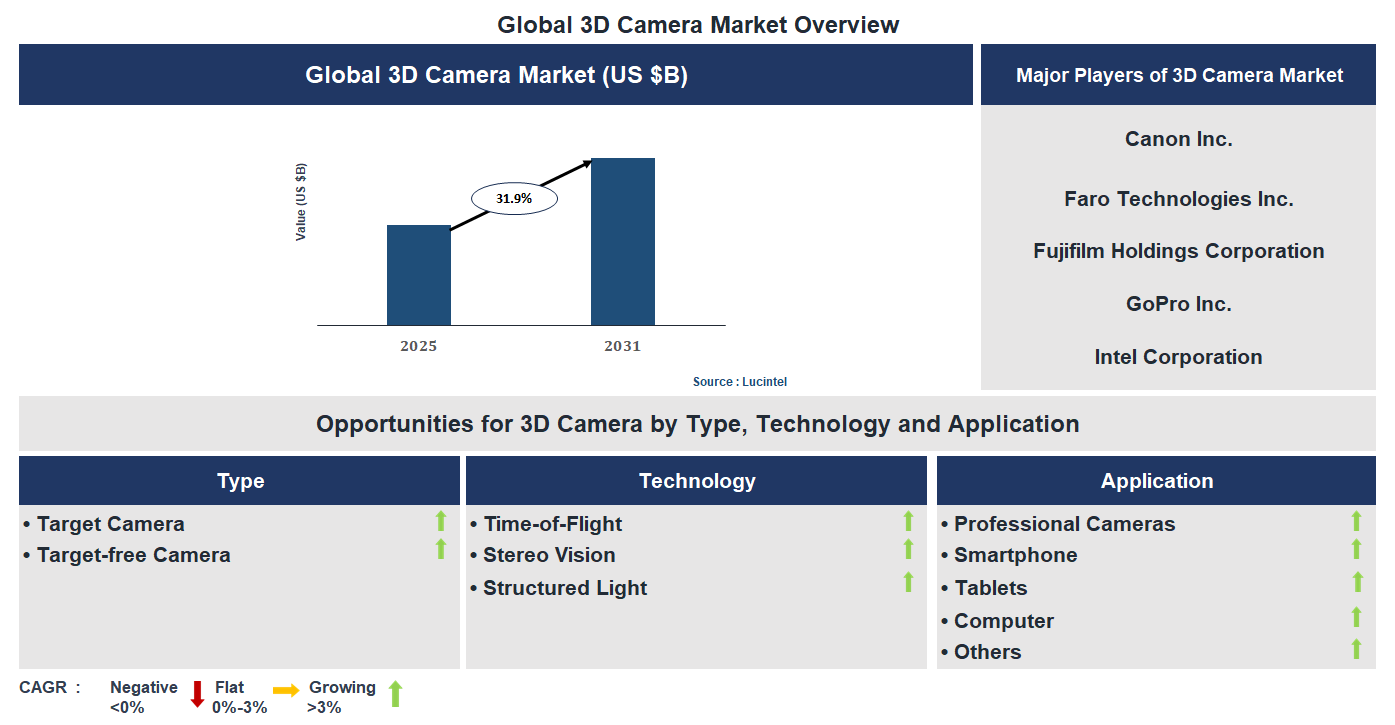
The future of the global 3D camera market looks promising with opportunities in the professional camera, smartphone, tablet, and computer markets. The global 3D camera market is expected to grow with a CAGR of 31.9% from 2025 to 2031. The major drivers for this market are the increasing demand for depth imaging, the rising adoption of advanced sensors, and the growing use of 3D vision systems.• Lucintel forecasts that, within the type category, target-free camera is expected to witness higher growth over the forecast period.
• Within the application category, professional camera is expected to witness the highest growth.
• In terms of region, APAC is expected to witness the highest growth over the forecast period. Gain valuable insights for your business decisions with our comprehensive 150+ page report. Sample figures with some insights are shown below.
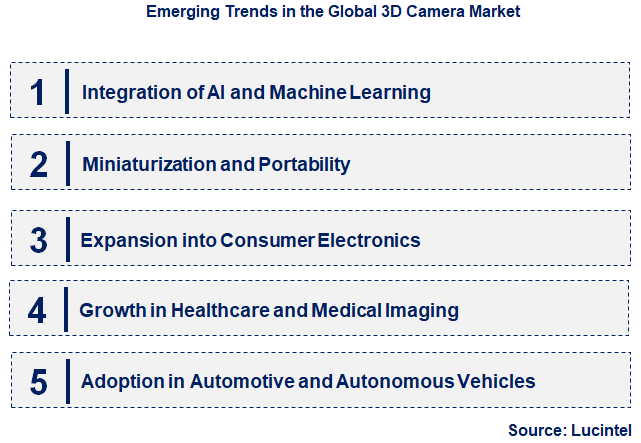
Emerging Trends in the 3D Camera Market
The 3D camera market is experiencing rapid growth driven by technological advancements, increasing demand across various industries, and evolving consumer preferences. As digital imaging becomes more sophisticated, new applications are emerging, transforming how we capture, analyze, and utilize three-dimensional visual data. These developments are not only expanding the market’s scope but also enhancing the quality, affordability, and versatility of 3D camera solutions. Companies are investing heavily in innovation to meet the rising demand from sectors such as entertainment, healthcare, automotive, and security. This dynamic environment is fostering a competitive landscape that is continuously pushing the boundaries of what 3D cameras can achieve.• Integration of AI and Machine Learning: The incorporation of AI and machine learning algorithms into 3D cameras is revolutionizing data processing and analysis. These intelligent systems enable real-time object recognition, depth mapping, and scene understanding, significantly improving accuracy and efficiency. This trend enhances applications in autonomous vehicles, robotics, and security systems by providing smarter, more responsive imaging solutions. As AI-driven features become standard, 3D cameras are becoming more autonomous and capable of complex tasks, reducing the need for manual intervention and opening new avenues for innovation.
• Miniaturization and Portability: Advances in miniaturization are making 3D cameras more compact and portable without compromising performance. Smaller, lightweight devices are ideal for consumer electronics, mobile devices, and wearable technology, broadening their usability. This trend allows for seamless integration into smartphones, drones, and AR/VR headsets, expanding the market reach. Portability also facilitates on-the-go applications in fields like healthcare diagnostics, industrial inspection, and entertainment, where mobility and ease of use are critical. As miniaturization continues, 3D cameras are becoming more accessible and versatile.
• Expansion into Consumer Electronics: The adoption of 3D cameras in consumer electronics is accelerating, driven by the demand for immersive experiences and enhanced functionalities. Smartphones, gaming consoles, and virtual reality devices increasingly incorporate 3D imaging to improve user interaction and content creation. This trend democratizes access to 3D technology, fueling innovation in gaming, social media, and multimedia content. As consumer electronics become more sophisticated, the integration of 3D cameras is expected to boost sales and stimulate new applications, making 3D imaging a standard feature in everyday devices.
• Growth in Healthcare and Medical Imaging: The healthcare sector is increasingly utilizing 3D cameras for diagnostics, surgical planning, and patient monitoring. High-resolution 3D imaging provides detailed anatomical views, improving accuracy and outcomes in medical procedures. This trend enhances minimally invasive surgeries, dental imaging, and physical therapy by offering precise, real-time visualization. The adoption of 3D cameras in healthcare is driven by the need for non-invasive, accurate diagnostic tools and the potential for remote consultations. As technology advances, 3D imaging is set to become a vital component of modern medical practice.
• Adoption in Automotive and Autonomous Vehicles: The automotive industry is rapidly integrating 3D cameras for advanced driver-assistance systems (ADAS) and autonomous vehicle navigation. These cameras enable precise object detection, lane recognition, and environment mapping, crucial for safety and automation. The trend is driven by stringent safety regulations and the push toward fully autonomous vehicles. 3D cameras improve situational awareness and decision-making capabilities, reducing accidents and enhancing passenger safety. As automotive manufacturers invest in this technology, the market for automotive-grade 3D cameras is expected to grow significantly, transforming transportation safety and efficiency. In summary, these emerging trends are reshaping the 3D camera market by making devices smarter, smaller, more accessible, and applicable across diverse sectors. The integration of AI, miniaturization, and expanding industry applications are driving innovation, leading to a more dynamic and competitive landscape that promises to redefine visual imaging and its uses in the future.
Recent Development in the 3D Camera Market
The 3D camera market has experienced significant growth driven by technological advancements, increasing demand across various industries, and evolving consumer preferences. As industries such as entertainment, healthcare, automotive, and security adopt 3D imaging technologies, the market is witnessing rapid innovation and expansion. Recent developments reflect a shift towards more sophisticated, affordable, and versatile 3D camera solutions, enabling broader application and integration. These trends are shaping the future landscape of 3D imaging, making it more accessible and impactful across multiple sectors. The following are five key recent developments in this dynamic market.• Integration of AI with 3D Cameras: Enhanced accuracy and real-time processing AI-powered 3D cameras now incorporate machine learning algorithms, improving object detection, facial recognition, and scene analysis. This integration allows for more precise and faster data processing, which is crucial in applications like autonomous vehicles, security, and industrial automation. The development boosts the efficiency and reliability of 3D imaging systems, expanding their usability in complex environments. As AI continues to evolve, these cameras are becoming smarter, enabling advanced functionalities and reducing the need for extensive post-processing.
• Miniaturization and Cost Reduction: Increased accessibility for consumer and industrial markets Manufacturers are focusing on reducing the size and cost of 3D cameras, making them more accessible to a broader audience. Smaller, affordable 3D cameras are now being integrated into smartphones, drones, and consumer electronics, democratizing 3D imaging technology. Cost reductions are also enabling startups and small enterprises to develop innovative applications, fostering market growth. This trend is driving widespread adoption, especially in sectors like gaming, virtual reality, and mobile applications, where portability and affordability are critical.
• Advancements in Depth Sensing Technologies: Improved resolution and accuracy Recent innovations in depth sensing, such as structured light and time-of-flight (ToF) sensors, have significantly enhanced the resolution and accuracy of 3D cameras. These improvements enable detailed 3D mapping and precise measurements, vital for applications in healthcare, robotics, and industrial inspection. Enhanced depth sensing capabilities facilitate better object recognition and environment modeling, leading to more reliable and sophisticated systems. As these technologies mature, they are expected to open new avenues for high-precision 3D imaging across various fields.
• Expansion into Healthcare and Medical Imaging: Non-invasive diagnostics and treatment planning 3D cameras are increasingly being adopted in healthcare for non-invasive diagnostics, surgical planning, and rehabilitation. They enable detailed 3D visualization of anatomical structures, improving accuracy and patient outcomes. The development of portable and high-resolution 3D imaging devices is making medical imaging more accessible and efficient. This expansion is transforming traditional diagnostic methods, reducing the need for invasive procedures, and enhancing personalized treatment options, thereby broadening the market scope and application diversity.
• Growth in Autonomous Vehicles and Robotics: Enhanced perception and navigation The deployment of 3D cameras in autonomous vehicles and robotics is revolutionizing perception systems. These cameras provide detailed 3D environmental data, essential for obstacle detection, navigation, and object recognition. Recent developments include multi-sensor fusion and real-time processing capabilities, improving safety and operational efficiency. As autonomous systems become more prevalent, the demand for high-performance 3D imaging solutions is surging. This growth is driving innovation in sensor technology and software, positioning 3D cameras as critical components in next-generation autonomous platforms. In summary, these recent developments are significantly transforming the 3D camera market by enhancing technological capabilities, reducing costs, and expanding application areas. The integration of AI, miniaturization, advanced depth sensing, healthcare applications, and autonomous vehicle integration are collectively driving market growth and innovation. These trends are making 3D imaging more precise, accessible, and versatile, ultimately broadening its impact across multiple industries and shaping the future of 3D technology.
Strategic Growth Opportunities in the 3D Camera Market
The 3D camera market is experiencing rapid expansion driven by technological advancements and increasing demand across various industries. As applications diversify, key growth opportunities are emerging that promise to reshape the market landscape. These opportunities are driven by innovations in imaging technology, rising adoption in emerging sectors, and the need for enhanced data accuracy and visualization. Companies that capitalize on these trends can gain competitive advantages and accelerate market penetration. Understanding these growth avenues is essential for stakeholders aiming to leverage the full potential of 3D camera technology in diverse applications.• Enhanced diagnostics and surgical precision : 3D cameras enable detailed imaging for diagnostics, surgical planning, and minimally invasive procedures, improving patient outcomes and reducing procedure times.
• Advanced driver-assistance systems (ADAS) : 3D cameras are integral to autonomous vehicles and ADAS, providing real-time depth perception, object detection, and collision avoidance, thus increasing safety.
• Immersive experiences and content creation : 3D cameras facilitate high-quality 3D content for movies, gaming, and virtual reality, enriching user engagement and expanding content portfolios.
• Quality control and automation : 3D imaging enhances inspection processes, precision manufacturing, and robotic automation, leading to higher efficiency and reduced errors.
• Enhanced monitoring and threat detection : 3D cameras improve spatial awareness, facial recognition, and intrusion detection, strengthening security infrastructure and response capabilities. These growth opportunities are significantly impacting the 3D camera market by broadening its application scope, increasing technological innovation, and driving demand across multiple sectors. As industries recognize the benefits of 3D imaging, market growth is expected to accelerate, fostering competitive advancements and new business models. This evolution underscores the transformative potential of 3D camera technology in shaping future industry standards and consumer experiences.
3D Camera Market Driver and Challenges
The 3D camera market is influenced by a variety of technological, economic, and regulatory factors that shape its growth trajectory. Advances in imaging technology, increasing demand across industries such as entertainment, healthcare, and automotive, and supportive government policies are key drivers. However, challenges such as high manufacturing costs, rapid technological obsolescence, and regulatory hurdles pose significant barriers. Understanding these drivers and challenges is essential for stakeholders to navigate the evolving landscape effectively and capitalize on emerging opportunities. The factors responsible for driving the 3D camera market include:• Technological Innovation: The continuous development of high-resolution sensors, miniaturization, and improved image processing algorithms has significantly enhanced 3D camera capabilities. These innovations enable more precise, faster, and cost-effective solutions, expanding their application scope. As technology advances, manufacturers can offer more sophisticated products, fueling market growth. The integration of AI and machine learning further enhances functionality, making 3D cameras more versatile across sectors like entertainment, security, and healthcare.
• Growing Adoption in Entertainment and Media: The entertainment industry is increasingly adopting 3D cameras for filmmaking, virtual reality, and augmented reality applications. The demand for immersive experiences drives the need for high-quality 3D imaging. Consumer electronics, including smartphones and gaming consoles, are also integrating 3D camera features, boosting sales. This trend is supported by consumer preferences for enhanced visual experiences, leading to increased investments by companies to develop innovative 3D imaging solutions.
• Expansion in Healthcare and Medical Imaging: The healthcare sector is leveraging 3D cameras for diagnostic imaging, surgical planning, and patient monitoring. These cameras provide detailed spatial information, improving accuracy and outcomes. The rising prevalence of chronic diseases and the need for minimally invasive procedures further propel demand. Technological advancements have made medical-grade 3D cameras more accessible and affordable, encouraging widespread adoption in hospitals and clinics, thus contributing significantly to market expansion.
• Automotive and Autonomous Vehicles: The automotive industry is increasingly integrating 3D cameras for driver assistance systems, collision avoidance, and autonomous driving. These cameras enable real-time 3D mapping of the environment, enhancing safety and navigation. Regulatory mandates for advanced driver-assistance systems (ADAS) and the push toward autonomous vehicles are key drivers. As automakers invest heavily in R&D, the demand for robust, high-performance 3D cameras continues to grow, opening new avenues for market growth.
• Increasing Use in Security and Surveillance: The need for enhanced security solutions is driving the adoption of 3D cameras in surveillance systems. These cameras offer superior depth perception, better object recognition, and improved image quality in low-light conditions. Governments and private organizations are deploying 3D surveillance for perimeter security, crowd monitoring, and crime prevention. The ability to provide detailed spatial data makes 3D cameras a preferred choice, supporting market expansion in security applications worldwide. The challenges facing this 3D camera market include:
• High Manufacturing and Implementation Costs: Developing advanced 3D cameras involves significant investment in R&D, high-quality components, and sophisticated manufacturing processes. These costs translate into higher retail prices, limiting accessibility for some end-users. Additionally, integrating 3D cameras into existing systems can be complex and expensive, especially for small and medium-sized enterprises. This financial barrier hampers widespread adoption, particularly in price-sensitive markets, and slows overall market growth.
• Rapid Technological Obsolescence: The fast-paced nature of technological innovation in imaging and sensor technology leads to frequent product updates and obsolescence. Companies face pressure to continuously innovate, which increases R&D costs and shortens product life cycles. Consumers and industries may hesitate to invest heavily in current-generation 3D cameras, fearing rapid obsolescence. This cycle hampers long-term planning and can result in market volatility, affecting manufacturers profitability and strategic investments.
• Regulatory and Privacy Concerns: The deployment of 3D cameras, especially in surveillance and healthcare, raises privacy and data security issues. Regulatory frameworks governing data collection, storage, and usage are evolving and can vary significantly across regions. Non-compliance can lead to legal penalties and reputational damage. Additionally, concerns over misuse of 3D imaging data may slow adoption, particularly in sensitive sectors. Navigating complex regulatory landscapes presents a challenge for market players aiming for global expansion. In summary, the 3D camera market is driven by rapid technological advancements, expanding applications across diverse sectors, and increasing consumer demand for immersive experiences. However, high costs, rapid obsolescence, and regulatory issues pose significant hurdles. These factors collectively influence market growth, requiring stakeholders to innovate strategically and address challenges proactively. Overall, the market holds substantial potential, but sustainable growth depends on balancing technological progress with cost management and regulatory compliance.
List of 3D Camera Companies
Companies in the market compete on the basis of product quality offered. Major players in this market focus on expanding their manufacturing facilities, R&D investments, infrastructural development, and leverage integration opportunities across the value chain. With these strategies 3D camera companies cater increasing demand, ensure competitive effectiveness, develop innovative products & technologies, reduce production costs, and expand their customer base. Some of the 3D camera companies profiled in this report include-• Canon Inc.
• Faro Technologies Inc.
• Fujifilm Holdings Corporation
• GoPro Inc.
• Intel Corporation
• LG Electronics Inc.
• Nikon Corporation
• Panasonic Corporation
• Samsung Electronics Co. Ltd.
• Sony Corporation
3D Camera Market by Segment
The study includes a forecast for the global 3D camera market by type, technology, application, and region.3D Camera Market by Type [Value from 2019 to 2031]:
• Target Camera
• Target-free Camera
3D Camera Market by Technology [Value from 2019 to 2031]:
• Time-of-Flight
• Stereo Vision
• Structured Light
3D Camera Market by Application [Value from 2019 to 2031]:
• Professional Cameras
• Smartphone
• Tablets
• Computer
• Others
3D Camera Market by Region [Value from 2019 to 2031]:
• North America
• Europe
• Asia Pacific
• The Rest of the World
Country Wise Outlook for the 3D Camera Market
The 3D camera market has experienced rapid growth driven by technological advancements, increasing adoption in various industries, and rising consumer demand for immersive experiences. Innovations in sensor technology, miniaturization, and integration with AI have expanded applications across entertainment, automotive, healthcare, and security sectors. As markets evolve, key players are focusing on improving image quality, affordability, and connectivity features. The United States, China, Germany, India, and Japan are at the forefront of these developments, each contributing uniquely to the global landscape through research, manufacturing, and consumer adoption.• United States: The US market has seen significant advancements with major tech companies investing heavily in 3D camera technology. Innovations in augmented reality (AR) and virtual reality (VR) applications are driving demand, especially in gaming and enterprise solutions. The adoption of 3D cameras in autonomous vehicles for environment sensing and navigation is also expanding. Additionally, US startups are pioneering in AI-powered 3D imaging, enhancing medical diagnostics and security systems. The government’s support for research and development continues to foster innovation, making the US a leader in 3D camera technology.
• China: China has rapidly emerged as a key player in the 3D camera market, with substantial investments in consumer electronics and industrial applications. Major Chinese manufacturers are producing affordable 3D cameras for smartphones, gaming, and security systems, boosting domestic adoption. The country is also focusing on integrating 3D cameras into smart city infrastructure, surveillance, and autonomous vehicles. Government initiatives to promote AI and IoT integration are accelerating development. Chinese companies are increasingly collaborating with global firms to enhance product capabilities, positioning China as a significant hub for 3D camera innovation and manufacturing.
• Germany: Germany’s market is characterized by a strong emphasis on industrial and automotive applications, leveraging its expertise in manufacturing and engineering. German firms are developing high-precision 3D cameras for quality control, robotics, and automotive safety systems. The focus on innovation is supported by robust research institutions and collaborations with European tech companies. Germany is also advancing in medical imaging, with 3D cameras improving diagnostic accuracy and minimally invasive procedures. The integration of 3D imaging in Industry 4.0 initiatives underscores Germany’s commitment to maintaining its leadership in industrial automation and precision technology.
• India: India’s 3D camera market is witnessing rapid growth driven by increasing smartphone penetration and government initiatives promoting digital infrastructure. Local startups and global companies are introducing affordable 3D camera solutions for consumer electronics, security, and healthcare. The healthcare sector is adopting 3D imaging for diagnostics and telemedicine, while the security industry is utilizing 3D cameras for surveillance. The government’s push for smart cities and digital India initiatives is creating a conducive environment for market expansion. Additionally, advancements in AI and machine learning are enhancing the capabilities of 3D imaging solutions in India.
• Japan: Japan remains a leader in technological innovation, with a focus on integrating 3D cameras into robotics, gaming, and healthcare. Japanese companies are developing compact, high-performance 3D sensors for consumer electronics and industrial automation. The gaming industry is adopting 3D cameras for immersive experiences, while healthcare applications include advanced diagnostic tools. Japan’s emphasis on precision engineering and quality control is reflected in the development of sophisticated 3D imaging systems. Collaborations between academia and industry continue to drive research, ensuring Japan’s position at the forefront of 3D camera technology development.

Features of the Global 3D Camera Market
Market Size Estimates: 3D camera market size estimation in terms of value ($B). Trend and Forecast Analysis: Market trends (2019 to 2024) and forecast (2025 to 2031) by various segments and regions. Segmentation Analysis: 3D camera market size by type, technology, application, and region in terms of value ($B). Regional Analysis: 3D camera market breakdown by North America, Europe, Asia Pacific, and Rest of the World. Growth Opportunities: Analysis of growth opportunities in different type, technology, application, and regions for the 3D camera market. Strategic Analysis: This includes M&A, new product development, and competitive landscape of the 3D camera market. Analysis of competitive intensity of the industry based on Porter’s Five Forces model.
FAQ
Q1. What is the growth forecast for 3D camera market? Answer: The global 3D camera market is expected to grow with a CAGR of 31.9% from 2025 to 2031. Q2. What are the major drivers influencing the growth of the 3D camera market? Answer: The major drivers for this market are the increasing demand for depth imaging, the rising adoption of advanced sensors, and the growing use of 3D vision systems. Q3. What are the major segments for 3D camera market? Answer: The future of the 3D camera market looks promising with opportunities in the professional camera, smartphone, tablet, and computer markets. Q4. Who are the key 3D camera market companies? Answer: Some of the key 3D camera companies are as follows:• Canon Inc.
• Faro Technologies Inc.
• Fujifilm Holdings Corporation
• GoPro Inc.
• Intel Corporation
• LG Electronics Inc.
• Nikon Corporation
• Panasonic Corporation
• Samsung Electronics Co. Ltd.
• Sony Corporation Q5. Which 3D camera market segment will be the largest in future? Answer: Lucintel forecasts that, within the type category, target-free camera is expected to witness higher growth over the forecast period. Q6. In 3D camera market, which region is expected to be the largest in next 5 years? Answer: In terms of region, APAC is expected to witness the highest growth over the forecast period. Q7. Do we receive customization in this report? Answer: Yes, Lucintel provides 10% customization without any additional cost.
Table of Contents
List of Figures
List of Tables
Methodology
- In-depth interviews of the major players in this market
- Detailed secondary research from competitors’ financial statements and published data
- Extensive searches of published works, market, and database information pertaining to industry news, company press releases, and customer intentions
- A compilation of the experiences, judgments, and insights of Lucintel’s professionals, who have analyzed and tracked this market over the years.


Buy Now
Choose a license that fits your team. Instant PDF delivery.
Prices exclude taxes. Instant delivery. Custom licensing available on request.
Key Questions
- • What are some of the most promising, high-growth opportunities for the 3D camera market by type (target camera and target-free camera), technology (time-of-flight, stereo vision, and structured light), application (professional cameras, smartphone, tablets, computer, and others), and region (North America, Europe, Asia Pacific, and the Rest of the World)?
- • Which segments will grow at a faster pace and why?
- • Which region will grow at a faster pace and why?
- • What are the key factors affecting market dynamics? What are the key challenges and business risks in this market?
- • What are the business risks and competitive threats in this market?
- • What are the emerging trends in this market and the reasons behind them?
- • What are some of the changing demands of customers in the market?
- • What are the new developments in the market? Which companies are leading these developments?
- • Who are the major players in this market? What strategic initiatives are key players pursuing for business growth?
- • What are some of the competing products in this market and how big of a threat do they pose for loss of market share by material or product substitution?
- • What M&A activity has occurred in the last 5 years and what has its impact been on the industry? For any questions related to 3D Camera Market, 3D Camera Market Size, 3D Camera Market Growth, 3D Camera Market Analysis, 3D Camera Market Report, 3D Camera Market Share, 3D Camera Market Trends, 3D Camera Market Forecast, 3D Camera Companies, write Lucintel analyst at email: helpdesk@lucintel.com. We will be glad to get back to you soon.


