
Report Feature
3D Battery Market Trends and Forecast
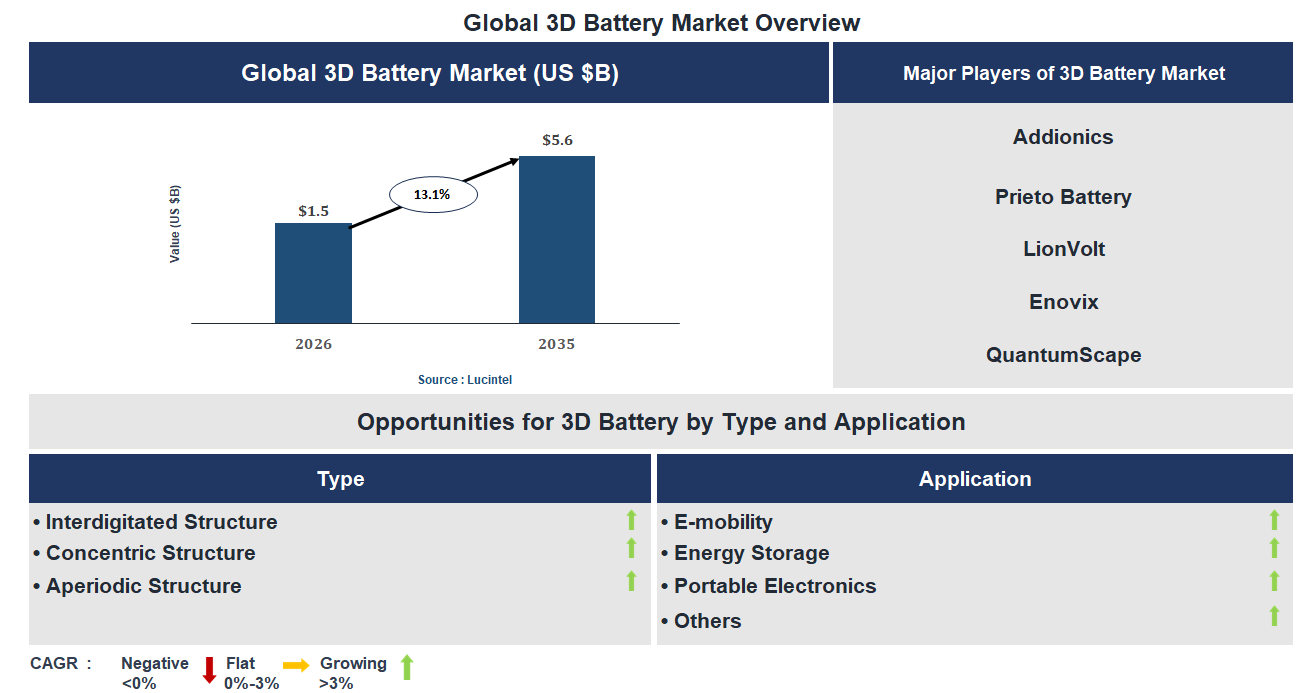
The future of the global 3D battery market looks promising with opportunities in the e-mobility, energy storage, and portable electronics markets. The global 3D battery market is expected to reach an estimated $5.6 billion by 2035 and grow with a CAGR of 13.1% from 2026 to 2035. The major drivers for this market are the increasing demand for compact electronics, the rising adoption of electric vehicles, and the growing need for higher energy density.• Lucintel forecasts that, within the type category, concentric structure is expected to witness the highest growth over the forecast period.
• Within the application category, E-mobility is expected to witness the highest growth.
• In terms of region, APAC is expected to witness the highest growth over the forecast period. Gain valuable insights for your business decisions with our comprehensive 150+ page report. Sample figures with some insights are shown below.
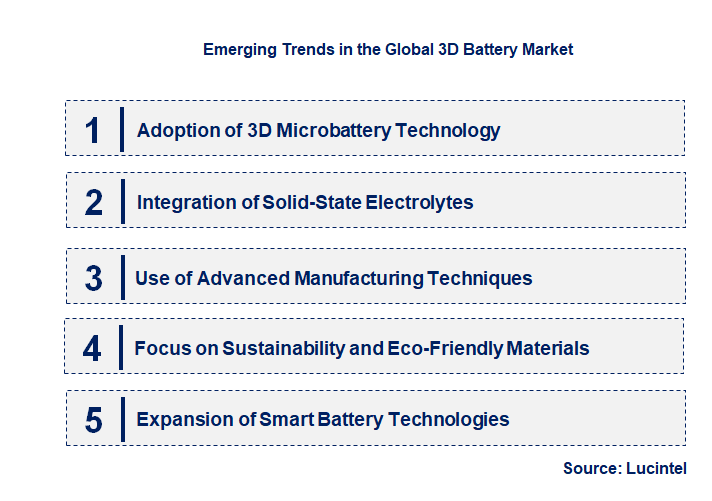
Emerging Trends in the 3D Battery Market
The 3D battery market is experiencing rapid innovation driven by advancements in materials science, manufacturing techniques, and increasing demand for high-performance energy storage solutions. As industries such as electric vehicles, consumer electronics, and renewable energy integration expand, the need for more efficient, durable, and compact batteries becomes critical. Emerging trends are shaping the future landscape of this market, influencing product development, competitive dynamics, and technological standards. These developments are not only enhancing battery performance but also addressing sustainability concerns, thus paving the way for a more sustainable and technologically advanced energy storage ecosystem.• Adoption of 3D Microbattery Technology: This trend involves developing micro-scale 3D batteries that offer higher energy density and faster charging capabilities. These batteries are ideal for IoT devices, medical implants, and wearable technology, providing compact, lightweight, and efficient power sources. The miniaturization and performance improvements are enabling new applications and expanding market opportunities, especially in sectors demanding small yet powerful energy solutions.
• Integration of Solid-State Electrolytes: The shift towards solid-state electrolytes in 3D batteries enhances safety, stability, and lifespan. Unlike liquid electrolytes, solid electrolytes reduce the risk of leakage and thermal runaway, making batteries safer for consumer and industrial use. This trend is driving innovation in battery design, leading to longer-lasting, more reliable energy storage systems that meet stringent safety standards, especially important for electric vehicles and aerospace applications.
• Use of Advanced Manufacturing Techniques: Additive manufacturing and 3D printing are revolutionizing how 3D batteries are produced. These techniques allow for complex geometries, customized designs, and rapid prototyping, reducing production costs and lead times. The ability to create intricate internal structures improves electrode-electrolyte interfaces, boosting performance. This trend is enabling manufacturers to innovate faster and tailor batteries to specific applications, fostering a more agile and responsive market environment.
• Focus on Sustainability and Eco-Friendly Materials: The market is increasingly adopting sustainable materials such as bio-based electrolytes and recyclable components. This shift aims to reduce environmental impact and improve the lifecycle management of batteries. Eco-friendly 3D batteries appeal to environmentally conscious consumers and regulatory bodies, encouraging industry-wide adoption of greener practices. This trend is crucial for aligning the market with global sustainability goals and ensuring long-term viability.
• Expansion of Smart Battery Technologies: Incorporating sensors and IoT connectivity into 3D batteries allows real-time monitoring of performance, health, and safety. Smart batteries enable predictive maintenance, optimize energy usage, and enhance user safety. This trend is transforming traditional batteries into intelligent systems, providing valuable data for manufacturers and consumers. The integration of smart features is expected to drive demand for connected energy solutions across various sectors, including automotive, healthcare, and consumer electronics. In summary, these emerging trends are significantly reshaping the 3D battery market by enhancing performance, safety, sustainability, and integration capabilities. They are fostering innovation, creating new application opportunities, and setting the stage for a more efficient and environmentally responsible energy storage future.
Recent Development in the 3D Battery Market
The 3D battery market is experiencing rapid innovation driven by advancements in energy storage technology. As demand for high-capacity, durable, and efficient batteries grows across sectors like electric vehicles, consumer electronics, and renewable energy, industry players are exploring novel architectures. Recent developments focus on enhancing energy density, extending lifespan, reducing costs, and improving safety. These innovations are shaping the future landscape of energy storage, offering new opportunities for manufacturers and consumers alike.• Increased Energy Density: The adoption of 3D architectures allows for stacking multiple electrode layers, significantly boosting energy storage capacity within a compact form. This development enables longer-lasting batteries for electric vehicles and portable devices, reducing the need for frequent charging. It also opens avenues for miniaturization in consumer electronics, making devices more powerful yet smaller. The impact is a substantial leap in performance, meeting rising energy demands efficiently.
• Advancements in Manufacturing Techniques: New manufacturing processes such as additive manufacturing and precision layering are making 3D batteries more feasible at scale. These techniques improve uniformity, reduce production costs, and enable complex designs that optimize space and performance. As a result, manufacturers can produce batteries with higher quality and consistency, accelerating commercialization. This progress is crucial for meeting market demand and lowering barriers to adoption across various industries.
• Use of Novel Materials: Incorporating advanced materials like solid electrolytes and nanostructured electrodes enhances battery safety, stability, and lifespan. These materials improve ion conductivity and reduce risks of thermal runaway, making 3D batteries safer for widespread use. Additionally, they contribute to higher charge/discharge rates and longer cycle life. The integration of such materials is transforming the market by addressing key safety and performance concerns, thus broadening application possibilities.
• Focus on Sustainability and Cost Reduction: Researchers are developing eco-friendly materials and scalable production methods to make 3D batteries more sustainable and affordable. Recycling techniques and biodegradable components are being explored to minimize environmental impact. Cost reductions are achieved through process innovations and material efficiencies, making these batteries more accessible for mass-market applications. This focus supports the market’s growth by aligning with global sustainability goals and consumer affordability.
• Integration with Emerging Technologies: 3D batteries are increasingly being integrated into cutting-edge applications like flexible electronics, wearable devices, and grid storage solutions. Their high energy density and customizable form factors enable seamless incorporation into diverse platforms. This integration accelerates innovation in various sectors, expanding market reach and creating new revenue streams. It also fosters collaboration between battery developers and technology innovators, driving further advancements and adoption. These developments are collectively transforming the 3D battery market by enhancing performance, safety, and sustainability. They enable new applications, reduce costs, and improve manufacturing efficiency, thereby expanding market potential. As these innovations mature, they are poised to meet the growing energy storage demands across multiple industries, fostering a more sustainable and technologically advanced future.
Strategic Growth Opportunities in the 3D Battery Market
The 3D battery market is experiencing rapid innovation driven by the demand for higher energy density, faster charging, and longer lifespan in portable electronics, electric vehicles, and renewable energy storage. Advancements in materials and manufacturing techniques are opening new avenues for performance enhancement. Market players are focusing on integrating 3D architectures to overcome the limitations of traditional batteries, creating opportunities for significant growth. Strategic investments and technological breakthroughs are expected to propel this market forward, meeting the evolving needs of various high-tech industries.• Enhanced Energy Density through 3D Architectures: 3D battery designs enable stacking of active materials in three dimensions, significantly increasing energy storage capacity within a compact form. This approach allows for higher volumetric and gravimetric energy densities, making batteries more efficient for electric vehicles and portable devices. The ability to optimize space and improve performance is attracting manufacturers to adopt 3D configurations, fostering innovation and market expansion.
• Faster Charging Capabilities Enabled by 3D Structures: The adoption of 3D architectures facilitates improved ion transport pathways, reducing resistance and enabling quicker charge and discharge cycles. This advancement addresses consumer demand for rapid charging in electric vehicles and mobile devices. Enhanced thermal management within 3D designs also minimizes overheating risks, further supporting high-rate charging. As a result, the market is poised for growth driven by the need for efficient, fast-charging energy storage solutions.
• Longer Lifespan and Improved Durability of 3D Batteries: 3D battery configurations help mitigate degradation mechanisms by providing better structural stability and uniform stress distribution during operation. This leads to increased cycle life and reliability, essential for applications like grid storage and electric vehicles. The ability to sustain performance over extended periods reduces replacement costs and enhances user confidence, making 3D batteries a preferred choice for long-term energy storage solutions.
• Material Innovations and Manufacturing Techniques for 3D Batteries: Advances in nanomaterials, solid electrolytes, and additive manufacturing are enabling the production of complex 3D battery architectures. These innovations improve electrochemical performance, safety, and scalability. Novel fabrication methods such as 3D printing allow for customized designs and rapid prototyping, accelerating market entry. Continuous material research and manufacturing improvements are critical drivers for expanding the adoption of 3D batteries across various sectors.
• Growing Demand from Electric Vehicles and Renewable Energy Storage: The increasing adoption of electric vehicles and renewable energy systems is fueling the need for high-capacity, reliable, and fast-charging batteries. 3D battery technology offers solutions to meet these demands by providing higher energy densities and longer cycle lives. As governments and industries push for sustainable energy solutions, the market for 3D batteries is expected to grow substantially, supporting the transition to cleaner transportation and energy infrastructure. The overall impact of these growth opportunities is set to transform the 3D battery market, making energy storage more efficient, durable, and adaptable. Innovation in design, materials, and manufacturing will drive market expansion, meeting the rising demands of high-performance applications. This evolution will foster competitive advantages for industry players and accelerate the adoption of advanced energy storage solutions worldwide.
3D Battery Market Driver and Challenges
The 3D battery market is influenced by a variety of technological, economic, and regulatory factors that shape its growth trajectory. Advances in materials science and manufacturing processes are enabling the development of more efficient and durable batteries. Economic factors such as increasing demand for electric vehicles and renewable energy storage are driving market expansion. Regulatory policies aimed at reducing carbon emissions and promoting clean energy are also significant catalysts. However, the market faces challenges including technological limitations, high production costs, and regulatory hurdles that could impede growth. Understanding these drivers and challenges is essential for stakeholders to navigate the evolving landscape effectively. The factors responsible for driving the 3D battery market include:• Technological Innovation: The continuous development of 3D microbattery architectures enhances energy density, charging speed, and lifespan. Innovations in electrode materials and manufacturing techniques enable batteries to perform better in compact spaces, making them ideal for portable electronics, IoT devices, and electric vehicles. These technological advancements reduce limitations of traditional batteries, opening new application avenues and increasing market demand. As research progresses, the cost of production is expected to decrease, further fueling adoption. The ability to customize 3D battery designs for specific applications provides a competitive edge, encouraging manufacturers to invest heavily in R&D.
• Growing Electric Vehicle (EV) Adoption: The surge in electric vehicle sales globally is a primary driver for the 3D battery market. EV manufacturers seek batteries with higher energy density, faster charging, and longer lifespan to improve vehicle performance and consumer acceptance. 3D batteries offer significant advantages over conventional lithium-ion batteries, including enhanced safety and efficiency. Government incentives, stricter emission regulations, and increasing consumer awareness are accelerating EV adoption, thereby boosting demand for advanced battery technologies. As automakers aim to reduce vehicle weight and improve range, 3D batteries are becoming a preferred choice, supporting market growth.
• Expansion in Renewable Energy Storage: The integration of renewable energy sources like solar and wind into power grids necessitates efficient energy storage solutions. 3D batteries provide high capacity, rapid charging/discharging capabilities, and long cycle life, making them suitable for grid storage applications. These batteries help stabilize energy supply, manage peak loads, and facilitate energy arbitrage, thereby supporting the transition to sustainable energy systems. Governments and private sector investments in renewable infrastructure are propelling demand for reliable storage solutions, positioning 3D batteries as a critical component in the future energy landscape.
• Increasing Demand for Portable Electronics: The proliferation of smartphones, tablets, wearables, and IoT devices is driving the need for compact, high-performance batteries. 3D battery technology allows for miniaturization without compromising capacity, enabling longer device operation and faster charging. Consumer preferences for lightweight, durable, and quick-charging devices are pushing manufacturers to adopt 3D batteries. Additionally, the rise of smart home devices and medical gadgets further expands the market scope. The ability to integrate 3D batteries into small form factors while maintaining high energy output is a key factor fueling market growth. The challenges facing this 3D battery market include:
• Technological Limitations: Despite advancements, developing scalable, cost-effective 3D battery manufacturing processes remains challenging. Issues such as material stability, thermal management, and manufacturing complexity hinder widespread adoption. Achieving uniformity and reliability in large-scale production is difficult, which can lead to inconsistent performance and higher costs. Overcoming these technical barriers requires significant R&D investment and innovation, which may delay commercialization and increase product prices, impacting market growth.
• High Production Costs: The complex manufacturing processes involved in creating 3D battery architectures contribute to elevated production costs. Specialized materials, precision engineering, and quality control add to expenses, making these batteries more expensive than traditional counterparts. This cost barrier limits adoption, especially in price-sensitive markets. As economies of scale are not yet fully realized, manufacturers face challenges in reducing costs, which could slow market penetration and limit widespread deployment across various sectors.
• Regulatory and Safety Concerns: The novel nature of 3D batteries raises regulatory challenges related to safety standards, environmental impact, and recycling protocols. Ensuring compliance with international safety regulations requires extensive testing and certification, which can be time-consuming and costly. Additionally, potential safety issues such as thermal runaway or material degradation need to be addressed to prevent accidents. Regulatory uncertainties and the need for standardized guidelines may hinder rapid market expansion and adoption, especially in highly regulated industries like automotive and aerospace. In summary, the 3D battery market is propelled by technological innovations, rising demand from electric vehicles, renewable energy storage needs, and portable electronics growth. However, technological challenges, high production costs, and regulatory hurdles pose significant obstacles. These drivers and challenges collectively influence the market’s pace of development, with technological progress and supportive policies likely to accelerate growth, while technical and regulatory issues may temper it. Overall, the market holds substantial potential, provided these challenges are effectively managed through continued innovation and strategic regulation.
List of 3D Battery Companies
Companies in the market compete on the basis of product quality offered. Major players in this market focus on expanding their manufacturing facilities, R&D investments, infrastructural development, and leverage integration opportunities across the value chain. With these strategies 3D battery companies cater increasing demand, ensure competitive effectiveness, develop innovative products & technologies, reduce production costs, and expand their customer base. Some of the 3D battery companies profiled in this report include-• Addionics
• Prieto Battery
• LionVolt
• Enovix
• QuantumScape
3D Battery Market by Segment
The study includes a forecast for the global 3D battery market by type, application, and region.3D Battery Market by Type [Value from 2019 to 2035]:
• Interdigitated Structure
• Concentric Structure
• Aperiodic Structure
3D Battery Market by Application [Value from 2019 to 2035]:
• E-mobility
• Energy Storage
• Portable Electronics
• Others
3D Battery Market by Region [Value from 2019 to 2035]:
• North America
• Europe
• Asia Pacific
• The Rest of the World
Country Wise Outlook for the 3D Battery Market
The 3D battery market has experienced significant advancements driven by increasing demand for higher energy density, faster charging, and improved safety across various sectors, including consumer electronics, electric vehicles, and renewable energy storage. Innovations in materials, manufacturing techniques, and design architectures have propelled the industry forward, with key players investing heavily in research and development. Governments and private sectors worldwide are emphasizing sustainable and efficient energy solutions, further accelerating market growth. As the technology matures, regional developments reflect diverse approaches tailored to local needs and technological capabilities, shaping the global landscape of 3D battery innovation.• United States: The US market has seen rapid advancements in 3D battery technology, with major companies like Tesla and QuantumScape pioneering solid-state and 3D architectures. Investment in research institutions and startups has increased, focusing on enhancing energy density and safety features. The government’s push for electric vehicle adoption and renewable energy integration has further fueled market growth. Several pilot projects and collaborations between academia and industry are underway to commercialize 3D batteries, aiming to replace traditional lithium-ion cells with more efficient alternatives.
• China: China remains a leader in 3D battery development, driven by its robust electric vehicle industry and government policies promoting new energy vehicles. Companies such as CATL and BYD are investing heavily in 3D battery research, aiming to improve performance and reduce costs. The country’s focus on scaling manufacturing capabilities and establishing supply chains has accelerated market penetration. Additionally, China’s emphasis on sustainable energy solutions has led to increased adoption of 3D batteries in grid storage and consumer electronics, positioning it as a key global player.
• Germany: Germany’s market is characterized by a strong emphasis on innovation and sustainability, with automotive giants like Volkswagen and BMW integrating 3D battery technologies into their electric vehicle platforms. Research institutions and startups are collaborating to develop safer, longer-lasting batteries with higher energy densities. The government’s funding programs and EU initiatives support the transition towards advanced energy storage solutions. Germany’s focus on industrial applications and renewable energy integration is driving the adoption of 3D batteries in various sectors, fostering a competitive and technologically advanced market.
• India: India’s 3D battery market is emerging, with increasing interest from government initiatives aimed at promoting electric mobility and renewable energy. Local startups and research centers are exploring cost-effective manufacturing processes and materials suitable for the Indian market. The focus is on developing affordable, high-performance batteries to support the country’s expanding electric vehicle fleet and energy storage needs. Policy incentives and collaborations with international firms are helping to accelerate technological development and market entry, positioning India as a potential growth hub for 3D battery technology.
• Japan: Japan continues to innovate in the 3D battery space, leveraging its strong electronics and automotive industries. Companies like Panasonic and Sony are investing in advanced battery architectures to improve safety and longevity. Japan’s focus on high-quality, reliable energy storage solutions aligns with its goals for sustainable energy and technological leadership. Government support for research and development, along with collaborations between industry and academia, is fostering breakthroughs in 3D battery materials and manufacturing techniques. The country’s strategic emphasis on energy security and environmental sustainability sustains its competitive edge in this evolving market.

Features of the Global 3D Battery Market
Market Size Estimates: 3D battery market size estimation in terms of value ($B). Trend and Forecast Analysis: Market trends (2019 to 2025) and forecast (2026 to 2035) by various segments and regions. Segmentation Analysis: 3D battery market size by type, application, and region in terms of value ($B). Regional Analysis: 3D battery market breakdown by North America, Europe, Asia Pacific, and Rest of the World. Growth Opportunities: Analysis of growth opportunities in different types, applications, and regions for the 3D battery market. Strategic Analysis: This includes M&A, new product development, and competitive landscape of the 3D battery market. Analysis of competitive intensity of the industry based on Porter’s Five Forces model.
FAQ
Q1. What is the market size and growth forecast for 3D battery market? Answer: The global 3D battery market is expected to reach an estimated $5.6 billion by 2035 and grow with a CAGR of 13.1% from 2026 to 2035. Q2. What are the major drivers influencing the growth of the 3D battery market? Answer: The major drivers for this market are the increasing demand for compact electronics, the rising adoption of electric vehicles, and the growing need for higher energy density. Q3. What are the major segments for 3D battery market? Answer: The future of the 3D battery market looks promising with opportunities in the e-mobility, energy storage, and portable electronics markets. Q4. Who are the key 3D battery market companies? Answer: Some of the key 3D battery companies are as follows:• Addionics
• Prieto Battery
• LionVolt
• Enovix
• QuantumScape Q5. Which 3D battery market segment will be the largest in future? Answer: Lucintel forecasts that, within the type category, concentric structure is expected to witness the highest growth over the forecast period. Q6. In 3D battery market, which region is expected to be the largest in next 5 years? Answer: In terms of region, APAC is expected to witness the highest growth over the forecast period. Q7. Do we receive customization in this report? Answer: Yes, Lucintel provides 10% customization without any additional cost.
Table of Contents
List of Figures
List of Tables
Methodology
- In-depth interviews of the major players in this market
- Detailed secondary research from competitors’ financial statements and published data
- Extensive searches of published works, market, and database information pertaining to industry news, company press releases, and customer intentions
- A compilation of the experiences, judgments, and insights of Lucintel’s professionals, who have analyzed and tracked this market over the years.


Buy Now
Choose a license that fits your team. Instant PDF delivery.
Prices exclude taxes. Instant delivery. Custom licensing available on request.
Key Questions
- • What are some of the most promising, high-growth opportunities for the 3D battery market by type (interdigitated structure, concentric structure, and aperiodic structure), application (E-mobility, energy storage, portable electronics, and others), and region (North America, Europe, Asia Pacific, and the Rest of the World)?
- • Which segments will grow at a faster pace and why?
- • Which region will grow at a faster pace and why?
- • What are the key factors affecting market dynamics? What are the key challenges and business risks in this market?
- • What are the business risks and competitive threats in this market?
- • What are the emerging trends in this market and the reasons behind them?
- • What are some of the changing demands of customers in the market?
- • What are the new developments in the market? Which companies are leading these developments?
- • Who are the major players in this market? What strategic initiatives are key players pursuing for business growth?
- • What are some of the competing products in this market and how big of a threat do they pose for loss of market share by material or product substitution?
- • What M&A activity has occurred in the last 7 years and what has its impact been on the industry? For any questions related to 3D Battery Market, 3D Battery Market Size, 3D Battery Market Growth, 3D Battery Market Analysis, 3D Battery Market Report, 3D Battery Market Share, 3D Battery Market Trends, 3D Battery Market Forecast, 3D Battery Companies, write Lucintel analyst at email: helpdesk@lucintel.com. We will be glad to get back to you soon.


