
Report Feature
1,4-Butanediol Polytetramethylene Ether Glycol and Spandex Market Trends and Forecast
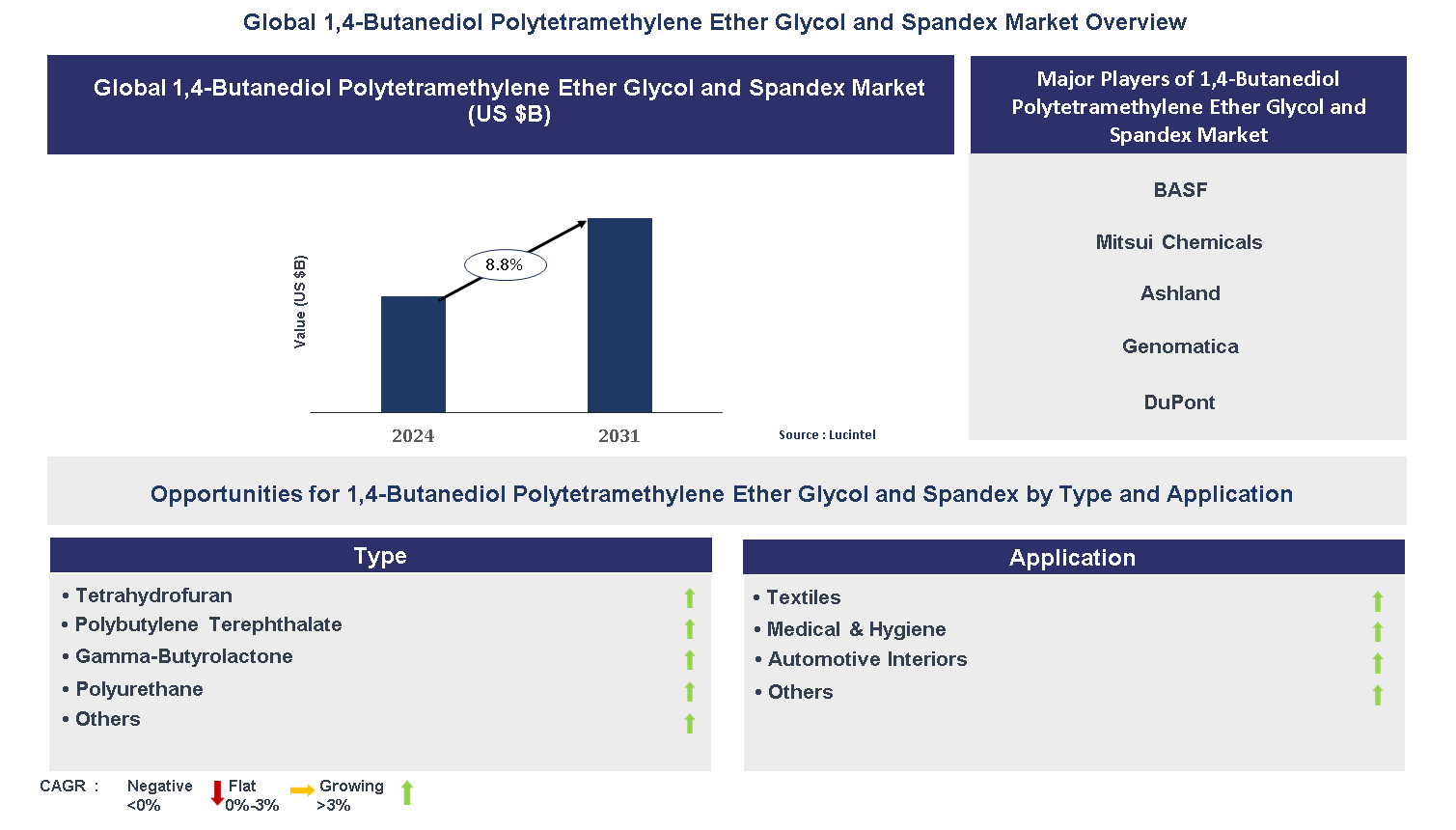
The future of the global 1,4-butanediol polytetramethylene ether glycol and spandex market looks promising with opportunities in the textile, medical & hygiene, and automotive interior markets. The global 1,4-butanediol polytetramethylene ether glycol and spandex market is expected to grow with a CAGR of 8.8% from 2025 to 2031. The major drivers for this market are the increasing demand from textile industry, the rising adoption in automotive applications, and the growing use in medical products.• Lucintel forecasts that, within the type category, tetrahydrofuran is expected to witness the highest growth over the forecast period.
• Within the application category, textile is expected to witness the highest growth.
• In terms of region, APAC is expected to witness the highest growth over the forecast period. Gain valuable insights for your business decisions with our comprehensive 150+ page report. Sample figures with some insights are shown below.
Emerging Trends in the 1,4-Butanediol Polytetramethylene Ether Glycol and Spandex Market
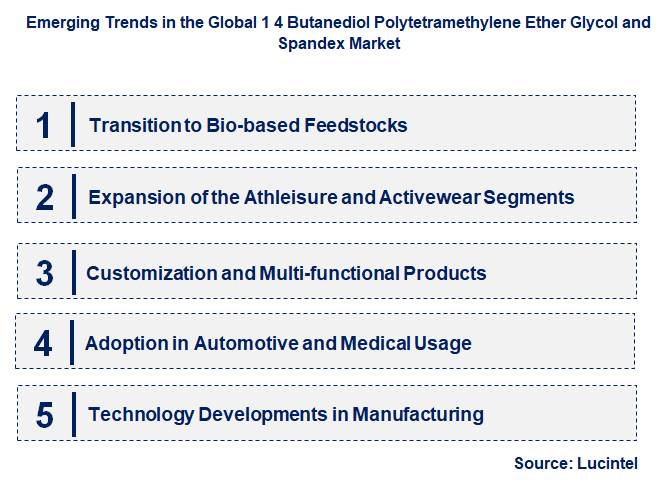
The 1,4-butanediol polytetramethylene ether glycol and spandex market is undergoing its revolutionary phase, moving away from its age-old position as a bulk commodity for commodity textiles towards adopting new, high-value applications and environmentally friendly practices. All this is being prompted by a mix of technological developments, changing consumer needs, and rising environmental concerns. These new trends are not only altering the production and application of these materials but also affecting supply chains, strategies for markets, and the competitive environment as a whole.• Transition to Bio-based Feedstocks: One major trend is the shift from fossil fuel-based BDO to bio-based BDO, which is manufactured from renewable feedstock such as plant sugars. This is a result of increased sustainability and minimization of carbon footprints globally. Companies are investing in new fermentation technologies to produce environmentally friendly alternatives. This trend is affecting the market by establishing a premium segment for bio-based products, drawing environmentally responsible consumers, and resulting in chemical companies forming strategic alliances with feedstock providers.
• Expansion of the Athleisure and Activewear Segments: The activewear and athleisure market is a top emerging trend for spandex. The increase in worldwide interest in health and wellness has triggered a huge need for high-performance, comfortable apparel that may be utilized for exercise as well as everyday activities. Spandex, with its better stretch and recovery functions, is a fundamental building block in the product. The trend is affecting the marketplace by generating a stable, high-value demand category, further establishing the material as a staple in the textile market.
• Customization and Multi-functional Products: There has been a developing trend towards customized and multi-functional spandex and its precursors. Companies are creating materials with further properties, including moisture-wicking, antimicrobial, or UV protection, in order to satisfy the unique requirements of various uses such as sportswear and medical textiles. The trend influences the market by stimulating a more cooperative effort between manufacturers and end-consumers to design bespoke solutions and presents new possibilities for product differentiation.
• Adoption in Automotive and Medical Usage: A trend that is coming into fruition is the expanding adoption of spandex and its variants in non-textile end uses, especially in the automobile and medical industries. In auto, it’s employed in light-weight seat textiles and in-housing parts. In medicine, it plays a critical role in compression wear and surgery hoses. This is spurred by the demand for high-performance, long-lasting, and flexible materials in these mission-critical applications. This trend is influencing the market by broadening its application base and forming new, high-value revenue streams.
• Technology Developments in Manufacturing: The industry is experiencing developments in technology in the production of BDO and PTMEG. Advances in catalysis, polymerization technology, and purification processes are contributing to increased yields, better product uniformity, and lower production costs. This is allowing manufacturers to make higher-quality materials in a more efficient manner. This trend is having the effect of enhancing efficiency, lowering production expenses, and enhancing the overall supply chain stability. These trends are combined in reshaping the BDO, PTMEG, and Spandex market towards a more technologically advanced, specialized, and high-value future. The focus on bio-based options, new applications in performance-oriented industries, and the drive towards multi-functional products is evolving the industry from being a bulk commodity business to an innovation and product differentiation-oriented business.
Recent Development in the 1,4-Butanediol Polytetramethylene Ether Glycol and Spandex Market
The 1,4-butanediol polytetramethylene ether glycol and spandex industry is experiencing vibrant changes with a mix of economic changes worldwide, technological advancements, and changing regulatory environments. These current trends are impacting production, supply chain, and end-use applications. The industry is experiencing pressure for capacity growth in order to address increasing demand while, at the same time, addressing challenges from raw material volatility and geopolitical tensions.• Transition to Bio-based Production: One major trend is the continued transition towards bio-based production of BDO and its derivatives. Firms are investing in new plants that use fermentation to make BDO from renewable raw materials. BASF SE, for instance, has acquired access to QIRA bio-based BDO from a Cargill HELM AG joint venture. This is affecting the market by decreasing the use of fossil fuels in the industry, attracting eco-friendly consumers, and providing a new sustainable value chain for fashion.
• Large Asia Capacity Expansions: The most important event is the major capacity expansion of BDO and PTMEG, especially in China. New large-volume plants are being commissioned to satisfy the record domestic demand for spandex and other derivatives. This is affecting the market by raising overall supply, heightening competition among manufacturers, and possibly creating a more stable but extremely competitive pricing environment, which favors downstream industries such as textiles.
• Integration of Artificial Intelligence and Automation: The industry is witnessing recent trends in the application of AI and automation in the manufacturing process. AI is applied to optimize manufacturing parameters, project maintenance requirements, and enhance product consistency, while automation is increasing operational effectiveness and decreasing labor costs. This is affecting the industry by allowing manufacturers to increase yield, minimize waste, and make higher-quality products with greater efficiency.
• Medical and Hygiene Sector Growth: One of the remarkable trends is the expanding demand for spandex and its derivatives from the medical and hygiene industry. The universal increase in global interest in health and hygiene, especially post-pandemic, has prompted an increased demand for flexible, strong, and comfortable materials for products such as compression bandages, operating room gowns, and specialty medical fabrics. This trend is shaping the market by opening a new, high-growth, and high-value revenue stream.
• Supply Chain Resilience: Geopolitical developments of late and logistics issues have resulted in dramatic disruption of the international supply chain for BDO and its derivatives. This has compelled firms to rethink their procurement strategies. One emerging trend is reliance on regional supply chains and local production to counter risks due to long-distance hauls and geopolitical tension. This is affecting the market by building a stronger but possibly decentralized global supply network. These pivotal developments are all together affecting the BDO, PTMEG, and Spandex market by forcing a shift toward a more diversified, competitive, and sustainable industry. Pressure on expansion of capacity and the emergence of strategic partnerships are building new growth prospects, while volatility in raw material prices is forcing companies to become more resilient. The adoption of technological innovation and the emphasis on high-purity products is radically transforming the market.
Strategic Growth Opportunities in the 1,4-Butanediol Polytetramethylene Ether Glycol and Spandex Market
The 1,4-butanediol polytetramethylene ether glycol and spandex industry, although mature in most applications, offers strong strategic growth prospects based on changing consumer patterns, innovations, and a worldwide sustainability drive. The prospects lie beyond generic uses and are realized in specialist, high-margin applications in different industries. In order to take advantage of these opportunities, players in the market need to emphasize innovation, product differentiation, and strategic alliances.• Growing into High-Performance Sports and Activewear: The high-performance sports and activewear market is a key strategic growth opportunity. Spandex’s enhanced stretch and recovery characteristics make it well-suited for athletic wear, from compression pants to swimwear. Global health and fitness focus is creating this demand. This affects the market by producing a high-volume, long-term usage that is less susceptible to customary economic cycles and more in tune with consumer trends toward an active lifestyle.
• Targeting the Automotive Interior Market: The market for automotive interiors presents an important growth opportunity. Spandex-based fabrics are being used more and more in automobile seats, dashboards, and other interior applications to provide more comfort, durability, and a lighter weight. This is a result of the automotive sector’s interest in weight reduction to make vehicles more fuel-efficient and, more recently, to increase the battery range of electric vehicles.
• Taking Advantage of the Medical and Hygiene Industry: The medical and hygiene industry is also a lucrative growth area. BDO, PTMEG, and spandex are applied in medical textiles to surgical masks, compression stockings, and hospital gowns. Increasing demand for healthcare products globally, sparked by population aging and hygiene awareness, is driving this opportunity. This affects the market through the creation of a new, high-value application which is vital to public safety and health.
• Growing into the Niche Industrial Applications Market: The industrial market provides a strategic opportunity, especially for high elasticity and durability requirements. BDO and its derivatives find application in industrial conveyor belts, hoses, and seals. Global pressure for industrial automation and an urgency for durable, long-lasting parts are fueling this opportunity. This affects the market by offering a new revenue stream vital to all kinds of manufacturing and logistics operations.
• Specializing in Circular Economy and Sustainable Solutions: The key strategic opportunity is to build sustainable and circular economy solutions. That goes beyond the transition towards bio-based BDO and also includes creating technologies for recycling spandex in old clothes. Those companies that can close the loop and provide a totally sustainable product will gain considerable competitive advantage. This impacts the market by fostering a culture of R&D and creating new, specialized segments that can command premium prices. These growth strategies are transforming the BDO, PTMEG, and Spandex market by promoting a transition away from a commodity bulk business to one that is specialized and high-value. By moving into high-growth markets and adopting the sustainability trend, firms can access new streams of revenue, distinguish themselves from rivals, and establish a more solid market foothold for the future.
1,4-Butanediol Polytetramethylene Ether Glycol and Spandex Market Driver and Challenges
The 1 4-butanediol polytetramethylene ether glycol and spandex industry is driven by a sophisticated set of key drivers and challenges, ranging from diverse technological, economic, and regulatory drivers to diverse demand drivers and challenges. The industry’s growth is fueled by increasing demand from principal industries and a shift towards more sustainable production, which drives innovation. But this expansion is balanced by severe challenges encompassing the volatility of raw material prices, fierce competition, and the intricate value chain. An understanding of the interactions among these forces is key to grasping the market’s present situation and predicting future direction. The factors responsible for driving the 1,4-butanediol polytetramethylene ether glycol and spandex market include: 1. Increasing Demand for Stretch Fabrics: The major propeller for the BDO, PTMEG, and Spandex market is the continuous and increasing worldwide demand for stretch fabrics in clothing. The growth of athleisure, sportswear, and performance sportswear has developed a tremendous requirement for spandex owing to its high elasticity and comfort. This is driven by evolving lifestyles among consumers and higher focus on exercise and active life. This need is a key stimulus to the whole value chain, raw material to end product. 2. Expansion to the Medical and Hygiene Market: The increased use of spandex in the medical and hygiene market is a key stimulus. Increased worldwide emphasis on health and safety has created greater demand for flexible, tough materials for medical equipment, protective clothing, and specialty fabrics. The characteristics of spandex, including its gentle compression and body-conforming attributes, make it a perfect fit for these uses. This driver enables companies to diversify their top lines and enter premium market spaces. 3. Technological Upgrades in Manufacturing: Technological upgrades in the manufacturing of BDO and PTMEG are another key driver. Advances in catalysis and polymerization technologies are resulting in greater yields and product consistency. Bio-based manufacturing technologies are also minimizing fossil fuel dependence, so the overall value chain becomes greener. These technologies improve the competitiveness and versatility of the products, allowing them to be applied to new and challenging uses. 4. Emergence of the Automotive Sector: Growth in the automotive sector, especially the demand for lightweighting and growth in the electric vehicle market, is a major trend driver. Spandex-based textiles are being implemented in the interior of vehicles to achieve weight reduction and enhance comfort for passengers. Flexible and resilient materials are needed in different parts of vehicles, creating a steady demand. This trend driver is associated with the wider phenomenon of automotive technology and design. 5. Growing Interest in Sustainable and Bio-based Materials: A primary driver is the growing global push towards sustainability. Consumers and businesses alike are wanting to lower their environmental impact, and demand for bio-based BDO and PTMEG is on the rise. That is driving firms to make R&D investments in renewable feedstocks and green manufacturing processes. This driver is building a new market for green products and is a core force influencing the future of the industry. Challenges in the 1,4-butanediol polytetramethylene ether glycol and spandex market are: 1. Volatility of Raw Material Prices: The market is challenged by the volatility of raw material prices. The cost of major feedstocks, including natural gas and crude oil, can be quite volatile, directly influencing the cost of making BDO and its derivatives. This volatility makes it challenging to plan production for manufacturers and can cause volatile pricing, which in turn impacts profit margins along the value chain. 2. Severe Competition and Overcapacity: The industry is dominated by severe competition, particularly from Asian producers. The recent addition of capacity has resulted in oversupply in certain markets, which places pressure on the prices to go down. This complicates it for small players to stay in business and can result in market consolidation. This kind of competition compels companies to innovate constantly and look for ways to lower their cost bases. 3. Comprehensively Fragmented Value Chain: The value chain of BDO, PTMEG, and Spandex is comprehensively fragmented and involves various stages and types of companies. This complicates management and can result in inefficiencies. It can cause delays and cost escalation due to the absence of an entirely integrated supply chain from raw material to finished garment. This issue is compelling businesses to look for means to attain more vertical integration. Overall, the BDO, PTMEG, and spandex industry stands at the crossroads, with strong drivers advancing it but with strong challenges requiring strategic adjustment. The widening demand in conventional and new industries, combined with an increasing emphasis on sustainability and technological progress, is opening fresh avenues for profitability and growth. Yet, the market has to deal with the volatility of raw material prices, the looming threat of competition and overcapacity, and the natural complexity of its value chain.List of 1,4-Butanediol Polytetramethylene Ether Glycol and Spandex Companies
Companies in the market compete on the basis of product quality offered. Major players in this market focus on expanding their manufacturing facilities, R&D investments, infrastructural development, and leverage integration opportunities across the value chain. With these strategies 1,4-butanediol polytetramethylene ether glycol and spandex companies cater increasing demand, ensure competitive effectiveness, develop innovative products & technologies, reduce production costs, and expand their customer base. Some of the 1,4-butanediol polytetramethylene ether glycol and spandex companies profiled in this report include-• BASF
• Mitsui Chemicals
• Ashland
• Genomatica
• DuPont
• Dow
• Toray
• Sipchem
• Lotte Chemical
• Indorama Synthetics
1,4-Butanediol Polytetramethylene Ether Glycol and Spandex Market by Segment
The study includes a forecast for the global 1,4-butanediol polytetramethylene ether glycol and spandex market by type, application, and region.1,4-Butanediol Polytetramethylene Ether Glycol and Spandex Market by Type [Value from 2019 to 2031]:
• Tetrahydrofuran
• Polybutylene Terephthalate
• Gamma-Butyrolactone
• Polyurethane
• Others
1,4-Butanediol Polytetramethylene Ether Glycol and Spandex Market by Application [Value from 2019 to 2031]:
• Textiles
• Medical & Hygiene
• Automotive Interiors
• Others
1,4-Butanediol Polytetramethylene Ether Glycol and Spandex Market by Region [Value from 2019 to 2031]:
• North America
• Europe
• Asia Pacific
• The Rest of the World
Country Wise Outlook for the 1,4-Butanediol Polytetramethylene Ether Glycol and Spandex Market
Current trends in the worldwide 1,4-butanediol polytetramethylene ether glycol and spandex market are influenced by a synergy of drivers, such as growing customer demand for flexible materials, enhanced emphasis on sustainability, and changing global manufacturing dynamics. The industry is experiencing a significant trend away from petrochemical dependence and towards bio-based alternatives as a way to minimize environmental footprints and mitigate dependence on petrochemicals. Concurrently, the regional market conditions are changing, with some nations becoming key production and consumption centers. These developments are creating a more competitive and innovative market.• United States: The US market for BDO, PTMEG, and spandex is primarily influenced by its established textile industry and strong emphasis on technical textiles and performance apparel. Current advances focus on the move towards sustainable and bio-based sourcing, with corporations going out of their way to cut their carbon footprint. Industry leaders are making investments in partnerships and technologies to manufacture BDO from renewable feedstocks such as sugars from plants.
• China: China is the world’s biggest market for BDO, PTMEG, and spandex, with recent news centered around major capacity growth. The textile sector is driven by the country’s high domestic demand for athleisure and activewear, as well as its leading position in worldwide exports. Recent news has been centered around the opening of new BDO and PTMEG facilities to decrease the reliance on imports and satisfy increased domestic consumption. The industry also has a movement towards vertical integration, with firms having control over the whole chain value from raw material to final product.
• Germany: Germany’s market is an integral sector of Europe’s cutting-edge chemical and engineering industries. The core development is the emphasis on high-performance and specialty uses of BDO and its derivatives, especially in automotive and medical applications. The market is fueled by rigorous environmental and safety standards, which prefer cutting-edge, high-quality products. German businesses are spending large amounts of money in research and development to create specialist PTMEG and spandex which satisfy the rigorous requirements of high-tech industries.
• India: India’s market for PTMEG, spandex, and BDO is in the growth phase, being fueled by its fast-growing textile and apparel industry. One of the developments is the growth in domestic production capacity to satisfy the growing demand for stretch fabrics in traditional as well as modern garments. The market also exhibits growing demand from the automotive sector for interior components and fabrics. The expansion is driven by a vast and young population with growing disposable incomes and therefore, higher consumption of activewear.
• Japan: Japan’s market is mature and highly integrated within its advanced manufacturing sector. One notable development is attention to premium, technical-grade spandex for high-end uses, such as in the electronics and medical industries. The market also has a significant presence in the automotive sector, where attention is given to next-generation materials for vehicle interiors. The Japanese are the driving forces behind R&D in new uses, including the application of BDO derivatives in niche polymers and functional materials, in order to stay competitive.

Features of the Global 1,4-Butanediol Polytetramethylene Ether Glycol and Spandex Market
Market Size Estimates: 1,4-butanediol polytetramethylene ether glycol and spandex market size estimation in terms of value ($B). Trend and Forecast Analysis: Market trends (2019 to 2024) and forecast (2025 to 2031) by various segments and regions. Segmentation Analysis: 1,4-butanediol polytetramethylene ether glycol and spandex market size by type, application, and region in terms of value ($B). Regional Analysis: 1,4-butanediol polytetramethylene ether glycol and spandex market breakdown by North America, Europe, Asia Pacific, and Rest of the World. Growth Opportunities: Analysis of growth opportunities in different types, applications, and regions for the 1,4-butanediol polytetramethylene ether glycol and spandex market. Strategic Analysis: This includes M&A, new product development, and competitive landscape of the 1,4-butanediol polytetramethylene ether glycol and spandex market. Analysis of competitive intensity of the industry based on Porter’s Five Forces model.
FAQ
Q1. What is the growth forecast for 1,4-butanediol polytetramethylene ether glycol and spandex market? Answer: The global 1,4-butanediol polytetramethylene ether glycol and spandex market is expected to grow with a CAGR of 8.8% from 2025 to 2031. Q2. What are the major drivers influencing the growth of the 1,4-butanediol polytetramethylene ether glycol and spandex market? Answer: The major drivers for this market are the increasing demand from textile industry, the rising adoption in automotive applications, and the growing use in medical products. Q3. What are the major segments for 1,4-butanediol polytetramethylene ether glycol and spandex market? Answer: The future of the 1,4-butanediol polytetramethylene ether glycol and spandex market looks promising with opportunities in the textile, medical & hygiene, and automotive interior markets. Q4. Who are the key 1,4-butanediol polytetramethylene ether glycol and spandex market companies? Answer: Some of the key 1,4-butanediol polytetramethylene ether glycol and spandex companies are as follows:• BASF
• Mitsui Chemicals
• Ashland
• Genomatica
• DuPont
• Dow
• Toray
• Sipchem
• Lotte Chemical
• Indorama Synthetics Q5. Which 1,4-butanediol polytetramethylene ether glycol and spandex market segment will be the largest in future? Answer: Lucintel forecasts that, within the type category, tetrahydrofuran is expected to witness the highest growth over the forecast period. Q6. In 1,4-butanediol polytetramethylene ether glycol and spandex market, which region is expected to be the largest in next 5 years? Answer: In terms of region, APAC is expected to witness the highest growth over the forecast period. Q7. Do we receive customization in this report? Answer: Yes, Lucintel provides 10% customization without any additional cost.
Table of Contents
List of Figures
List of Tables
Methodology
- In-depth interviews of the major players in this market
- Detailed secondary research from competitors’ financial statements and published data
- Extensive searches of published works, market, and database information pertaining to industry news, company press releases, and customer intentions
- A compilation of the experiences, judgments, and insights of Lucintel’s professionals, who have analyzed and tracked this market over the years.


Buy Now
Choose a license that fits your team. Instant PDF delivery.
Prices exclude taxes. Instant delivery. Custom licensing available on request.
Key Questions
- • What are some of the most promising, high-growth opportunities for the 1,4-butanediol polytetramethylene ether glycol and spandex market by type (tetrahydrofuran, polybutylene terephthalate, gamma-butyrolactone, polyurethane, and others), application (textiles, medical & hygiene, automotive interiors, and others), and region (North America, Europe, Asia Pacific, and the Rest of the World)?
- • Which segments will grow at a faster pace and why?
- • Which region will grow at a faster pace and why?
- • What are the key factors affecting market dynamics? What are the key challenges and business risks in this market?
- • What are the business risks and competitive threats in this market?
- • What are the emerging trends in this market and the reasons behind them?
- • What are some of the changing demands of customers in the market?
- • What are the new developments in the market? Which companies are leading these developments?
- • Who are the major players in this market? What strategic initiatives are key players pursuing for business growth?
- • What are some of the competing products in this market and how big of a threat do they pose for loss of market share by material or product substitution?
- • What M&A activity has occurred in the last 5 years and what has its impact been on the industry? For any questions related to 1,4-Butanediol Polytetramethylene Ether Glycol and Spandex Market, 1,4-Butanediol Polytetramethylene Ether Glycol and Spandex Market Size, 1,4-Butanediol Polytetramethylene Ether Glycol and Spandex Market Growth, 1,4-Butanediol Polytetramethylene Ether Glycol and Spandex Market Analysis, 1,4-Butanediol Polytetramethylene Ether Glycol and Spandex Market Report, 1,4-Butanediol Polytetramethylene Ether Glycol and Spandex Market Share, 1,4-Butanediol Polytetramethylene Ether Glycol and Spandex Market Trends, 1,4-Butanediol Polytetramethylene Ether Glycol and Spandex Market Forecast, 1,4-Butanediol Polytetramethylene Ether Glycol and Spandex Companies, write Lucintel analyst at email: helpdesk@lucintel.com. We will be glad to get back to you soon.


