
Market Report · July 29, 2026

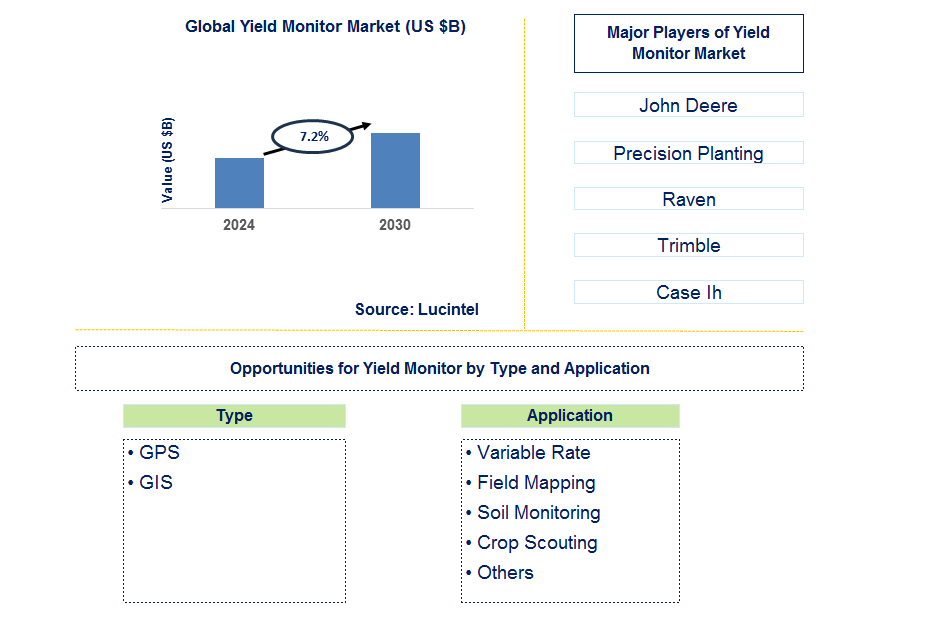
Key data points: The growth forecast = 7.2% annually for the next 6 years. Scroll below to get more insights. This market report covers trends, opportunities, and forecasts in the global yield monitor market to 2030 by type (GPS and GIS), application (variable rate, field mapping, soil monitoring, crop scouting, and others), and region (North America, Europe, Asia Pacific, and the Rest of the World)
We'll send your sample report shortly.
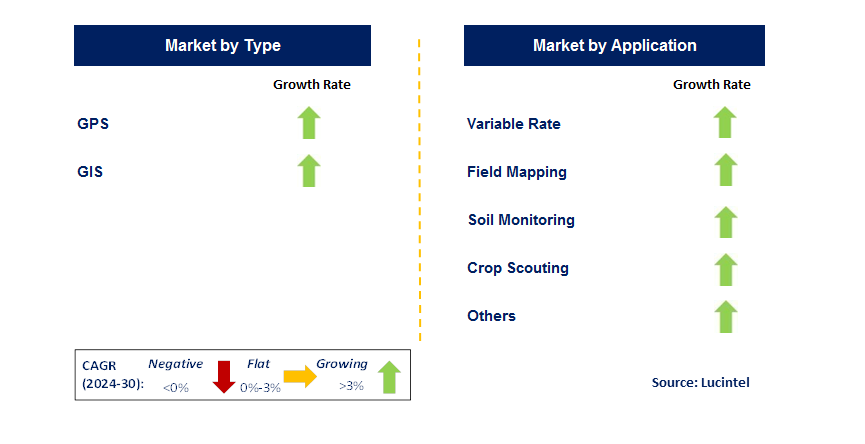
• Lucintel forecasts that, within the type category, GPS is expected to witness higher growth over the forecast period.
• Within the application category, variable rate is expected to witness the highest growth.
• In terms of regions, North America is expected to witness the highest growth over the forecast period. Gain valuable insights for your business decisions with our comprehensive 150+ page report.
• Lucintel forecasts that, within the type category, PS is expected to witness higher growth over the forecast period.
• Within the end use category, variable rate is expected to witness the highest growth.
• North America is expected to witness the highest growth over the forecast period. A more than 150-page report is developed to help in your business decisions.
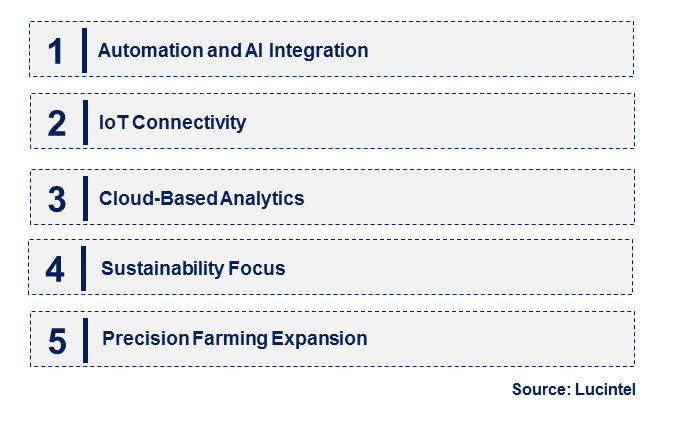
• Automation and AI Integration: Yield monitors are increasingly integrating AI algorithms, enabling real-time decision-making and automating data collection. These technologies provide actionable insights that optimize crop yields with minimal manual intervention.
• IoT Connectivity: IoT integration enables yield monitors to connect with other farming equipment, fostering improved data sharing and overall farm management. This connectivity enhances operational efficiency and promotes better crop health.
• Cloud-Based Analytics: Cloud computing adoption in yield monitoring allows for remote data access, real-time updates, and long-term data storage. This trend is especially beneficial for large-scale farming operations looking to streamline resource management.
• Sustainability Focus: Yield monitors are essential in promoting sustainable farming practices. By offering data that helps optimize water and fertilizer usage, these systems play a pivotal role in reducing environmental impact.
• Precision Farming Expansion: With the growth of precision farming, yield monitors are becoming indispensable tools for accurate data collection, helping farmers apply inputs more efficiently and reduce wastage. These trends are driving a major transformation in the Yield Monitor market, focusing on automation, sustainability, and data-driven decision-making, which are revolutionizing modern agriculture.
• AI Integration: The incorporation of AI into yield monitors is enhancing predictive capabilities, allowing farmers to forecast yields with greater accuracy. This reduces uncertainties in planning and improves productivity.
• Sensor Technology Advancements: New sensors are being integrated into yield monitors, enabling real-time monitoring of a broader range of environmental factors. These advancements improve data accuracy and help farmers make better-informed decisions.
• Mobile Connectivity: Enhanced mobile app integration allows farmers to access yield data on-the-go. This improves farm management efficiency by enabling remote data analysis and decision-making.
• Cost-Effective Models for Small Farmers: The development of affordable yield monitors tailored to small-scale farmers is expanding market access, particularly in developing regions. These low-cost models help optimize yields and reduce the barriers to adoption in smaller farming operations.
• Cloud Integration: Cloud-based yield monitoring systems are gaining popularity, allowing farmers to store and access vast amounts of data. This facilitates better long-term planning and predictive analytics to optimize crop outcomes. These recent advancements are making yield monitors more accessible, cost-effective, and technologically advanced, encouraging broader adoption across diverse farming operations.
• Precision Agriculture: Yield monitors are becoming central to precision farming, allowing farmers to apply inputs like water, fertilizers, and pesticides more efficiently. This opportunity lies in helping farms achieve higher productivity with fewer resources.
• Crop Management: Yield monitors offer substantial growth potential in crop management by providing real-time data on planting, irrigation, and harvesting decisions. This helps farmers optimize resources and enhance crop yields.
• Data-Driven Decision Making: The demand for yield monitors that facilitate data analytics is growing. This drives the development of advanced analytics tools to help farmers make data-informed decisions that improve productivity.
• Sustainable Farming: Yield monitors that promote sustainable farming practices are gaining momentum. These systems help optimize resource use, reduce waste, and enhance environmental stewardship, making them essential in sustainable farming initiatives.
• Large-Scale Farming Operations: Large-scale farming operations are increasingly adopting yield monitors to improve operational efficiency and reduce labor costs. The scalability of these systems is a key growth driver for large agricultural enterprises. These strategic growth opportunities are shaping the future of the Yield Monitor market, boosting farming productivity and supporting sustainability on a large scale.
• Technological Advancements: The integration of AI, IoT, and cloud computing technologies is enhancing the functionality of yield monitors, making them more accurate and efficient.
• Increased Demand for Precision Farming: As precision agriculture practices grow, farmers are increasingly adopting yield monitors to optimize resources and boost productivity.
• Government Initiatives: Supportive policies and subsidies from governments are encouraging the adoption of smart farming technologies, including yield monitors.
• Sustainability Goals: Growing environmental awareness is pushing farmers to adopt technologies that reduce resource wastage, making yield monitors essential in achieving sustainability goals.
• Growing Farm Size: Larger farming operations are turning to yield monitors to improve efficiency, enhance productivity, and reduce labor costs. Challenges in the yield monitor market are:
• High Initial Costs: The cost of advanced yield monitors can be prohibitive, especially for small and medium-sized farmers, limiting widespread adoption.
• Limited Awareness: Many farmers, particularly in emerging markets, are unaware of the benefits that yield monitors can offer, slowing market growth.
• Technological Barriers: The complexity of yield monitors may deter farmers who are unfamiliar with digital tools, limiting the adoption of this technology.
• Data Privacy Concerns: As farmers become more reliant on digital tools, concerns about data ownership and privacy are rising, creating hesitance in some regions.
• Lack of Infrastructure: In many developing countries, limited access to reliable internet and power supplies hampers the adoption of connected yield monitors. Addressing these challenges particularly around cost, awareness, and infrastructure—will be critical to unlocking the full potential of yield monitoring technologies.
• John Deere
• Precision Planting
• Raven
• Trimble
• Case Ih
• Topcon
• Ag Leader
• GPS
• GIS
• Variable Rate
• Field Mapping
• Soil Monitoring
• Crop Scouting
• Others
• North America
• Europe
• Asia Pacific
• The Rest of the World
• United States: The U.S. Yield Monitor market is seeing significant integration of IoT-based solutions and cloud computing. Companies are focusing on real-time data analytics to improve decision-making and increase yield efficiency.
• China: Advancements in AI-powered yield monitors are enhancing the accuracy of yield predictions in China. Government initiatives supporting smart agriculture are driving market expansion, with more manufacturers adopting precision farming technologies.
• Germany: German agricultural equipment manufacturers are enhancing the compatibility of yield monitors with other farming machinery. New developments include the integration of advanced GPS technology for more accurate data collection and analysis.
• India: India’s Yield Monitor market is expanding due to increased government focus on digital agriculture. Affordable, low-cost solutions are being developed to cater to small and medium-scale farmers, improving crop yield and resource optimization.
• Japan: Japan is at the forefront of using robotics and automation in yield monitoring. Recent advancements include the development of AI-driven monitors that analyze a range of environmental factors to help farmers make data-driven decisions in real-time.




Choose a license that fits your team. Instant PDF delivery.
Prices exclude taxes. Instant delivery. Custom licensing available on request.
Market Report · July 29, 2026
Market Report · July 20, 2026
Market Report · July 20, 2026
Trusted partner for strategic intelligence and business growth


Receive a complimentary market analysis tailored to your industry. Our analysts will identify key growth opportunities and competitive dynamics specific to your business.

Market size, growth rate, and key trend analysis for your specific sector.

Top competitor positioning and market share analysis.

Strategic recommendations backed by data-driven insights.
Get curated market intelligence and competitive moves straight to your inbox.
By subscribing, you agree to receive our monthly insights. Unsubscribe anytime.
Receive a complimentary market analysis tailored to your industry. Our analysts will identify key growth opportunities and competitive dynamics specific to your business.
Market size, growth rate, and key trend analysis for your specific sector.
Top competitor positioning and market share analysis.
Strategic recommendations backed by data-driven insights.
Get curated market intelligence, emerging trends, and competitive moves straight to your inbox each month.
By subscribing, you agree to receive our monthly insights. Unsubscribe anytime.
We'll send your sample report shortly.