
Market Report · July 16, 2026

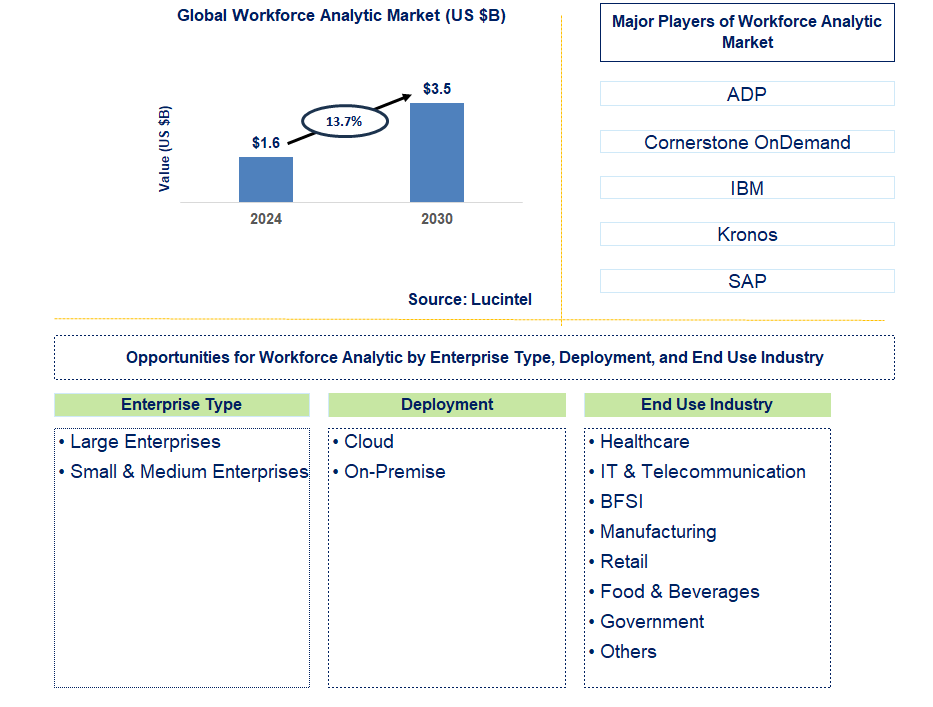
Key data points: The market size in 2030 = $3.5 billion, growth forecast = 13.7% annually for the next 6 years. Scroll below to get more insights. This market report covers trends, opportunities, and forecasts in the global workforce analytic market to 2030 by enterprise type (large enterprises and small & medium enterprises), deployment (cloud and on-premise), end use industry (healthcare, IT & telecommunication, BFSI, manufacturing, retail, food & beverages, government, and others), and region (North America, Europe, Asia Pacific, and the Rest of the World)
We'll send your sample report shortly.
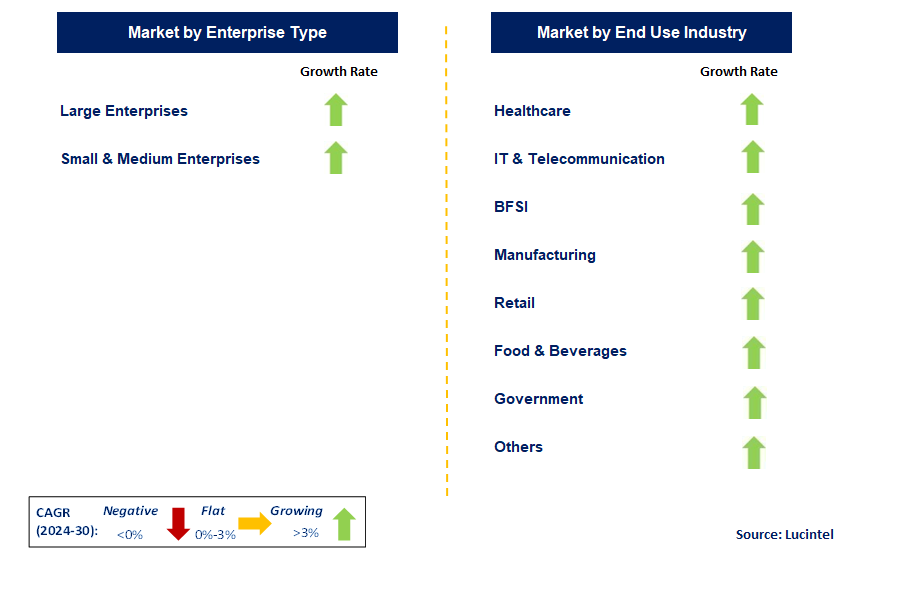
• Lucintel forecasts that, within the enterprise category, large enterprises will remain the largest segment over the forecast period due to initial adoption of the software.
• Within the end use category, IT & telecommunication is expected to witness the highest growth due to swift progress in the sector driven by the increasing demand for enhanced it and telecommunication services.
• In terms of regions, North America will remain the largest region over the forecast period due to this region is technologically progressive, embracing new technologies quickly. Gain valuable insight for your business decision with our comprehensive 150+ page report.
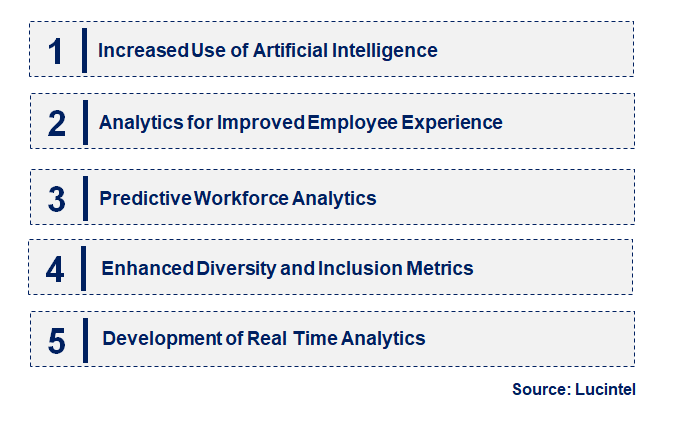
• Increase Use of Artificial Intelligence: Human resource management has shifted focus from traditional managerial frameworks to advanced AI-enabled solutions. Business HR professionals help organizations navigate difficult landscapes by minimizing misunderstandings and placing the right talent in the right positions through the use and implementation of AI-driven solutions that enhance employee behavior, recruitment, and development plans.
• Analytics for Improved Employee Experience: The adoption of analytics to better support employees and monitor their health and satisfaction is also a growing trend. Businesses are using data to help detect problems with mental health, job satisfaction, and even work-life balance. This trend arises from the understanding that treating illness is not as cost-effective as preventing it and promoting healthier working environments, which can lead to increased productivity and retention.
• Predictive Workforce Analytics: The constructive use of analytics has led to the growing incorporation of workload forecasting into operational plans. Organizations need to determine skill sets, patterns of turnover, and issues related to skill shortages, among other factors, and make effective plans for workforce utilization.
• Enhanced Diversity and Inclusion Metrics: More organizations are attempting to analyze how diversity and inclusion can be improved. More sophisticated metrics for measuring representation, identifying gaps, and building an inclusive work culture are being adopted. This trend indicates a growing commitment to equity and fairness in the workplace.
• Development of Real-Time Analytics: The increasing use of real-time analytics is creating an environment where immediate, data-driven decisions are possible. This trend is fueled by advancements in technology that allow constant monitoring and processing of information, helping businesses adapt to changing environments and enhance operational performance. It is noticeable that these emerging trends suggest a transition towards more advanced, investment-driven approaches in workforce analytics. Complementing employee welfare and diversity concerns, AI, predictive analytics, and real-time data are expanding HR system capabilities in modern transformation management. Collectively, these trends are changing the way organizations orchestrate and utilize their human resources.
• Advancement in AI and Machine Learning: The use of AI and machine learning in workforce analytics is changing how data is analyzed in corporations and how decisions are made within organizations. These technologies assist in developing better projections of employee performance, retention, and hiring, thereby facilitating strategic HR planning.
• Growth of Predictive Analytics Tools: Predictive analytics tools are continuously evolving and enhancing, and so is the intelligence gathered on predicting future workforce trends. Companies are using these tools to estimate the amount of talent needed, identify potential challenges, and develop strategies to mitigate them, which improves personnel management.
• Enhanced Focus on Employee Experience: There is a greater focus on analytics that elevate the employee experience. Organizations are harnessing data to examine employee engagement, job satisfaction, and overall employee well-being in an effort to enhance the habitability and productivity of workplaces.
• Increased Adoption of Real-Time Analytics: There is a growing acceptance of real-time analytics, allowing organizations to factor in real-time data when making decisions. This enables organizations to quickly address changes that may arise in human resources or the organization’s operations in general to attain better performance.
• Integration of Diversity and Inclusion Metrics: There is an increasing integration of measures aimed at assessing and improving diversity and inclusion within firms. Workforce analytics have been applied in areas such as representation, gap analysis, and initiatives to support diversity and inclusion. These developments highlight the increased use of data-driven strategies in workforce analytics. HR efficiency improves with the growth of artificial intelligence, predictive and naturalistic tools, and a focused approach to employee experience and diversity in larger corporations. These trends are defining the next frontier of managing and optimizing workforces.
• Expansion of AI-Powered Analytics: The increasing adoption of AI-powered analytics technologies provides opportunities for a more advanced approach to understanding and using data. Organizations can utilize artificial intelligence in areas such as talent acquisition and employee management, improving the efficiency of operations and HR services.
• Development of Predictive Workforce Planning: Through advanced technologies, predictive analytics assists organizations in workforce planning by providing data that anticipates future talent demands. Organizations can leverage these insights to align their HR strategies with their objectives, foresee future skills gaps, and develop mitigation measures to address these challenges.
• Expansion of Employee Engagement Solutions: There is significant potential in building employee engagement solutions. Employing analytic techniques can monitor satisfaction at work and wellness, which can boost proactive and effective organizations, reducing labor turnover and improving overall output effectiveness.
• Concentration on D&I Analytics: Tools used to assess and enhance diversity and inclusiveness among employees are strategic growth drivers. Organizations have utilized these tools to evaluate representation, identify challenges, and devise strategic solutions to improve representation.
• Embedding Real-Time Data Solutions: Timely or real-time data solutions are improving in that they assist in making quick decisions. Firms that invest in real-time analytics gain the advantage of rapidly adapting to emerging conditions, enhancing productivity, and improving efficiency in HR management. Such strategic growth opportunities provide insight into how workforce analytics can facilitate enhanced HR performance and improve organizational outcomes. Companies need to focus on AI, apply predictive analytics, prioritize employee engagement and diversity, and rely on real-time data to improve workforce strategies.
• Technological Innovations: The growth of workforce analytics relies on the exponential growth of AI, machine learning, and real-time analytics. Today, technologies facilitate better data analysis, better decisions, and improved people-oriented functions in organizations, leading to better management of personnel.
• Decision Making Using Data: The rising need to make decisions based on data is prompting many organizations to acquire sophisticated workforce analytics tools for data interpretation. Organizations want to utilize data to improve talent management, increase productivity, and achieve strategic objectives, making workforce analytics a must-have tool.
• Focus on Employee Wellness: There is a growing concern regarding job analytics within an organizational context to enhance satisfaction, health, and engagement of employees, increasing the focus on leveraging ancillary data. Companies use data to improve working conditions, decrease burnout, and enhance the overall employee experience.
• Social Pressure: Keeping up with a continuous cycle of changes in legislation concerning data and employee rights is a primary motivator. Organizations must observe legal boundaries while conducting workforce analytics, which affects the design and implementation of analytical solutions.
• Economic Factors: The impetus for workforce analytics stems from economic conditions. During a recession or economic downturn, companies may focus more on cost containment rather than investing in analytics, whereas an economic upturn is likely to result in increased spending on advanced analytics solutions. Challenges in the workforce analytics market include:
• Data Privacy and Security: Protecting data privacy and security is a critical issue and poses a challenge during workforce analytics initiatives. Organizations must safeguard the confidential information of their employees and prevent leaks or inappropriate use of that information, necessitating strong security measures and adherence to legal frameworks for information protection.
• Integration with Existing Systems: A significant obstacle for organizations is integrating workforce analytics into existing HR systems and processes. Difficulties in fitting new analytic solutions into legacy systems can affect the utilization and delivery of data-driven interventions.
• Skill Gaps in Data Analysis: There is often a bias where specific skill sets are necessary for effective data analysis, but HR teams may lack these skills. Organizations may struggle to source and retain individuals with the required expertise, impacting the productivity of workforce analytical tools and explaining the shortfall in data-driven insights. The major drivers and challenges in workforce analytics highlight the importance of technology, data privacy, and economic factors in shaping the market. Growth is driven by technological advances and an emphasis on data-informed decision-making; however, issues such as privacy, integration, and skill gaps must be addressed for these analytics solutions to be adopted and used effectively.
• ADP
• Cornerstone OnDemand
• IBM
• Kronos
• SAP
• Workday
• WorkForce Software
• Visier
• Oracle
• TriNet
• Large Enterprises
• Small & Medium Enterprises
• Cloud
• On-Premise
• Healthcare
• IT & Telecommunication
• BFSI
• Manufacturing
• Retail
• Food & Beverages
• Others
• North America
• Europe
• Asia Pacific
• The Rest of the World
• United States: In the U.S., the adoption of workforce analytics is redeeming the process of employee management as well as recruitment through the use of artificial intelligence as one of the tools. Organizations are utilizing AI to establish various correlations between different performance measures, employee characteristics, retention, and diversity. This includes supplementary measures designed to assist in managing workplace diversity, particularly regarding inclusion and management of diversity initiatives to realize better organizational effectiveness.
• China: In China, attention is directed towards the application of big data and predictive analytics, particularly concerning workforce planning and talent management. Companies are implementing advanced analytics to predict the number of talents required and enhance employees’ active participation. This shift has fundamentally changed the approach to workforce management and allows for enhanced data-driven decision-making and strategy optimization for human resources.
• Germany: There is a positive shift towards adopting workforce analytics in Germany, focusing on improving productivity as well as employee well-being. Organizations have begun adopting analytics solutions to track employees’ work behaviors, health status, and satisfaction levels. The intended goal is to mitigate issues like employee burnout and improve productivity by offering better work environments.
• India: Indian organizations have made great strides in employing workforce analytics to address skill gaps and improve talent acquisition strategies. Companies draw from employee and market data on skills and business trends to recruit what will be relevant for their business in the near future. In this way, it assists in cultivating a more versatile and skilled workforce.
• Japan: To resolve problems surrounding an aging society, Japan is deploying workforce analytics practices for better workforce management. These analytics tools are particularly used to improve succession management and retain qualified personnel. Furthermore, there is an emphasis on mechanizing repetitive tasks to enhance productivity and enable older workers to perform optimally.


• ADP
• Cornerstone OnDemand
• IBM
• Kronos
• SAP
• Workday
• WorkForce Software
• Visier
• Oracle
• TriNet Q6. Which workforce analytic market segment will be the largest in future? Answer: Lucintel forecasts that large enterprises will remain the largest segment over the forecast period due to initial adoption of the software. Q7. In workforce analytic market, which region is expected to be the largest in next 5 years? Answer: North America will remain the largest region over the forecast period due to this region is technologically progressive, embracing new technologies quickly. Q.8 Do we receive customization in this report? Answer: Yes, Lucintel provides 10% customization without any additional cost.


Choose a license that fits your team. Instant PDF delivery.
Prices exclude taxes. Instant delivery. Custom licensing available on request.
Market Report · July 16, 2026
Market Report · May 18, 2026
Market Report · May 18, 2026
Trusted partner for strategic intelligence and business growth


Receive a complimentary market analysis tailored to your industry. Our analysts will identify key growth opportunities and competitive dynamics specific to your business.

Market size, growth rate, and key trend analysis for your specific sector.

Top competitor positioning and market share analysis.

Strategic recommendations backed by data-driven insights.
Get curated market intelligence and competitive moves straight to your inbox.
By subscribing, you agree to receive our monthly insights. Unsubscribe anytime.
Receive a complimentary market analysis tailored to your industry. Our analysts will identify key growth opportunities and competitive dynamics specific to your business.
Market size, growth rate, and key trend analysis for your specific sector.
Top competitor positioning and market share analysis.
Strategic recommendations backed by data-driven insights.
Get curated market intelligence, emerging trends, and competitive moves straight to your inbox each month.
By subscribing, you agree to receive our monthly insights. Unsubscribe anytime.
We'll send your sample report shortly.