
Market Report · July 29, 2026

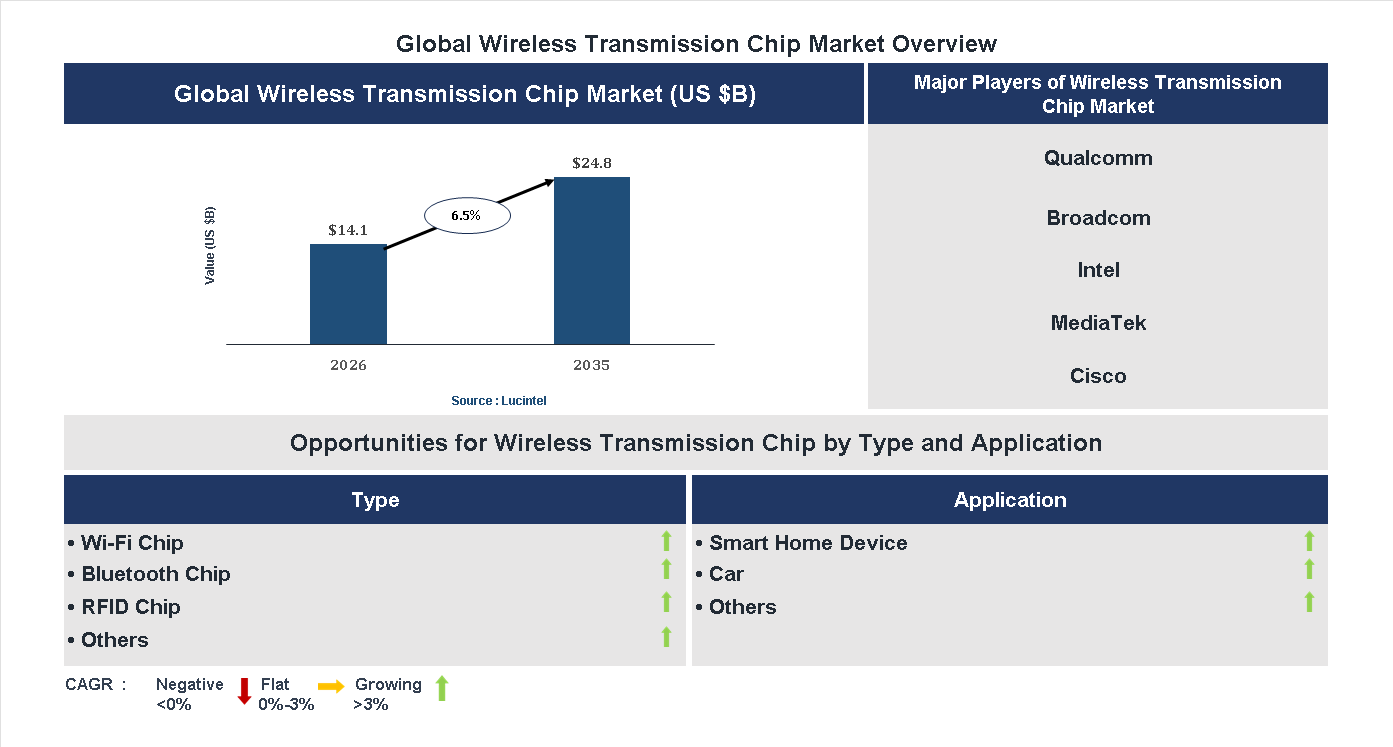
Key data points: The market size in 2035 = $24.8 billion, growth forecast = 6.5% annually for the next 8 years. Scroll below to get more insights. This market report covers trends, opportunities and forecasts in wireless transmission chip market to 2035 by type (Wi-Fi chip, bluetooth chip, RFID chip, and others), application (smart home device, car, and others), and region (North America, Europe, Asia Pacific, and the Rest of the World)
We'll send your sample report shortly.
• Lucintel forecasts that, within the type category, Wi-Fi chip is expected to witness the highest growth over the forecast period.
• Within the application category, smart home device is expected to witness higher growth.
• In terms of region, APAC is expected to witness the highest growth over the forecast period. Gain valuable insights for your business decisions with our comprehensive 150+ page report. Sample figures with some insights are shown below.
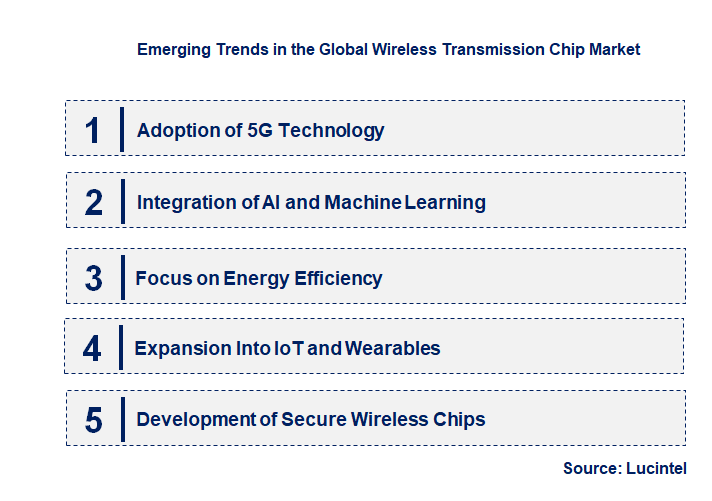
• Adoption of 5G Technology: The deployment of 5G networks is revolutionizing wireless communication by offering higher speeds, lower latency, and increased capacity. Wireless transmission chips optimized for 5G are enabling new applications such as IoT, autonomous vehicles, and smart cities. This trend is driving chip manufacturers to innovate with advanced materials and architectures to meet the stringent requirements of 5G standards. The impact includes enhanced user experiences, improved device connectivity, and the opening of new market segments, making 5G-compatible chips a key growth driver.
• Integration of AI and Machine Learning: Incorporating AI and machine learning capabilities into wireless transmission chips is transforming how data is processed and transmitted. These chips can optimize signal quality, reduce interference, and improve energy efficiency through intelligent algorithms. This integration enhances device performance, supports real-time analytics, and enables smarter network management. The trend is fostering the development of more autonomous and adaptive wireless systems, which are crucial for applications like smart homes, industrial automation, and healthcare, thereby expanding market opportunities.
• Focus on Energy Efficiency: As the number of connected devices surges, energy-efficient wireless transmission chips are becoming increasingly vital. Manufacturers are developing low-power chips that extend battery life and reduce operational costs, especially for IoT devices and wearable technology. Innovations include advanced power management techniques and energy harvesting capabilities. This trend not only supports sustainability goals but also broadens the applicability of wireless devices in remote or inaccessible locations, impacting market growth by enabling longer device lifespans and reducing environmental impact.
• Expansion into IoT and Wearables: The proliferation of IoT devices and wearable technology is significantly expanding the demand for specialized wireless transmission chips. These chips are designed to be compact, low power, and capable of supporting various wireless standards such as Bluetooth, Zigbee, and Wi-Fi. Their integration facilitates seamless connectivity, data collection, and real-time communication across diverse sectors, including healthcare, manufacturing, and consumer electronics. This trend is fueling innovation in chip design and fostering new business models centered around connected ecosystems, thereby driving substantial market growth and diversification.
• Development of Secure Wireless Chips: With increasing concerns over data security and privacy, the market is witnessing a surge in the development of secure wireless transmission chips. These chips incorporate hardware-based security features such as encryption, secure boot, and tamper resistance to protect sensitive data during transmission. The focus on security is critical for applications in finance, healthcare, and government sectors. This trend enhances trust in wireless systems, encourages adoption in sensitive environments, and creates a competitive edge for manufacturers investing in security features, ultimately shaping a safer and more reliable wireless communication landscape. These trends are collectively reshaping the wireless transmission chip market by fostering innovation, enhancing performance, and expanding application horizons. The integration of advanced technologies like 5G, AI, and security features is driving growth, while a focus on energy efficiency and IoT expansion is broadening market reach. As these developments continue, the market is poised for significant transformation, enabling smarter, faster, and more secure wireless communication solutions across industries.
• 5G Integration: Accelerating Connectivity and Data Speeds: The integration of 5G technology into wireless transmission chips is revolutionizing connectivity, enabling faster data transfer, lower latency, and improved network reliability. This advancement supports the growth of IoT devices, smart cities, and autonomous vehicles, creating new market opportunities. Enhanced chip capabilities are also reducing power consumption, making devices more efficient. As 5G adoption expands globally, the demand for advanced wireless chips will surge, significantly impacting the market’s growth trajectory.
• AI-Enabled Wireless Chips: Enhancing Performance and Functionality: The incorporation of artificial intelligence (AI) into wireless transmission chips is transforming device capabilities. AI-enabled chips facilitate smarter data processing, real-time analytics, and adaptive communication protocols, improving overall performance. This development benefits applications in healthcare, automotive, and consumer electronics by enabling more intelligent, responsive devices. The integration of AI also drives innovation in chip design, fostering competitive advantages for manufacturers. As AI becomes more prevalent, the market for intelligent wireless chips is expected to expand rapidly.
• Miniaturization and Power Efficiency: Driving Portable and IoT Devices: Advances in miniaturization and power efficiency are enabling the development of smaller, more energy-efficient wireless chips. These chips are essential for wearable devices, IoT sensors, and compact consumer electronics, where space and battery life are critical. Improved power management reduces energy consumption, extending device lifespan and reducing operational costs. This trend supports the proliferation of connected devices in everyday life and industrial settings, creating new opportunities for market players to innovate and meet the growing demand for portable, efficient wireless solutions.
• Integration with Edge Computing: Enabling Real-Time Data Processing: The convergence of wireless chips with edge computing technologies is facilitating real-time data processing at the device level. This integration reduces latency, enhances data security, and decreases reliance on cloud infrastructure. It is particularly impactful in autonomous vehicles, industrial automation, and smart surveillance systems, where immediate decision-making is crucial. As edge computing becomes more mainstream, wireless transmission chips optimized for this purpose will see increased demand, significantly influencing market dynamics and fostering new application development.
• Focus on Security and Privacy: Protecting Data in Wireless Communications: With rising concerns over data security and privacy, recent developments focus on embedding advanced security features within wireless transmission chips. These include encryption, secure boot, and hardware-based security modules to prevent cyber threats. Enhanced security capabilities are vital for sensitive applications like banking, healthcare, and government communications. As cyber threats evolve, the market for secure wireless chips will grow, prompting manufacturers to prioritize security features. This focus is shaping the market by increasing trust and enabling broader adoption of wireless technologies. These recent developments are significantly impacting the wireless transmission chip market by enhancing connectivity, performance, and security. The integration of 5G, AI, and edge computing is driving innovation, expanding application areas, and creating new revenue streams. Miniaturization and power efficiency are enabling portable and IoT devices, while security enhancements are building trust in wireless solutions. Collectively, these advancements are fostering a more connected, efficient, and secure digital ecosystem, propelling market growth and competitiveness.
• Growing Demand for IoT Connectivity: The proliferation of IoT devices across sectors such as healthcare, manufacturing, and smart homes is boosting the need for efficient wireless transmission chips. These chips enable seamless data exchange, real-time monitoring, and automation, which are critical for IoT applications. As IoT adoption accelerates globally, the demand for advanced, low-power, and high-speed wireless chips is expected to surge, creating substantial growth opportunities for market players.
• Expansion in 5G Infrastructure and Devices: The rollout of 5G networks is revolutionizing wireless communication by offering higher speeds, lower latency, and increased capacity. Wireless transmission chips are essential components in 5G-enabled smartphones, routers, and infrastructure equipment. The increasing deployment of 5G infrastructure worldwide is driving demand for specialized chips capable of supporting new frequency bands and advanced features, opening avenues for innovation and market expansion.
• Integration of AI and Machine Learning in Wireless Chips: Incorporating AI and machine learning capabilities into wireless transmission chips enhances their performance, security, and adaptability. These intelligent chips can optimize data transmission, reduce interference, and improve energy efficiency. As AI-driven solutions become integral to wireless communication systems, the development of smart chips presents a significant growth opportunity, enabling more sophisticated applications in autonomous vehicles, smart cities, and industrial automation.
• Rising Adoption of Wireless Chips in Consumer Electronics: The consumer electronics sector, including smartphones, wearables, and smart home devices, is a major driver of wireless chip demand. Consumers seek faster, more reliable wireless connectivity for streaming, gaming, and communication. Innovations in chip design that support higher data rates, energy efficiency, and miniaturization are critical to meet these needs, fostering market growth through increased adoption and new product launches.
• Strategic Collaborations and Technological Innovations: Companies are forming strategic alliances to accelerate research and development of advanced wireless transmission chips. Collaborations with technology providers, telecom operators, and research institutions facilitate access to new markets and innovative solutions. Continuous technological advancements, such as integration with edge computing and enhanced security features, are vital for maintaining a competitive advantage and expanding the market footprint. The overall market outlook remains highly positive, with these growth opportunities poised to significantly influence the evolution of wireless transmission chips. Innovation, strategic partnerships, and expanding application areas will drive market growth, enabling companies to meet the increasing demand for faster, more reliable wireless communication solutions across diverse industries.
• Technological Innovation: The continuous evolution of wireless communication standards like 5G, Wi-Fi 6, and Bluetooth 5.0 has significantly enhanced data transfer speeds, reduced latency, and improved connectivity reliability. These advancements enable new applications in IoT, autonomous vehicles, and smart homes, fueling demand for advanced wireless chips. Companies investing heavily in R&D are able to develop more efficient, power-saving, and miniaturized chips, which are crucial for portable and embedded devices. As technology progresses, the market benefits from increased adoption of high-performance chips that support complex data processing and real-time communication, thus expanding the overall market size.
• Growing IoT Ecosystem: The rapid expansion of the Internet of Things (IoT) ecosystem is a major driver for wireless transmission chips. IoT devices require seamless, reliable wireless connectivity to function effectively across industries such as healthcare, manufacturing, and consumer electronics. The increasing deployment of smart sensors, wearables, and connected appliances necessitates sophisticated wireless chips capable of supporting multiple protocols and low power consumption. This growth is further stimulated by the rising adoption of smart city initiatives and industrial automation, which demand scalable wireless solutions. As IoT continues to evolve, the demand for innovative wireless chips that enable efficient data transmission and device interoperability will surge.
• Rising 5G Deployment: The global rollout of 5G networks is a pivotal factor driving the wireless transmission chip market. 5G offers significantly higher data speeds, lower latency, and increased network capacity, which are essential for applications like autonomous vehicles, augmented reality, and high-definition streaming. The deployment of 5G infrastructure necessitates new hardware components, including advanced wireless chips capable of supporting the new standards. Telecom operators and device manufacturers are investing heavily in 5G-compatible chips, creating a substantial market opportunity. As 5G adoption accelerates worldwide, the demand for specialized wireless transmission chips that can handle the increased data throughput and network complexity will continue to grow.
• Increasing Consumer Electronics Demand: The proliferation of smartphones, tablets, laptops, and wearable devices is a key economic driver for the wireless transmission chip market. Consumers demand faster, more reliable wireless connectivity for streaming, gaming, and communication. Manufacturers are integrating advanced wireless chips into their products to meet these expectations, which boosts market growth. Additionally, the trend toward smart home devices and wireless peripherals further amplifies demand. As consumer electronics become more sophisticated and interconnected, the need for high-performance wireless transmission chips becomes critical, fostering innovation and competition among chip manufacturers to deliver better connectivity solutions.
• Regulatory Support and Standards Development: Governments and industry bodies are actively promoting the adoption of wireless technologies through favorable policies, spectrum allocation, and standardization efforts. These regulatory frameworks facilitate the deployment of new wireless standards and ensure interoperability across devices and networks. For instance, initiatives to standardize 5G and Wi-Fi protocols help streamline product development and reduce barriers to market entry. Regulatory support also encourages investments in infrastructure and innovation, creating a conducive environment for market expansion. As standards evolve and regulatory landscapes stabilize, manufacturers can develop compliant, high-quality wireless chips that meet global demands, further propelling market growth. The challenges facing the wireless transmission chip market include:
• Regulatory and Spectrum Constraints: Despite supportive policies, regulatory hurdles and spectrum limitations pose significant challenges. Governments often control spectrum allocation, which can delay deployment and increase costs for wireless chip manufacturers. Regulatory compliance across different regions adds complexity, requiring chips to meet diverse standards and certifications. Spectrum scarcity, especially in high-frequency bands used for 5G, can hinder network expansion and device integration. These constraints can slow down innovation, increase time-to-market, and elevate costs, ultimately impacting the competitiveness of wireless transmission chip providers and limiting market growth potential.
• Security and Privacy Concerns: As wireless devices become more pervasive, security vulnerabilities and privacy issues emerge as critical challenges. Wireless transmission chips are susceptible to hacking, data breaches, and unauthorized access, which threaten user trust and regulatory compliance. Ensuring robust encryption, secure authentication, and data integrity requires continuous innovation and investment. Failure to address these concerns can lead to legal liabilities, reputational damage, and restrictions on device deployment. The evolving threat landscape necessitates ongoing security enhancements, which can increase development costs and complicate product design, potentially slowing market expansion.
• Technological Compatibility and Interoperability: The rapid evolution of wireless standards creates compatibility challenges among devices and networks. Ensuring seamless interoperability between different protocols, frequencies, and hardware platforms is complex and costly. Manufacturers must develop chips that support multiple standards to cater to diverse markets, which can increase design complexity and production costs. Compatibility issues can lead to fragmented ecosystems, limiting user experience and slowing adoption rates. Additionally, rapid technological changes may render existing chips obsolete quickly, pressuring companies to invest continually in R&D. Overcoming these hurdles is essential for sustained growth but remains a significant challenge. The wireless transmission chip market is driven by technological advancements, expanding IoT applications, 5G deployment, consumer electronics demand, and supportive regulatory frameworks. However, it faces challenges such as spectrum limitations, security risks, and interoperability issues. These factors collectively influence the pace of innovation, market expansion, and competitiveness. While opportunities abound, stakeholders must navigate regulatory complexities and technological hurdles to sustain growth. Strategic investments in R&D, security, and standardization will be crucial for capitalizing on emerging trends and ensuring long-term market stability.
• Qualcomm
• Broadcom
• Intel
• MediaTek
• Cisco
• Marvell Technology Group
• NXP Semiconductors
• Realtek Semiconductor
• Skyworks Solutions
• Sili Micro
• Wi-Fi Chip
• Bluetooth Chip
• RFID Chip
• Others
• Smart Home Device
• Car
• Others
• North America
• Europe
• Asia Pacific
• The Rest of the World
• United States: The US has seen major investments in 5G infrastructure and wireless chip R&D, with companies like Qualcomm and Intel leading innovation. There is a focus on developing high-performance chips for smartphones, IoT, and autonomous vehicles. The government has also increased funding for wireless technology research, fostering collaborations between academia and industry to accelerate commercialization. US firms are expanding their global footprint through strategic partnerships and acquisitions to enhance chip capabilities and market reach.
• China: China has made significant progress in wireless transmission chip development, driven by government initiatives like Made in China 2025. Domestic companies such as Huawei and SMIC are advancing in 5G chip design and manufacturing, aiming for self-sufficiency. The country is investing heavily in 6G research and expanding 5G network deployment nationwide. Chinese firms are also focusing on integrating wireless chips into consumer electronics, smart cities, and industrial applications, positioning themselves as key players in the global market.
• Germany: Germany emphasizes high-quality, reliable wireless chips for industrial and automotive applications, aligning with its strong manufacturing sector. Companies like Infineon and Bosch are innovating in secure wireless communication solutions for connected vehicles and industrial automation. Germany is also investing in research collaborations within the European Union to develop next-generation wireless technologies, including 6G. The focus remains on integrating wireless chips into smart factories and automotive systems to enhance efficiency and safety.
• India: India is rapidly expanding its wireless transmission chip ecosystem, driven by government initiatives like Digital India and Make in India. Local startups and established firms are developing cost-effective chips for smartphones, IoT devices, and rural connectivity projects. The country is also investing in 5G spectrum auctions and infrastructure deployment, aiming to boost domestic manufacturing and reduce reliance on imports. India’s focus is on creating affordable, scalable wireless solutions to bridge the digital divide and support its growing digital economy.
• Japan: Japan continues to innovate in wireless transmission chips, emphasizing high-frequency and low-power solutions for robotics, healthcare, and industrial automation. Companies such as Sony and Renesas are advancing in 5G and beyond, exploring applications in smart devices and autonomous systems. Japan is also investing in research for 6G technology, collaborating with global partners to lead future wireless standards. The country’s focus remains on integrating wireless chips into advanced manufacturing and smart infrastructure to maintain technological leadership.


• Qualcomm
• Broadcom
• Intel
• MediaTek
• Cisco
• Marvell Technology Group
• NXP Semiconductors
• Realtek Semiconductor
• Skyworks Solutions
• Sili Micro Q6. Which wireless transmission chip market segment will be the largest in future? Answer: Lucintel forecasts that, within the type category, Wi-Fi chip is expected to witness the highest growth over the forecast period. Q7. In wireless transmission chip market, which region is expected to be the largest in next 5 years? Answer: In terms of region, APAC is expected to witness the highest growth over the forecast period. Q8. Do we receive customization in this report? Answer: Yes, Lucintel provides 10% customization without any additional cost.


Choose a license that fits your team. Instant PDF delivery.
Prices exclude taxes. Instant delivery. Custom licensing available on request.
Market Report · July 29, 2026
Market Report · July 20, 2026
Market Report · July 20, 2026
Trusted partner for strategic intelligence and business growth


Receive a complimentary market analysis tailored to your industry. Our analysts will identify key growth opportunities and competitive dynamics specific to your business.

Market size, growth rate, and key trend analysis for your specific sector.

Top competitor positioning and market share analysis.

Strategic recommendations backed by data-driven insights.
Get curated market intelligence and competitive moves straight to your inbox.
By subscribing, you agree to receive our monthly insights. Unsubscribe anytime.
Receive a complimentary market analysis tailored to your industry. Our analysts will identify key growth opportunities and competitive dynamics specific to your business.
Market size, growth rate, and key trend analysis for your specific sector.
Top competitor positioning and market share analysis.
Strategic recommendations backed by data-driven insights.
Get curated market intelligence, emerging trends, and competitive moves straight to your inbox each month.
By subscribing, you agree to receive our monthly insights. Unsubscribe anytime.
We'll send your sample report shortly.