
Market Report · July 31, 2026

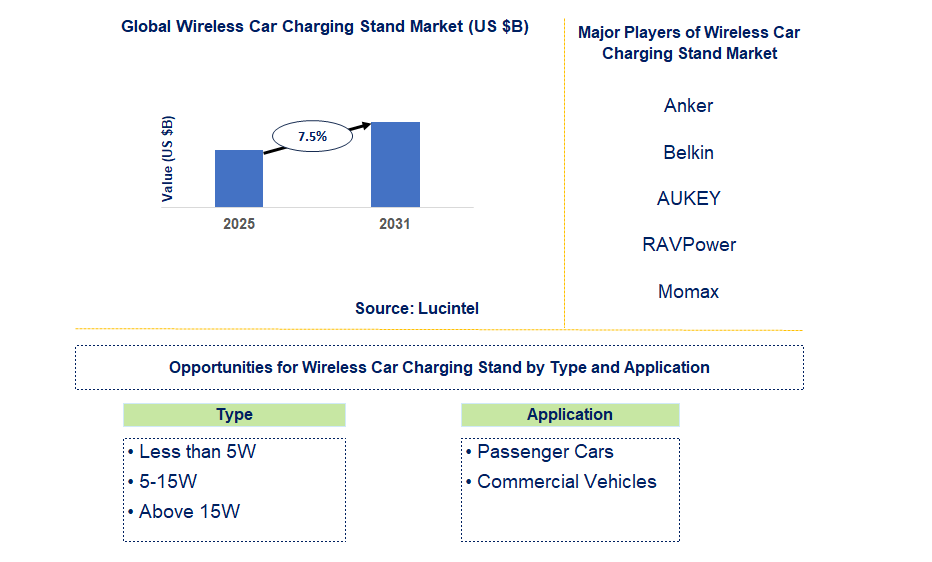
Key data points: The growth forecast = 7.5% annually for the next 7 years. Scroll below to get more insights. This market report covers trends, opportunities and forecasts in wireless car charging stand market to 2031 by type (less than 5W, 5-15W, and above 15W), application (passenger cars and commercial vehicles), and region (North America, Europe, Asia Pacific, and the Rest of the World)
We'll send your sample report shortly.
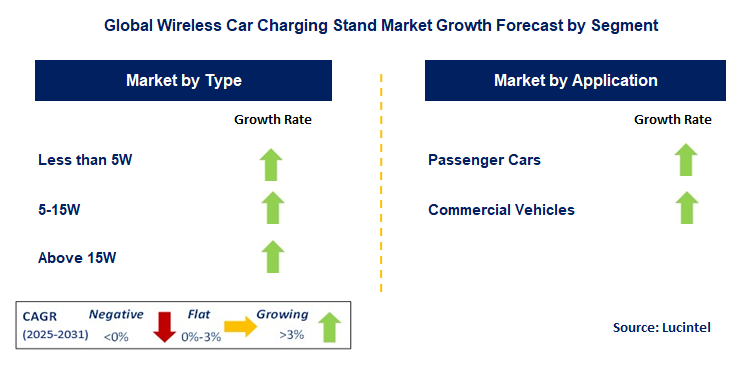
• Lucintel forecasts that, within the type category, above 15W is expected to witness the highest growth over the forecast period.
• Within the application category, passenger car is expected to witness higher growth.
• In terms of region, APAC is expected to witness the highest growth over the forecast period. Gain valuable insights for your business decisions with our comprehensive 150+ page report. Sample figures with some insights are shown below.
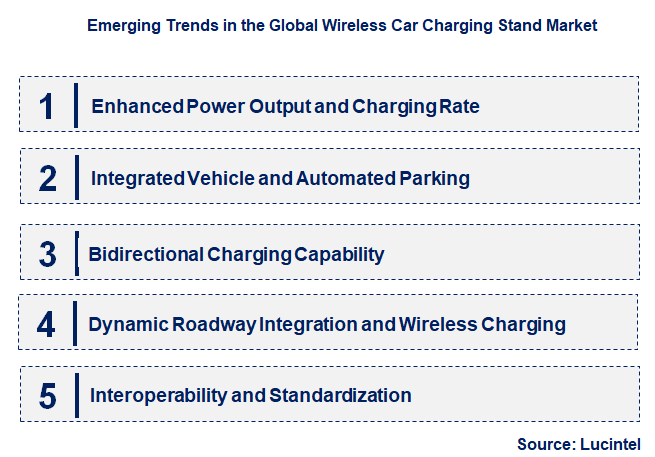
• Enhanced Power Output and Charging Rate: This trend is about creating wireless charging stands with higher power output levels, thus making the charging time much shorter. Breakthroughs in Li-Fi-like inductive charging and resonant charging tech are making it possible to deliver power much more quickly, typically comparable to hardwired Level 2 or even DC fast charging for certain purposes. The effect is a significant decrease in range anxiety and greater pragmatism for EV owners, making wireless charging a more feasible and appealing main charging method for everyday use.
• Integrated Vehicle and Automated Parking: One of the most prominent emerging trends is the more extensive incorporation of wireless charging functionality directly into the vehicle's design and its cooperation with automated parking systems. This makes for accurate positioning over the charging pad without human interference, often provided through in-car sensors or assisted valet parking systems. The effect is unprecedented convenience, avoiding physical plugging in, simplifying the charging process to effortless and genuinely "set and forget," especially of interest for future self-driving vehicles.
• Bidirectional Charging Capability: This is a trend of wireless charging stands that not only charge the EV battery but also enable the vehicle to deliver power back to the grid (Vehicle-to-Grid, V2G) or home (Vehicle-to-Home, V2H). This makes EVs into mobile energy storage systems, providing grid stabilization services or backup power during blackouts. The effect is an extreme transformation in the perception of EVs, turning them into active players in energy management, generating new revenue, and increasing energy resilience.
• Dynamic Roadway Integration and Wireless Charging: This revolutionary trend is about integrating wireless charging coils in roadways and allowing EVs to recharge while moving (dynamic charging) or while idling momentarily at traffic signals or bus stops. There are pilot projects being implemented around the world to pilot this technology. It could have a revolutionary effect, enabling smaller EV battery packs, lighter vehicles, unlimited effective range on fitted routes, and an entirely seamless electric mobility experience, particularly for public transport and logistics fleets.
• Interoperability and Standardization: With the maturity of the market, there is a strong developing pattern towards creating globally approved standards for wireless car charging, just like the Qi standard for mobile phones. Companies are developing protocols that maintain compatibility among various models of vehicles and charging infrastructure providers. The effect is key to mass adoption because it promotes consumer confidence through the assurance that any wireless-capable EV can charge at any compliant wireless charging stand, lowering costs through economies of scale and speeding up infrastructure deployment. These new developments are all coming together to collectively reshape the wireless car charging industry by expanding the possibilities of convenience, efficiency, and integration. This is taking the industry towards a future where EV charging becomes less of an inconvenience and more of an invisible, integrated aspect of driving, greatly driving the shift to electric mobility.
• Higher Power Transfer Efficiency and Speed: One major advancement is that the efficiency and speed of wireless power transfer have improved immensely. Advances in inductive charging technology, such as coil design enhancements and power electronics, can now achieve higher wattage from wireless charging stands, at times rivaling Level 2 wired charging. The effect is a shorter charging time, making wireless charging more convenient and appealing for everyday use, and hence more attractive to EV owners.
• Automotive OEM Integration and Partnerships: A strong recent trend exists in the direct integration by automotive Original Equipment Manufacturers (OEMs) of wireless charging features into their new EV models. Top automobile makers are working in partnership with wireless charging technology companies to have receiving coils and alignment systems factory-installed. The effect is a hassle-free user experience right from the time of purchase without the need for aftermarket installations, pointing towards mainstream acceptability of wireless charging as an industry standard feature on future electric cars.
• Implementation of Dynamic Wireless Charging Pilots: A more revolutionary breakthrough is the establishment of pilot initiatives for dynamic wireless charging, where charging pads in roadways provide power to EVs when in motion or momentarily halted. Though still in nascent stages, these pilots seek to prove the viability of round-the-clock charging. The effect may transform EV infrastructure, allowing for smaller batteries on vehicles, greater range, and continuous power supply, mainly to public transport and logistics fleets.
• Evolution of Foreign Object Detection and Safety: Wireless car charging stands' safety features have been considerably improved, especially with Foreign Object Detection (FOD) and Living Object Protection (LOP). Sophisticated sensors can identify foreign objects or living organisms between the charging pad and the car, stopping power delivery and maintaining safety. The effect is greater user confidence and regulatory approval, mitigating key safety issues related to wireless power transfer and opening the door for wider deployment.
• Bidirectional Charging Capability Emergence: New technology is the incorporation of bidirectional charging capacity (Vehicle-to-Grid or V2G) into certain wireless car charging systems. This enables EVs not only to receive electricity but also to supply electricity to the grid or home, essentially functioning as a mobile power bank. The effect is a shift of EVs into high-value assets for energy management, facilitating grid stabilization, peak shaving, and backup power in case of outages, opening up new opportunities for energy services. These technological breakthroughs are coming together collectively to shape the market for wireless car charging by driving performance, raising safety, enabling direct integration by automakers, and investigating groundbreaking new uses such as dynamic and bidirectional charging. This all-encompassing innovation is making wireless car charging a central technology for the future of electric mobility.
• Residential Home Charging Solutions: This represents an immediate strategic growth opportunity with a focus on creating convenient, user-friendly wireless charging stands for residential driveways and garages. Opportunities include presenting attractive, space-saving designs that fit harmoniously within home settings, with easy installation and everyday use for active EV owners. Marketing emphasizes the "park and charge" convenience without cables and enriching the overall smart home experience for EV-owning homeowners.
• Public and Commercial Parking Garages: Widening wireless charging infrastructure in the public and commercial arenas, such as shopping centers, corporate buildings, airports, and hotels, is a huge growth opportunity. Strategic emphasis should be on durable, weather-immune charging pads able to handle high traffic, perhaps coupled with payment mechanisms and occupancy detectors. Opportunities involve collaborations with property developers and urban planners to integrate charging capability into new and retrofitted parking lots, presenting a premium level of convenience to consumers and employees.
• Fleet Vehicles: The commercial fleet market represents a strong growth opportunity based on the intensive usage and regular routes of vehicles such as taxis, public buses, and last-mile delivery vans. Strategic expansion is about creating high-power, long-lasting wireless charging solutions that allow for "opportunity charging" at short depot stops or designated stands. Opportunities include partnering with fleet operators to implement charging systems that optimize uptime, lower operating costs, and simplify energy management for large electric fleets.
• Automated Valet Parking Integration: With the expansion of autonomous driving technology, wireless charging integration with Automated Valet Parking (AVP) systems is a valuable strategic potential. Autonomous vehicles can park and charge themselves wirelessly without the need for human interaction. Opportunities are to collaborate with automotive original equipment manufacturers (OEMs) and technology vendors to create seamless, smart parking and charging solutions that will increase the convenience and efficacy of future autonomous vehicle systems within smart cities.
• Dynamic Wireless Charging for Roadways: Although a long-term opportunity, the establishment of dynamic wireless charging (driving while charging) along particular road sections, e.g., bus lanes or highway segments, is a revolutionary potential. Strategic priority includes heavy research and development, pilot schemes, and co-working with government and infrastructure developers. Opportunities are there in meeting the energy needs of high-volume corridors, minimizing the requirement for big on-board EV batteries, and increasing the continuous driving range of electric vehicles, especially for heavy-duty transport. Such strategic expansion prospects are collectively transforming the wireless car charging market by pushing innovation towards multifaceted applications, enhancing collaboration between technology suppliers and other industries, and setting the stage for a more unified and convenient electric vehicle charging ecosystem. It is this multifaceted approach that is key to the mass adoption and future success of wireless car charging.
• Anker
• Belkin
• AUKEY
• RAVPower
• Momax
• Energizer
• Bull Group
• Ugreen
• Logitech
• Yootech
• Less than 5W
• 5-15W
• Above 15W
• Passenger Cars
• Commercial Vehicles
• North America
• Europe
• Asia Pacific
• The Rest of the World
• United States: The United States wireless car charging market is picking up, driven largely by robust EV sales and government incentives. Developments in recent times concentrate on wireless charging systems of high power for residential and public applications, with firms such as WiTricity already collaborating with automotive OEMs to embed technology as an integral component within new EV models. Increasing attention is being focused on bidirectional charging capacity (Vehicle-to-Grid or V2G) for power management, and initiatives are being pursued to extend wireless charging facilities within public areas such as car parks and business premises.
• China: China is a world leader in EV deployment and production, so its wireless car charging business is especially vibrant. There have been recent advances, such as widespread government promotion of new energy vehicles (NEVs) and the widespread rollout of charging points. Chinese manufacturers are experimenting with varied wireless charging configurations, from internal phone charging pads in vehicles to bigger EV charging pedestals, typically emphasizing affordability and high-volume production. Wireless taxi and city bus charging pilot schemes in big cities are also showing real-world applications of the technology.
• Germany: The German wireless car charging market is being fueled by its robust automotive sector and emphasis on high-end EV models. Recent developments indicate German manufacturers such as Volkswagen, BMW, and Mercedes-Benz are incorporating wireless charging as a premium feature in their premium electric cars. There is a heavy investment in research for dynamic wireless charging, with cars being charged on the move, and pilot schemes on the Autobahn. It is focused on high efficiency, strong design, and smooth integration with innovative vehicle systems.
• India: The wireless car charging market in India is still in its infancy, but is growing fast with rising EV sales and government support such as FAME II subsidies. Recent trends include local producers and technology companies joining hands to create low-cost and pragmatic wireless charging options, usually with a public transport and fleet use scenario in mind. Pilot schemes of wireless bus charging are being initiated, and there is a strategic effort to incorporate inductive charging as part of smart city infrastructure, with a view to creating indigenous technology.
• Japan: The Japanese wireless car charging market prioritizes technological superiority and careful integration. Current advancements feature a significant emphasis on hybrid and electric vehicle high-efficiency inductive charging. Domestic Japanese automakers like Toyota, Honda, and Nissan are enthusiastically investigating and integrating wireless charging as part of their vehicle-to-everything (V2X) initiatives to establish end-to-end smart city infrastructure. The interest in creating ultra-dense and highly dependable wireless charging solutions for various applications is high as well.


• Anker
• Belkin
• AUKEY
• RAVPower
• Momax
• Energizer
• Bull Group
• Ugreen
• Logitech
• Yootech Q5. Which wireless car charging stand market segment will be the largest in future? Answer: Lucintel forecasts that, within the type category, above 15W is expected to witness the highest growth over the forecast period. Q6. In wireless car charging stand market, which region is expected to be the largest in next 5 years? Answer: In terms of region, APAC is expected to witness the highest growth over the forecast period. Q7. Do we receive customization in this report? Answer: Yes, Lucintel provides 10% customization without any additional cost.


Choose a license that fits your team. Instant PDF delivery.
Prices exclude taxes. Instant delivery. Custom licensing available on request.
Market Report · July 31, 2026
Market Report · July 22, 2026
Market Report · July 17, 2026
Trusted partner for strategic intelligence and business growth


Receive a complimentary market analysis tailored to your industry. Our analysts will identify key growth opportunities and competitive dynamics specific to your business.

Market size, growth rate, and key trend analysis for your specific sector.

Top competitor positioning and market share analysis.

Strategic recommendations backed by data-driven insights.
Get curated market intelligence and competitive moves straight to your inbox.
By subscribing, you agree to receive our monthly insights. Unsubscribe anytime.
Receive a complimentary market analysis tailored to your industry. Our analysts will identify key growth opportunities and competitive dynamics specific to your business.
Market size, growth rate, and key trend analysis for your specific sector.
Top competitor positioning and market share analysis.
Strategic recommendations backed by data-driven insights.
Get curated market intelligence, emerging trends, and competitive moves straight to your inbox each month.
By subscribing, you agree to receive our monthly insights. Unsubscribe anytime.
We'll send your sample report shortly.