
Report Feature
Window Digital Signage Market Trends and Forecast
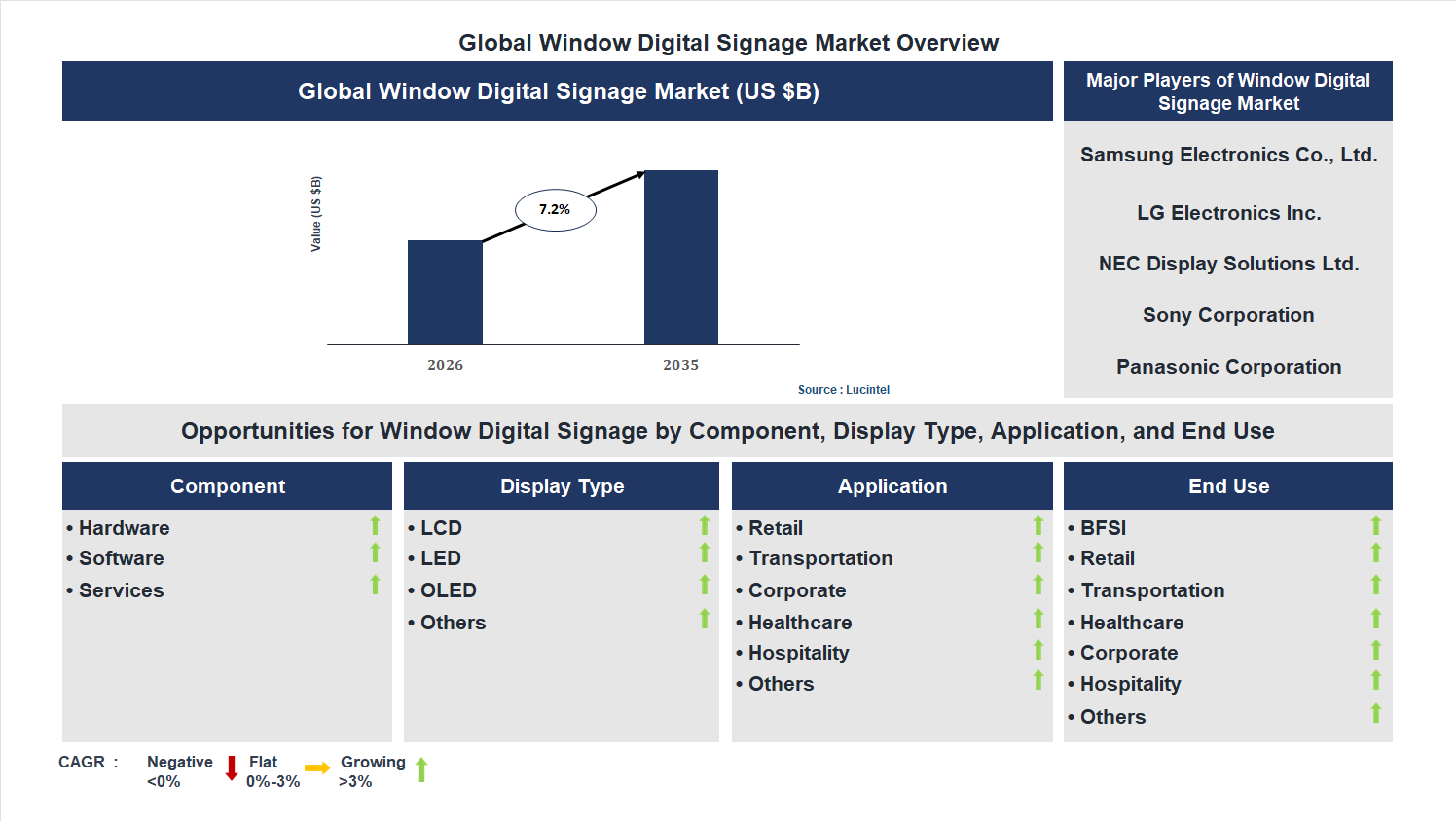
The future of the global window digital signage market looks promising with opportunities in the BFSI, retail, transportation, healthcare, corporate, and hospitality markets. The global window digital signage market is expected to reach an estimated $5 billion by 2035 with a CAGR of 8.4% from 2026 to 2035. The major drivers for this market are the increasing adoption of interactive storefront displays, the rising demand for dynamic retail advertising, and the growing use in smart retail environments.• Lucintel forecasts that, within the component category, hardware is expected to witness higher growth over the forecast period.
• Within the end use category, BFSI is expected to witness the highest growth.
• In terms of region, APAC is expected to witness the highest growth over the forecast period. Gain valuable insights for your business decisions with our comprehensive 150+ page report. Sample figures with some insights are shown below.
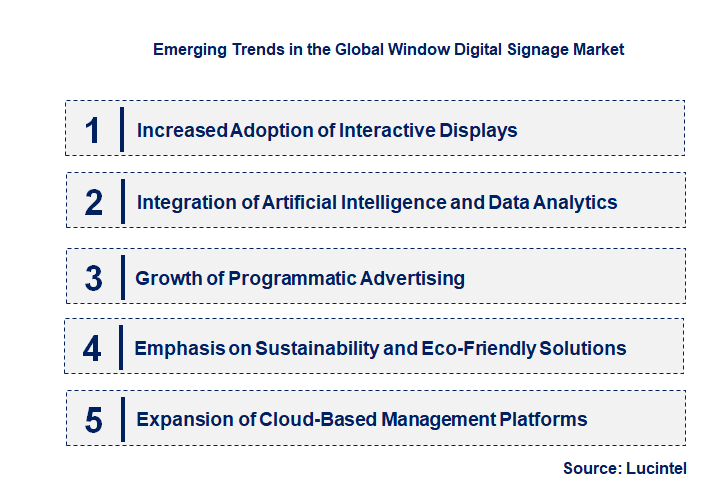
Emerging Trends in the Window Digital Signage Market
The window digital signage market is experiencing rapid growth driven by technological advancements, changing consumer behaviors, and the increasing demand for dynamic advertising solutions. As businesses seek innovative ways to attract attention and engage customers, digital signage has become a vital component of marketing strategies across various sectors. The market is characterized by evolving hardware and software solutions, integration with IoT, and a focus on sustainability. These developments are transforming how brands communicate with their audiences, creating new opportunities and challenges. Understanding these emerging trends is essential for stakeholders aiming to stay competitive and leverage the full potential of window digital signage.• Increased Adoption of Interactive Displays: Interactive displays are becoming more prevalent in window digital signage, allowing consumers to engage directly with content. Touch-enabled screens, motion sensors, and augmented reality features enhance user experience, making advertising more personalized and memorable. This trend boosts customer engagement, increases dwell time, and provides valuable data insights. Retailers and brands benefit from real-time interaction, which can influence purchasing decisions and foster brand loyalty. As technology becomes more affordable and sophisticated, the adoption of interactive displays is expected to accelerate, reshaping customer engagement strategies.
• Integration of Artificial Intelligence and Data Analytics: AI and data analytics are increasingly integrated into digital signage solutions to deliver targeted content. By analyzing customer demographics, behaviors, and preferences, AI enables real-time customization of advertisements. This personalization enhances relevance, improves conversion rates, and optimizes marketing ROI. Data-driven insights also help businesses understand consumer patterns and preferences, informing future campaigns. The integration of AI with digital signage is transforming static advertising into dynamic, intelligent communication channels that adapt to audience needs, making marketing efforts more effective and efficient.
• Growth of Programmatic Advertising: Programmatic advertising in window digital signage allows for automated, real-time ad buying and placement. This trend enables brands to deliver highly targeted messages based on location, time, and audience data. Programmatic solutions improve efficiency, reduce costs, and increase campaign flexibility. They also facilitate the rapid deployment of campaigns across multiple locations, ensuring consistent messaging. As programmatic advertising matures, it is expected to become a dominant method for managing digital signage content, providing brands with greater control and precision in their marketing efforts.
• Emphasis on Sustainability and Eco-Friendly Solutions: Sustainability is a key focus in the development of window digital signage. Manufacturers are adopting energy-efficient displays, recyclable materials, and eco-friendly manufacturing processes. These initiatives reduce carbon footprints and align with corporate social responsibility goals. Additionally, solar-powered signage and low-power consumption screens are gaining popularity. This trend not only appeals to environmentally conscious consumers but also helps businesses reduce operational costs. The push for sustainability is reshaping product development and marketing strategies, emphasizing eco-friendly solutions as a competitive advantage in the digital signage market.
• Expansion of Cloud-Based Management Platforms: Cloud technology is transforming how digital signage content is managed and deployed. Cloud-based platforms enable remote content updates, centralized control, and real-time monitoring across multiple locations. This flexibility simplifies operations, reduces maintenance costs, and allows for rapid content changes to respond to market trends or campaigns. The scalability of cloud solutions supports the growth of large-scale digital signage networks, making it easier for businesses to expand their digital footprint. As cloud management becomes more sophisticated, it is set to enhance the efficiency, security, and customization of digital signage systems. These emerging trends are fundamentally reshaping the window digital signage market by making digital displays more interactive, personalized, efficient, sustainable, and manageable. These developments are driving innovation, improving customer engagement, and providing brands with powerful tools to enhance their marketing strategies in an increasingly digital world.
Recent Development in the Window Digital Signage Market
The window digital signage market is experiencing rapid growth driven by technological advancements and increasing demand for dynamic advertising solutions. Businesses seek innovative ways to attract customers and enhance engagement through digital displays. As the market evolves, new opportunities emerge across various sectors, including retail, hospitality, and transportation. These developments are transforming how brands communicate with consumers, offering more interactive and personalized experiences. The following key developments highlight the current trajectory and future potential of this expanding industry.• Technological Innovations in Display Quality: Enhanced resolution and brightness are improving visual appeal, making digital signage more attractive and effective. These advancements enable clearer, more vibrant images, increasing viewer engagement and retention. As display technology becomes more affordable and sophisticated, businesses can deploy larger, more eye-catching signage. This growth in display quality directly impacts market competitiveness, encouraging wider adoption across sectors seeking impactful advertising solutions.
• Integration of Artificial Intelligence and Data Analytics: AI-driven digital signage allows for personalized content delivery based on viewer data, location, and time. This integration enhances customer experience by providing relevant information, offers, and advertisements. Data analytics enable businesses to measure engagement and optimize campaigns in real-time. The ability to deliver targeted content increases ROI and customer satisfaction, making AI integration a key driver for market expansion and innovation.
• Adoption of Interactive and Touchscreen Displays: Interactive signage engages consumers actively, encouraging participation through touch, gestures, or mobile integration. This technology enhances user experience, increases dwell time, and boosts brand interaction. Retailers and venues are increasingly adopting interactive displays to create memorable experiences and gather customer insights. The trend toward interactivity is expected to accelerate, significantly impacting market growth and the development of immersive advertising environments.
• Expansion in Retail and Hospitality Sectors: Retail stores and hotels are increasingly utilizing window digital signage to attract foot traffic and enhance customer engagement. These sectors benefit from dynamic content that can be updated instantly, promoting sales, events, or brand messaging. The ability to create visually appealing, flexible displays helps businesses stand out in competitive markets. This expansion is driving demand for tailored solutions, fostering innovation, and broadening the market scope.
• Growing Emphasis on Sustainability and Energy Efficiency: Eco-friendly digital signage solutions focus on reducing energy consumption and environmental impact. Innovations include LED displays with lower power requirements and recyclable materials. Sustainability initiatives appeal to environmentally conscious consumers and comply with regulations. As sustainability becomes a priority, the market is witnessing increased adoption of energy-efficient technologies, influencing product development and market strategies. These developments are significantly transforming the window digital signage market by enhancing display quality, personalization, interactivity, sector-specific applications, and sustainability. They are driving increased adoption across industries, fostering innovation, and expanding market opportunities. As a result, the industry is poised for sustained growth, with businesses leveraging these advancements to create more engaging, efficient, and environmentally responsible digital signage solutions.
Strategic Growth Opportunities in the Window Digital Signage Market
The window digital signage market is experiencing rapid expansion driven by increasing demand for dynamic advertising, enhanced customer engagement, and technological advancements. Businesses across the retail, hospitality, and transportation sectors are adopting digital signage solutions to improve communication and brand visibility. The integration of IoT, AI, and cloud-based platforms is further fueling growth. As the market evolves, strategic opportunities emerge for companies to innovate, expand geographically, and cater to diverse application needs, ensuring sustained growth and competitive advantage.• Expansion Into Retail and Commercial Spaces: The retail sector is increasingly adopting window digital signage to attract customers, promote products, and enhance in-store experiences. Commercial buildings and shopping malls are utilizing these displays for advertising, wayfinding, and branding. The ability to deliver targeted, real-time content improves customer engagement and sales. As consumer expectations grow for immersive shopping environments, the demand for innovative window signage solutions is expected to rise, creating significant growth opportunities for providers.
• Integration With Smart Technologies And IoT: Incorporating IoT and smart technology into window digital signage enables real-time data collection, remote management, and personalized content delivery. This integration allows businesses to adapt messaging based on weather, time, or customer demographics, increasing relevance and effectiveness. The use of AI-driven analytics enhances content optimization, leading to better engagement. As IoT adoption accelerates, the market for intelligent, connected window signage solutions is poised for substantial growth, offering competitive advantages to early adopters.
• Development Of Interactive And Touch-Enabled Displays: Interactive window digital signage with touch capabilities offers immersive experiences that attract and retain viewers. These displays facilitate direct customer interaction, product exploration, and feedback collection, enriching engagement. Retailers and service providers leverage interactivity to boost conversions and gather insights. The technological advancements in touch sensors and display quality make these solutions more affordable and reliable, opening new avenues for market expansion across various sectors seeking innovative customer engagement tools.
• Focus on Sustainability and Eco-Friendly Solutions: Growing environmental awareness prompts demand for sustainable digital signage options. Manufacturers are developing energy-efficient displays, recyclable materials, and eco-friendly manufacturing processes. These initiatives reduce carbon footprints and align with corporate social responsibility goals. Sustainable window signage not only appeals to environmentally conscious consumers but also helps businesses meet regulatory standards. The emphasis on eco-friendly solutions is expected to drive market growth, encouraging adoption among organizations committed to sustainability.
• Geographic Expansion Into Emerging Markets: Emerging economies present untapped opportunities for window digital signage deployment due to rising urbanization and digital infrastructure development. These markets offer lower installation costs and less saturated competition, making them attractive for expansion. Local businesses seek affordable, effective advertising tools to reach growing consumer bases. Strategic investments in these regions can facilitate market penetration, foster brand recognition, and generate new revenue streams. As infrastructure improves, the adoption rate of window digital signage is expected to accelerate significantly. These growth opportunities will significantly influence the evolution of the window digital signage market by fostering innovation, expanding geographic reach, and enhancing application versatility. Companies that capitalize on these trends can achieve competitive advantages, meet evolving customer demands, and sustain long-term growth in a dynamic digital landscape.
Window Digital Signage Market Driver and Challenges
The window digital signage market is influenced by a variety of technological, economic, and regulatory factors that shape its growth and development. Advances in display technology, increasing demand for dynamic advertising, and the proliferation of internet connectivity are key drivers. Simultaneously, regulatory standards regarding digital content and privacy concerns pose challenges. Economic factors such as rising marketing budgets and the need for cost-effective advertising solutions further impact the market. Understanding these drivers and challenges is essential for stakeholders to navigate the evolving landscape and capitalize on emerging opportunities. The factors responsible for driving the window digital signage market include:-• Technological Advancements: The rapid evolution of display technologies such as LED, LCD, and OLED has significantly enhanced visual quality and interactivity. These innovations enable more engaging and customizable content, attracting businesses seeking innovative advertising solutions. Additionally, integration with IoT and AI allows for real-time data-driven content management, improving user engagement and operational efficiency. As technology continues to advance, the market benefits from increased adoption of smart signage, making digital displays more versatile and appealing across various sectors.
• Growing Demand for Digital Advertising: Businesses are shifting from traditional to digital advertising to reach wider audiences effectively. Window digital signage offers high visibility in high-traffic areas like malls, airports, and retail stores. The ability to update content instantly and target specific demographics makes it a preferred choice for marketers. This demand is driven by the need for dynamic, eye-catching displays that can adapt to changing marketing campaigns, thereby boosting sales and brand recognition.
• Increasing Urbanization and Foot Traffic: Rapid urbanization has led to increased foot traffic in commercial areas, creating a prime environment for window digital signage. Retailers and service providers leverage these displays to attract passersby and influence purchasing decisions. The high density of urban populations ensures maximum exposure, making digital signage a cost-effective marketing tool. As cities expand, the potential for digital signage to enhance customer engagement and drive sales continues to grow.
• Rising Investment in Smart Infrastructure: Governments and the private sector are investing heavily in smart city initiatives and infrastructure, which include digital signage networks. These investments facilitate better communication, public information dissemination, and advertising. The integration of digital signage into urban planning enhances the aesthetic appeal and functionality of public spaces, encouraging more businesses to adopt these solutions. This trend supports the expansion of the market by creating new opportunities for deployment and innovation. The challenges in the window digital signage market are:
• Regulatory and Content Compliance Issues: The digital signage industry faces strict regulations regarding content, advertising standards, and data privacy. Compliance with local laws can be complex, especially for international companies operating across multiple regions. Content restrictions, licensing requirements, and privacy laws can limit creative freedom and increase operational costs. Non-compliance risks include legal penalties and damage to brand reputation, which can hinder market growth and innovation.
• High Initial Investment and Maintenance Costs: Although digital signage offers long-term benefits, the initial setup costs for hardware, software, installation, and integration can be substantial. Ongoing maintenance, content updates, and technical support add to operational expenses. Small and medium-sized enterprises may find these costs prohibitive, limiting market penetration. The need for continuous investment to keep displays updated and functional poses a significant challenge to widespread adoption.
• Technological Obsolescence and Compatibility Issues: Rapid technological changes can render existing digital signage systems obsolete quickly. Compatibility issues between different hardware and software platforms can complicate deployment and upgrades. Businesses may face frequent replacement costs and technical challenges, discouraging investment. Ensuring interoperability and future-proofing digital signage solutions is critical but often difficult, impacting the market’s stability and growth prospects. The window digital signage market is driven by technological innovations, increasing demand for digital advertising, urbanization, and smart infrastructure investments. However, regulatory hurdles, high costs, and rapid technological obsolescence pose significant challenges. These factors collectively influence market dynamics, requiring stakeholders to adapt strategically. While growth opportunities are substantial, addressing the challenges effectively will be crucial for sustained expansion and innovation in this evolving landscape.
List of Window Digital Signage Companies
Companies in the market compete on the basis of product quality offered. Major players in this market focus on expanding their manufacturing facilities, R&D investments, infrastructural development, and leverage integration opportunities across the value chain. With these strategies window digital signage companies cater increasing demand, ensure competitive effectiveness, develop innovative products & technologies, reduce production costs, and expand their customer base. Some of the window digital signage companies profiled in this report include-• Samsung Electronics Co., Ltd.
• LG Electronics Inc.
• NEC Display Solutions Ltd.
• Sony Corporation
• Panasonic Corporation
• Sharp Corporation
• Planar Systems, Inc.
• Leyard Optoelectronic Co., Ltd.
• BenQ Corporation
• ViewSonic Corporation
Window Digital Signage Market by Segment
The study includes a forecast for the global window digital signage market by component, display type, application, end use, and region.Window Digital Signage Market by Component [Value from 2019 to 2035]:
• Hardware
• Software
• Services
Window Digital Signage Market by Display Type [Value from 2019 to 2035]:
• LCD
• LED
• OLED
• Others
Window Digital Signage Market by Application [Value from 2019 to 2035]:
• Retail
• Transportation
• Corporate
• Healthcare
• Hospitality
• Others
Window Digital Signage Market by End Use [Value from 2019 to 2035]:
• BFSI
• Retail
• Transportation
• Healthcare
• Corporate
• Hospitality
• Others
Window Digital Signage Market by Region [Value from 2019 to 2035]:
• North America
• Europe
• Asia Pacific
• The Rest of the World
Country Wise Outlook for the Window Digital Signage Market
The window digital signage market has experienced significant growth driven by technological advancements, increasing demand for dynamic advertising, and the integration of digital solutions into retail, corporate, and public spaces. As businesses seek innovative ways to engage consumers and enhance brand visibility, countries worldwide are adopting new strategies and technologies. The markets evolution reflects a shift towards more interactive, high-resolution displays and smarter content management systems. This global trend is particularly prominent in major economies, where digital infrastructure investments and consumer preferences are shaping the future landscape of window digital signage. Here are recent developments in key countries:• United States: The U.S. market has seen rapid adoption of 4K and OLED displays, with increased integration of AI-driven content personalization. Major retail chains are upgrading storefronts with interactive digital signage to attract customers, and there is a growing trend of using digital signage for contactless interactions amid health concerns. Additionally, advancements in cloud-based content management systems have streamlined operations for businesses.
• China: China continues to lead in digital signage deployment, with a focus on large-scale, high-resolution displays in urban centers. The government promotes smart city initiatives, encouraging the use of digital signage for public information and advertising. Innovations include the use of facial recognition and data analytics to tailor content, along with the expansion of 5G networks to support real-time content delivery and interactivity.
• Germany: The German market emphasizes sustainability and energy efficiency in digital signage solutions. There is a notable shift towards eco-friendly displays and modular designs that reduce waste. The adoption of digital signage in transportation hubs and retail outlets is increasing, with a focus on high-quality visuals and seamless integration with other digital systems. Regulatory standards for data privacy also influence content management practices.
• India: Rapid urbanization and a growing retail sector drive the expansion of digital signage in India. The market is characterized by affordable, small-format displays and the adoption of digital signage in small and medium-sized enterprises. Innovations include the use of solar-powered displays in rural areas and the integration of digital signage with mobile marketing strategies. The government’s push for smart cities further accelerates market growth.
• Japan: Japan's market is marked by the integration of advanced technologies such as augmented reality (AR) and touchless interfaces. There is a focus on high-end, aesthetically appealing displays in retail and entertainment sectors. The adoption of digital signage for public transportation and information systems is widespread, with an emphasis on durability and energy efficiency. Japan also explores the use of digital signage for cultural and promotional events, leveraging its technological expertise.

Features of the Global Window Digital Signage Market
Market Size Estimates: Window digital signage market size estimation in terms of value ($B). Trend and Forecast Analysis: Market trends (2019 to 2025) and forecast (2026 to 2035) by various segments and regions. Segmentation Analysis: Window digital signage market size by various segments, such as by component, display type, application, end use, and region in terms of value ($B). Regional Analysis: Window digital signage market breakdown by North America, Europe, Asia Pacific, and Rest of the World. Growth Opportunities: Analysis of growth opportunities in different components, display types, applications, end uses, and regions for the window digital signage market. Strategic Analysis: This includes M&A, new product development, and competitive landscape of the window digital signage market. Analysis of competitive intensity of the industry based on Porter’s Five Forces model.
FAQ
Q1. What is the market size and growth forecast for window digital signage market? Answer: The global window digital signage market is expected to reach an estimated $5 billion by 2035 and grow with a CAGR of 8.4% from 2026 to 2035. Q2. What are the major drivers influencing the growth of the window digital signage market? Answer: The major drivers for this market are the increasing adoption of interactive storefront displays, the rising demand for dynamic retail advertising, and the growing use in smart retail environments. Q3. What are the major segments for window digital signage market? Answer: The future of the window digital signage market looks promising with opportunities in the BFSI, retail, transportation, healthcare, corporate, and hospitality markets. Q4. Who are the key window digital signage market companies? Answer: Some of the key window digital signage companies are as follows:• Samsung Electronics Co., Ltd.
• LG Electronics Inc.
• NEC Display Solutions Ltd.
• Sony Corporation
• Panasonic Corporation
• Sharp Corporation
• Planar Systems, Inc.
• Leyard Optoelectronic Co., Ltd.
• BenQ Corporation
• ViewSonic Corporation Q5. Which window digital signage market segment will be the largest in future? Answer: Lucintel forecasts that, within the component category, hardware is expected to witness higher growth over the forecast period. Q6. In window digital signage market, which region is expected to be the largest in next 5 years? Answer: In terms of region, APAC is expected to witness the highest growth over the forecast period. Q7. Do we receive customization in this report? Answer: Yes, Lucintel provides 10% customization without any additional cost.
Table of Contents
List of Figures
List of Tables
Methodology
- In-depth interviews of the major players in this market
- Detailed secondary research from competitors’ financial statements and published data
- Extensive searches of published works, market, and database information pertaining to industry news, company press releases, and customer intentions
- A compilation of the experiences, judgments, and insights of Lucintel’s professionals, who have analyzed and tracked this market over the years.


Buy Now
Choose a license that fits your team. Instant PDF delivery.
Prices exclude taxes. Instant delivery. Custom licensing available on request.
Key Questions
- • What are some of the most promising, high-growth opportunities for the window digital signage market by component (hardware, software, and services), display type (LCD, LED, OLED, and others), application (retail, transportation, corporate, healthcare, hospitality, and others), end use (BFSI, retail, transportation, healthcare, corporate, hospitality, and others), and region (North America, Europe, Asia Pacific, and the Rest of the World)?
- • Which segments will grow at a faster pace and why?
- • Which region will grow at a faster pace and why?
- • What are the key factors affecting market dynamics? What are the key challenges and business risks in this market?
- • What are the business risks and competitive threats in this market?
- • What are the emerging trends in this market and the reasons behind them?
- • What are some of the changing demands of customers in the market?
- • What are the new developments in the market? Which companies are leading these developments?
- • Who are the major players in this market? What strategic initiatives are key players pursuing for business growth?
- • What are some of the competing products in this market and how big of a threat do they pose for loss of market share by material or product substitution?
- • What M&A activity has occurred in the last 7 years and what has its impact been on the industry? For any questions related to Window Digital Signage Market, Window Digital Signage Market Size, Window Digital Signage Market Growth, Window Digital Signage Market Analysis, Window Digital Signage Market Report, Window Digital Signage Market Share, Window Digital Signage Market Trends, Window Digital Signage Market Forecast, Window Digital Signage Companies, write Lucintel analyst at email: helpdesk@lucintel.com. We will be glad to get back to you soon.


