
Market Report · July 31, 2026

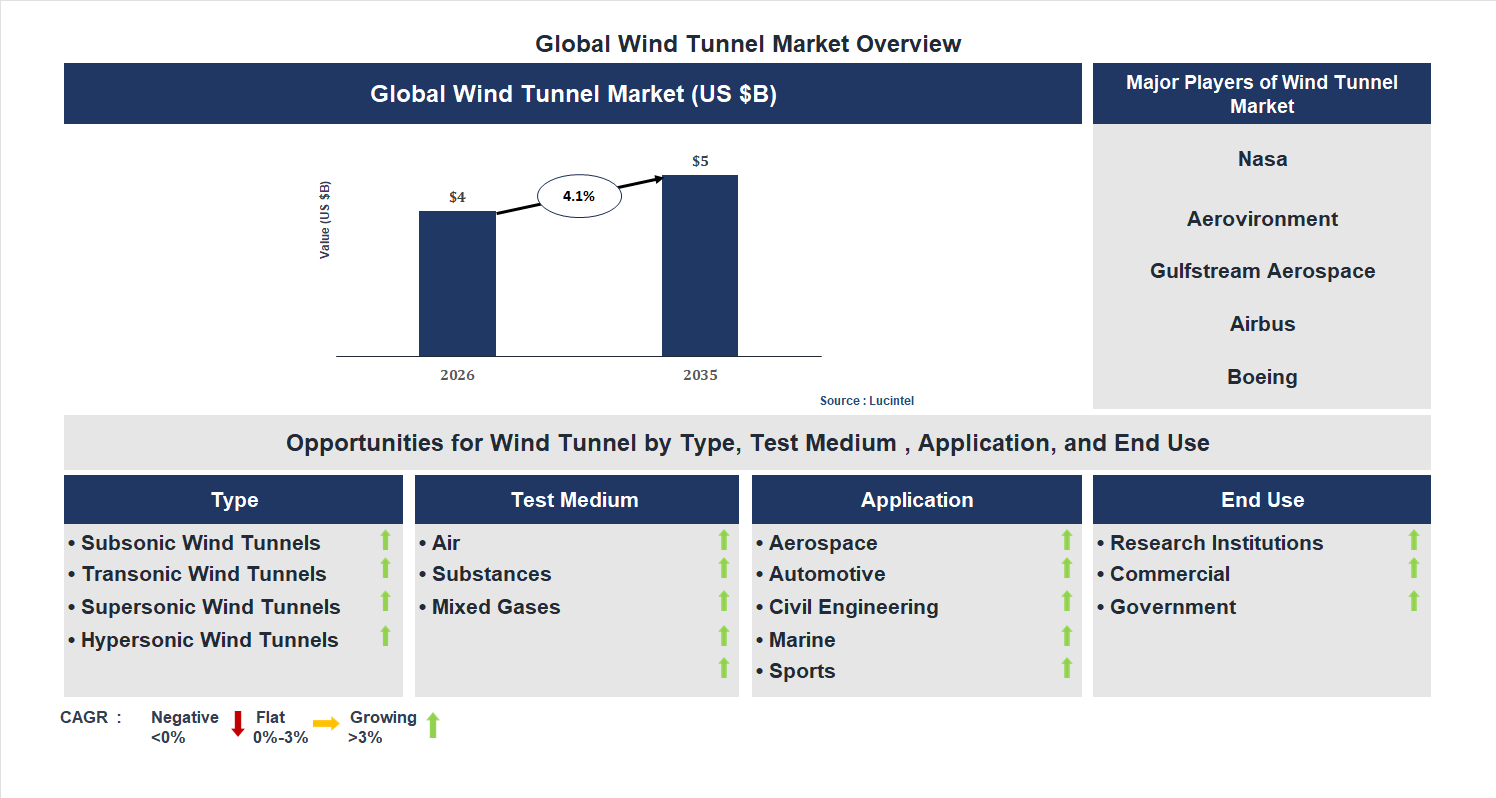
Key data points: The market size in 2035 = $5 billion, growth forecast = 4.1% annually for the next 8 years. Scroll below to get more insights. This market report covers trends, opportunities and forecasts in wind tunnel market to 2035 by type (subsonic wind tunnels, transonic wind tunnels, supersonic wind tunnels, and hypersonic wind tunnels), test medium (air, substances, and mixed gases), application (aerospace, automotive, civil engineering, marine, and sports), end use (research institutions, commercial, and government), and region (North America, Europe, Asia Pacific, and the Rest of the World)
We'll send your sample report shortly.
• Lucintel forecasts that, within the type category, subsonic wind tunnel is expected to witness the highest growth over the forecast period.
• Within the end use category, research institution is expected to witness the highest growth.
• In terms of region, APAC is expected to witness the highest growth over the forecast period. Gain valuable insights for your business decisions with our comprehensive 150+ page report. Sample figures with some insights are shown below.
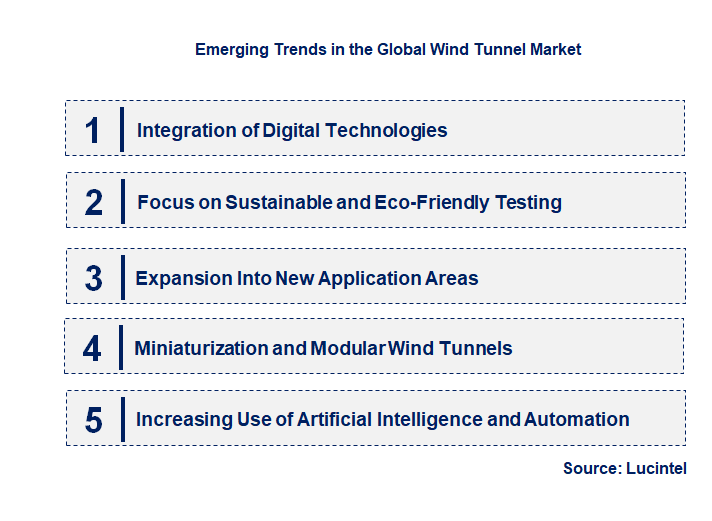
• Integration Of Digital Technologies: The adoption of digital tools such as computational fluid dynamics (CFD), virtual reality (VR), and data analytics is transforming wind tunnel testing. These technologies enable real-time data collection, simulation, and analysis, improving accuracy and reducing physical testing needs. Digital integration allows for faster design iterations, cost savings, and enhanced collaboration across teams. As a result, companies can optimize aerodynamic performance more efficiently, leading to quicker product development cycles and better market responsiveness.
• Focus On Sustainable And Eco-Friendly Testing: Environmental concerns are prompting the industry to develop greener wind tunnel solutions. Innovations include energy-efficient fans, noise reduction techniques, and the use of sustainable materials. Additionally, there is a trend toward designing wind tunnels that minimize energy consumption and carbon footprint. This shift aligns with global sustainability goals and regulatory pressures, encouraging companies to adopt eco-friendly practices. The focus on sustainability not only reduces operational costs but also enhances corporate social responsibility and brand reputation.
• Expansion Into New Application Areas: Beyond traditional aerospace and automotive sectors, wind tunnels are increasingly used in renewable energy, sports engineering, and urban planning. For instance, testing wind turbine blades, sports equipment aerodynamics, and city wind flow patterns are gaining prominence. This diversification broadens market opportunities and drives innovation in wind tunnel design. As new applications emerge, tailored solutions are developed to meet specific industry needs, fostering growth and technological advancement across multiple sectors.
• Miniaturization And Modular Wind Tunnels: The development of compact, modular wind tunnels allows for versatile testing in limited spaces and on smaller scale models. These systems are cost-effective, easier to install, and adaptable to various testing requirements. Miniaturization enables more frequent testing cycles and supports rapid prototyping, especially in research and development settings. Modular designs facilitate customization and scalability, making wind tunnel testing accessible to smaller organizations and academic institutions, thereby expanding the market reach and fostering innovation.
• Increasing Use Of Artificial Intelligence And Automation: AI-driven automation is revolutionizing wind tunnel operations by enabling predictive maintenance, automated data analysis, and optimized testing procedures. Machine learning algorithms can identify patterns and anomalies, improving test accuracy and efficiency. Automation reduces human error and operational costs while increasing throughput. This trend enhances the overall productivity of wind tunnel facilities and accelerates the development of aerodynamic solutions. As AI integration deepens, the market is poised for smarter, more autonomous testing environments that support complex research and development projects. These trends are collectively transforming the Wind Tunnel Market by making testing more efficient, sustainable, versatile, and technologically advanced. They are enabling industries to innovate faster, reduce costs, and meet evolving regulatory and environmental standards, ultimately reshaping the competitive landscape and driving future growth.
• Technological Innovations in Wind Tunnel Design: Enhanced accuracy and efficiency are achieved through advanced materials, automation, and data analytics, enabling more precise aerodynamic testing. These innovations reduce testing time and costs, improve data quality, and allow for complex simulations. The integration of digital twin technology and AI-driven controls further enhances capabilities, making wind tunnels more adaptable and versatile for various industries. This progress attracts new customers and expands application scopes, fueling market growth.
• Rising Demand for Aerodynamic Testing in Aerospace: The aerospace sectors focus on fuel efficiency and safety drives increased use of wind tunnels for aircraft design and certification. Innovations in large-scale and high-speed wind tunnels facilitate testing of next-generation aircraft, including supersonic jets and drones. Governments and private companies invest heavily in research, boosting market expansion. The ability to simulate extreme conditions and complex geometries enhances design accuracy, leading to safer, more efficient aircraft and expanding the market’s reach.
• Automotive Industry’s Shift Toward Electric Vehicles: The automotive sector’s transition to electric vehicles (EVs) emphasizes aerodynamics to improve range and performance. Wind tunnels are crucial for testing EV designs, reducing drag, and optimizing airflow. The development of compact, high-precision tunnels allows automakers to conduct rapid prototyping and validation. This focus on sustainability and efficiency accelerates market growth, with increased adoption of wind tunnel testing for EVs, autonomous vehicles, and lightweight materials, broadening application areas.
• Expansion of Wind Tunnel Testing in Research and Development: Academic institutions and research organizations increasingly utilize wind tunnels for fundamental aerodynamic studies and innovative research. The development of versatile, modular tunnels supports a wide range of experiments, from renewable energy to sports engineering. Funding from government agencies and private sectors boosts R&D activities, fostering innovation. This expansion enhances understanding of aerodynamics, leading to new applications and technological breakthroughs, thereby strengthening the overall market and encouraging industry collaboration.
• Growing Adoption of Digital and Virtual Wind Tunnels: Digital wind tunnels and virtual simulation tools complement physical testing, offering cost-effective, rapid analysis options. These technologies enable virtual prototyping, reducing the need for extensive physical models and testing cycles. The integration of cloud computing and AI enhances predictive accuracy and data management. This shift toward digital solutions democratizes access, accelerates product development, and reduces time-to-market, significantly impacting the market by expanding its reach and enabling more innovative, sustainable designs. These developments are significantly transforming the wind tunnel market by improving testing precision, reducing costs, and expanding application areas across aerospace, automotive, and research sectors. The integration of digital technologies and innovative designs is fostering a more efficient, versatile, and sustainable industry. As a result, the market is poised for sustained growth, driven by increasing demand for aerodynamic testing and technological advancements, ultimately shaping the future of aerodynamic research and development.
• Expansion Into Aerospace Testing Applications: The aerospace sector is a primary driver for wind tunnel market growth, with increased demand for aircraft aerodynamic testing, space vehicle development, and drone research. Advanced wind tunnels enable precise simulation of flight conditions, improving safety and efficiency. Growing investments by aerospace manufacturers and government agencies in next-generation aircraft and space exploration projects create substantial opportunities. Sub-segments like high-speed aerodynamics and composite material testing are particularly promising, supporting innovation and regulatory compliance.
• Growth in Automotive Aerodynamics and Vehicle Development: The automotive industry is increasingly adopting wind tunnel testing to optimize vehicle design for fuel efficiency, safety, and performance. Electric vehicles and autonomous cars benefit from aerodynamic enhancements, reducing drag and energy consumption. The rise of sports cars and luxury vehicles also boosts demand for high-precision testing. Additionally, the development of wind-resistant vehicle structures and noise reduction features are expanding market opportunities. Collaborations between automakers and testing facilities further accelerate adoption of advanced wind tunnel solutions.
• Rising Demand for Renewable Energy and Wind Power Testing: The renewable energy sector, especially wind power, is a significant growth avenue for wind tunnel applications. Testing blade designs, turbine components, and environmental impact assessments require sophisticated wind tunnel facilities. As offshore and onshore wind farms expand globally, the need for accurate aerodynamic testing increases. Innovations in blade materials and turbine efficiency are driven by wind tunnel research, supporting sustainable energy goals. This segment offers substantial opportunities for specialized testing services and equipment providers.
• Technological Innovations in Wind Tunnel Design and Data Analytics: Advances in wind tunnel technology, such as open-jet, closed-jet, and multi-axis testing, enhance simulation accuracy and versatility. Integration of digital twin technology and real-time data analytics allows for more detailed insights and faster product development cycles. These innovations enable testing of complex geometries and multi-parameter environments, opening new markets in healthcare, sports, and consumer electronics. Companies investing in smart, automated, and scalable wind tunnel systems can gain competitive advantages and expand their service offerings.
• Regional Growth Opportunities in Asia-Pacific and Emerging Markets: Rapid industrialization and infrastructure development in Asia-Pacific, Latin America, and Africa are creating new demand for wind tunnel testing. Countries like China, India, and Brazil are investing heavily in aerospace, automotive, and renewable energy sectors, boosting regional market growth. Local manufacturing hubs and government initiatives support the adoption of advanced testing facilities. These emerging markets present opportunities for market expansion, strategic partnerships, and localized service offerings, helping global players tap into high-growth regions. The overall impact of these opportunities is set to significantly accelerate market growth, foster innovation, and diversify application areas. Stakeholders who strategically invest in technological advancements and regional expansion will be well-positioned to capitalize on evolving industry needs. As demand for precise aerodynamic testing continues to rise across sectors, the wind tunnel market is poised for sustained expansion and increased competitiveness.
• Technological Advancements: The continuous development of sophisticated wind tunnel testing techniques, such as high-speed and multi-axis testing, enhances accuracy and efficiency. These innovations enable aerospace and automotive industries to optimize designs, reduce development time, and improve safety standards. As technology progresses, the ability to simulate real-world conditions more precisely accelerates market growth, attracting investments and expanding application scopes across various sectors.
• Increasing Demand for Aerodynamic Optimization: The push for fuel efficiency and reduced emissions in transportation sectors drives the need for aerodynamic testing. Wind tunnels help in designing more streamlined vehicles, aircraft, and wind turbines, leading to better performance and lower operational costs. This demand is further fueled by environmental regulations and consumer preferences for sustainable solutions, making wind tunnel testing an indispensable part of product development.
• Growth in Aerospace and Automotive Industries: The expanding aerospace sector, driven by commercial aircraft production and space exploration, relies heavily on wind tunnel testing for safety and performance validation. Similarly, the automotive industry seeks aerodynamic improvements to meet fuel efficiency standards. The rise in these industries globally, especially in emerging markets, propels the demand for advanced wind tunnel facilities, fostering market expansion.
• Regulatory and Safety Standards: Stringent government regulations concerning safety, emissions, and environmental impact compel manufacturers to adopt comprehensive testing methods. Wind tunnels provide critical data for compliance and certification processes, ensuring products meet international standards. This regulatory landscape encourages investment in state-of-the-art testing facilities, further stimulating market growth. The challenges facing the wind tunnel market are:
• High Capital and Operational Costs: Establishing and maintaining wind tunnel facilities require substantial investment in infrastructure, equipment, and skilled personnel. These costs can be prohibitive, especially for small and medium-sized enterprises, limiting market entry and expansion. Additionally, operational expenses related to energy consumption and maintenance add to financial burdens, potentially hindering widespread adoption.
• Regulatory and Environmental Constraints: While regulations promote safety and environmental standards, they also impose complex compliance requirements that can delay project timelines and increase costs. Environmental concerns related to noise pollution and energy consumption of wind tunnels pose additional challenges, necessitating investments in eco-friendly technologies and sustainable practices, which may not always be feasible or cost-effective.
• Technological Complexity and Rapid Innovation: The fast pace of technological change demands continuous upgrades and innovation in wind tunnel testing methods. Keeping pace with these advancements requires significant R&D investment, which can strain resources. Moreover, integrating new technologies into existing facilities can be complex and disruptive, potentially leading to obsolescence and reduced competitiveness if not managed effectively. The wind tunnel market is shaped by technological progress, increasing demand for aerodynamic efficiency, and supportive regulatory frameworks. However, high costs, environmental and regulatory hurdles, and rapid technological changes pose significant challenges. These factors collectively influence market growth, requiring stakeholders to balance innovation with sustainability and cost-efficiency. Strategic investments and adaptive approaches will be crucial for sustained success in this evolving landscape.
• Nasa
• Aerovironment
• Gulfstream Aerospace
• Airbus
• Boeing
• Lockheed Martin
• Daimler Ag
• Rolls-Royce
• National Research Council
• University Of Maryland
• Subsonic Wind Tunnels
• Transonic Wind Tunnels
• Supersonic Wind Tunnels
• Hypersonic Wind Tunnels
• Air
• Substances
• Mixed Gases
• Aerospace
• Automotive
• Civil Engineering
• Marine
• Sports
• Research Institutions
• Commercial
• Government
• North America
• Europe
• Asia Pacific
• The Rest of the World
• United States: The US wind tunnel market has seen substantial investments in high-tech testing facilities, especially for aerospace and automotive sectors. Leading companies are adopting digital twin technologies and advanced aerodynamic testing methods to improve vehicle efficiency and safety. Government agencies are funding research to develop eco-friendly testing solutions, boosting market growth. The focus on renewable energy, particularly wind power, has also increased demand for specialized wind tunnel testing to optimize turbine designs. Overall, the US remains a global leader in wind tunnel innovation, emphasizing sustainability and technological integration.
• China: China’s wind tunnel market is rapidly expanding, driven by its booming aerospace and automotive industries. The government’s strategic initiatives aim to enhance domestic testing capabilities and reduce reliance on foreign technology. Recent developments include the construction of large-scale, state-of-the-art wind tunnels equipped with advanced measurement systems. The country is also investing heavily in research to improve wind turbine efficiency for renewable energy projects. Additionally, collaborations between academia and industry are fostering innovation. China’s focus on sustainable development and technological self-sufficiency is propelling its wind tunnel market forward at an accelerated pace.
• Germany: Germany continues to be a key player in the wind tunnel market, with a strong emphasis on automotive and aerospace testing. The country is pioneering the integration of renewable energy testing, especially for wind turbine blade aerodynamics. German firms are adopting cutting-edge simulation and measurement technologies to enhance testing accuracy and reduce costs. The government’s commitment to sustainability and green energy policies has spurred investments in eco-friendly testing facilities. Collaborative projects between research institutes and industry are fostering innovation. Germany’s focus on precision engineering and environmental sustainability positions it as a leader in advanced wind tunnel solutions.
• India: India’s wind tunnel market is witnessing rapid growth, primarily driven by the expanding automotive and renewable energy sectors. The government’s push for clean energy and self-reliance has led to increased investments in wind turbine testing facilities. Recent developments include the establishment of new wind tunnel centers with modern testing capabilities. The focus is on improving aerodynamic performance and energy efficiency of turbines and vehicles. Additionally, public-private partnerships are fostering innovation and technology transfer. India’s strategic emphasis on sustainable development and infrastructure expansion is expected to further boost its wind tunnel market in the coming years.
• Japan: Japan’s wind tunnel market is characterized by advanced research and development activities, especially in aerospace and automotive sectors. The country is investing in high-precision testing technologies to support its innovation-driven industries. Recent advancements include the integration of digital simulation tools and wind tunnel automation to enhance testing efficiency. Japan is also exploring wind tunnel applications for renewable energy, particularly in optimizing wind turbine designs. The government’s focus on disaster resilience and energy sustainability is encouraging investments in eco-friendly testing solutions. Japan’s expertise in precision engineering continues to position it as a leader in innovative wind tunnel technology.


• Nasa
• Aerovironment
• Gulfstream Aerospace
• Airbus
• Boeing
• Lockheed Martin
• Daimler Ag
• Rolls-Royce
• National Research Council
• University Of Maryland Q6. Which wind tunnel market segment will be the largest in future? Answer: Lucintel forecasts that, within the type category, subsonic wind tunnel is expected to witness the highest growth over the forecast period. Q7. In wind tunnel market, which region is expected to be the largest in next 8 years? Answer: In terms of region, APAC is expected to witness the highest growth over the forecast period. Q8. Do we receive customization in this report? Answer: Yes, Lucintel provides 10% customization without any additional cost.


Choose a license that fits your team. Instant PDF delivery.
Prices exclude taxes. Instant delivery. Custom licensing available on request.
Market Report · July 31, 2026
Market Report · July 31, 2026
Market Report · July 31, 2026
Trusted partner for strategic intelligence and business growth


Receive a complimentary market analysis tailored to your industry. Our analysts will identify key growth opportunities and competitive dynamics specific to your business.

Market size, growth rate, and key trend analysis for your specific sector.

Top competitor positioning and market share analysis.

Strategic recommendations backed by data-driven insights.
Get curated market intelligence and competitive moves straight to your inbox.
By subscribing, you agree to receive our monthly insights. Unsubscribe anytime.
Receive a complimentary market analysis tailored to your industry. Our analysts will identify key growth opportunities and competitive dynamics specific to your business.
Market size, growth rate, and key trend analysis for your specific sector.
Top competitor positioning and market share analysis.
Strategic recommendations backed by data-driven insights.
Get curated market intelligence, emerging trends, and competitive moves straight to your inbox each month.
By subscribing, you agree to receive our monthly insights. Unsubscribe anytime.
We'll send your sample report shortly.