
Market Report · July 15, 2026

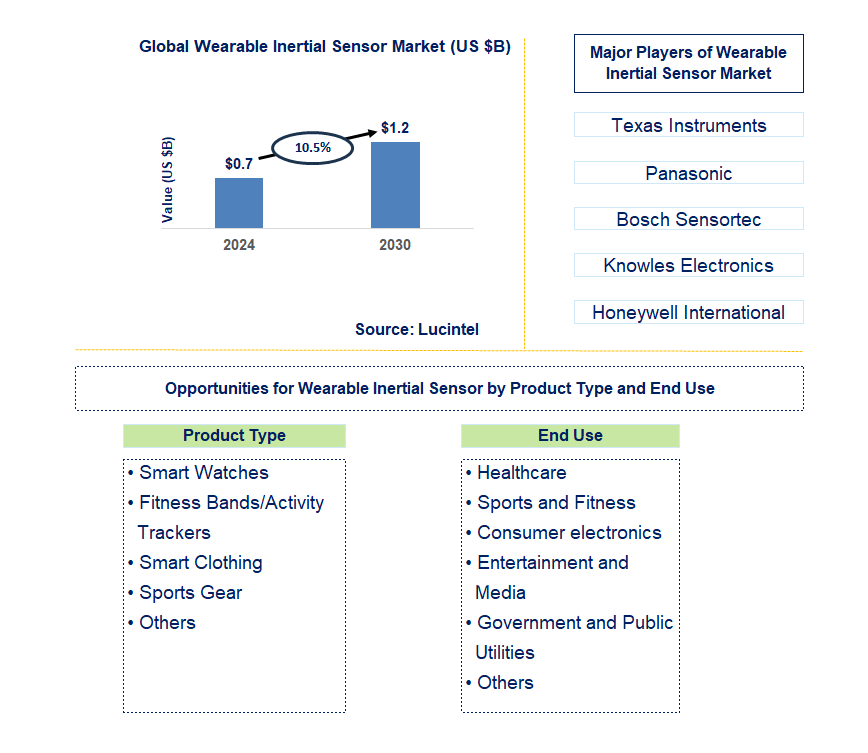
Key data points: The market size in 2030 = $1.2 billion, growth forecast = 10.5% annually for the next 6 years. Scroll below to get more insights. This market report covers trends, opportunities, and forecasts in the global wearable inertial sensor market to 2030 by product type (smart watches, fitness bands/activity tracker, smart clothing, sports gear, and others), end use (healthcare, sports and fitness, consumer electronics, entertainment and media, government and public utilities, and others), and region (North America, Europe, Asia Pacific, and the Rest of the World)
We'll send your sample report shortly.
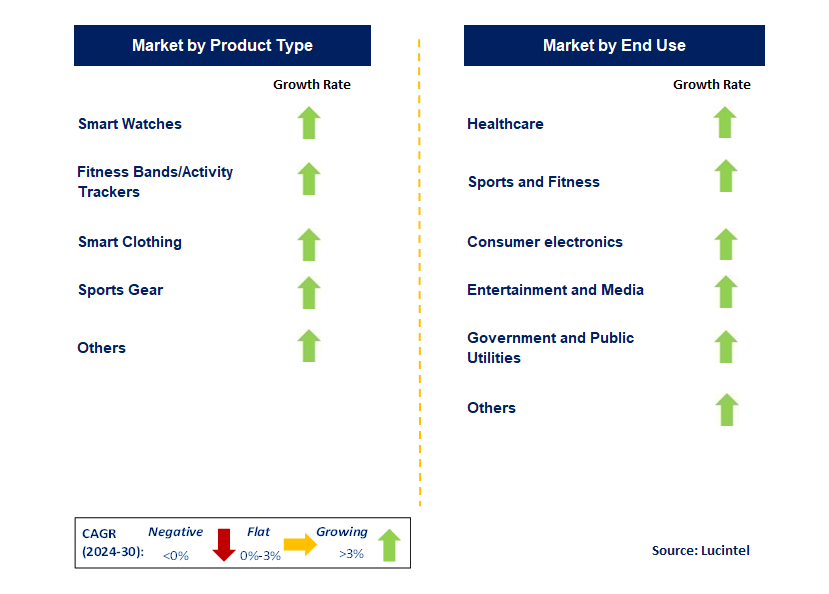
• Lucintel forecasts that, within the product type category, smart watch will remain the largest segment over the forecast period due to rising popularity of smartwatches among consumers.
• Within the end use category, consumer electronic will remain the largest segment due to increasing internet connectivity and improved data exchange capabilities.
• In terms of regions, APAC will remain the largest region over the forecast period due to increasing popularity of wearable devices and digital technologies and presence of major electronic manufacturers in the region. A more than 150-page report is developed to help in your business decisions.
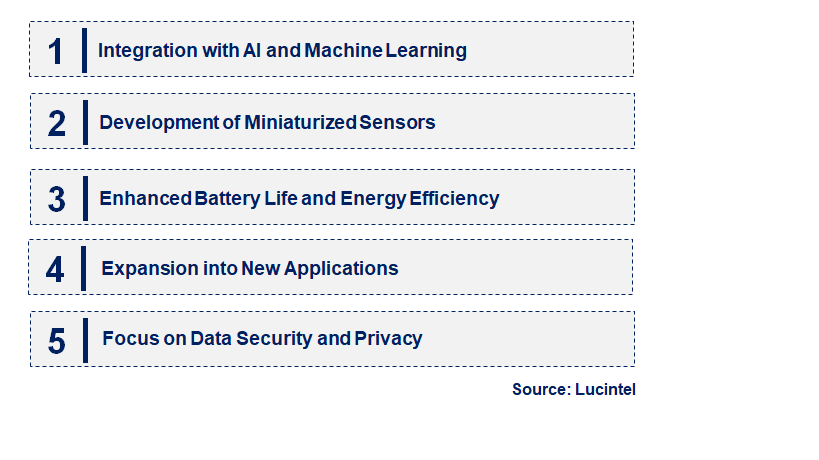
• Integration with AI and Machine Learning: Wearable inertial sensors are increasingly being integrated with artificial intelligence (AI) and machine learning algorithms. This integration enhances the accuracy and functionality of sensors by enabling more sophisticated data analysis and interpretation. AI-driven algorithms can analyze complex movement patterns, provide actionable insights, and predict potential health issues. This trend is improving the effectiveness of wearables in monitoring health conditions and optimizing fitness routines, making devices more intelligent and responsive to user needs.
• Development of Miniaturized Sensors: Miniaturization is a key trend in wearable inertial sensors, allowing for smaller, lighter, and more comfortable devices. Advances in microelectronics and sensor technology are enabling the development of compact sensors without compromising performance. Miniaturized sensors are being incorporated into a wide range of wearables, from smartwatches to health-monitoring patches. This trend is expanding the possibilities for wearable design and enhancing the user experience by making devices less obtrusive and more convenient.
• Enhanced Battery Life and Energy Efficiency: Improved battery life and energy efficiency are critical for the growing wearables market. Innovations in power management and energy harvesting technologies are extending the operational time of wearable devices. Advances include low-power sensor designs, efficient power management systems, and energy harvesting from body movements or ambient sources. These improvements ensure that wearables can operate longer between charges and provide a more seamless user experience, addressing one of the key limitations of wearable technology.
• Expansion into New Applications: Wearable inertial sensors are finding applications beyond fitness and health monitoring, including in industrial, automotive, and entertainment sectors. In industrial settings, sensors are used for equipment monitoring and worker safety. In automotive applications, they contribute to advanced driver-assistance systems. The expansion into new applications is driving innovation and broadening the market for wearable inertial sensors, creating opportunities for new products and services that leverage sensor technology in diverse ways.
• Focus on Data Security and Privacy: As wearable inertial sensors collect increasingly sensitive data, there is a growing focus on data security and privacy. Manufacturers are implementing robust encryption and data protection measures to safeguard user information. Privacy concerns and regulatory requirements are prompting companies to adopt best practices for data handling and security. This trend is crucial for building user trust and ensuring compliance with privacy regulations, as well as protecting users from potential misuse of their personal data. These emerging trends are significantly reshaping the wearable inertial sensor market by enhancing functionality, expanding applications, and addressing user concerns. Integration with AI and miniaturization are driving advancements in sensor capabilities and design, while improved battery life and energy efficiency enhance usability. Expansion into new sectors and a focus on data security are broadening market opportunities and addressing critical user needs. Together, these trends are contributing to a more sophisticated, versatile, and user-friendly landscape for wearable inertial sensors.
• Introduction of Advanced Multi-Axis Sensors: The development of advanced multi-axis inertial sensors has significantly enhanced the capability of wearable devices. These sensors offer improved accuracy in tracking complex movements and orientations by measuring acceleration and angular velocity along multiple axes. This advancement is particularly valuable for applications requiring detailed motion analysis, such as sports performance monitoring and rehabilitation. Enhanced multi-axis sensors are providing users with more precise and comprehensive data, driving advancements in various wearable technologies.
• Emergence of Flexible and Stretchable Sensors: Flexible and stretchable inertial sensors are emerging as a major development, enabling the creation of wearable devices that conform to the body’s shape and movements. These sensors are made from materials that can stretch and bend without losing functionality, making them ideal for integration into clothing or skin-like patches. This development is expanding the possibilities for wearable designs and improving comfort and usability. Flexible sensors are being used in applications ranging from fitness trackers to health-monitoring garments.
• Advances in Sensor Fusion Technology: Advances in sensor fusion technology are enhancing the performance of wearable inertial sensors by combining data from multiple sensors to provide more accurate and reliable information. Sensor fusion algorithms integrate data from accelerometers, gyroscopes, and magnetometers to offer a comprehensive view of motion and orientation. This development is improving the performance of wearables in complex environments and applications, such as virtual reality and advanced navigation systems, and providing users with more detailed and actionable insights.
• Growth of Wearable Health Monitoring Devices: The growth of wearable health monitoring devices is a significant development in the wearable inertial sensor market. These devices use advanced inertial sensors to monitor vital signs, track physical activity, and detect health conditions such as falls or irregular movements. The increasing focus on preventive healthcare and remote patient monitoring is driving the demand for such devices. Innovations in sensor technology are improving the accuracy and reliability of health monitoring wearables, making them valuable tools for both consumers and healthcare providers.
• Expansion of Market Players and New Entrants: The wearable inertial sensor market is seeing an influx of new entrants and expansion of existing players, leading to increased competition and innovation. Companies are developing a wide range of wearable devices with advanced sensor technology to capture different market segments. This development is fostering a dynamic market environment with diverse product offerings and driving technological advancements. New entrants are bringing fresh perspectives and solutions, contributing to the overall growth and evolution of the wearable inertial sensor market. These recent developments are transforming the wearable inertial sensor market by improving sensor capabilities, expanding applications, and fostering a competitive environment. Advanced multi-axis sensors, flexible designs, and sensor fusion technology are enhancing performance and usability, while the growth of health monitoring devices and new market players is driving innovation and market expansion. Together, these developments are shaping the future of wearable technology and creating new opportunities for both consumers and businesses.
• Health Monitoring: The integration of advanced inertial sensors in health monitoring devices presents a major growth opportunity. Wearable sensors can track vital signs, detect irregular movements, and monitor chronic conditions, providing real-time health data to users and healthcare providers. This capability enhances preventive care and remote patient monitoring, driving demand for innovative health solutions. As the global focus on personalized healthcare increases, the development of accurate and reliable health monitoring wearables can lead to significant market growth and improved patient outcomes.
• Fitness Tracking: Fitness tracking is a rapidly growing application for wearable inertial sensors, driven by rising health awareness and demand for personalized fitness solutions. Sensors that accurately measure physical activity, track exercise routines, and analyze movement patterns are becoming increasingly popular. This growth opportunity is supported by advancements in sensor technology, which enhance the precision and functionality of fitness trackers. As consumers seek more effective ways to manage their fitness goals, wearable sensors offer valuable insights and motivation, fueling market expansion in this segment.
• Sports Analytics: The use of wearable inertial sensors in sports analytics is revolutionizing how athletes and coaches analyze performance. Sensors can provide detailed data on movement, technique, and biomechanics, enabling targeted training and injury prevention. This opportunity is driven by the increasing investment in sports technology and the desire for competitive advantage. By offering precise performance metrics and insights, wearable sensors can enhance training effectiveness and athlete performance, contributing to significant growth in the sports analytics sector.
• Industrial Safety: Industrial safety applications represent a key growth opportunity for wearable inertial sensors. These sensors can monitor workers' movements, detect falls, and ensure compliance with safety protocols in hazardous environments. As industries focus on improving workplace safety and reducing accidents, the demand for advanced wearable safety devices is rising. By providing real-time alerts and data-driven insights, wearable sensors can enhance worker safety, prevent accidents, and support regulatory compliance, driving growth in the industrial sector.
• Augmented Reality (AR): The integration of wearable inertial sensors into augmented reality (AR) systems offers a promising growth opportunity. Sensors enhance AR experiences by providing accurate spatial and motion tracking, improving user interaction and immersion. As AR technology advances and applications expand across gaming, training, and industrial use, the role of inertial sensors in delivering seamless and responsive AR experiences becomes increasingly important. This growth opportunity is driven by the rising popularity of AR applications and the need for precise sensor data. These strategic growth opportunities highlight the diverse potential applications for wearable inertial sensors, ranging from health monitoring and fitness tracking to sports analytics, industrial safety, and augmented reality. By addressing these opportunities, businesses can drive market expansion and create innovative solutions that meet evolving consumer and industry needs. Leveraging advancements in sensor technology and targeting high-growth application areas can significantly impact the wearable inertial sensor market and foster continued innovation and development.
• Technological Advancements: Technological advancements in sensor technology, including miniaturization, improved accuracy, and integration with AI, are significant drivers for the wearable inertial sensor market. Innovations such as enhanced multi-axis sensors and flexible materials are expanding the capabilities of wearable devices. These advancements lead to more accurate, reliable, and versatile sensors, meeting growing consumer expectations and enabling new applications. The continuous evolution of technology fuels market growth by enhancing the performance and appeal of wearable sensors.
• Increasing Health Consciousness: Rising health consciousness among consumers is driving demand for wearable inertial sensors in health and fitness applications. People are increasingly seeking tools to monitor their health, track physical activity, and manage wellness. Wearable sensors that provide real-time health data and personalized insights are becoming essential for maintaining a healthy lifestyle. This growing focus on health and wellness creates a strong market for wearables that support proactive health management and fitness tracking.
• Demand for Personalized Solutions: The growing demand for personalized solutions in health, fitness, and sports is driving the wearable inertial sensor market. Consumers are looking for devices that offer tailored feedback and insights based on individual needs and activities. Wearable sensors that provide customized data and recommendations can significantly enhance user experience and satisfaction. This demand for personalization is fueling innovation and expanding market opportunities for wearable technology.
• Expansion into New Applications: The expansion of wearable inertial sensors into new applications, such as industrial safety, augmented reality, and sports analytics, is a key growth driver. Sensors are being increasingly integrated into diverse sectors, providing valuable data and enhancing functionality. This broadening of applications opens up new market opportunities and drives demand for advanced wearable technologies. The ability to adapt and apply sensors in various contexts supports market growth and diversification.
• Supportive Regulatory Environments: Supportive regulatory environments and standards are fostering growth in the wearable inertial sensor market. Clear guidelines and regulations help ensure safety, quality, and interoperability of wearable devices. Regulatory support can facilitate market entry and adoption by providing a framework for compliance and innovation. As regulations evolve to accommodate new technologies and applications, they can positively impact market development and encourage investment in wearable sensor technologies. Challenges in the wearable inertial sensor market are:
• High Development Costs: High development costs for advanced wearable inertial sensors can pose a significant challenge. The expenses associated with research, development, and manufacturing can be substantial, impacting profitability and market entry for new players. These costs can also affect the pricing of end-user products, potentially limiting market accessibility. Addressing development costs through technological advancements and economies of scale is crucial for market growth and competitiveness.
• Data Privacy Concerns: Data privacy concerns are a major challenge in the wearable inertial sensor market. As wearable devices collect sensitive personal data, there is a growing need for robust data protection measures and transparent privacy practices. Users and regulatory bodies are increasingly focused on how data is managed and secured. Companies must address privacy concerns by implementing strong security protocols and complying with data protection regulations to build trust and ensure market acceptance.
• Regulatory Hurdles: Regulatory hurdles can impact the development and commercialization of wearable inertial sensors. Different regions have varying regulations and standards, which can create challenges for global market entry and compliance. Navigating these regulatory requirements can be complex and time-consuming, potentially delaying product launches and increasing costs. Effective management of regulatory challenges is essential for successful market integration and international expansion. The wearable inertial sensor market is shaped by key drivers such as technological advancements, increasing health consciousness, and demand for personalized solutions, which collectively foster growth and innovation. However, challenges like high development costs, data privacy concerns, and regulatory hurdles can impact market dynamics and require careful management. Addressing these drivers and challenges effectively will influence the market's trajectory, shaping its future and ensuring sustainable growth and development in the wearable inertial sensor sector.
• Texas Instruments
• Panasonic
• Bosch Sensortec
• Knowles Electronics
• Honeywell International
• Smart Watches
• Fitness Bands/Activity Trackers
• Smart Clothing
• Sports Gear
• Others
• Healthcare
• Sports and Fitness
• Consumer electronics
• Entertainment and Media
• Government and Public Utilities
• Others
• North America
• Europe
• Asia Pacific
• The Rest of the World
• United States: In the U.S., the wearable inertial sensor market is booming due to advancements in health monitoring and fitness tracking technologies. Companies like Fitbit and Apple are integrating advanced inertial sensors into their devices to offer improved activity tracking, posture monitoring, and fall detection. The focus on personalized health solutions and the growing adoption of wearable technology in medical applications, including rehabilitation and remote patient monitoring, is driving innovation. Additionally, partnerships between tech companies and research institutions are pushing the boundaries of sensor capabilities and applications.
• China: China's wearable inertial sensor market is expanding rapidly due to increased investment in technology and manufacturing. Chinese companies are advancing sensor technology to enhance accuracy and reduce costs, making wearables more accessible. The country is also seeing a rise in smart sports gear and health devices, driven by consumer demand for fitness and wellness solutions. Government support for technology development and innovation is further accelerating market growth. Major players like Xiaomi and Huawei are leading the way with new products that integrate sophisticated inertial sensors for improved user experience.
• Germany: In Germany, the focus is on integrating wearable inertial sensors into industrial and automotive applications. German companies are developing high-precision sensors for applications such as vehicle tracking, industrial machinery monitoring, and worker safety. The emphasis is on improving sensor reliability and accuracy in challenging environments. Collaborations between technology firms and research institutions are pushing the boundaries of sensor technology. Additionally, Germany's strong emphasis on engineering excellence and innovation is driving the development of advanced wearable sensors tailored for professional and industrial uses.
• India: India's market for wearable inertial sensors is growing as the country sees increased adoption of fitness and health monitoring devices. Startups and established companies are working on affordable, high-performance sensors that cater to the needs of a large, health-conscious population. Innovations include sensors designed for yoga and meditation tracking, as well as devices for monitoring chronic conditions. Government initiatives to promote health tech and increasing smartphone penetration are also contributing to market growth. Indian companies are focusing on making wearable technology more accessible and relevant to local consumers.
• Japan: Japan is advancing wearable inertial sensor technology with a focus on robotics and healthcare. Japanese companies are integrating sensors into robotic exoskeletons and assistive devices to enhance mobility and support elderly care. The emphasis is on creating sensors that offer high precision and reliability in various environments. Japan's strong tradition of innovation and technology development is driving advancements in sensor miniaturization and functionality. Additionally, the Japanese market is seeing increased interest in wearable devices for sports and health monitoring, leading to further development of advanced sensor technologies.


• Texas Instruments
• Panasonic
• Bosch Sensortec
• Knowles Electronics
• Honeywell International Q6. Which wearable inertial sensor market segment will be the largest in future? Answer: Lucintel forecasts that smart watch will remain the largest segment over the forecast period due to rising popularity of smartwatches among consumers. Q7. In wearable inertial sensor market, which region is expected to be the largest in next 5 years? Answer: APAC will remain the largest region over the forecast period due to increasing popularity of wearable devices and digital technologies and presence of major electronic manufacturers in the region. Q.8 Do we receive customization in this report? Answer: Yes, Lucintel provides 10% customization without any additional cost.


Choose a license that fits your team. Instant PDF delivery.
Prices exclude taxes. Instant delivery. Custom licensing available on request.
Market Report · July 15, 2026
Market Report · July 13, 2026
Market Report · July 13, 2026
Trusted partner for strategic intelligence and business growth


Receive a complimentary market analysis tailored to your industry. Our analysts will identify key growth opportunities and competitive dynamics specific to your business.

Market size, growth rate, and key trend analysis for your specific sector.

Top competitor positioning and market share analysis.

Strategic recommendations backed by data-driven insights.
Get curated market intelligence and competitive moves straight to your inbox.
By subscribing, you agree to receive our monthly insights. Unsubscribe anytime.
Receive a complimentary market analysis tailored to your industry. Our analysts will identify key growth opportunities and competitive dynamics specific to your business.
Market size, growth rate, and key trend analysis for your specific sector.
Top competitor positioning and market share analysis.
Strategic recommendations backed by data-driven insights.
Get curated market intelligence, emerging trends, and competitive moves straight to your inbox each month.
By subscribing, you agree to receive our monthly insights. Unsubscribe anytime.
We'll send your sample report shortly.