
Market Report · August 26, 2024

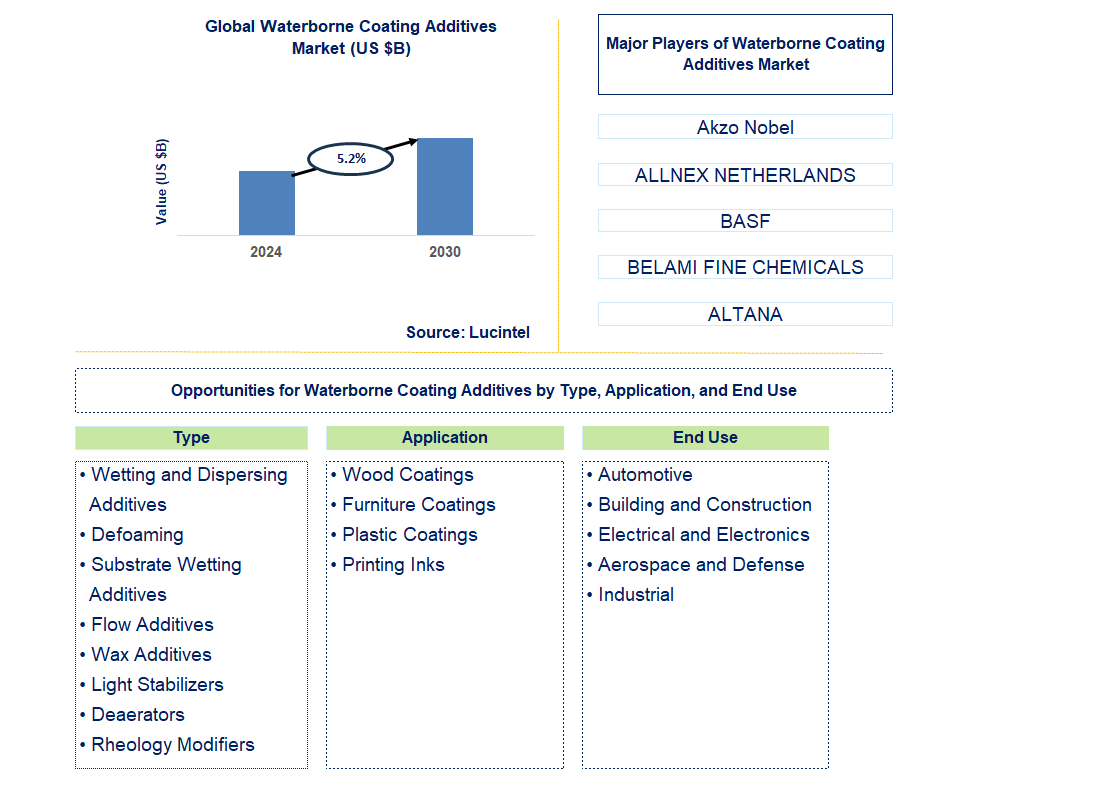
Key data points: The growth forecasts = 5.2% annually for the next 6 years. Scroll below to get more insights. This market report covers trends, opportunities, and forecasts in the global waterborne coating additives market to 2030 by type (wetting and dispersing additives, defoaming, substrate wetting additives, flow additives, wax additives, light stabilizers, deaerators, and rheology modifiers), application (wood coatings, furniture coatings, plastic coatings, and printing inks), end use (automotive, building and construction, electrical and electronics, aerospace and defense, and industrial), and region (North America, Europe, Asia Pacific, and the Rest of the World)
We'll send your sample report shortly.
• Lucintel forecasts that, within the type category, rheology modifiers will remain the largest segment over the forecast period due to wetting properties and health or environmental benefits.
• Within the application category, wood coatings will remain the largest segment due to high level of quality and their perfect fit with the natural properties of wood.
• In terms of regions APAC is expected to witness highest growth over the forecast period due to increasing demand for plastics. Gain valuable insights for your business decisions with our comprehensive 150+ page report.
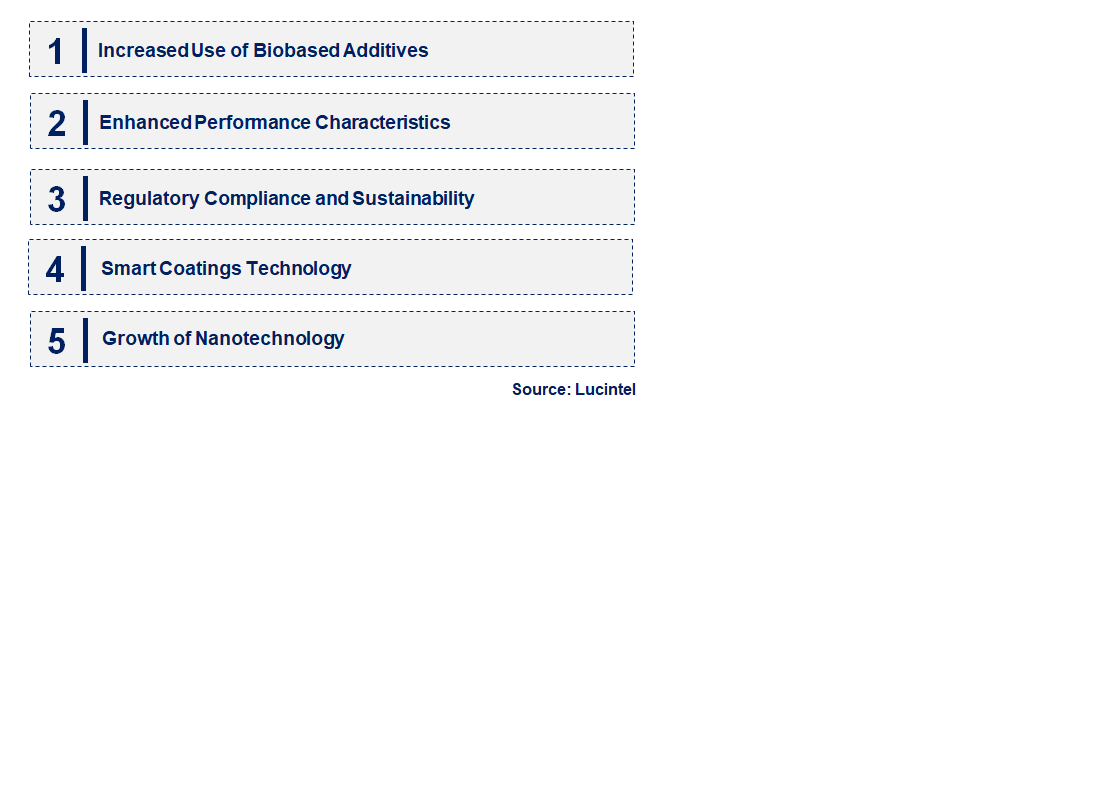
• Increased Use of Biobased Additives: There is a growing trend towards using renewable resources in coating additives. Plant-derived and other fact-based components, biobased additives in particular, have mitigated dependence on fossil fuels and reduced VOC emissions, hence supporting green marketing strategies.
• Enhanced Performance Characteristics: New, principally water-suppressing coatings are expected to enhance the efficiency of waterborne polymeric coatings in terms of durability, adhesion, and environmental resistance. Enhanced functional additives are being developed for increasingly demanding consumers who require high-performance coatings at a lower cost.
• Regulatory Compliance and Sustainability: Increased pollution control measures are addressed within the framework of creating a new generation of additives with very low VOC content. Investments in promotion strategies aim to ensure that research focuses on materials that are compliant while still providing the best performance.
• Smart Coatings Technology: There is a growing convergence between smart technologies and coatings. Self-healing, self-cleaning, or temperature-responsive additives are increasingly coming to the fore, enhancing the utility of coatings and extending their lifespan.
• Growth of Nanotechnology: The application of nanotechnology in waterborne coatings is becoming very common. The incorporation of nanoparticles improves the strength, durability, and aesthetic qualities of the coatings, providing better options for industrial and household use. The waterborne coating additives market is driven by these trends, especially the focus on sustainable development, performance improvements, and technological advancements. The provision of products tailored with biobased content, built-in smart features, and adherence to standards is fostering development and expansion, resulting in enhanced and greener coating application methods.
• Development of Biobased Additives: There has been a growing trend toward sourcing biobased additives from renewable biomass by companies. This trend intends to lessen the negative impact on the environment and boost the sustainability of waterborne coatings while responding to calls from end users and regulators for cleaner products.
• Advancements in Performance Additives: Stakeholders in the coating technologies market are working on new performance additives that will improve adhesion, durability, and weatherability across various coatings. Such developments meet the rising market demand for high-quality coatings in industries such as automotive and construction.
• Introduction of Low-VOC Solutions: The introduction of low-VOC additives and emulsions is a new trend in the market due to tightening environmental policies. These solutions help manufacturers comply with regulations while enhancing indoor air quality and the environment.
• Integration of Smart Coatings: There is an increasing adoption of smart features, like self-cleaning and self-healing mechanisms, among other new technologies. Such innovations offer additional benefits in terms of functionality and durability of coatings, thus meeting the growing demands of consumers and industries.
• Growth in Nanotechnology Applications: Nanotechnology is continually being adopted to add functional and aesthetic advantages to coatings. Nanoparticles enhance performance integrity, durability, and appearance, thus offering advanced packaging solutions for coatings. Such innovations and developments are causing significant changes within the global waterborne coating additives market to cater to performance, sustainability, and technological advancements. This evolution proactively responds to regulatory and market demands, bringing forth more innovative and effective coating solutions.
• Expansion in the Automotive Sector: The automotive sector is one of the fastest-growing areas for low-cost waterborne solvent technologies. The rising concern for eco-friendly and high-performance coatings creates a demand for additives that enhance durability, appearance, and corrosion resistance.
• Growth in the Construction Industry: The booming construction industry presents new opportunities for waterborne coatings with improved weather and adhesion performance. There is a strong market for additives that support sustainable and high-performing coatings.
• Research and Development of Industrial Coatings: Technological improvements are prompting a growing demand for advanced water-based additives to enhance protective and functional attributes. It is necessary to extend the scope of additives to ensure compliance with coating performance and environmental requirements.
• Increasing Consumption of Consumer Goods: The demand for water-based coatings is increasing, particularly in the consumer goods sector for the furniture and appliance industries. Beneficial additives that enhance aesthetic and functional properties while minimizing environmental impact are emerging in the market.
• Emphasis on Green Solutions: There is steadily growing pressure for the development of waterborne coatings and additives with lower or no VOCs that rely on renewable raw material resources. This shift aligns with global aims to minimize environmental impact as more consumers seek eco-friendly products. These growth opportunities indicate that the potential space within the market for waterborne coating additives is progressively widening across its applications. Technological evolution focused on the progress of automotive, construction, industrial, and consumer goods, coupled with the embrace of green technologies, is fostering change and opening new frontiers for the market.
• Technological Improvement: The performance and durability of coatings and their compliance with environmental standards are enhanced through the use of superior additives. Emerging market trends, such as nanotechnology and smart coatings, are boosting market growth as these innovations function effectively while adhering to regulatory policies.
• Regulatory Pressure for Sustainability: The implementation of more environmental policies is compelling manufacturers to develop low-VOC and biobased additives. Meeting these requirements significantly reduces environmental pollution and fulfills market demand for environmentally friendly products.
• Increasing Requirement for High-Performance Coatings: Industries such as automotive and construction demand advanced performance characteristics in these additives. This requirement propels the need for innovative development of new waterborne coating solutions.
• Increasing Emphasis on Green Chemistry: An increasing number of coating additives are being developed using principles of green chemistry, emphasizing the use of renewable resources. This trend favors the development of green products while minimizing the use of toxic chemicals. Challenges in the waterborne coating additives market include:
• Supply Chain Disruptions: Global supply chain issues, such as lack of raw materials and transport delays, can affect the availability and cost of additives. These problems can disrupt market stability and impact product pricing.
• Regulatory Compliance Challenges: Manufacturers may find it problematic to manage the complexity of differing regulations in various regions. Adhering to diverse standards and regulations requires substantial time and financial investment. The waterborne coating additives market serves as an enabler of technology and market regulation, driven by the demand for more advanced and eco-friendly products. The growth drivers include conceptualization, market introduction, and adherence to policies; however, risks associated with costs and addressing supply chain disruptions must be contained for growth to continue.
• Akzo Nobel
• ALLNEX NETHERLANDS
• BASF
• BELAMI FINE CHEMICALS
• ALTANA
• Wetting and Dispersing Additives
• Defoaming
• Substrate Wetting Additives
• Flow Additives
• Wax Additives
• Light Stabilizers
• Deaerators
• Rheology Modifiers
• Wood Coatings
• Furniture Coatings
• Plastic Coatings
• Printing Inks
• Automotive
• Building and Construction
• Electrical and Electronics
• Aerospace and Defense
• Industrial
• North America
• Europe
• Asia Pacific
• The Rest of the World
• US: Market Analysis of the United States: In this region, a growing preference for green additives has been observed, with legislative enforcement serving as a driving force. New biobased additive developments and improvements in performance features can be noted. Products with low VOCs and high durability fulfill consumer demand for sustainable and high-performance solutions.
• China: Market Analysis of China: The China market is rapidly progressing due to high industrial development and urbanization. There is a growing focus on low-VOC and high-efficiency additives. Government environmental concerns have greatly fueled advancements in water-based coatings, with funding provided for R&D initiatives.
• Germany: Market Analysis of Germany: Germany is a hub of modern technology in waterborne additives, with current trends oriented towards extending the life and effectiveness of coatings. The market is driven by stringent regulations imposed by the EU, along with sustainability measures in place. Innovations include new products aiming to improve coating durability without compromising environmental standards, in line with Germany policies on green technology.
• India: Rapid industrialization and infrastructure development in India are propelling market growth. There is a visible shift in preference toward coatings that incorporate waterborne technology, exhibiting increased adhesion and weather resistance. Local manufacturers are seeking cheaper and more environmentally friendly methods as the construction and automotive markets continue to expand.
• Japan: Japan places greater importance on high-performance, environmentally sensitive additives. The market in this country is substantial and continues to evolve, offering a broad array of options due to improved and modern additives, such as moisture-resistant protective and decorative materials. Japanese corporations are at the forefront of devising solutions that enhance coating quality and performance while ensuring compliance with regulations.


• Akzo Nobel
• ALLNEX NETHERLANDS
• BASF
• BELAMI FINE CHEMICALS
• ALTANA Q5. Which waterborne coating additives market segment will be the largest in future? Answer: Lucintel forecasts that within the type category, rheology modifiers will remain the largest segment over the forecast period due to wetting properties and health or environmental benefits. Q6. In waterborne coating additives market, which region is expected to be the largest in next 5 years? Answer: In terms of regions APAC is expected to witness highest growth over the forecast period due to increasing demand for plastics. Q.7 Do we receive customization in this report? Answer: Yes, Lucintel provides 10% customization without any additional cost.


Choose a license that fits your team. Instant PDF delivery.
Prices exclude taxes. Instant delivery. Custom licensing available on request.
Market Report · August 26, 2024
Market Report · May 16, 2026
Market Report · January 3, 2025
Trusted partner for strategic intelligence and business growth


Receive a complimentary market analysis tailored to your industry. Our analysts will identify key growth opportunities and competitive dynamics specific to your business.

Market size, growth rate, and key trend analysis for your specific sector.

Top competitor positioning and market share analysis.

Strategic recommendations backed by data-driven insights.
Get curated market intelligence and competitive moves straight to your inbox.
By subscribing, you agree to receive our monthly insights. Unsubscribe anytime.
Receive a complimentary market analysis tailored to your industry. Our analysts will identify key growth opportunities and competitive dynamics specific to your business.
Market size, growth rate, and key trend analysis for your specific sector.
Top competitor positioning and market share analysis.
Strategic recommendations backed by data-driven insights.
Get curated market intelligence, emerging trends, and competitive moves straight to your inbox each month.
By subscribing, you agree to receive our monthly insights. Unsubscribe anytime.
We'll send your sample report shortly.