
Market Report · May 18, 2026

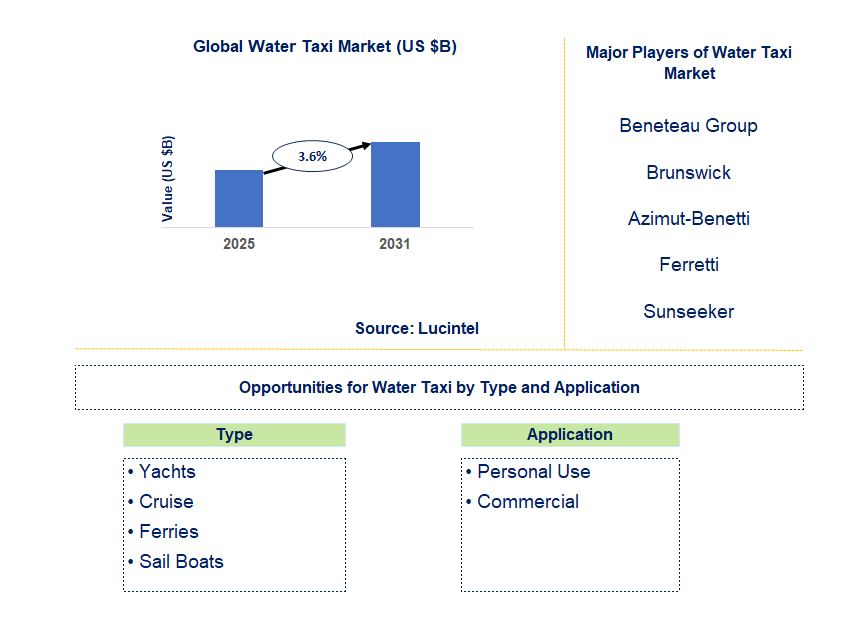
Key data points: The growth forecast = 3.6% annually for the next 7 years. Scroll below to get more insights. This market report covers Trends, opportunities and forecasts in water taxi market to 2031 by type (yachts, cruise, ferries, and sail boats), application (personal use and commercial), and region (North America, Europe, Asia Pacific, and the Rest of the World)
We'll send your sample report shortly.
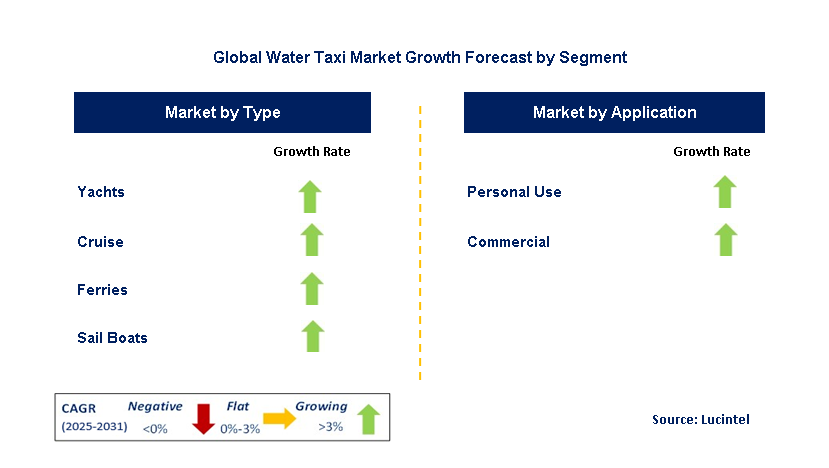
• Lucintel forecasts that, within the type category, sail boats is expected to witness the highest growth over the forecast period.
• Within the application category, commercial is expected to witness higher growth.
• In terms of region, APAC is expected to witness the highest growth over the forecast period.
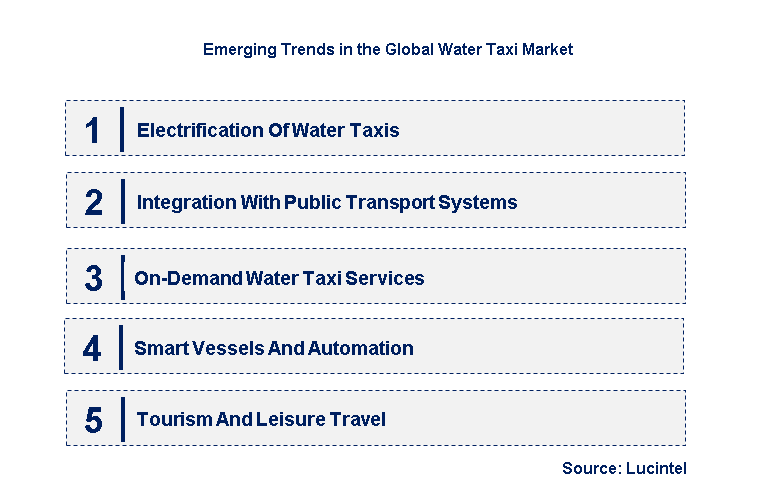
• Electrification Of Water Taxis: Growing demand for greener modes of transport has promoted the electrification of water taxis. Electric water taxis are also zero-emitting, and people are shifting more towards sustainable ways of transportation with electric water taxis. It has been in strong demand in large cities such as New York and Hamburg. The growing adoption of electric vessels is expected to reduce operating costs, noise pollution, and the environmental impact of water transportation. Additionally, the technological advancements in battery efficiency and charging infrastructure are contributing to the broader adoption of electric-powered water taxis worldwide.
• Integration With Public Transport Systems: Water taxis are increasingly being integrated with traditional public transport systems, allowing passengers to seamlessly transition between different modes of transportation. In cities such as Hamburg and Tokyo, water taxis are part of a wider strategy to offer a multi-modal transport network that reduces congestion and enhances urban mobility. This is often coordinated in terms of scheduling, ticketing systems, and docking stations with other forms of public transport such as buses, trains, and ferries. The availability of water taxis can provide efficient, convenient routes for daily commutes and support the development of transport networks to reduce the load on land-based infrastructure.
• On-Demand Water Taxi Services: The trend of on-demand water taxi services, akin to app-based ride-hailing, is changing how passengers use water transport. The model pioneered by companies like Uber and Lyft in land-based ride-hailing has been adapted to water taxis as well. These on-demand platforms allow booking rides through mobile apps, more flexible and convenient than traditional water transport schedules. This trend is gaining momentum in cities where the water taxi will be a great alternative to traffic on roads. The ease of access and greater availability of water taxis will extend the market.
• Smart Vessels And Automation: The water taxi market is gradually embracing smart vessel technologies and automation to improve efficiency, safety, and customer experience. Automation, in the form of autonomous water taxis, is being tested in some regions. This can be a way of reducing operational costs and improving safety by minimizing human error. Additionally, smart technologies include GPS tracking, real-time data collection, and predictive analytics being integrated into the operations of a water taxi. These improve on route planning, fleet management, and passenger satisfaction through better accurate and efficient service delivery. As technology continues to advance, adoption of smart vessels will also change.
• Tourism And Leisure Travel: Water taxis are increasingly being used in tourism and leisure travel. They offer scenic routes and unique experiences for passengers. Cities like Venice and Sydney are already using water taxis as a major tourist attraction. This trend is expanding to other regions, with water taxis offering sightseeing tours, luxury travel options, and access to hard-to-reach destinations. Secondly, water taxis are already turning out to be a part of the eco-tourism package, and a few companies are even focusing on sustainable travel for tourists. This way, it can become an opening for the coastal markets to increase water taxi usage, hence benefiting local economies and the tourism industry as well. These are some of the new trends emerging in electrification, integration with public transport, on-demand services, automation, and tourism and that are altering the water taxi market. This makes water taxis one of the crucial components for the sustainable efficient, and flexible transport networks across cities worldwide in the future evolution of urban mobility.
• Electric-Powered Water Taxis: The introduction of electric-powered water taxis has been a major development in the industry. These environmentally friendly boats are used to decrease carbon emissions, as well as a sustainable option rather than traditional water transport. The cities of New York and Hamburg are in the forefront in utilizing electric water taxis, seeing how it could improve the environment. Electric water taxis not only respond to global calls for sustainability but also make services cheaper for companies to run. As battery technology goes on to further improve, there will be wider ranges and efficacies for an electric water taxi, thus propelling the uptake of these new services.
• Government Support and Regulation: There's a rise globally in the participation of governments funding and supporting infrastructural frameworks about water taxi developments. China, India, amongst others, do this through an investment in necessary infrastructure, particularly in terms of water transport infrastructures as the government invests in its master plans of new urban mobility frameworks. In addition, governments are setting regulations to ensure safety, environmental protection, and efficient operation of water taxi services. This support is essential for the growth of the market, as it provides financial incentives and a legal framework for service providers. Moreover, regulatory compliance ensures that water taxis are operated in a safe and sustainable manner.
• Ride-hailing Apps for Water Taxis: Ride-hailing apps for water taxis have dramatically changed the nature of access for passengers to use water transport. Like Uber in land-based services, water taxis are increasingly coming on demand, with mobile apps available for commuters. This is a particularly alluring innovation to urban commuters: flexible, convenient, and quick. These allow passengers the facility to hail rides at times and convenience appropriate for them to significantly improve on overall accessibility, therefore making short distances and also water taxis interesting routes for commuters, thereby attracting users to continue its growth further in the future market.
• Sustainability and Green Transport Initiatives: Water taxi firms become more involved with sustainability practices such as greening transport measures for their vehicles, which means being environmentally-friendly with the fleet service. Renewable energy sources, eco-friendly vessels, and environmentally responsible waste management systems are becoming more mainstream. This shift is being promoted by public demands for greener transport options as well as governmental regulations to curtail environmental impacts. The acceptance of green technologies in the water taxi market aids in reducing emissions while also responding to the consumer's demand to be environmentally sensitive. As sustainability is soon to become an important factor of the transportation industry, green water taxi services can be expected in demand.
• Expansion into New Geographical Markets: The water taxi market is advancing into new markets as the product of urban mobility solutions picks pace across the world. Cities on water, for example, have cities like Mumbai, Kochi, and Tokyo adopting water taxis as part of their public modes of transport. Water taxis have become very popular for tourist traveling to coastal and riverine cities, offering sight-seeing opportunities that are unlike those offered by others. New markets will lead to increased competition, which will put pressure on innovation in the industry, with many service providers seeking ways to distinguish themselves through uniquely efficient and sustainable transport options. The changes underway include electrified vessels, government support, ride-hailing integrations, sustainability efforts, and expansion into the wider market are indeed changing the water taxi market. Climbing demand for environmental-friendly, efficient transport options will further foster growth and innovation in the water taxi industry.
• Urban Mobility Solutions: Water taxis are gaining popularity as urban mobility solutions in cities with navigable waterways. Water taxis, by offering a quick and environmentally friendly alternative to road transport, help reduce traffic congestion and provide an avenue for commuters. Cities are now dealing with the rise in population and increase in traffic, and waters taxis become a necessity for the multi-modal transport networks. Expanded city water taxi operations and their connection with other public transport, for example, bus and train lines, would have a lot of growth opportunities.
• Tourism/Leisure: Water taxis give tourists an amazing view and method of touring coast and river towns, providing potential for growth in the tourism segment. Many cities with attractive waterfronts, such as Venice, Sydney, and New York, are adopting water taxis for guided tours and luxury travel for tourists. Providing comfortable, eco-friendly vessels would attract tourists seeking a more personal experience in travel. Extending water taxi services to leisure travel and sightseeing tours would dramatically increase market growth in regions that have high tourist traffic.
• Environment-Friendly Transportation Solutions: Rapid attention to environmental sustainability has emerged as a significant growth driver for the water taxi market. Consumers as well as governments emphasize 'green' transportation solutions; electric water taxis fit that bill. Operators in such a market can differentiate themselves by offering eco-friendly transport solutions, which attracts customers looking to do environmentally conscious spending. In addition, electric and hybrid-powered boats can reduce the costs of operating the vessels. As sustainability is a key focus in the transportation industry, green water taxis will be in great demand, hence providing a long-term growth opportunity for service providers.
• Integration with Smart City Infrastructure: Water taxis have high potential to be integrated into smart city infrastructure, such as integrating water taxis into digital platforms to track them in real time, make payments, and schedule pickups. By leveraging IoT (Internet of Things) and smart technologies, water taxis can become a seamless part of urban transport systems. This integration could improve passenger experience, increase operational efficiency, and reduce costs. Collaborations between tech companies and water taxi operators will drive innovation in the industry and lead to more streamlined, user-friendly services.
• Private and Luxury Water Taxi Services: There is a growing demand for luxury and private water taxi services, particularly in tourist hotspots and affluent urban centers. These services cater to individuals or small groups seeking a premium, personalized experience. Operators offering exclusive, high-end water taxis can capitalize on this trend by providing features such as comfortable seating, onboard amenities, and customized routes. The private water taxi services for residents and tourists increase the market base for service providers. The growth opportunities from urban mobility, tourism, sustainability, smart cities, and luxury services are supporting the growth in the water taxi market. As such, providers that take part in these areas will be adequately positioned to reap the benefits offered by the current changing consumer behavior and emerging opportunities in the markets.
• Beneteau Group
• Brunswick
• Azimut-Benetti
• Ferretti
• Sunseeker
• Bavaria Yachtbau
• American Sail Inc
• Catalina Yachts
• Macgregor
• Hunter
• Yachts
• Cruise
• Ferries
• Sail Boats
• Personal Use
• Commercial
• North America
• Europe
• Asia Pacific
• The Rest of the World
• United States: The United States is seeing a significant rise in the growth of the water taxi market in cities such as New York, Miami, and Seattle. These cities have invested in expanding their water taxi services to alleviate traffic congestion and provide a cleaner, faster alternative to land-based transportation. In New York, the NYC Ferry service has been a success, providing daily water transport to commuters. The rise of electric-powered water taxis is also a notable trend, driven by a desire to reduce carbon emissions. More recently, technological innovations are enabling ride-hailing apps for water taxis to make services more accessible and convenient to the end-users.
• China: In China, water taxis remain an exciting sector on the rise. It is experiencing a rapid growth in cities with gigantic waterways like Shanghai and Guangzhou. The government has taken a significant lead in investing heavily in the extension of water transport networks, offering water taxis for public transportation in major cities. In this move toward sustainable transport, China is introducing electric and hybrid-powered water taxis to cut down on emissions. The country is also focused on the development of advanced infrastructure, such as floating piers and docking stations. The water taxi market is viewed as part of the broader effort to improve urban mobility and reduce road congestion in China's megacities.
• Germany: Another country that advances its water taxi services is Germany, especially within cities like Hamburg and Berlin that emphasize sustainability, as well as innovative transport options. In Hamburg, the service of HafenCity water taxis provides a 'green' means of transportation with respect to competition from buses or taxis. Currently, electrically powered water taxis are becoming one of the increasingly popular trends among German cities which test these so-called 'environment-friendly' alternative transport options. In addition, water taxis are being increasingly integrated into Germany's broader public transportation system, providing more efficient and environmentally friendly transport options for urban commuters. The government's support for green technologies further accelerates this development.
• India: India's water taxi market is gradually developing, particularly in coastal regions and cities with significant waterways like Mumbai, Kochi, and Goa. In Mumbai, water taxis are part of the city's efforts to decongest the roads and offer a more efficient mode of transport. Kochi has also started its water taxi services to enhance tourism and create a viable transport option for its residents. Water taxis are being considered by the Indian government as part of the broader focus on improving urban mobility. However, there is still a challenge in infrastructure development, such as modern docking stations and safety standards.
• Japan: In Japan, the water taxi market has grown, especially in major coastal cities like Tokyo and Osaka. Advanced infrastructure and a high-tech approach to transportation have led to efficient water taxi systems, including automated and electric-powered vessels. For instance, electric water taxis have been introduced in Tokyo Bay with the intention of reducing environmental impacts. Water taxis are also gaining popularity among tourists, providing panoramic views of the city's waterfronts. The Japanese government is promoting these efforts by providing funds for green technologies and marketing water taxis as part of its integrated transportation plan.


• Beneteau Group
• Brunswick
• Azimut-Benetti
• Ferretti
• Sunseeker
• Bavaria Yachtbau
• American Sail Inc
• Catalina Yachts
• Macgregor
• Hunter Q5. Which water taxi market segment will be the largest in future? Answer: Lucintel forecasts that, within the type category, sail boats is expected to witness the highest growth over the forecast period. Q6. In water taxi market, which region is expected to be the largest in next 5 years? Answer: In terms of region, APAC is expected to witness the highest growth over the forecast period. Q7. Do we receive customization in this report? Answer: Yes, Lucintel provides 10% customization without any additional cost.


Choose a license that fits your team. Instant PDF delivery.
Prices exclude taxes. Instant delivery. Custom licensing available on request.
Market Report · May 18, 2026
Market Report · May 16, 2026
Market Report · May 16, 2026
Trusted partner for strategic intelligence and business growth


Receive a complimentary market analysis tailored to your industry. Our analysts will identify key growth opportunities and competitive dynamics specific to your business.

Market size, growth rate, and key trend analysis for your specific sector.

Top competitor positioning and market share analysis.

Strategic recommendations backed by data-driven insights.
Get curated market intelligence and competitive moves straight to your inbox.
By subscribing, you agree to receive our monthly insights. Unsubscribe anytime.
Receive a complimentary market analysis tailored to your industry. Our analysts will identify key growth opportunities and competitive dynamics specific to your business.
Market size, growth rate, and key trend analysis for your specific sector.
Top competitor positioning and market share analysis.
Strategic recommendations backed by data-driven insights.
Get curated market intelligence, emerging trends, and competitive moves straight to your inbox each month.
By subscribing, you agree to receive our monthly insights. Unsubscribe anytime.
We'll send your sample report shortly.