
Water Soluble Polymer Market Trends and Forecast
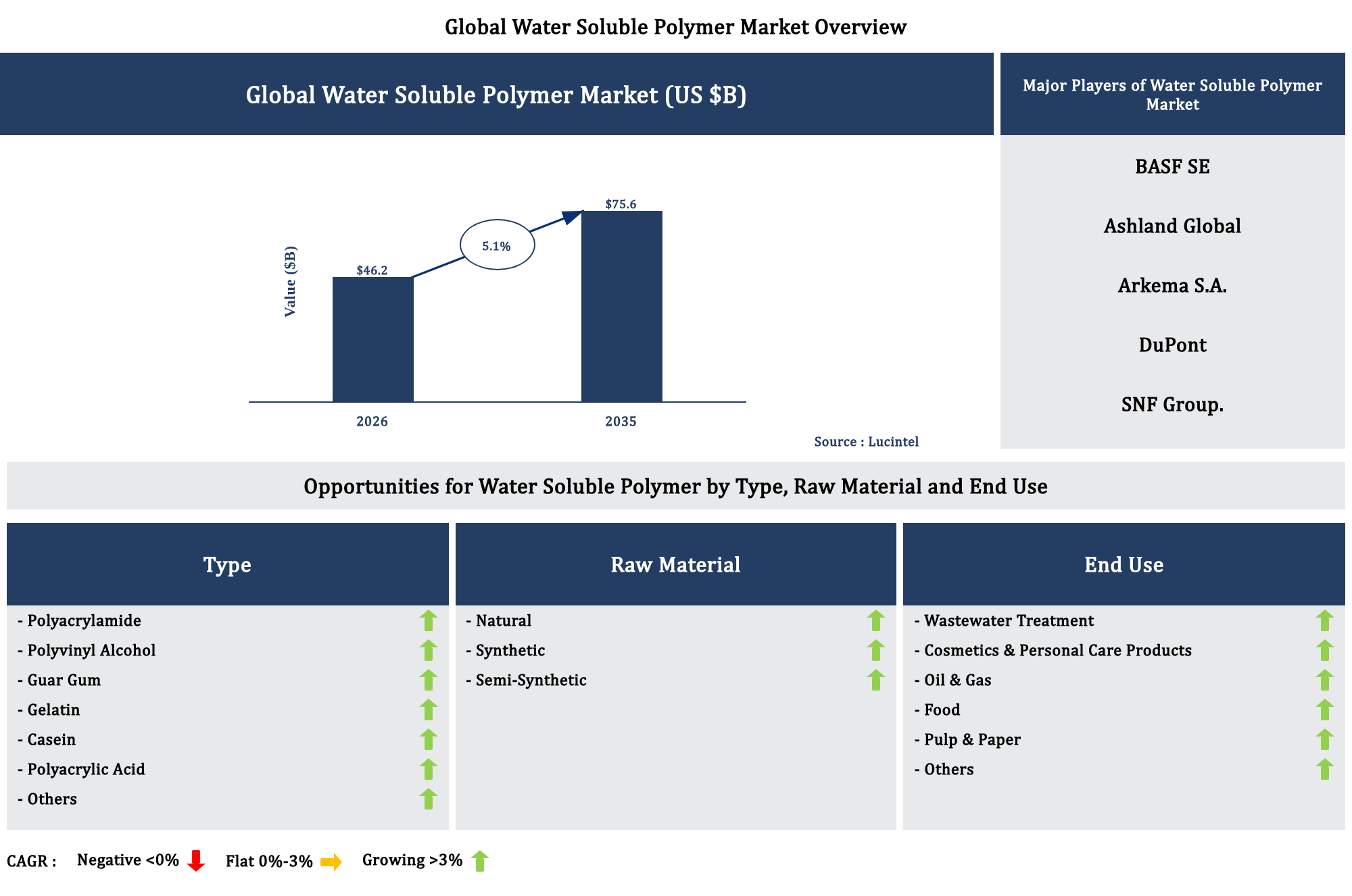
The future of the global water soluble polymer market looks promising with opportunities in the wastewater treatment, cosmetic & personal care product, oil & gas, food, and pulp & paper markets. The global water soluble polymer market is expected to reach an estimated $75602 million by 2035 with a CAGR of 5.1% from 2026 to 2035. The major drivers for this market are the increasing demand for clean water treatment solutions, the growing demand in oil & gas recovery processes, and the rising demand for food & beverage processing.
• Lucintel forecasts that, within the type category, polyacrylamide is expected to witness the highest growth over the forecast period.
• Within the end use category, wastewater treatment is expected to witness the highest growth.
• In terms of region, APAC is expected to witness the highest growth over the forecast period.
Gain valuable insights for your business decisions with our comprehensive 150+ page report. Sample figures with some insights are shown below.
Emerging Trends in the Water Soluble Polymer Market
The water soluble polymer market is experiencing rapid growth driven by increasing demand across various industries such as packaging, textiles, pharmaceuticals, and water treatment. Innovations in polymer formulations, sustainability initiatives, and technological advancements are shaping the market landscape. As environmental concerns intensify, there is a shift towards eco-friendly and biodegradable options. Additionally, the integration of water-soluble polymers in emerging applications like 3D printing and electronics is expanding market opportunities. These developments are not only transforming product offerings but also influencing supply chains and regulatory frameworks, ultimately redefining the competitive landscape of the water-soluble polymer industry.
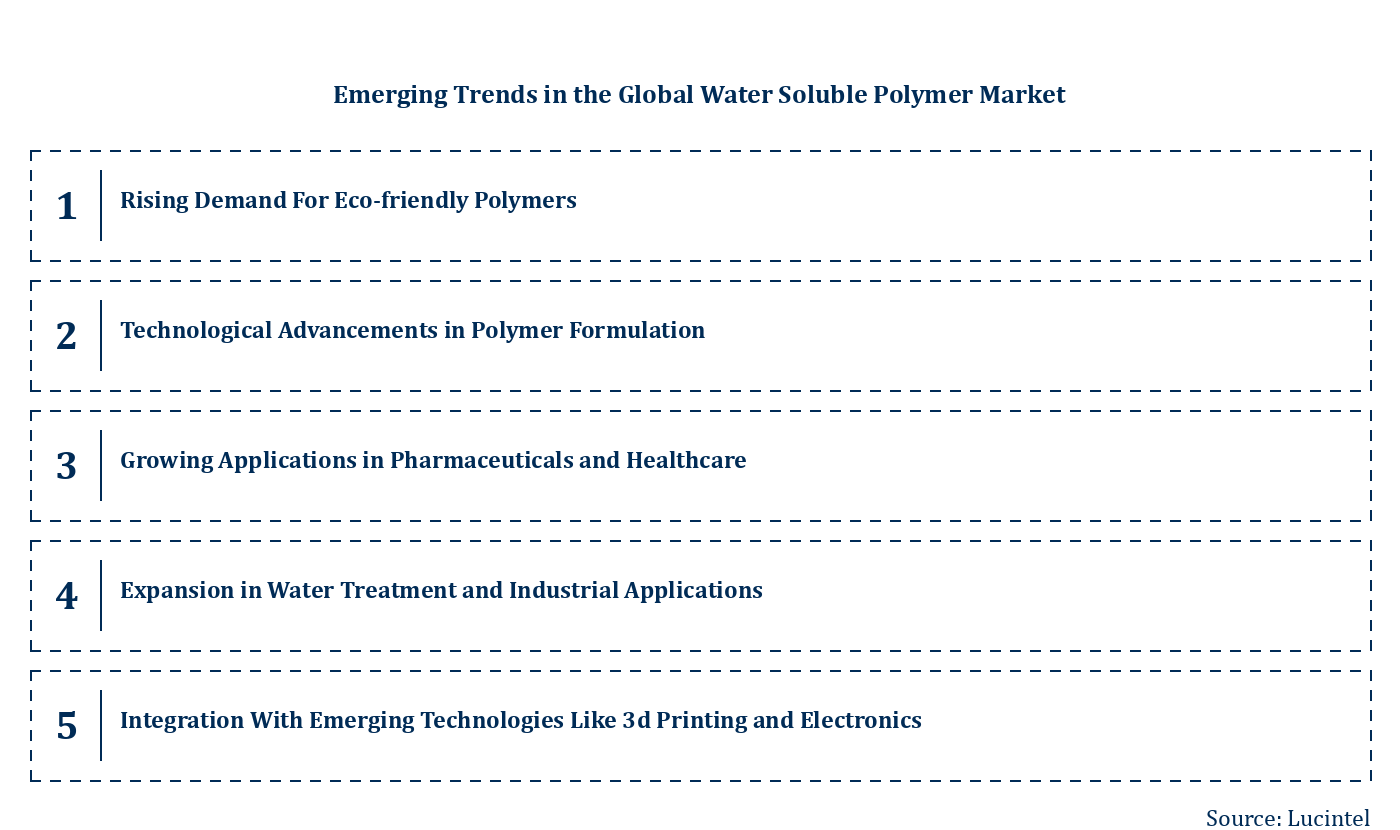
• Rising Demand for Eco-Friendly Polymers: The market is witnessing a significant shift towards biodegradable and environmentally friendly water-soluble polymers. Consumers and regulators are increasingly emphasizing sustainability, prompting manufacturers to develop polymers that reduce environmental impact. Innovations in bio-based polymers derived from renewable resources are gaining traction, offering comparable performance with minimal ecological footprint. This trend is driving research and development efforts, leading to a broader product portfolio that aligns with global sustainability goals. The adoption of eco-friendly polymers is expected to enhance market growth while addressing environmental concerns.
• Technological Advancements in Polymer Formulation: Advances in polymer chemistry and processing technologies are enabling the development of high-performance water-soluble polymers with enhanced properties such as increased solubility, stability, and compatibility. These innovations facilitate their application in diverse industries, including pharmaceuticals for drug delivery, textiles for finishing, and water treatment for contaminant removal. Improved manufacturing techniques also reduce production costs and improve product consistency. As a result, companies can offer more specialized solutions, expanding market reach and opening new application avenues, thereby fueling overall industry growth.
• Growing Applications in Pharmaceuticals and Healthcare: Water-soluble polymers are increasingly used in drug delivery systems, wound dressings, and bio adhesives due to their biocompatibility and solubility. The rising prevalence of chronic diseases and the demand for advanced healthcare solutions are propelling this trend. These polymers enable controlled release formulations and targeted delivery, improving therapeutic efficacy. Additionally, their use in tissue engineering and regenerative medicine is expanding. This diversification of applications is boosting market revenues and encouraging investment in research, positioning water-soluble polymers as vital components in modern healthcare.
• Expansion in Water Treatment and Industrial Applications: The need for efficient water purification and waste management solutions is driving the adoption of water-soluble polymers in flocculants and coagulants. These polymers improve sedimentation and filtration processes, making water treatment more effective and cost-efficient. Industrial applications, such as paper manufacturing, oil recovery, and textile processing, also benefit from water-soluble polymers that enhance process efficiency and reduce environmental impact. Growing environmental regulations and the need for sustainable industrial practices are further accelerating this trend, making water-soluble polymers indispensable in modern water management strategies.
• Integration with Emerging Technologies like 3D Printing and Electronics: The versatility of water-soluble polymers is being harnessed in innovative fields such as 3D printing and electronics. In 3D printing, they serve as biodegradable binders and support materials, enabling eco-friendly manufacturing processes. In electronics, they are used in coatings, adhesives, and conductive inks due to their solubility and functional properties. This integration opens new market segments and applications, fostering product innovation. As these technologies evolve, the demand for specialized water-soluble polymers is expected to grow, significantly expanding the market scope and driving future growth.
These trends are collectively reshaping the water soluble polymer market by emphasizing sustainability, technological innovation, and expanding application horizons. They are fostering a more dynamic, environmentally conscious, and technologically advanced industry, poised for sustained growth and diversification.
Recent Development in the Water Soluble Polymer Market
The water soluble polymer market is experiencing rapid growth driven by increasing industrial applications, environmental regulations, and technological advancements. As industries seek sustainable and efficient solutions, water-soluble polymers are becoming essential in sectors like packaging, textiles, and water treatment. Innovations in polymer formulations and rising demand for eco-friendly products are shaping market dynamics. This evolving landscape presents significant opportunities for manufacturers and investors to capitalize on emerging trends and expand their market share.
• Growing Demand in Water Treatment: The need for effective, eco-friendly water treatment solutions is boosting water-soluble polymer use. These polymers improve filtration, coagulation, and sludge dewatering processes, making water treatment more efficient and sustainable. Governments and industries are investing heavily in water infrastructure, which increases demand for these polymers. Their ability to reduce chemical usage and enhance process efficiency positions them as vital components in modern water management systems, driving market expansion.
• Expansion in Packaging Industry: The packaging sector‘s shift towards biodegradable and sustainable materials is fueling the demand for water-soluble polymers. These polymers are used in eco-friendly packaging films, adhesives, and coatings, offering benefits like easy dissolution and reduced environmental impact. As consumers and regulators push for greener packaging solutions, manufacturers are innovating with water-soluble polymers to meet these needs. This trend is expected to significantly boost market growth, especially in regions with strict environmental standards.
• Technological Advancements in Polymer Formulations: Innovations in polymer chemistry are leading to the development of high-performance, water-soluble polymers with enhanced properties such as increased stability, solubility, and biodegradability. These advancements enable their application in diverse industries, including textiles, paper, and personal care. Improved formulations also allow for cost-effective production and better environmental profiles. As research continues, these technological improvements will expand the scope and efficiency of water-soluble polymers, further propelling market growth.
• Rising Environmental Regulations and Sustainability focus: Stricter environmental policies worldwide are encouraging industries to adopt eco-friendly materials like water-soluble polymers. These polymers offer advantages such as reduced pollution, lower chemical usage, and easier waste management. Companies are increasingly integrating sustainable practices to comply with regulations and meet consumer expectations. This regulatory landscape is fostering innovation and investment in greener polymer solutions, which will likely sustain long-term market growth and drive the adoption of water-soluble polymers across multiple sectors.
• Increasing Applications in Textiles and Personal Care: The textile industry is utilizing water-soluble polymers for dyeing, finishing, and coating processes to improve efficiency and reduce environmental impact. Similarly, in personal care, these polymers serve as thickeners, film formers, and stabilizers, enhancing product performance. The demand for eco-friendly and biodegradable ingredients is boosting their adoption. As these industries prioritize sustainability, the market for water-soluble polymers is expected to grow substantially, driven by their versatility and environmental benefits.
These developments are significantly transforming the water soluble polymer market by expanding its applications, improving product performance, and aligning with sustainability goals. Increased demand from water treatment, packaging, textiles, and personal care sectors is fueling growth. Technological innovations and stricter environmental regulations are further accelerating adoption. Overall, these opportunities are positioning water-soluble polymers as essential, eco-friendly solutions, ensuring sustained market expansion and attracting investments across diverse industries.
Strategic Growth Opportunities in the Water Soluble Polymer Market
The water soluble polymer market is experiencing rapid expansion driven by diverse industrial applications, technological advancements, and increasing environmental regulations. As industries seek sustainable and efficient solutions, the demand for water-soluble polymers is rising across sectors such as packaging, textiles, and water treatment. Market players are focusing on innovation, strategic partnerships, and expanding production capacities to capitalize on emerging opportunities. This dynamic landscape offers significant growth potential, promising enhanced product offerings and market penetration in the coming years.
• Growing Demand in Water Treatment Applications: Water soluble polymers are increasingly used in water treatment processes for sludge dewatering, coagulation, and filtration. The need for efficient, eco-friendly solutions to meet stringent environmental standards is boosting demand. Industries such as municipal water management, oil & gas, and industrial wastewater treatment are adopting these polymers to improve process efficiency, reduce operational costs, and comply with regulations, thereby driving market growth.
• Expansion of the Packaging Industry Fuels Demand for Biodegradable Polymers: The packaging sector’s shift towards sustainable and biodegradable materials is propelling the use of water-soluble polymers like polyvinyl alcohol (PVA). These polymers are used in packaging films, detergents, and single-use products due to their solubility and eco-friendly nature. Rising consumer awareness and regulatory pressures are encouraging manufacturers to develop innovative, biodegradable packaging solutions, creating new growth avenues for water-soluble polymers.
• Increasing Adoption in Textiles for Eco-Friendly Finishing Processes: The textile industry is adopting water-soluble polymers for eco-friendly dyeing, finishing, and sizing processes. These polymers reduce water consumption and pollution, aligning with sustainability goals. The demand for environmentally safe textile processing chemicals is rising globally, prompting manufacturers to develop specialized water-soluble polymers that enhance fabric quality while minimizing environmental impact, thus expanding market opportunities.
• Technological Advancements in Polymer Synthesis Enhance Product Performance: Innovations in polymer chemistry are leading to the development of high-performance water-soluble polymers with improved stability, solubility, and functional properties. These advancements enable applications in pharmaceuticals, adhesives, and paper manufacturing. Enhanced product performance and customization are attracting new industry segments, fostering market expansion and enabling companies to meet specific client needs more effectively.
• Strategic Collaborations and Regional Market Expansion Drive Growth: Companies are forming strategic alliances, joint ventures, and partnerships to expand their product portfolios and market reach. Emerging economies in Asia-Pacific and Latin America present lucrative opportunities due to rapid industrialization and infrastructure development. These collaborations facilitate technology transfer, local manufacturing, and distribution, accelerating market penetration and supporting overall industry growth.
These growth opportunities are poised to significantly influence the water soluble polymer market by fostering innovation, expanding application scopes, and enabling sustainable practices. The combined effect of technological progress, regulatory support, and strategic market expansion will likely propel the industry toward sustained growth, meeting the evolving needs of global industries and contributing to environmental sustainability.
Water Soluble Polymer Market Driver and Challenges
The water soluble polymer market is influenced by a variety of technological, economic, and regulatory factors that shape its growth trajectory. Advances in polymer synthesis, increasing demand across industries such as packaging, textiles, and water treatment, and evolving environmental regulations are key drivers. However, the market also faces challenges including environmental concerns, high production costs, and regulatory hurdles that can impede expansion. Understanding these drivers and challenges is essential for stakeholders to navigate the market effectively and capitalize on emerging opportunities while addressing potential risks.
The factors responsible for driving the water soluble polymer market include:-
• Technological Innovations: The development of new, eco-friendly water-soluble polymers has significantly expanded application possibilities. Innovations in polymer chemistry have led to products with enhanced performance, such as improved solubility, biodegradability, and stability. These advancements enable industries like pharmaceuticals, agriculture, and water treatment to adopt water-soluble polymers more widely, fueling market growth. Continuous R&D efforts are expected to further improve product offerings, making them more sustainable and cost-effective, thus attracting more end-users and expanding market reach.
• Growing Industrial Applications: The increasing demand for water-soluble polymers in diverse sectors such as paper and packaging, textiles, personal care, and water treatment is a major growth driver. For instance, in water treatment, these polymers are used as flocculants and coagulants, improving efficiency and reducing chemical usage. In the textile industry, they serve as sizing agents and thickeners. The expanding scope of applications driven by industrial modernization and environmental regulations is propelling market expansion, with rising adoption expected to continue as industries seek sustainable and efficient solutions.
• Environmental Regulations and Sustainability Trends: Stricter environmental policies worldwide are pushing industries to adopt greener alternatives, including biodegradable and water-soluble polymers. Governments are imposing regulations to reduce the use of hazardous chemicals, encouraging the development and adoption of eco-friendly polymers. This regulatory landscape fosters innovation and market growth by incentivizing companies to develop sustainable products that comply with environmental standards, thereby opening new market segments and increasing demand for biodegradable water-soluble polymers.
• Increasing Demand from Water Treatment Sector: The global emphasis on clean water and wastewater management is a significant driver for water-soluble polymers. These polymers are essential in coagulation, flocculation, and sludge dewatering processes, improving water quality and treatment efficiency. The rising urbanization, industrialization, and stringent water quality standards are boosting demand. As governments and industries prioritize sustainable water management practices, the market for water-soluble polymers in water treatment is expected to grow substantially, offering lucrative opportunities for manufacturers.
The challenges facing the water soluble polymer market include:-
• Environmental Concerns and Biodegradability Issues: Despite their advantages, some water-soluble polymers pose environmental risks due to their non-biodegradable nature and potential toxicity. Disposal and degradation of these polymers can lead to pollution and harm aquatic ecosystems. Increasing awareness and regulatory scrutiny demand the development of more environmentally friendly alternatives, which can be costly and time-consuming. This challenge necessitates ongoing innovation to balance performance with environmental safety, impacting market growth and product development strategies.
• High Production Costs: Manufacturing water-soluble polymers often involves complex processes and expensive raw materials, leading to high production costs. These costs can hinder competitiveness, especially in price-sensitive markets. Additionally, scaling up production while maintaining quality and environmental standards adds to operational expenses. High costs may limit adoption in certain applications or regions, constraining market expansion and forcing manufacturers to seek cost-effective production methods.
• Regulatory and Compliance Challenges: The market faces stringent regulations related to chemical safety, environmental impact, and product labeling. Navigating diverse regulatory frameworks across different countries can be complex and costly. Non-compliance can result in legal penalties, product recalls, and damage to reputation. Keeping pace with evolving regulations requires continuous monitoring and adaptation, which can delay product launches and increase operational costs, thereby posing significant hurdles to market players.
The water soluble polymer market is driven by technological advancements, expanding industrial applications, environmental sustainability trends, and increasing demand in water treatment. However, environmental concerns, high production costs, and regulatory complexities present notable challenges. These factors collectively influence market dynamics, requiring stakeholders to innovate and adapt strategically. The overall impact suggests a promising growth trajectory, provided that industry players address environmental and regulatory hurdles effectively to sustain long-term development.
List of Water Soluble Polymer Companies
Companies in the market compete on the basis of product quality offered. Major players in this market focus on expanding their manufacturing facilities, R&D investments, infrastructural development, and leverage integration opportunities across the value chain. With these strategies water soluble polymer companies cater increasing demand, ensure competitive effectiveness, develop innovative products & technologies, reduce production costs, and expand their customer base. Some of the water soluble polymer companies profiled in this report include-
• BASF SE
• Ashland Global
• Arkema S.A.
• DuPont
• SNF Group.
Water Soluble Polymer Market by Segment
The study includes a forecast for the global water soluble polymer market by type, raw material, end use, and region.
Water Soluble Polymer Market by Type [Value from 2019 to 2035]:
• Polyacrylamide
• Polyvinyl Alcohol
• Guar Gum
• Gelatin
• Casein
• Polyacrylic Acid
• Others
Water Soluble Polymer Market by Raw Material [Value from 2019 to 2035]:
• Natural
• Synthetic
• Semi-Synthetic
Water Soluble Polymer Market by End Use [Value from 2019 to 2035]:
• Wastewater Treatment
• Cosmetics & Personal Care Products
• Oil & Gas
• Food
• Pulp & Paper
• Others
Water Soluble Polymer Market by Region [Value from 2019 to 2035]:
• North America
• Europe
• Asia Pacific
• The Rest of the World
Country Wise Outlook for the Water Soluble Polymer Market
The water soluble polymer market has experienced significant growth driven by increasing industrial applications, environmental regulations, and technological innovations. Countries are investing in research and development to enhance polymer performance and sustainability. The market‘s evolution reflects a shift towards eco-friendly solutions and advanced manufacturing processes. As demand rises across sectors such as packaging, textiles, and water treatment, key players are expanding their product portfolios and geographic reach. The following summaries highlight recent developments in the United States, China, Germany, India, and Japan, emphasizing their unique contributions and market dynamics.
• United States: The US market has seen substantial innovation in biodegradable water-soluble polymers, driven by stringent environmental regulations. Major companies are investing in sustainable product lines for applications in packaging and agriculture. The adoption of advanced manufacturing techniques has improved polymer efficiency and cost-effectiveness. Additionally, increased demand for water treatment solutions has spurred research into high-performance polymers, positioning the US as a leader in technological advancements and eco-friendly solutions.
• China: China remains the largest producer and consumer of water-soluble polymers, with rapid industrial growth fueling market expansion. Recent developments include the adoption of green manufacturing practices and increased focus on biodegradable options to meet environmental standards. The government’s support for sustainable development has encouraged innovation in water treatment, textiles, and paper industries. Domestic companies are expanding their R&D capabilities, leading to a broader product portfolio and enhanced export potential.
• Germany: Germany‘s market is characterized by a focus on high-quality, sustainable water-soluble polymers, especially for use in pharmaceuticals, cosmetics, and industrial applications. Recent advancements include the development of bio-based polymers with improved biodegradability and performance. The country’s emphasis on environmental sustainability and strict regulatory frameworks have driven innovation. German companies are also investing in digitalization and process optimization to enhance product quality and reduce environmental impact.
• India: The Indian market is witnessing rapid growth due to expanding industrial sectors such as textiles, paper, and water treatment. Recent developments include increased adoption of eco-friendly polymers and government initiatives promoting sustainable manufacturing. Local companies are investing in R&D to develop cost-effective, biodegradable water-soluble polymers suitable for diverse applications. The market is also benefiting from rising awareness of environmental issues and supportive policies aimed at reducing pollution.
• Japan: Japan‘s market is focused on advanced, high-performance water-soluble polymers used in electronics, healthcare, and water purification. Recent innovations include the development of specialty polymers with enhanced stability and functionality. The country’s strong emphasis on research and development, coupled with strict environmental standards, has led to the creation of eco-friendly and highly efficient products. Japanese firms are also exploring nanotechnology and other cutting-edge techniques to maintain their competitive edge in the global market.
Features of the Global Water Soluble Polymer Market
Market Size Estimates: Water soluble polymer market size estimation in terms of value ($M).
Trend and Forecast Analysis: Market trends (2019 to 2025) and forecast (2026 to 2035) by various segments and regions.
Segmentation Analysis: Water soluble polymer market size by type, raw material, end use, and region in terms of value ($M).
Regional Analysis: Water soluble polymer market breakdown by North America, Europe, Asia Pacific, and Rest of the World.
Growth Opportunities: Analysis of growth opportunities in different type, raw material, end use, and regions for the water soluble polymer market.
Strategic Analysis: This includes M&A, new product development, and competitive landscape of the water soluble polymer market.
Analysis of competitive intensity of the industry based on Porter’s Five Forces model.
FAQ
Q1. What is the water soluble polymer market size?
Answer: The global water soluble polymer market is expected to reach an estimated $75602 million by 2035.
Q2. What is the growth forecast for water soluble polymer market?
Answer: The global water soluble polymer market is expected to grow with a CAGR of 5.1% from 2026 to 2035.
Q3. What are the major drivers influencing the growth of the water soluble polymer market?
Answer: The major drivers for this market are the increasing demand for clean water treatment solutions, the growing demand in oil & gas recovery processes, and the rising demand for food & beverage processing.
Q4. What are the major segments for water soluble polymer market?
Answer: The future of the water soluble polymer market looks promising with opportunities in the wastewater treatment, cosmetic & personal care product, oil & gas, food, and pulp & paper markets.
Q5. Who are the key water soluble polymer market companies?
Answer: Some of the key water soluble polymer companies are as follows:
• BASF SE
• Ashland Global
• Arkema S.A.
• DuPont
• SNF Group.
Q6. Which water soluble polymer market segment will be the largest in future?
Answer: Lucintel forecasts that, within the type category, polyacrylamide is expected to witness the highest growth over the forecast period.
Q7. In water soluble polymer market, which region is expected to be the largest in next 8 years?
Answer: In terms of region, APAC is expected to witness the highest growth over the forecast period.
Q8. Do we receive customization in this report?
Answer: Yes, Lucintel provides 10% customization without any additional cost.
This report answers following 11 key questions:
Q.1. What are some of the most promising, high-growth opportunities for the water soluble polymer market by type (polyacrylamide, polyvinyl alcohol, guar gum, gelatin, casein, polyacrylic acid, and others), raw material (natural, synthetic, and semi-synthetic), end use (wastewater treatment, cosmetics & personal care products, oil & gas, food, pulp & paper, and others), and region (North America, Europe, Asia Pacific, and the Rest of the World)?
Q.2. Which segments will grow at a faster pace and why?
Q.3. Which region will grow at a faster pace and why?
Q.4. What are the key factors affecting market dynamics? What are the key challenges and business risks in this market?
Q.5. What are the business risks and competitive threats in this market?
Q.6. What are the emerging trends in this market and the reasons behind them?
Q.7. What are some of the changing demands of customers in the market?
Q.8. What are the new developments in the market? Which companies are leading these developments?
Q.9. Who are the major players in this market? What strategic initiatives are key players pursuing for business growth?
Q.10. What are some of the competing products in this market and how big of a threat do they pose for loss of market share by material or product substitution?
Q.11. What M&A activity has occurred in the last 7 years and what has its impact been on the industry?
For any questions related to Water Soluble Polymer Market, Water Soluble Polymer Market Size, Water Soluble Polymer Market Growth, Water Soluble Polymer Market Analysis, Water Soluble Polymer Market Report, Water Soluble Polymer Market Share, Water Soluble Polymer Market Trends, Water Soluble Polymer Market Forecast, Water Soluble Polymer Companies, write Lucintel analyst at email: helpdesk@lucintel.com. We will be glad to get back to you soon.