
Market Report · July 15, 2026

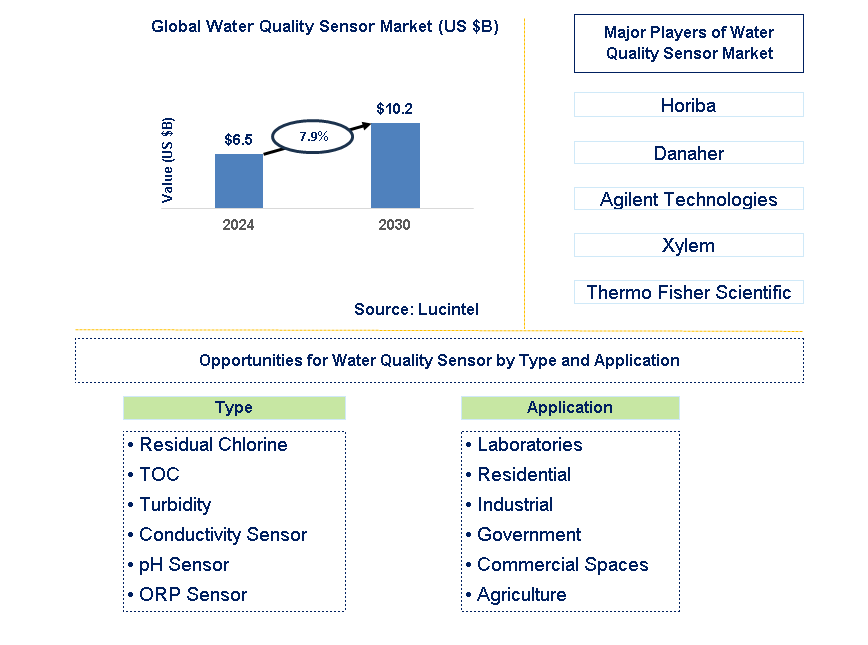
Key data points: The market size in 2030 = $10.2 billion, growth forecast = 7.9% annually for the next 6 years. Scroll below to get more insights. This market report covers trends, opportunities, and forecasts in the global water quality sensor market to 2030 by type (residual chlorine sensor, total organic carbon (TOC), turbidity sensor, conductivity sensor, pH sensor, and ORP sensor ), application (laboratories, residential, industrial, government, commercial spaces, and agriculture), and region (North America, Europe, Asia Pacific, and the Rest of the World)
We'll send your sample report shortly.
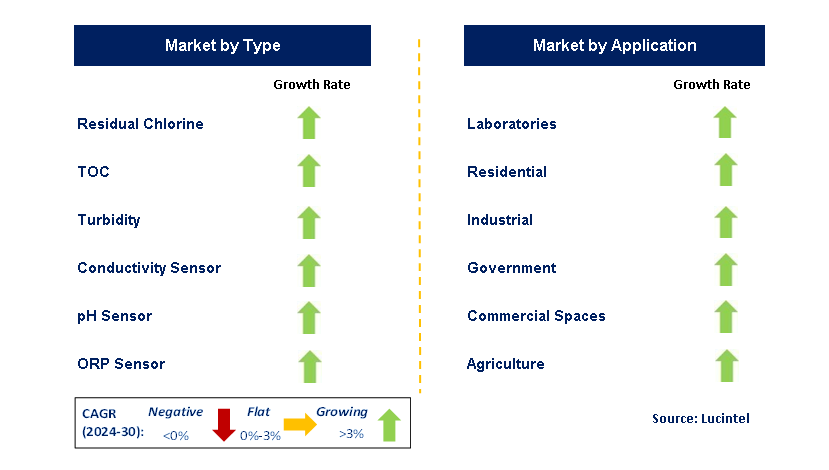
• Lucintel forecasts that, within the type category, ph is expected to witness highest growth over the forecast period.
• Within the application category, residential will remain the largest segment.
• In terms of regions, APAC is expected to witness highest growth over the forecast period. Gain valuable insights for your business decisions with our 150+ page report.
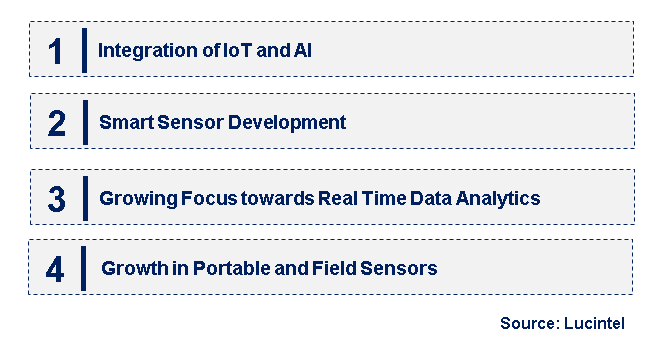
• Integration of IoT and AI: The integration of IoT and AI technologies has brought new waves to the water quality sensor market. IoT operates based on wireless data transmission, making its operation smooth and enabling remote monitoring. AI enhances data analysis through pattern and anomaly detection. By combining these two components, real-time monitoring becomes possible, and the problems of water quality prediction become more accurate. AI-driven analytics facilitate early contaminant detection and enhance decision-making processes in water management. These enhancements result in an increasingly proactive and efficient system of water quality monitoring and management.
• Smart Sensor Development: One key trend in the water quality sensor market is the development of smart sensors. Smart sensors possess advanced capabilities, such as connectivity, real-time data processing, and self-calibration. These sensors can communicate with other devices or systems regarding water quality. Since smart sensors can integrate with other devices or digital platforms, they assure better accuracy and ease of access to data, thereby improving water management responses to possible issues much faster.
• Growing Focus on Real-Time Data Analytics: The water quality sensor market is increasingly focusing on real-time data analytics. Real-time analytics allow for the detection of water quality issues on the spot, enabling immediate corrective actions. Advanced sensors with real-time data can continuously monitor and provide instantaneous feedback, making effective water management more plausible. This trend is powered by the increasing need to deliver timely information about contamination and pollution, aiming to make the water supply safer and cleaner.
• Growth in Portable and Field Sensors: The market is expected to continue growing as the demand for flexible and accessible solutions for monitoring water quality increases. Portable sensors are designed to be easy to use across a wide range of applications, from remote field sites to response operations. These sensors are used for on-site testing, providing immediate results that are sometimes essential for decision-making and prompt action. The growth in portable sensors reflects the growing need for more adaptable and practical solutions for diverse water quality monitoring applications. Recent trends and developments in water quality sensors indicate significant growth in technology and applications. Improvements in sensor precision, integration with IoT and AI, and the development of smart and portable sensors are emerging trends in water monitoring and management. These trends are changing the way water quality is measured and managed globally, leading to much better efficiency. This evolution will continue with emerging technology, and these advancements are critical in the pursuit of safe and clean water supplies while responding to present and future challenges in water quality worldwide.
• Development of Multi-Parameter Sensors: Recent advancements in technology have produced multi-parameter sensors capable of determining key indicators of water quality, such as pH, turbidity, dissolved oxygen, and contaminants. By providing comprehensive data from one device, the number of sensors is reduced, simplifying the monitoring process. This contributes to raising the accuracy of water quality assessments and further improving the efficiency of water management practices.
• Integration with IoT and Cloud Technologies: The integration of water quality sensors with the Internet of Things (IoT) and cloud technologies has transformed the monitoring of water quality, enabling access to real-time data from any location. Sensors connected through an IoT network transmit data to cloud platforms for continuous monitoring and analysis. This connectivity ensures high data accessibility, timely responses to water quality issues, and informs decision-making for better management based on factual data.
• Advancing Sensor Calibration and Accuracy: Recent advances in sensor calibration methods have greatly improved the accuracy and reliability of water quality measurements. Advanced calibration methods ensure sensors can provide highly accurate data for longer periods, reducing the need for frequent recalibration and maintenance. This represents a major step toward maintaining high standards of water quality monitoring and ensuring reliability in sensor performance under variable conditions.
• Development of Portable and Field-Deployable Sensors: The development of portable and field-deployable sensors has increased accessibility and flexibility in water quality monitoring. These sensors are designed for a wide range of applications, from the most remote areas to emergency response situations. Their portability allows for on-site testing and immediate data collection, which is critical for real-time assessments and rapid responses to water quality issues in diverse settings. Recent developments in the water quality sensor market show key progress in technologies and applications. Multi-parameter sensors, integration of IoT and cloud technologies, advances in calibration and accuracy, and portable sensors are transforming water quality monitoring and management. These innovations enhance data accuracy, accessibility, and responsiveness.
• Industrial Water Management: There is an increasing demand within industrial water management for sophisticated sensors to monitor and manage water quality in manufacturing processes. Sensors provide real-time data on contaminants and other quality indicators to support industries in optimizing water usage, reducing waste, and meeting environmental regulations. The application of sophisticated sensors in this arena enhances operational efficiency and sustainability.
• Municipal Water Supply and Treatment: Advanced water quality sensors are increasingly adopted by municipal water supply and treatment facilities to ensure communities have safe and clean water. Sensors for real-time monitoring of water quality parameters enable early detection of contamination and assist in effective treatment processes. Such adoption improves public health and maintains compliance with regulatory standards for potable water.
• Environmental Monitoring: Another key growth area is environmental monitoring, particularly regarding water quality in natural bodies of water. Sensors play a crucial role in this respect. Advanced sensors provide the capability to monitor ecosystems for pollutants and general changes in environmental conditions. Information from sensors is significant and aids in conservation and management of aquatic health.
• Agricultural Applications: Water quality sensors are utilized in agriculture to monitor irrigation systems for optimal water quality for crops. Sensors measuring parameters such as nutrient levels and contaminants help farmers manage water resources more effectively, thus improving yields. This enhances sustainable agriculture and resource conservation. These diverse applications of water quality sensors across various industries offer strategic growth opportunities in industrial water management, municipal water supply, environmental monitoring, agriculture, and residential use. Advanced sensors significantly impact key sectors, creating these opportunities as a result of the increasing demand for accurate and reliable solutions to monitor water quality, furthering expansion and innovation within the market.
• Technological Advancement: The development of technology is the main driving force behind growth in the water quality sensor market. Advancements in sensor technology—such as greater accuracy, miniaturization, and interfacing with digital platforms—all contribute to better outcomes in monitoring water quality. These advances enable more accurate measurement and analysis in real time, thus increasing the deployment of advanced sensors across different applications.
• Increasing Regulatory Requirements: Growing regulatory requirements regarding water quality standards are major factors driving market growth. Stringent regulations demand continuous monitoring and reporting of water quality parameters. This, in turn, encourages users to adopt advanced sensors that comply with regulations and maintain safety in water supplies, thus meeting public health demands. As a result, the demand for reliable and accurate solutions in water quality monitoring surges.
• Rising Environmental Concerns: Increased awareness of environmental issues—such as water body contamination through pollution and depletion of this vital resource—demands effective ways of monitoring water quality. Awareness of the impacts of contamination on ecosystems and public health emphasizes the need for advanced sensors for water quality monitoring. This heightened awareness accelerates market growth by increasing pressure for effective and timely monitoring solutions. Challenges in the water quality sensor market include:
• High Costs of Advanced Sensors: Some water quality sensors can be very expensive. While technological advances improve sensor performance, they often lead to increased costs, which may dampen the willingness for widespread adoption, particularly in budget-constrained sectors. Finding cost-effective solutions and balancing performance and affordability are crucial to providing advanced monitoring technologies to a broader audience.
• Regulatory Complexities: The water quality sensor market faces regulatory complexities that can be difficult for both manufacturers and users to navigate as regulations change from region to region. Additionally, changing standards and requirements present challenges in deploying and operating sensors, impacting market growth and adoption. Streamlining regulatory processes and providing clear guidance on expectations would be prudent in this respect. The market feels the impact of a wide range of drivers and challenges, including technological advances, increasing regulatory requirements, and growing awareness of environmental problems on one hand, and high costs, regulatory complications, and technical limitations on the other. Understanding and addressing these factors is crucial for navigating the market and developing effective water quality monitoring solutions.
• Horiba
• Danaher
• Agilent Technologies
• Xylem
• Thermo Fisher Scientific
• Atlas Scientific
• Hach Instruments
• Honeywell
• ABB
• Residual Chlorine
• TOC
• Turbidity
• Conductivity Sensor
• pH Sensor
• ORP Sensor
• Laboratories
• Residential
• Industrial
• Government
• Commercial Spaces
• Agriculture
• North America
• Europe
• Asia Pacific
• The Rest of the World
• Market Size and Growth: The water quality sensor market has exhibited significant growth, fueled by increasing awareness of the importance of water quality management. Market size is anticipated to continue expanding, driven by demand for advanced monitoring solutions across various applications, including municipal water supply, industrial sectors, agriculture, and environmental monitoring.
• Technological Innovations: The market is experiencing a surge in technological innovations, especially concerning smart sensors and IoT integration. Smart sensors facilitate real-time monitoring and allow for better data collection and analysis, enhancing decision-making in water management. These innovations promise to transform the water quality sensor market into a more connected and responsive domain.
• Market Segmentation: The market can be segmented by sensor type, application, and geography. Sensor types include electrochemical, optical, and multi-parameter sensors, each catering to specific needs and industries. Applications cover various sectors such as municipal water management, industrial applications, agriculture, and environmental monitoring, highlighting the widespread applicability of water quality sensors.
• Regional Analysis: The water quality sensor market varies significantly by region, with North America and Europe currently leading due to strict regulatory frameworks and high awareness levels. However, emerging markets in Asia-Pacific and Latin America are expected to grow rapidly as governments and industries emphasize better water management and quality monitoring. The water quality sensor market is witnessing dynamic changes influenced by technological advances, heightened environmental awareness, and increased regulatory requirements. With ongoing innovations and expansions, the market is likely to see significant growth in the coming years as sectors adopt more sophisticated water quality monitoring solutions.


• Horiba
• Danaher
• Agilent Technologies
• Xylem
• Thermo Fisher Scientific
• Atlas Scientific
• Hach Instruments
• Honeywell
• ABB Q6. Which water quality sensor market segment will be the largest in future? Answer: Lucintel forecasts that ph is expected to witness highest growth over the forecast period. Q7. In water quality sensor market, which region is expected to be the largest in next 5 years? Answer: APAC is expected to witness highest growth over the forecast period. Q.8 Do we receive customization in this report? Answer: Yes, Lucintel provides 10% customization without any additional cost.


Choose a license that fits your team. Instant PDF delivery.
Prices exclude taxes. Instant delivery. Custom licensing available on request.
Market Report · July 15, 2026
Market Report · July 13, 2026
Market Report · July 13, 2026
Trusted partner for strategic intelligence and business growth


Receive a complimentary market analysis tailored to your industry. Our analysts will identify key growth opportunities and competitive dynamics specific to your business.

Market size, growth rate, and key trend analysis for your specific sector.

Top competitor positioning and market share analysis.

Strategic recommendations backed by data-driven insights.
Get curated market intelligence and competitive moves straight to your inbox.
By subscribing, you agree to receive our monthly insights. Unsubscribe anytime.
Receive a complimentary market analysis tailored to your industry. Our analysts will identify key growth opportunities and competitive dynamics specific to your business.
Market size, growth rate, and key trend analysis for your specific sector.
Top competitor positioning and market share analysis.
Strategic recommendations backed by data-driven insights.
Get curated market intelligence, emerging trends, and competitive moves straight to your inbox each month.
By subscribing, you agree to receive our monthly insights. Unsubscribe anytime.
We'll send your sample report shortly.