
Close Lucintel Chat
Didn't Find What You're Looking for?
Call us at +1972 636 5056 or write at helpdesk@Lucintel.com
Ask an Expert Provide Custom Requirements Download Sample Report Search Available Reports
  • helpdesk@Lucintel.com
  • |
  • Call Lucintel +1 972 636 5056
  • |
  • Login
  • |
  • Register
  • |
  • Search
  • |
'
...

The Impact of COVID-19 is included in Water Pump Market Report. Buy it today to get an advantage.

Request the impact of COVID-19 on your product or industry


Water Pump Market Trends and Forecast

The future of the global water pump market looks promising with opportunities in the industrial, household, agricultural, and municipal markets. The global water pump market is expected to grow with a CAGR of 7.3% from 2025 to 2031. The major drivers for this market are the increasing demand for water management solutions, the rising need for efficient irrigation systems, and the growing adoption of energy-efficient pumps.

• Lucintel forecasts that, within the type category, submersible pump is expected to witness the highest growth over the forecast period.
• Within the application category, industrial is expected to witness the highest growth.
• In terms of region, APAC is expected to witness the highest growth over the forecast period.
Gain valuable insights for your business decisions with our comprehensive 150+ page report. Sample figures with some insights are shown below.
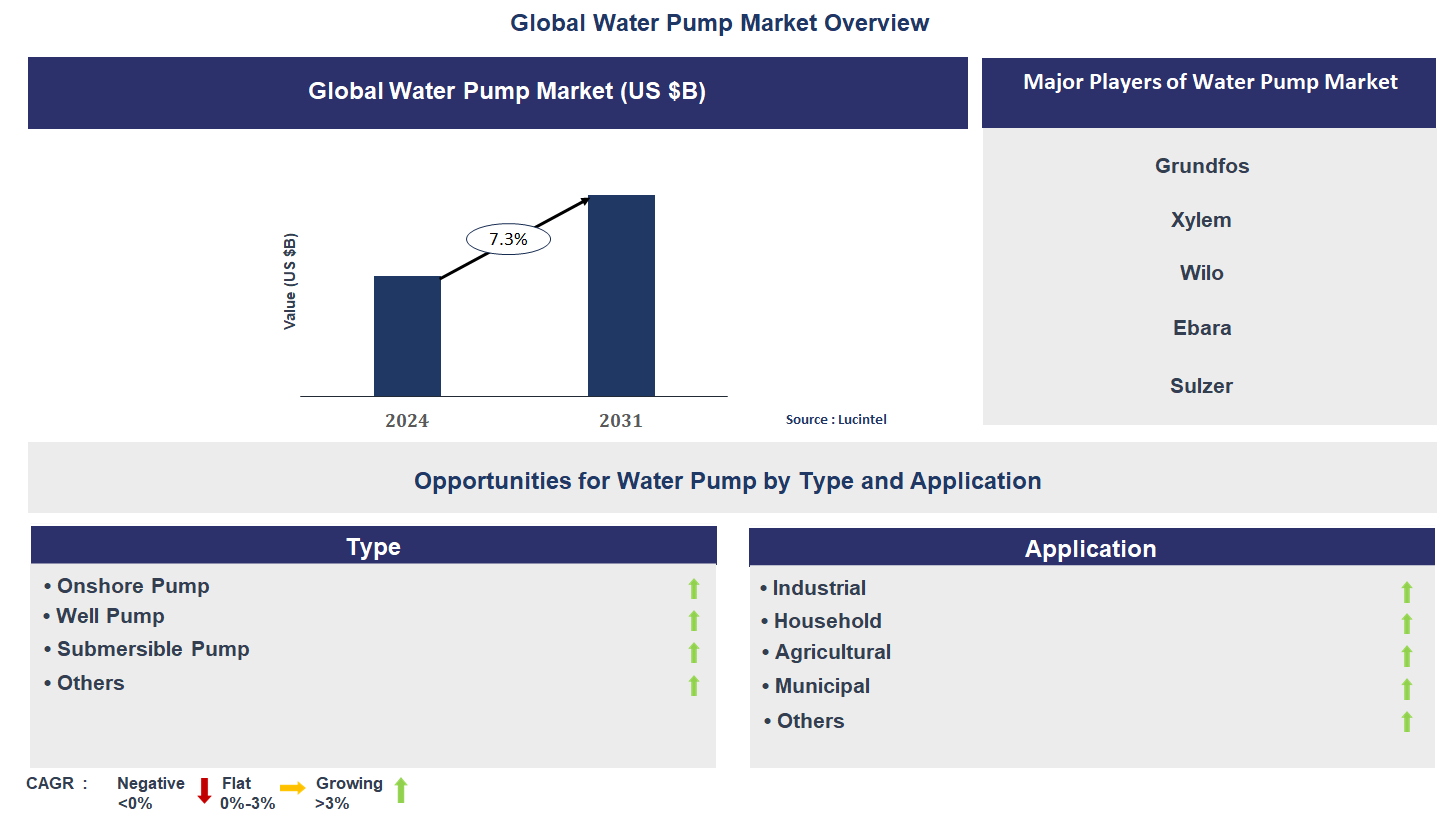
Water Pump Market Trends and Forecast

Emerging Trends in the Water Pump Market

The market for water pump is being transformed by a number of strong trends. These emerging trends are driving the industry toward a future that is characterized by intelligence, sustainability, and efficiency, radically changing the way water is handled in all aspects of the industry. The growing need for water scarcity, energy conservation, and cost of operations solutions is driving innovation. These changes are motivating manufacturers to make products that are not only highly technologically advanced but also sustainable.
• Smart Pumps and Digitalization: The marriage of sensors, the Internet of Things, and artificial intelligence is making water pumps smart. Such pumps are able to track their own performance, sense impending fault, and report real-time information to operators. This digitalization allows for predictive maintenance, minimizes unplanned downtime, and maximizes energy usage. By enabling useful insights into operational effectiveness, smart pumps enable data-driven decision making that optimizes reliability and minimizes life cycle costs for end users in urban, agricultural, and industrial applications.
• Energy Efficiency and Sustainable Design: There is an increased worldwide focus on minimizing energy use and carbon emissions. This has spurred the creation of very energy-efficient pumps with variable frequency drives (VFDs) that vary motor speed according to demand. Solar-driven pumps are increasingly becoming popular as well, especially in agriculture and remote areas with limited access to the grid. These eco-friendly designs are not only green but also save costs in the long run, fitting into the global drive toward a more resource-aware and sustainable economy.
• Decentralized Water Management: The movement towards decentralized water systems is on the increase, especially in light of water shortages and requirements for more robust infrastructure. Rather than large-scale, centralized systems, treatment and distribution networks of water in smaller, localized networks are being established. This calls for adaptable, scalable, and modular pumping technology that can be readily installed and maintained in small communities, urban neighborhoods, and remote locations.
• 3D Printing and Advanced Manufacturing Revolution: Additive manufacturing, or 3D printing, is transforming pump making. Using this technology, companies are enabled to design and make complex, customized pump components at high speed and with optimized internal geometries. This leads to enhanced hydraulic performance and efficiency. Additionally, 3D printing also provides cost-efficient manufacture of bespoke components, minimizes lead times, and enables new materials for usage, which leads to opportunities for customized solutions in numerous applications, ranging from high-pressure industrial systems to low-volume residential pumps.
• Total Cost of Ownership : End users are increasingly focusing on more than the purchase price alone and looking at the total cost of ownership over the life of a pump. This encompasses energy usage, maintenance, and repair expenses. To meet this demand, manufacturers are taking steps to create more resilient pumps that are less maintenance-intensive and simpler to service. The transition from a transaction-based to a life cycle cost strategy is advantageous to high quality pump manufacturers and is stimulating innovation in materials, design, and installed monitoring systems that extend pump life and provide assured long-term operation.
These trends are deeply transforming the water pump industry by prioritizing value, sustainability, and long-term value over conventional measures such as upfront cost. The intersection of these factors is creating a market that is more efficient, resilient, and responsive to global challenges.
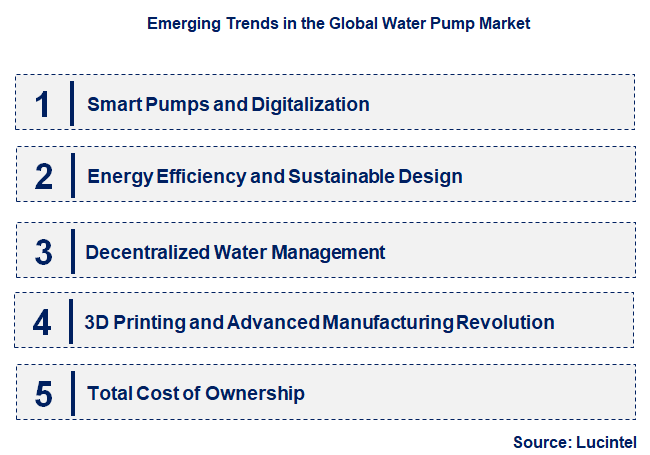
Emerging Trends in the Water Pump Market

Recent Development in the Water Pump Market

The market for the water pump is in the process of making massive transformations, with technological advancements and changing customer demands across industries. The emphasis has shifted from merely pumping water to offering smart, efficient, and sustainable solutions. All these changes are impacting product design, the manufacturing process, and business planning. The most important developments are a reaction to urgent worldwide concerns such as water shortage and energy use, and they are creating a new generation of pumping that is both high performance and responsible in terms of the environment.
• IoT and Predictive Analytics Integration: The biggest leap is the general integration of the Internet of Things into water pumps. This entails the inclusion of sensors that gather real-time information on parameters such as pressure, temperature, and vibration. This information is processed through predictive analytics to predict possible failures and plan maintenance in advance. This innovation is bearing heavily on the market by cutting unscheduled downtime and end-user costs of operation. It changes maintenance from a reactive to a proactive process, delivering higher reliability and efficiency to municipal water supply systems and industrial facilities.
• Growth of Solar-Powered Pumps: The increase in the use of solar powered water pumps is a revolutionary growth, particularly in agriculture and rural communities. Pursued by declining solar panel prices and subsidies from governments, the systems offer a cost-effective and eco-friendly substitute for conventional electric or diesel pumps. The innovation is making a significant contribution to the marketplace by creating fresh opportunities for growth in off grid areas and enabling farmers to lower operating costs.
• Manufacturing of High Efficiency Pumps with Variable Frequency Drives (VFDs): One of the important developments is the increased use of high efficiency pumps with VFDs. VFDs enable the speed of the pump motor to be varied based on the flow requirement, which can result in considerable energy savings. This is an important development as pumps are big consumers of energy in most industrial and municipal processes. By optimizing performance and conserving energy, VFD-enabled pumps present an attractive value proposition that saves electricity and enables organizations to meet energy efficiency mandates, ensuring they become a fundamental component of contemporary pump solutions.
• Emphasis on Modular and Compact Designs: There is increased emphasis on more modular and compact designs for pumps. This development is driven by the need for pumps that are easier to install, maintain, and integrate into various systems, particularly in space constrained environments. The impact of this development is an increase in design flexibility and a reduction in installation time and costs. It is especially applicable to applications in commercial buildings, small industrial processes, and decentralized water systems where space is at a premium and ease of use is an essential consideration.
• Aftermarket Services and Digital Twins Growth: The industry is experiencing a significant advancement in aftermarket services and digital twins usage. Manufacturers are not merely peddling pumps; they are providing end-to-end service contracts with maintenance, repair, and optimization of performance. With the idea of a digital twin, a virtual representation of the pump, it is possible to simulate and monitor performance without being on site. This innovation is affecting the market by offering manufacturers new streams of revenue and customers more support and a greater degree of long-term reliability for their pumping equipment.
These changes are impacting significantly the market for water pumps by generating new business models, impacting the buying behavior, and promoting a shift towards intelligent, sustainable, and integrated offerings. Overall, the impact is a more dynamic, technology-driven, and long-term value-oriented market for the end customer.

Strategic Growth Opportunities in the Water Pump Market

The water pump market offers enormous strategic growth opportunities in different key applications, which are influenced by world trends like urbanization, industrialization, and the growing emphasis on sustainable management of resources. Manufacturers can adapt their products and business strategies to address niche customer requirements and ride new demands by concentrating on certain application segments. These opportunities are not just about selling goods but about delivering holistic solutions that overcome the unique challenges of each industry.
• Municipal Water and Wastewater Management: The strategic growth opportunity within this sector stems from the imperative to renew and build new aging municipal infrastructure. With increasing urban populations comes the increased demand for effective water supply and sanitation systems. Businesses can take advantage of this by providing high capacity, energy conserving pumps with intelligent monitoring features that save the consumer money and keep systems from malfunctioning.
• Farm Irrigation and Water Management: The agricultural industry is a huge growth opportunity, especially in growing economies. The key area of focus is efficient and sustainable irrigation solutions to counter water scarcity and enhance crop quality. The strategic advantage is solar powered pumps, providing farmers with a cost efficient and reliable alternative to conventional power. In addition, smart irrigation systems that employ pumps fitted with variable speed drives and remote monitoring can optimize the use of water, cut down on energy usage, and offer precious data about the efficiency of irrigation, making them extremely appealing to a climate-dealing global agricultural industry.
• Manufacturing and Industrial Processes: In the industrial process, the opportunity for growth is to supply pumps that conform to high performance, reliability, and safety requirements. Pumps are crucial to numerous industrial processes, such as chemical processing, oil and gas production, and food and beverages manufacturing. The opportunity is to supply custom engineered, high-durability pumps for particular applications. The trend towards predictive maintenance and condition monitoring is another major growth sector, enabling industrial customers to reduce downtime and refine production schedules, and rendering pump manufacturers strategic partners in their efficiency.
• Building and Construction: With the faster pace of urbanization, there is an increasing demand for pumps to be used in residential, commercial, and public buildings. This segment embraces pumps for HVAC applications, fire protection, and domestic water supply. The strategic potential is to offer small, quiet, and energy-efficient pumps that are simple to install and service. The growth in green building certifications and intelligent building technologies also creates a market for pumps that can be easily integrated with building management systems, enabling remote monitoring and energy optimization.
• Mining and Mineral Processing: The mining sector demands heavy-duty, high performance pumps to deal with abrasive slurries, dewatering, and tailings management. This is a niche but high value growth segment. The focus of the strategy is building pumps that are very durable and reliable under tough operating conditions. The global demand for minerals and the trend towards more eco-friendly mining are creating a demand for pumps that can minimize water use and energy consumption. Firms that provide specialized heavy duty pumps with remote monitoring and predictive maintenance services can gain a substantial competitive edge in this use.
These opportunities are significantly influencing the water pump market by leading it to focus on delivering integrated, application specific solutions. The market is beyond the sale of basic products and extending to the delivery of value added services and technology to enable customers to realize higher efficiency, sustainability, and operational resilience in critical sectors.

Water Pump Market Driver and Challenges

The market for water pumps is an active industry, driven by a multi-dimensional mix of drivers that propel its growth and challenges that limit its potential. The primary drivers and challenges involve different technological, economic, and regulatory forces. It is important for stakeholders to grasp these forces in order to negotiate the market effectively. On the one hand, the drivers are compelling the market to innovate and grow, and on the other, the challenges are compelling businesses to change and seek new mechanisms of value creation.
The factors responsible for driving the water pump market include:
1. Urbanization and Infrastructure Development: World-wide rapid urbanization is a lead driver. With an increasing population shifting to urban areas, there is a growing need for safe water supply and wastewater treatment systems. This requires the installation and expansion of municipal water infrastructure, ranging from a large number of different types of pumps. At the same time, industrial development linked with urbanization further boosts the requirement for pumps in industry, power plants, and other industries.
2. Technological Developments: Ongoing technological advancements are one of the key drivers of growth. The deployment of smart pumps with Internet of Things (IoT), predictive insights, and variable frequency drives (VFDs) is revolutionizing the industry. These technologies improve energy efficiency, increase reliability through remote monitoring, and decrease operational expenses. How newer pumps can offer real-time data and optimize performance is a top selling feature, compelling firms and municipalities to upgrade to newer, technologically superior equipment.
3. Increasing Demand for Energy-Efficient Products: Higher energy prices and a worldwide drive for sustainability are generating huge demand for energy-saving water pumps. Government regulations and green building codes are also pushing industries toward using power-saving pumps. Manufacturers are reacting to this trend by creating more efficient hydraulic systems and integrating technologies such as VFDs. This trend not only allows businesses to lower their carbon emissions but also creates a powerful economic incentive in terms of lower electricity costs throughout the life of the pump.
4. Growth of the Agricultural Industry: The agricultural industry is one of the largest users of water pumps, particularly in developing countries. The urgency to raise food output to support an expanding world population, as well as issues such as water shortage and unpredictable rainfall, is compelling farmers to seek effective irrigation systems. Government programs and solar pump subsidies are additionally fueling the shift, compelling modern, reliable pumps to become major requirements for farmers to provide crop insurance and enhance yields.
5. Water Conservation and Management: Expanding worldwide water shortage is an important impetus for the market. It has resulted in increased emphasis on water conservation, recycling, and reuse. Pumps are crucial to these operations, ranging from conveying water in desalination plants to conveying treated wastewater to industrial reuse. The necessity for sophisticated water management technologies is opening up opportunities for specialized pumps tailored to these end-uses, further driving market expansion and development.
Challenges in the water pump market are:
1. High Initial and Maintenance Costs: One major challenge for the market is the initial expense of sophisticated pumping systems, especially smart and high efficiency type. This may pose an impediment to adoption for small scale consumers, e.g., single farmers or small enterprises. Also, complex systems require skilled people to maintain them, which are not always available, particularly in the rural or developing areas, increasing the cost of ownership and providing a barrier for large-scale adoption.
2. Furious Competition and Price Pressure: The market for water pumps is very competitive with multiple global and local players. This fierce competition frequently results in price pressure, which compresses profit margins of manufacturers. Low cost, non-branded products, especially in growing markets, also increase this pressure further, so it becomes challenging for firms to make a case for spending on research and development and establish a competitive advantage solely based on quality and innovation.
3. Volatile Raw Material Prices: The raw material price of steel and other metals utilized in pump manufacturing can be extremely volatile. This volatility directly reflects on the cost of production and can complicate manufacturers ability to keep product pricing stable. This unpredictability in the supply chain is a major impediment to long term financial planning and can compel businesses to either absorb or transfer costs to customers, which could impact sales.
Overall, the water pump market is at a tipping point, with strong drivers compelling technology development and sustainability, but with major barriers such as cost and competition. The combined result of these factors is a market that is increasingly segmented and characterized by a two-way focus on offering both high technology, value-added solutions for industrial and municipal applications and economical, straightforward solutions for agricultural and residential applications.

List of Water Pump Companies

Companies in the market compete on the basis of product quality offered. Major players in this market focus on expanding their manufacturing facilities, R&D investments, infrastructural development, and leverage integration opportunities across the value chain. With these strategies water pump companies cater increasing demand, ensure competitive effectiveness, develop innovative products & technologies, reduce production costs, and expand their customer base. Some of the water pump companies profiled in this report include-
• Grundfos
• Xylem
• Wilo
• Ebara
• Sulzer
• Flowserve
• KSB
• Pentair
• Shanghai Kaiquan Pump
• Nanfang Zhongjin Environment

Water Pump Market by Segment

The study includes a forecast for the global water pump market by type, application, and region.

Water Pump Market by Type [Value from 2019 to 2031]:


• Onshore Pump
• Well Pump
• Submersible Pump
• Others

Water Pump Market by Application [Value from 2019 to 2031]:


• Industrial
• Household
• Agricultural
• Municipal
• Others

Water Pump Market by Region [Value from 2019 to 2031]:


• North America
• Europe
• Asia Pacific
• The Rest of the World

Country Wise Outlook for the Water Pump Market

The world water pump market is also experiencing dramatic change, fueled by technological advancements, escalating environmental issues, and a changing global economy. Industry trends are aimed at developing more efficient, dependable, and sustainable pump solutions to meet rising demands in major sectors such as agriculture, municipal water supply, and process industries. Major developments involve the adoption of smart technologies such as the Internet of Things (IoT) and artificial intelligence (AI), increased use of energy-efficient and solar-powered pumps, and more focus on decentralized water management systems.
• United States: The US water pump market has a high emphasis on high-performance and energy-efficient solutions and cutting-edge technologies. The growth is spurred by continuous infrastructure upgrades, strict environmental policies, and rising use of smart pumping systems with IoT capabilities. These systems allow predictive maintenance and remote monitoring to lower operational expenses and increase reliability. The growth is especially pronounced in municipal water supply and wastewater treatment, as cities spend capital on replacing aging infrastructure to improve water resilience and sustainability. The market also experiences consistent demand from the oil and gas industry.
• China: The water pump market of China is the largest in the world and is driven by strong urbanization, industrialization, and huge investments in infrastructure by the government. High-efficiency and long-lasting pumps for major municipal-scale projects as well as industrial uses are the focus. The nation is a significant producer and exporter of pumps, with increasing focus on intelligent, automated systems to enhance water management. Although cost continues to play a role, the push for greater manufacturing capacity and environmental regulation is spurring the use of higher-tech pump technologies.
• Germany: Germanys market is a technology leader and a strong market for high-performance, long-life pump solutions. The market is fueled by a robust industrial backbone, a renewable energy focus, and stringent environmental regulations that will enhance energy-efficient designs. German industry leaders are pioneers in the development of intelligent, IoT-pump solutions for industrial and municipal uses, stressing high reliability and lower lifecycle costs. The chemical and power generation industries are significant end-markets, calling for high-performance, specialized pumping solutions.
• India: The Indian water pump industry is growing at a fast rate, led mainly by the agricultural industry, which is dependent on pumps for irrigation. Government schemes, like the Kisan Urja Suraksha Evam Uthaman Mah Abhiyan (KUSUM) program to boost solar-powered pumps, are acting as a key growth driver. Urbanization and the Smart Cities Mission are also driving demand for municipal water and wastewater management. The market is very competitive, with a combination of domestic and foreign companies, and witnessing a growing uptake of energy-efficient and solar-powered pumps.
• Japan: The Japanese market for water pumps is technology-oriented and mature, with a high focus on compact, high-quality, and long-lasting products. The market is motivated by the demand for sophisticated, energy-efficient pumps for industrial applications, building services, and agriculture. With a strong emphasis on disaster preparedness and water conservation in the country, effective pumps for flood control and water recycling systems have been developed. Japanese pump manufacturers are recognized for their high-precision engineering and are rapidly adding digitalization and automation to their product offerings to maximize performance and efficiency of operations.

Lucintel Analytics Dashboard

Features of the Global Water Pump Market

Market Size Estimates: Water pump market size estimation in terms of value ($B).
Trend and Forecast Analysis: Market trends (2019 to 2024) and forecast (2025 to 2031) by various segments and regions.
Segmentation Analysis: Water pump market size by type, application, and region in terms of value ($B).
Regional Analysis: Water pump market breakdown by North America, Europe, Asia Pacific, and Rest of the World.
Growth Opportunities: Analysis of growth opportunities in different type, application, and regions for the water pump market.
Strategic Analysis: This includes M&A, new product development, and competitive landscape of the water pump market.
Analysis of competitive intensity of the industry based on Porter’s Five Forces model.

Lucintel Consulting Services

FAQ

Q1. What is the growth forecast for water pump market?
Answer: The global water pump market is expected to grow with a CAGR of 7.3% from 2025 to 2031.
Q2. What are the major drivers influencing the growth of the water pump market?
Answer: The major drivers for this market are the increasing demand for water management solutions, the rising need for efficient irrigation systems, and the growing adoption of energy-efficient pumps.
Q3. What are the major segments for water pump market?
Answer: The future of the water pump market looks promising with opportunities in the industrial, household, agricultural, and municipal markets.
Q4. Who are the key water pump market companies?
Answer: Some of the key water pump companies are as follows:
• Grundfos
• Xylem
• Wilo
• Ebara
• Sulzer
• Flowserve
• KSB
• Pentair
• Shanghai Kaiquan Pump
• Nanfang Zhongjin Environment
Q5. Which water pump market segment will be the largest in future?
Answer: Lucintel forecasts that, within the type category, submersible pump is expected to witness the highest growth over the forecast period.
Q6. In water pump market, which region is expected to be the largest in next 5 years?
Answer: In terms of region, APAC is expected to witness the highest growth over the forecast period.
Q7. Do we receive customization in this report?
Answer: Yes, Lucintel provides 10% customization without any additional cost.

This report answers following 11 key questions:

Q.1. What are some of the most promising, high-growth opportunities for the water pump market by type (onshore pump, well pump, submersible pump, and others), application (industrial, household, agricultural, municipal, and others), and region (North America, Europe, Asia Pacific, and the Rest of the World)?
Q.2. Which segments will grow at a faster pace and why?
Q.3. Which region will grow at a faster pace and why?
Q.4. What are the key factors affecting market dynamics? What are the key challenges and business risks in this market?
Q.5. What are the business risks and competitive threats in this market?
Q.6. What are the emerging trends in this market and the reasons behind them?
Q.7. What are some of the changing demands of customers in the market?
Q.8. What are the new developments in the market? Which companies are leading these developments?
Q.9. Who are the major players in this market? What strategic initiatives are key players pursuing for business growth?
Q.10. What are some of the competing products in this market and how big of a threat do they pose for loss of market share by material or product substitution?
Q.11. What M&A activity has occurred in the last 5 years and what has its impact been on the industry?

For any questions related to Water Pump Market, Water Pump Market Size, Water Pump Market Growth, Water Pump Market Analysis, Water Pump Market Report, Water Pump Market Share, Water Pump Market Trends, Water Pump Market Forecast, Water Pump Companies, write Lucintel analyst at email: helpdesk@lucintel.com. We will be glad to get back to you soon.
                                           Table of Contents

            1. Executive Summary

            2. Market Overview

                        2.1 Background and Classifications
                        2.2 Supply Chain

            3. Market Trends & Forecast Analysis

                        3.1 Macroeconomic Trends and Forecasts
                        3.2 Industry Drivers and Challenges
                        3.3 PESTLE Analysis
                        3.4 Patent Analysis
                        3.5 Regulatory Environment
                        3.6 Global Water Pump Market Trends and Forecast

            4. Global Water Pump Market by Type

                        4.1 Overview
                        4.2 Attractiveness Analysis by Type
                        4.3 Onshore Pump : Trends and Forecast 2025 to 2031
                        4.4 Well Pump : Trends and Forecast 2025 to 2031
                        4.5 Submersible Pump : Trends and Forecast 2025 to 2031
                        4.6 Others : Trends and Forecast 2025 to 2031

            5. Global Water Pump Market by Application

                        5.1 Overview
                        5.2 Attractiveness Analysis by Application
                        5.3 Industrial : Trends and Forecast 2025 to 2031
                        5.4 Household : Trends and Forecast 2025 to 2031
                        5.5 Agricultural : Trends and Forecast 2025 to 2031
                        5.6 Municipal : Trends and Forecast 2025 to 2031
                        5.7 Others : Trends and Forecast 2025 to 2031

            6. Regional Analysis

                        6.1 Overview
                        6.2 Global Water Pump Market by Region

            7. North American Water Pump Market

                        7.1 Overview
                        7.2 North American Water Pump Market by Type
                        7.3 North American Water Pump Market by Application
                        7.4 The United States Water Pump Market
                        7.5 Canadian Water Pump Market
                        7.6 Mexican Water Pump Market

            8. European Water Pump Market

                        8.1 Overview
                        8.2 European Water Pump Market by Type
                        8.3 European Water Pump Market by Application
                        8.4 German Water Pump Market
                        8.5 French Water Pump Market
                        8.6 Italian Water Pump Market
                        8.7 Spanish Water Pump Market
                        8.8 The United Kingdom Water Pump Market

            9. APAC Water Pump Market

                        9.1 Overview
                        9.2 APAC Water Pump Market by Type
                        9.3 APAC Water Pump Market by Application
                        9.4 Chinese Water Pump Market
                        9.5 Indian Water Pump Market
                        9.6 Japanese Water Pump Market
                        9.7 South Korean Water Pump Market
                        9.8 Indonesian Water Pump Market

            10. ROW Water Pump Market

                        10.1 Overview
                        10.2 ROW Water Pump Market by Type
                        10.3 ROW Water Pump Market by Application
                        10.4 Middle Eastern Water Pump Market
                        10.5 South American Water Pump Market
                        10.6 African Water Pump Market

            11. Competitor Analysis

                        11.1 Product Portfolio Analysis
                        11.2 Operational Integration
                        11.3 Porter’s Five Forces Analysis
                                    • Competitive Rivalry
                                    • Bargaining Power of Buyers
                                    • Bargaining Power of Suppliers
                                    • Threat of Substitutes
                                    • Threat of New Entrants
                        11.4 Market Share Analysis

            12. Opportunities & Strategic Analysis

                        12.1 Value Chain Analysis
                        12.2 Growth Opportunity Analysis
                                    12.2.1 Growth Opportunity by Type
                                    12.2.2 Growth Opportunity by Application
                        12.3 Emerging Trends in the Global Water Pump Market
                        12.4 Strategic Analysis
                                    12.4.1 New Product Development
                                    12.4.2 Certification and Licensing
                                    12.4.3 Mergers, Acquisitions, Agreements, Collaborations, and Joint Ventures

            13. Company Profiles of the Leading Players Across the Value Chain

                        13.1 Competitive Analysis
                        13.2 Grundfos
                                    • Company Overview
                                    • Water Pump Market Business Overview
                                    • New Product Development
                                    • Merger, Acquisition, and Collaboration
                                    • Certification and Licensing
                        13.3 Xylem
                                    • Company Overview
                                    • Water Pump Market Business Overview
                                    • New Product Development
                                    • Merger, Acquisition, and Collaboration
                                    • Certification and Licensing
                        13.4 Wilo
                                    • Company Overview
                                    • Water Pump Market Business Overview
                                    • New Product Development
                                    • Merger, Acquisition, and Collaboration
                                    • Certification and Licensing
                        13.5 Ebara
                                    • Company Overview
                                    • Water Pump Market Business Overview
                                    • New Product Development
                                    • Merger, Acquisition, and Collaboration
                                    • Certification and Licensing
                        13.6 Sulzer
                                    • Company Overview
                                    • Water Pump Market Business Overview
                                    • New Product Development
                                    • Merger, Acquisition, and Collaboration
                                    • Certification and Licensing
                        13.7 Flowserve
                                    • Company Overview
                                    • Water Pump Market Business Overview
                                    • New Product Development
                                    • Merger, Acquisition, and Collaboration
                                    • Certification and Licensing
                        13.8 KSB
                                    • Company Overview
                                    • Water Pump Market Business Overview
                                    • New Product Development
                                    • Merger, Acquisition, and Collaboration
                                    • Certification and Licensing
                        13.9 Pentair
                                    • Company Overview
                                    • Water Pump Market Business Overview
                                    • New Product Development
                                    • Merger, Acquisition, and Collaboration
                                    • Certification and Licensing
                        13.10 Shanghai Kaiquan Pump
                                    • Company Overview
                                    • Water Pump Market Business Overview
                                    • New Product Development
                                    • Merger, Acquisition, and Collaboration
                                    • Certification and Licensing
                        13.11 Nanfang Zhongjin Environment
                                    • Company Overview
                                    • Water Pump Market Business Overview
                                    • New Product Development
                                    • Merger, Acquisition, and Collaboration
                                    • Certification and Licensing

            14. Appendix

                        14.1 List of Figures
                        14.2 List of Tables
                        14.3 Research Methodology
                        14.4 Disclaimer
                        14.5 Copyright
                        14.6 Abbreviations and Technical Units
                        14.7 About Us
                        14.8 Contact Us

                                               List of Figures


            Chapter 1

                        Figure 1.1: Trends and Forecast for the Global Water Pump Market

            Chapter 2

                        Figure 2.1: Usage of Water Pump Market
                        Figure 2.2: Classification of the Global Water Pump Market
                        Figure 2.3: Supply Chain of the Global Water Pump Market

            Chapter 3

                        Figure 3.1: Trends of the Global GDP Growth Rate
                        Figure 3.2: Trends of the Global Population Growth Rate
                        Figure 3.3: Trends of the Global Inflation Rate
                        Figure 3.4: Trends of the Global Unemployment Rate
                        Figure 3.5: Trends of the Regional GDP Growth Rate
                        Figure 3.6: Trends of the Regional Population Growth Rate
                        Figure 3.7: Trends of the Regional Inflation Rate
                        Figure 3.8: Trends of the Regional Unemployment Rate
                        Figure 3.9: Trends of Regional Per Capita Income
                        Figure 3.10: Forecast for the Global GDP Growth Rate
                        Figure 3.11: Forecast for the Global Population Growth Rate
                        Figure 3.12: Forecast for the Global Inflation Rate
                        Figure 3.13: Forecast for the Global Unemployment Rate
                        Figure 3.14: Forecast for the Regional GDP Growth Rate
                        Figure 3.15: Forecast for the Regional Population Growth Rate
                        Figure 3.16: Forecast for the Regional Inflation Rate
                        Figure 3.17: Forecast for the Regional Unemployment Rate
                        Figure 3.18: Forecast for Regional Per Capita Income
                        Figure 3.19: Driver and Challenges of the Water Pump Market

            Chapter 4

                        Figure 4.1: Global Water Pump Market by Type in 2019, 2024, and 2031
                        Figure 4.2: Trends of the Global Water Pump Market ($B) by Type
                        Figure 4.3: Forecast for the Global Water Pump Market ($B) by Type
                        Figure 4.4: Trends and Forecast for Onshore Pump in the Global Water Pump Market (2019-2031)
                        Figure 4.5: Trends and Forecast for Well Pump in the Global Water Pump Market (2019-2031)
                        Figure 4.6: Trends and Forecast for Submersible Pump in the Global Water Pump Market (2019-2031)
                        Figure 4.7: Trends and Forecast for Others in the Global Water Pump Market (2019-2031)

            Chapter 5

                        Figure 5.1: Global Water Pump Market by Application in 2019, 2024, and 2031
                        Figure 5.2: Trends of the Global Water Pump Market ($B) by Application
                        Figure 5.3: Forecast for the Global Water Pump Market ($B) by Application
                        Figure 5.4: Trends and Forecast for Industrial in the Global Water Pump Market (2019-2031)
                        Figure 5.5: Trends and Forecast for Household in the Global Water Pump Market (2019-2031)
                        Figure 5.6: Trends and Forecast for Agricultural in the Global Water Pump Market (2019-2031)
                        Figure 5.7: Trends and Forecast for Municipal in the Global Water Pump Market (2019-2031)
                        Figure 5.8: Trends and Forecast for Others in the Global Water Pump Market (2019-2031)

            Chapter 6

                        Figure 6.1: Trends of the Global Water Pump Market ($B) by Region (2019-2024)
                        Figure 6.2: Forecast for the Global Water Pump Market ($B) by Region (2025-2031)

            Chapter 7

                        Figure 7.1: Trends and Forecast for the North American Water Pump Market (2019-2031)
                        Figure 7.2: North American Water Pump Market by Type in 2019, 2024, and 2031
                        Figure 7.3: Trends of the North American Water Pump Market ($B) by Type (2019-2024)
                        Figure 7.4: Forecast for the North American Water Pump Market ($B) by Type (2025-2031)
                        Figure 7.5: North American Water Pump Market by Application in 2019, 2024, and 2031
                        Figure 7.6: Trends of the North American Water Pump Market ($B) by Application (2019-2024)
                        Figure 7.7: Forecast for the North American Water Pump Market ($B) by Application (2025-2031)
                        Figure 7.8: Trends and Forecast for the United States Water Pump Market ($B) (2019-2031)
                        Figure 7.9: Trends and Forecast for the Mexican Water Pump Market ($B) (2019-2031)
                        Figure 7.10: Trends and Forecast for the Canadian Water Pump Market ($B) (2019-2031)

            Chapter 8

                        Figure 8.1: Trends and Forecast for the European Water Pump Market (2019-2031)
                        Figure 8.2: European Water Pump Market by Type in 2019, 2024, and 2031
                        Figure 8.3: Trends of the European Water Pump Market ($B) by Type (2019-2024)
                        Figure 8.4: Forecast for the European Water Pump Market ($B) by Type (2025-2031)
                        Figure 8.5: European Water Pump Market by Application in 2019, 2024, and 2031
                        Figure 8.6: Trends of the European Water Pump Market ($B) by Application (2019-2024)
                        Figure 8.7: Forecast for the European Water Pump Market ($B) by Application (2025-2031)
                        Figure 8.8: Trends and Forecast for the German Water Pump Market ($B) (2019-2031)
                        Figure 8.9: Trends and Forecast for the French Water Pump Market ($B) (2019-2031)
                        Figure 8.10: Trends and Forecast for the Spanish Water Pump Market ($B) (2019-2031)
                        Figure 8.11: Trends and Forecast for the Italian Water Pump Market ($B) (2019-2031)
                        Figure 8.12: Trends and Forecast for the United Kingdom Water Pump Market ($B) (2019-2031)

            Chapter 9

                        Figure 9.1: Trends and Forecast for the APAC Water Pump Market (2019-2031)
                        Figure 9.2: APAC Water Pump Market by Type in 2019, 2024, and 2031
                        Figure 9.3: Trends of the APAC Water Pump Market ($B) by Type (2019-2024)
                        Figure 9.4: Forecast for the APAC Water Pump Market ($B) by Type (2025-2031)
                        Figure 9.5: APAC Water Pump Market by Application in 2019, 2024, and 2031
                        Figure 9.6: Trends of the APAC Water Pump Market ($B) by Application (2019-2024)
                        Figure 9.7: Forecast for the APAC Water Pump Market ($B) by Application (2025-2031)
                        Figure 9.8: Trends and Forecast for the Japanese Water Pump Market ($B) (2019-2031)
                        Figure 9.9: Trends and Forecast for the Indian Water Pump Market ($B) (2019-2031)
                        Figure 9.10: Trends and Forecast for the Chinese Water Pump Market ($B) (2019-2031)
                        Figure 9.11: Trends and Forecast for the South Korean Water Pump Market ($B) (2019-2031)
                        Figure 9.12: Trends and Forecast for the Indonesian Water Pump Market ($B) (2019-2031)

            Chapter 10

                        Figure 10.1: Trends and Forecast for the ROW Water Pump Market (2019-2031)
                        Figure 10.2: ROW Water Pump Market by Type in 2019, 2024, and 2031
                        Figure 10.3: Trends of the ROW Water Pump Market ($B) by Type (2019-2024)
                        Figure 10.4: Forecast for the ROW Water Pump Market ($B) by Type (2025-2031)
                        Figure 10.5: ROW Water Pump Market by Application in 2019, 2024, and 2031
                        Figure 10.6: Trends of the ROW Water Pump Market ($B) by Application (2019-2024)
                        Figure 10.7: Forecast for the ROW Water Pump Market ($B) by Application (2025-2031)
                        Figure 10.8: Trends and Forecast for the Middle Eastern Water Pump Market ($B) (2019-2031)
                        Figure 10.9: Trends and Forecast for the South American Water Pump Market ($B) (2019-2031)
                        Figure 10.10: Trends and Forecast for the African Water Pump Market ($B) (2019-2031)

            Chapter 11

                        Figure 11.1: Porter’s Five Forces Analysis of the Global Water Pump Market
                        Figure 11.2: Market Share (%) of Top Players in the Global Water Pump Market (2024)

            Chapter 12

                        Figure 12.1: Growth Opportunities for the Global Water Pump Market by Type
                        Figure 12.2: Growth Opportunities for the Global Water Pump Market by Application
                        Figure 12.3: Growth Opportunities for the Global Water Pump Market by Region
                        Figure 12.4: Emerging Trends in the Global Water Pump Market

                                               List of Tables


            Chapter 1

                        Table 1.1: Growth Rate (%, 2023-2024) and CAGR (%, 2025-2031) of the Water Pump Market by Type and Application
                        Table 1.2: Attractiveness Analysis for the Water Pump Market by Region
                        Table 1.3: Global Water Pump Market Parameters and Attributes

            Chapter 3

                        Table 3.1: Trends of the Global Water Pump Market (2019-2024)
                        Table 3.2: Forecast for the Global Water Pump Market (2025-2031)

            Chapter 4

                        Table 4.1: Attractiveness Analysis for the Global Water Pump Market by Type
                        Table 4.2: Market Size and CAGR of Various Type in the Global Water Pump Market (2019-2024)
                        Table 4.3: Market Size and CAGR of Various Type in the Global Water Pump Market (2025-2031)
                        Table 4.4: Trends of Onshore Pump in the Global Water Pump Market (2019-2024)
                        Table 4.5: Forecast for Onshore Pump in the Global Water Pump Market (2025-2031)
                        Table 4.6: Trends of Well Pump in the Global Water Pump Market (2019-2024)
                        Table 4.7: Forecast for Well Pump in the Global Water Pump Market (2025-2031)
                        Table 4.8: Trends of Submersible Pump in the Global Water Pump Market (2019-2024)
                        Table 4.9: Forecast for Submersible Pump in the Global Water Pump Market (2025-2031)
                        Table 4.10: Trends of Others in the Global Water Pump Market (2019-2024)
                        Table 4.11: Forecast for Others in the Global Water Pump Market (2025-2031)

            Chapter 5

                        Table 5.1: Attractiveness Analysis for the Global Water Pump Market by Application
                        Table 5.2: Market Size and CAGR of Various Application in the Global Water Pump Market (2019-2024)
                        Table 5.3: Market Size and CAGR of Various Application in the Global Water Pump Market (2025-2031)
                        Table 5.4: Trends of Industrial in the Global Water Pump Market (2019-2024)
                        Table 5.5: Forecast for Industrial in the Global Water Pump Market (2025-2031)
                        Table 5.6: Trends of Household in the Global Water Pump Market (2019-2024)
                        Table 5.7: Forecast for Household in the Global Water Pump Market (2025-2031)
                        Table 5.8: Trends of Agricultural in the Global Water Pump Market (2019-2024)
                        Table 5.9: Forecast for Agricultural in the Global Water Pump Market (2025-2031)
                        Table 5.10: Trends of Municipal in the Global Water Pump Market (2019-2024)
                        Table 5.11: Forecast for Municipal in the Global Water Pump Market (2025-2031)
                        Table 5.12: Trends of Others in the Global Water Pump Market (2019-2024)
                        Table 5.13: Forecast for Others in the Global Water Pump Market (2025-2031)

            Chapter 6

                        Table 6.1: Market Size and CAGR of Various Regions in the Global Water Pump Market (2019-2024)
                        Table 6.2: Market Size and CAGR of Various Regions in the Global Water Pump Market (2025-2031)

            Chapter 7

                        Table 7.1: Trends of the North American Water Pump Market (2019-2024)
                        Table 7.2: Forecast for the North American Water Pump Market (2025-2031)
                        Table 7.3: Market Size and CAGR of Various Type in the North American Water Pump Market (2019-2024)
                        Table 7.4: Market Size and CAGR of Various Type in the North American Water Pump Market (2025-2031)
                        Table 7.5: Market Size and CAGR of Various Application in the North American Water Pump Market (2019-2024)
                        Table 7.6: Market Size and CAGR of Various Application in the North American Water Pump Market (2025-2031)
                        Table 7.7: Trends and Forecast for the United States Water Pump Market (2019-2031)
                        Table 7.8: Trends and Forecast for the Mexican Water Pump Market (2019-2031)
                        Table 7.9: Trends and Forecast for the Canadian Water Pump Market (2019-2031)

            Chapter 8

                        Table 8.1: Trends of the European Water Pump Market (2019-2024)
                        Table 8.2: Forecast for the European Water Pump Market (2025-2031)
                        Table 8.3: Market Size and CAGR of Various Type in the European Water Pump Market (2019-2024)
                        Table 8.4: Market Size and CAGR of Various Type in the European Water Pump Market (2025-2031)
                        Table 8.5: Market Size and CAGR of Various Application in the European Water Pump Market (2019-2024)
                        Table 8.6: Market Size and CAGR of Various Application in the European Water Pump Market (2025-2031)
                        Table 8.7: Trends and Forecast for the German Water Pump Market (2019-2031)
                        Table 8.8: Trends and Forecast for the French Water Pump Market (2019-2031)
                        Table 8.9: Trends and Forecast for the Spanish Water Pump Market (2019-2031)
                        Table 8.10: Trends and Forecast for the Italian Water Pump Market (2019-2031)
                        Table 8.11: Trends and Forecast for the United Kingdom Water Pump Market (2019-2031)

            Chapter 9

                        Table 9.1: Trends of the APAC Water Pump Market (2019-2024)
                        Table 9.2: Forecast for the APAC Water Pump Market (2025-2031)
                        Table 9.3: Market Size and CAGR of Various Type in the APAC Water Pump Market (2019-2024)
                        Table 9.4: Market Size and CAGR of Various Type in the APAC Water Pump Market (2025-2031)
                        Table 9.5: Market Size and CAGR of Various Application in the APAC Water Pump Market (2019-2024)
                        Table 9.6: Market Size and CAGR of Various Application in the APAC Water Pump Market (2025-2031)
                        Table 9.7: Trends and Forecast for the Japanese Water Pump Market (2019-2031)
                        Table 9.8: Trends and Forecast for the Indian Water Pump Market (2019-2031)
                        Table 9.9: Trends and Forecast for the Chinese Water Pump Market (2019-2031)
                        Table 9.10: Trends and Forecast for the South Korean Water Pump Market (2019-2031)
                        Table 9.11: Trends and Forecast for the Indonesian Water Pump Market (2019-2031)

            Chapter 10

                        Table 10.1: Trends of the ROW Water Pump Market (2019-2024)
                        Table 10.2: Forecast for the ROW Water Pump Market (2025-2031)
                        Table 10.3: Market Size and CAGR of Various Type in the ROW Water Pump Market (2019-2024)
                        Table 10.4: Market Size and CAGR of Various Type in the ROW Water Pump Market (2025-2031)
                        Table 10.5: Market Size and CAGR of Various Application in the ROW Water Pump Market (2019-2024)
                        Table 10.6: Market Size and CAGR of Various Application in the ROW Water Pump Market (2025-2031)
                        Table 10.7: Trends and Forecast for the Middle Eastern Water Pump Market (2019-2031)
                        Table 10.8: Trends and Forecast for the South American Water Pump Market (2019-2031)
                        Table 10.9: Trends and Forecast for the African Water Pump Market (2019-2031)

            Chapter 11

                        Table 11.1: Product Mapping of Water Pump Suppliers Based on Segments
                        Table 11.2: Operational Integration of Water Pump Manufacturers
                        Table 11.3: Rankings of Suppliers Based on Water Pump Revenue

            Chapter 12

                        Table 12.1: New Product Launches by Major Water Pump Producers (2019-2024)
                        Table 12.2: Certification Acquired by Major Competitor in the Global Water Pump Market

.

Buy full report or by chapter as follows

Limited Time Offer

Price by License Type:
[-] Hide Chapter Details
[Chapter Number] [Chapter Name] [Chapter Number Of Pages] [Chapter Price]
Title/Chapter Name Pages Price
Full Report: Water Pump Market Report: Trends, Forecast and Competitive Analysis to 2031 Full Report $ 2,990
A 150 Page Report
Lucintel has been in the business of market research and management consulting since 2000 and has published over 1000 market intelligence reports in various markets / applications and served over 1,000 clients worldwide. This study is a culmination of four months of full-time effort performed by Lucintel's analyst team. The analysts used the following sources for the creation and completion of this valuable report:
  • In-depth interviews of the major players in this market
  • Detailed secondary research from competitors’ financial statements and published data 
  • Extensive searches of published works, market, and database information pertaining to industry news, company press releases, and customer intentions
  • A compilation of the experiences, judgments, and insights of Lucintel’s professionals, who have analyzed and tracked this market over the years.
Extensive research and interviews are conducted across the supply chain of this market to estimate market share, market size, trends, drivers, challenges, and forecasts. Below is a brief summary of the primary interviews that were conducted by job function for this report.
 
Thus, Lucintel compiles vast amounts of data from numerous sources, validates the integrity of that data, and performs a comprehensive analysis. Lucintel then organizes the data, its findings, and insights into a concise report designed to support the strategic decision-making process. The figure below is a graphical representation of Lucintel’s research process. 
 

Please sign in below to get report brochure - Water Pump Market Report.

At Lucintel, we respect your privacy and maintain the confidentiality of information / data provided by you
(Please enter your corporate email. * These fields are mandatory )

Follow us on