
Report Feature
Water Cut Meter Market Trends and Forecast
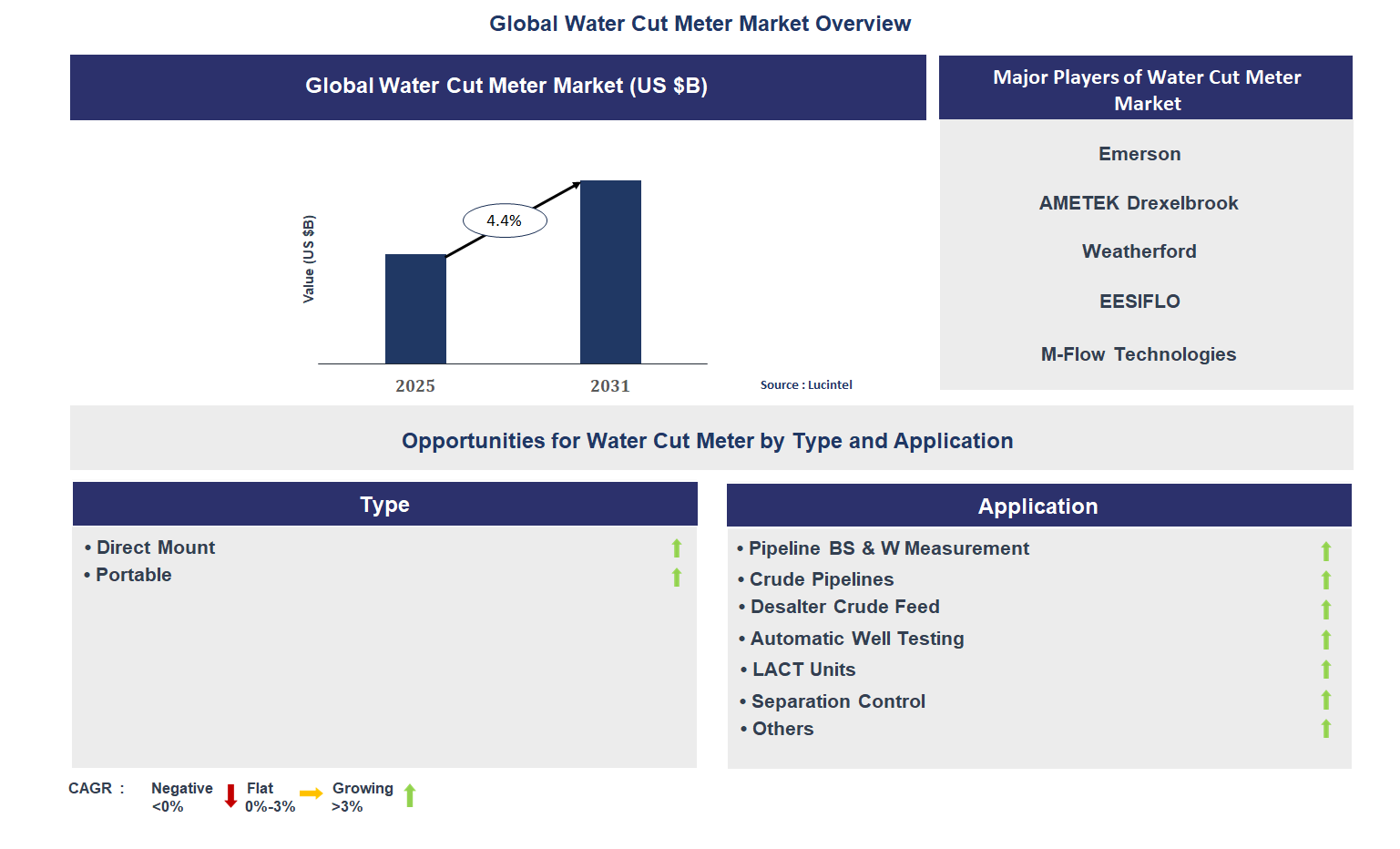
The future of the global water cut meter market looks promising with opportunities in the pipeline BS & W measurement, crude pipeline, desalter crude feed, automatic well testing, LACT unit, and separation control markets. The global water cut meter market is expected to grow with a CAGR of 4.4% from 2025 to 2031. The major drivers for this market are the increasing need for accurate measurement technologies, the rising demand for oilfield optimization solutions, and the growing focus on production efficiency improvements.• Lucintel forecasts that, within the type category, portable is expected to witness higher growth over the forecast period.
• Within the application category, automatic well testing is expected to witness the highest growth.
• In terms of region, APAC is expected to witness the highest growth over the forecast period. Gain valuable insights for your business decisions with our comprehensive 150+ page report. Sample figures with some insights are shown below.
Emerging Trends in the Water Cut Meter Market
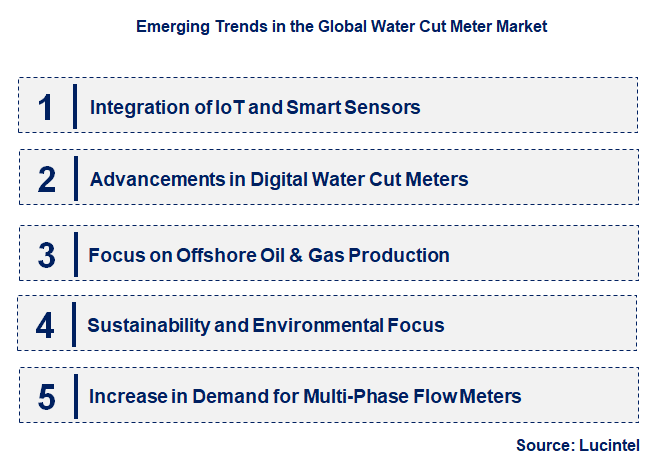
The water cut meter market is evolving rapidly with the advent of new technologies and increasing market demand for precise water content measurement. These emerging trends reflect the shift toward digitalization, automation, and sustainability across the oil and gas industry. Below are five key trends that are reshaping the water cut meter market.• Integration of IoT and Smart Sensors: The rise of IoT and smart sensors has transformed the water cut meter market. IoT-enabled devices offer real-time data analytics, predictive maintenance, and remote monitoring. This enhances decision-making and reduces downtime by enabling operators to monitor water cut levels continuously. These smart meters are becoming an essential part of automated production systems.
• Advancements in Digital Water Cut Meters: Digital water cut meters are gaining popularity due to their high accuracy, reliability, and ease of use. These meters provide real-time, accurate readings and reduce the need for manual intervention, improving operational efficiency. With better integration into digital platforms, these meters are driving a shift toward more data-driven decision-making in production processes.
• Focus on Offshore Oil & Gas Production: With increasing offshore exploration, the demand for water cut meters in these environments is growing. Offshore oil and gas production requires more robust and accurate systems to handle harsh environmental conditions. The market is witnessing the development of specialized meters that can operate in extreme conditions, ensuring efficient water content measurement in these challenging environments.
• Sustainability and Environmental Focus: The push toward sustainability is affecting the water cut meter market as industries seek to minimize water wastage and improve resource management. Water cut meters play a crucial role in reducing water contamination and optimizing oil recovery. Environmental regulations in many regions are also driving the adoption of these technologies as part of green initiatives.
• Increase in Demand for Multi-Phase Flow Meters: The demand for multi-phase flow meters is increasing due to their ability to measure the water, oil, and gas content in production wells. These meters allow for more accurate production monitoring and help in optimizing the separation process. The versatility and accuracy of multi-phase flow meters are making them an essential tool for the oil and gas industry. These emerging trends—such as IoT integration, digital metering, and sustainability focus—are reshaping the water cut meter market. The demand for high-precision, real-time data is growing, with industries increasingly relying on advanced metering systems to optimize resource extraction and meet environmental standards. These trends will continue to drive innovation and growth in the sector.
Recent Development in the Water Cut Meter Market
The water cut meter market has seen numerous advancements recently, from technological innovations to increased adoption across various regions. These developments are focused on improving accuracy, enhancing efficiency, and ensuring better environmental compliance. Here are some of the key developments driving the market forward.• Introduction of Multi-Phase Flow Meters: The integration of multi-phase flow meters into the market has revolutionized water cut measurement. These meters measure the oil, gas, and water content simultaneously, enhancing the accuracy of production monitoring. This development is especially important in offshore oil fields where multi-phase flow is common, making accurate water cut measurements critical for optimal production.
• Increased Adoption of Wireless Technologies: Wireless water cut meters are gaining traction due to their ability to offer remote monitoring and easier installation. These systems use real-time data transmission, which enhances operational efficiency by allowing operators to access critical data without being on-site. This trend is particularly valuable in remote or hazardous locations where traditional wired systems are impractical.
• Smart Sensor Integration: The integration of smart sensors into water cut meters has led to more accurate and reliable data. These sensors can detect minute changes in water cut levels, improving the precision of measurements and minimizing the risk of errors. The use of AI and machine learning with these sensors further enables predictive maintenance, reducing downtime and increasing the lifespan of the equipment.
• Environmental Regulation Compliance: Stricter environmental regulations are prompting more companies to invest in advanced water cut meters. These meters help ensure that water contamination and waste are minimized during the oil extraction process. Compliance with regulations is becoming more critical, especially as environmental sustainability continues to be a focal point for governments and industries worldwide.
• Customization for Harsh Environments: Water cut meters are being specifically designed for extreme environments such as deep-water drilling and offshore production. Customization to withstand high pressures, temperatures, and corrosive elements is a key development, ensuring that water cut meters perform reliably in challenging conditions. These meters improve operational efficiency by providing accurate data in harsh operational settings. Recent developments in the water cut meter market, including technological advancements and customization for extreme environments, are driving industry growth. These developments enhance operational efficiency, ensure regulatory compliance, and improve overall accuracy in water content measurement. As these innovations continue to unfold, they will help shape the future of water cut measurement in the oil and gas industry.
Strategic Growth Opportunities in the Water Cut Meter Market
The water cut meter market presents various strategic growth opportunities across key applications, particularly in the oil and gas industry. As the demand for efficiency, accuracy, and sustainability increases, several applications are poised for growth. Below are five key growth opportunities by application, highlighting the evolving market dynamics and their impact.• Offshore Oil & Gas Exploration: Offshore exploration presents a significant growth opportunity for the water cut meter market. The harsh and complex conditions of offshore drilling require specialized meters that can withstand extreme temperatures and pressures. As offshore production expands, the need for accurate water cut measurement in these environments becomes critical for operational success.
• Onshore Oil Production: Onshore oil production remains a substantial market for water cut meters. As many onshore wells age and water cuts increase, these meters play a crucial role in optimizing recovery and reducing operational costs. Onshore operators are increasingly turning to advanced water cut meters for better monitoring and more efficient water management during extraction processes.
• Enhanced Oil Recovery (EOR) Projects: Water cut meters are essential in enhanced oil recovery (EOR) projects, where precise monitoring of water injection and extraction rates is crucial. As EOR methods gain traction to extend the lifespan of aging oil fields, the demand for accurate water cut measurement devices will rise to optimize recovery and improve economic viability.
• Shale Oil & Gas Production: The growing focus on shale oil and gas production presents an opportunity for water cut meters to help optimize output and reduce water contamination. Shale wells often produce high water cuts, making accurate measurement systems indispensable. The rise in shale exploration will drive demand for more efficient water cut meters in the market.
• Renewable Energy Sector Integration: As the renewable energy sector grows, there is an opportunity for water cut meters to be integrated into systems that support energy extraction from unconventional sources. These meters can ensure accurate water management in geothermal, hydropower, and bioenergy applications, supporting the global transition to cleaner energy alternatives. The water cut meter market has significant growth opportunities across offshore and onshore oil production, enhanced oil recovery projects, shale production, and renewable energy applications. As demand for accurate water content measurement continues to rise, these opportunities will drive innovation, improve operational efficiency, and contribute to sustainable resource management.
Water Cut Meter Market Driver and Challenges
The water cut meter market is influenced by various technological, economic, and regulatory factors that drive its growth. However, the market also faces challenges related to costs, operational complexities, and the need for innovation. Here are the key drivers and challenges affecting the markets progress. The factors responsible for driving the water cut meter market include: 1. Demand for Accurate Water Measurement: The primary driver for the water cut meter market is the need for accurate real-time water content measurements in oil and gas production. These meters help improve production efficiency, optimize oil recovery, and reduce environmental impact by minimizing water contamination. Increasing focus on water management in oil fields drives demand for these devices. 2. Technological Advancements in Metering Systems: Continuous technological innovation is enhancing the accuracy, efficiency, and reliability of water cut meters. New developments such as IoT integration, wireless connectivity, and smart sensors are expanding the capabilities of water cut meters, making them more attractive for both onshore and offshore applications, driving market growth. 3. Growth in Offshore Oil & Gas Exploration: As offshore oil and gas exploration grows, the need for reliable and accurate water cut meters is increasing. Offshore environments require specialized equipment that can operate under extreme conditions. This sector’s expansion provides a significant market for advanced water cut meters, which are essential for efficient resource extraction in challenging offshore environments. 4. Environmental Regulations and Compliance: Stricter environmental regulations are pushing industries to adopt more efficient technologies that help reduce waste, minimize contamination, and optimize resource extraction. Water cut meters play an essential role in ensuring compliance with these regulations by providing accurate measurements and enabling better water management practices. 5. Increasing Adoption of Automation in Oil Production: The trend toward automation in oil production, including remote monitoring and data-driven decision-making, is driving the demand for advanced water cut meters. Automated systems that provide real-time data and insights are vital for improving production efficiency, reducing operational costs, and minimizing downtime in the oil and gas industry. Challenges in the water cut meter market are: 1. High Initial Investment Costs: Water cut meters, especially advanced digital systems, can be expensive to purchase and install. This high upfront cost can be a barrier for smaller oil producers or companies operating on tight budgets, limiting widespread adoption of advanced water cut measurement technologies. 2. Complex Installation and Maintenance: The installation of water cut meters in existing systems can be complex, especially in offshore and remote locations. Additionally, maintaining these systems requires specialized knowledge, which can increase operational costs and pose challenges for operators who may lack the expertise to troubleshoot and repair equipment. 3. Limited Standardization: The lack of standardization across different types of water cut meters can be a challenge. Companies often need to invest in custom solutions for specific applications, which may lead to compatibility issues and higher costs. Developing standardized solutions that can be easily integrated into various systems will be crucial for market expansion. The water cut meter market is driven by the growing demand for efficient water management in oil production, technological innovations, and regulatory compliance. However, challenges such as high costs, complex installation, and limited standardization may hinder market growth. Addressing these challenges will be key to maximizing the potential of water cut meters in the oil and gas sector.List of Water Cut Meter Companies
Companies in the market compete on the basis of product quality offered. Major players in this market focus on expanding their manufacturing facilities, R&D investments, infrastructural development, and leverage integration opportunities across the value chain. With these strategies water cut meter companies cater increasing demand, ensure competitive effectiveness, develop innovative products & technologies, reduce production costs, and expand their customer base. Some of the water cut meter companies profiled in this report include-• Emerson
• AMETEK Drexelbrook
• Weatherford
• EESIFLO
• M-Flow Technologies
• KAM Controls
• HAIMO
• Liebherr-Mischtechnik
• Phase Dynamics
• AppliTek
Water Cut Meter Market by Segment
The study includes a forecast for the global water cut meter market by type, application, and region.Water Cut Meter Market by Type [Value from 2019 to 2031]:
• Direct Mount
• Portable
Water Cut Meter Market by Application [Value from 2019 to 2031]:
• Pipeline BS & W Measurement
• Crude Pipelines
• Desalter Crude Feed
• Automatic Well Testing
• LACT Units
• Separation Control
• Others
Water Cut Meter Market by Region [Value from 2019 to 2031]:
• North America
• Europe
• Asia Pacific
• The Rest of the World
Country Wise Outlook for the Water Cut Meter Market
The water cut meter market is witnessing significant growth globally, driven by the increasing demand for real-time measurement of water content in oil and gas production. This technology is crucial in managing oil-water separation and optimizing resource extraction. The United States, China, Germany, India, and Japan are at the forefront of adopting advanced water cut metering solutions, each contributing to the markets expansion in distinct ways.• United States: In the U.S., the water cut meter market is expanding as oil and gas operators increasingly adopt advanced monitoring technologies to optimize production. The rise in shale oil and gas exploration has driven the demand for accurate water cut measurement tools, with companies investing in innovative solutions to ensure efficiency and meet environmental regulations.
• China: Chinas water cut meter market is growing rapidly due to the country’s heavy investment in its oil and gas industry. The focus on improving production efficiency and minimizing water contamination has led to greater adoption of water cut meters, especially in offshore and deep-water drilling operations. Moreover, Chinese manufacturers are developing more affordable solutions for domestic and global markets.
• Germany: Germany is focusing on high-precision water cut metering systems for use in both oil and gas and industrial applications. The country’s commitment to automation and digitalization in energy sectors has increased the demand for real-time monitoring of water content in oil wells, leading to advancements in sensor technology and integration with AI for predictive analytics.
• India: India’s growing oil and gas industry is embracing water cut meters as a means to optimize extraction and reduce production costs. With increasing exploration in offshore and onshore fields, water cut meters have become essential tools to improve efficiency. Local manufacturers are focusing on developing cost-effective solutions to meet the needs of the Indian market.
• Japan: Japan’s water cut meter market is driven by technological advancements and a strong push toward environmental sustainability in its oil and gas operations. The integration of smart sensors and automation into water cut metering systems has allowed for more efficient extraction processes, helping Japan maintain a competitive edge in the energy sector.

Features of the Global Water Cut Meter Market
Market Size Estimates: Water cut meter market size estimation in terms of value ($B). Trend and Forecast Analysis: Market trends (2019 to 2024) and forecast (2025 to 2031) by various segments and regions. Segmentation Analysis: Water cut meter market size by type, application, and region in terms of value ($B). Regional Analysis: Water cut meter market breakdown by North America, Europe, Asia Pacific, and Rest of the World. Growth Opportunities: Analysis of growth opportunities in different types, applications, and regions for the water cut meter market. Strategic Analysis: This includes M&A, new product development, and competitive landscape of the water cut meter market. Analysis of competitive intensity of the industry based on Porter’s Five Forces model.
FAQ
Q1. What is the growth forecast for water cut meter market? Answer: The global water cut meter market is expected to grow with a CAGR of 4.4% from 2025 to 2031. Q2. What are the major drivers influencing the growth of the water cut meter market? Answer: The major drivers for this market are the increasing need for accurate measurement technologies, the rising demand for oilfield optimization solutions, and the growing focus on production efficiency improvements. Q3. What are the major segments for water cut meter market? Answer: The future of the water cut meter market looks promising with opportunities in the pipeline BS & W measurement, crude pipeline, desalter crude feed, automatic well testing, LACT unit, and separation control markets. Q4. Who are the key water cut meter market companies? Answer: Some of the key water cut meter companies are as follows:• Emerson
• AMETEK Drexelbrook
• Weatherford
• EESIFLO
• M-Flow Technologies
• KAM Controls
• HAIMO
• Liebherr-Mischtechnik
• Phase Dynamics
• AppliTek Q5. Which water cut meter market segment will be the largest in future? Answer: Lucintel forecasts that, within the type category, portable is expected to witness higher growth over the forecast period. Q6. In water cut meter market, which region is expected to be the largest in next 5 years? Answer: In terms of region, APAC is expected to witness the highest growth over the forecast period. Q7. Do we receive customization in this report? Answer: Yes, Lucintel provides 10% customization without any additional cost.
Table of Contents
List of Figures
List of Tables
Methodology
- In-depth interviews of the major players in this market
- Detailed secondary research from competitors’ financial statements and published data
- Extensive searches of published works, market, and database information pertaining to industry news, company press releases, and customer intentions
- A compilation of the experiences, judgments, and insights of Lucintel’s professionals, who have analyzed and tracked this market over the years.


Buy Now
Choose a license that fits your team. Instant PDF delivery.
Prices exclude taxes. Instant delivery. Custom licensing available on request.
Key Questions
- • What are some of the most promising, high-growth opportunities for the water cut meter market by type (direct mount and portable), application (pipeline BS & W measurement, crude pipelines, desalter crude feed, automatic well testing, LACT units, separation control, and others), and region (North America, Europe, Asia Pacific, and the Rest of the World)?
- • Which segments will grow at a faster pace and why?
- • Which region will grow at a faster pace and why?
- • What are the key factors affecting market dynamics? What are the key challenges and business risks in this market?
- • What are the business risks and competitive threats in this market?
- • What are the emerging trends in this market and the reasons behind them?
- • What are some of the changing demands of customers in the market?
- • What are the new developments in the market? Which companies are leading these developments?
- • Who are the major players in this market? What strategic initiatives are key players pursuing for business growth?
- • What are some of the competing products in this market and how big of a threat do they pose for loss of market share by material or product substitution?
- • What M&A activity has occurred in the last 5 years and what has its impact been on the industry? For any questions related to Water Cut Meter Market, Water Cut Meter Market Size, Water Cut Meter Market Growth, Water Cut Meter Market Analysis, Water Cut Meter Market Report, Water Cut Meter Market Share, Water Cut Meter Market Trends, Water Cut Meter Market Forecast, Water Cut Meter Companies, write Lucintel analyst at email: helpdesk@lucintel.com. We will be glad to get back to you soon.


