
Close Lucintel Chat
Didn't Find What You're Looking for?
Call us at +1972 636 5056 or write at helpdesk@Lucintel.com
Ask an Expert Provide Custom Requirements Download Sample Report Search Available Reports
  • helpdesk@Lucintel.com
  • |
  • Call Lucintel +1 972 636 5056
  • |
  • Login
  • |
  • Register
  • |
  • Search
  • |
'
...

The Impact of COVID-19 is included in Wafer Used Dry Etching Equipment Market Report. Buy it today to get an advantage.

Request the impact of COVID-19 on your product or industry


Wafer Used Dry Etching Equipment Market Trends and Forecast

The future of the global wafer used dry etching equipment market looks promising with opportunities in the IDM and foundry markets. The global wafer used dry etching equipment market is expected to grow with a CAGR of 7.3% from 2025 to 2031. The major drivers for this market are the increasing demand for semiconductor devices, the rising adoption of miniaturized electronics, and the growing need for advanced manufacturing processes.

• Lucintel forecasts that, within the type category, silicon etch is expected to witness the highest growth over the forecast period.
• Within the application category, foundry is expected to witness higher growth.
• In terms of region, APAC is expected to witness the highest growth over the forecast period.
Gain valuable insights for your business decisions with our comprehensive 150+ page report. Sample figures with some insights are shown below.
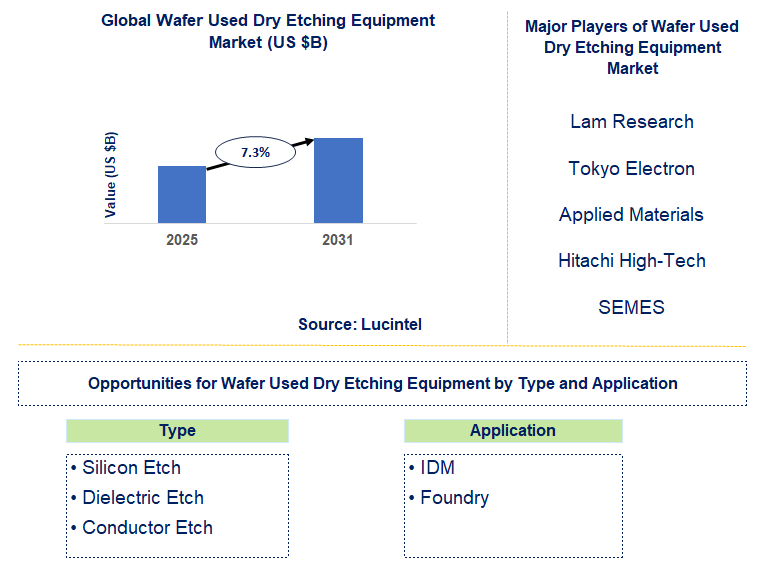
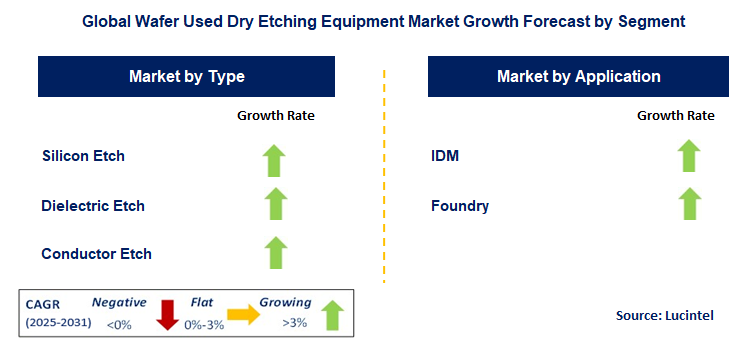
Wafer Used Dry Etching Equipment Market Trends and Forecast

Wafer Used Dry Etching Equipment Market by Segment

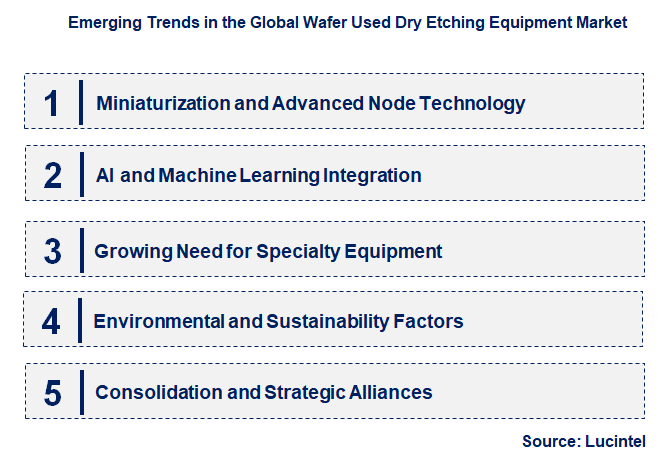
Emerging Trends in the Wafer Used Dry Etching Equipment Market

New trends in the market for wafer used dry etching equipment are dramatically rewriting the landscape of the semiconductor industry. These trends are spurred on by growing complexity of chip designs and demands for more manufacturing efficiency. New technologies and approaches are taking the industry to new heights, and a new age of innovation is unfolding. These advancements are affecting everything from the development of new equipment to how semiconductor makers operate.
• Miniaturization and Advanced Node Technology: As chip makers transition to sub-5nm and even 3nm process nodes, the need for highly accurate and consistent etching equipment is growing. Conventional etching techniques are not enough for such scales. Equipment makers are reacting by creating sophisticated solutions such as atomic layer etching (ALE), in which material is etched one atomic layer at a time. Such precision is necessary for avoiding damage to fragile chip structures and achieving high yields.
• AI and Machine Learning Integration: Integration of artificial intelligence and machine learning is a dominant trend. AI algorithms are utilized to automate etching processes, foretell maintenance requirements, and enhance equipment performance overall. Through real-time analysis from sensors and cameras, AI can make changes to process parameters in real time, minimizing defects as well as maximizing throughput. The technology also supports predictive maintenance, reducing downtime and increasing operational efficiency.
• Growing Need for Specialty Equipment: Diversification of semiconductor uses across power electronics, photonics, and MEMS is placing a growing demand on specialty dry etching equipment. These use cases frequently demand special materials and structure that cannot be accommodated by general-purpose etchers. Companies are creating customized solutions with customized plasma chemistry and chamber solutions to address these niche demands, entering new market segments and stimulating innovation within specialized areas.
• Environmental and Sustainability Factors: The semiconductor sector is becoming more concerned with minimizing its environmental impact. This is creating a trend towards environmentally more sustainable dry etching equipment. Equipment manufacturers are creating systems that will be less power-hungry, use fewer toxic process gases, and be better waste-managed. Its attention is being directed at minimizing the global warming contribution of gases and enhancing the overall energy efficiency of the fabrication process, which supports international environmental agendas.
• Consolidation and Strategic Alliances: The exorbitant cost of R&D and the sophistication of the new-age semiconductor manufacturing are pushing consolidation and strategic alliances in the industry. Firms are partnering with each other to swap expertise, capital, and expenses. This enables them to commercialize new technologies more quickly and cost-effectively. Mergers and acquisitions are also prevalent as larger firms look to acquire niche technologies or expand their geographical reach, reconfiguring the competitive landscape.
In summary, these new trends are essentially transforming the wafer dry etching equipment market. The trend towards miniaturization and higher nodes is compelling innovation in accurate etching, and the incorporation of AI is streamlining processes and improving efficiency. Demand for specialized equipment is serving varied application requirements, and the emphasis on sustainability is compelling the industry to go greener. Lastly, market consolidation and strategic alliances are making it possible for firms to meet the rising expenditures and sophistication of contemporary R&D while providing for a steady flow of technological innovations.
Emerging Trends in the Wafer Used Dry Etching Equipment Market

Recent Development in the Wafer Used Dry Etching Equipment Market

Current advances in wafer used dry etching equipment technology are a direct reaction to the constant increasing needs of the semiconductor industry. These advances are necessitated by the requirement for higher precision, increased throughput, and reduced cost of ownership. As chip makers continue to shrink the size of the chips, the technology employed in etching wafers has to advance as well. These technologies not only enhance the performance and quality of semiconductor devices but are also streamlining the manufacturing process and making it more efficient and sustainable.
• Emergence of Atomic Layer Etching Technology: ALE is a significant innovation that enables material removal one atomic layer at a time, with unheard-of precision and control. This is essential for producing advanced memory and logic chips with 3nm features. The effect of ALE is considerable because it reduces wafer damage and defects, resulting in increased yields and better device performance. ItÄX%$%Xs becoming the norm in future fabrication plants.
• Advanced Process Control System Integration: APC systems, based on sensors and real-time data that automatically set process parameters, are also becoming standard. These are important for sustained process conditions within the wafer and wafer to wafer. Their effect is a strong reduction in process variation, which results in more consistent results, increased yields, and better final product reliability.
• New Plasma Sources and Chemistries Development: Manufacturers of equipment are constantly creating new plasma sources and chemistries to manage the intricacy of new materials and chip architectures. This encompasses the utilization of unusual gases and creative chamber designs for the purpose of carrying out highly selective and anisotropic etching. The effect is increased manufacturing flexibility, making complex 3D structures possible and a broader array of semiconductor devices.
• Sustainability and Energy Efficiency: There is increased focus on creating dry etching equipment that is energy efficient and environmentally friendly in gases used. This is an answer to worldwide pressure to make the semiconductor industry more environmentally friendly. The result is lower operating costs for manufacturers and a cleaner production process. This is also affecting the design and materials for new equipment.
• 300mm and 450mm wafer processing expansion: The sector is trending towards bigger wafers to boost the quantity of chips per wafer and the lower cost per chip. This needs new dry etching equipment that can process these larger sizes with the same precision and uniformity. The effect is an improvement in manufacturing productivity significantly and lowering the total cost of semiconductor devices, propelling the sector forward.
In summary, these advancements are significantly affecting the wafer dry etching equipment market. The introduction of ALE and APC systems is propelling a new era of precision and control, while emerging plasma sources and chemistries are allowing more intricate devices to be fabricated. The emphasis on sustainability is rendering the manufacturing process more environmentally friendly, and the shift to higher wafer sizes is increasing productivity and lowering costs. These innovations are collectively creating a more sophisticated, efficient, and greener semiconductor industry.

Strategic Growth Opportunities in the Wafer Used Dry Etching Equipment Market

Strategic opportunities for growth in the wafer used dry etching equipment market are arising across different significant applications as the need for advanced semiconductor devices grows. Such opportunities are not limited to the conventional logic and memory production but also extending to new, high-growth markets. Exploiting these opportunities needs significant insight into the distinct technical needs and market dynamics of each application. These areas of growth are impacting investment strategy and R&D emphasis for equipment makers.
• Manufacturing of Memory Chips: The ongoing expansion of data centers, smartphones, and other technologies is creating a tremendous demand for memory chips, including DRAM and NAND flash. This is a key growth area for dry etching equipment. Companies are concentrating on enhancing high-aspect-ratio etching capabilities to produce sophisticated 3D NAND structures and highly selective etching for cutting-edge DRAM. The effect is an equipment market that supports higher storage density and increased data access speed.
• Microprocessor and Logic Production: More powerful and power-efficient processors for everything from AI to autonomous cars is a high growth driver. Dry etching tools with extreme accuracy are needed for producing sub-5nm features in this application. The opportunity is in creating systems that can execute sophisticated multi-patterning methods and atomic layer etching (ALE), which are necessary for producing the complex structures of todayÄX%$%Xs CPUs and GPUs.
• Wide-bandgap Semiconductors and Power Electronics: The shift towards efficient power grids, renewable energy, and electric vehicles is building a tremendous need for power electronics, which are typically based on wide-bandgap materials such as silicon carbide (Sic) and gallium nitride (Gan). These materials are ten times more difficult to etch than silicon. The opportunity is to develop specialized dry etching tools and processes that can process these materials with high throughput and accuracy to make more efficient power devices.
• MEMS and Sensors: The IoT and automotive sectors are driving a fast growth in the application of micro-electromechanical systems (MEMS) and sensors. These applications demand specialized and even deep-etching capabilities to fabricate intricate 3D structures and cantilevers. The opportunity is to offer highly flexible and adaptive dry etching solutions that can be adapted to the unique and varied requirements of MEMS producers, which tend to be different from those of traditional semiconductor production.
• Photonics and Optoelectronics: Advances in fiber optics, high-speed data transmission, and sophisticated sensing are generating new demands for photonic devices. Photonic devices need dry etching tools that can etch various materials and produce very flat, vertical sidewalls on waveguides and other optical features. The opportunity for growth is in creating equipment with specialized plasma chemistries and process control for the precise requirements of photonic device fabrication, a very fast-growing technology.
Overall, these strategic growth opportunities are remaking the wafer dry etching equipment market by broadening its base of applications. The historical dependence on memory and logic chips is being supplemented by high-growth segments such as power electronics, MEMS, and photonics. This is forcing equipment makers to innovate and create specialized solutions for each application, driving technological improvements and increasing the total market size. Companies that can successfully address these diverse needs will be well-positioned for future growth and market leadership.

Wafer Used Dry Etching Equipment Market Driver and Challenges

Wafer dry etching equipment market is presently under the grip of a very intricate interplay of key drivers and challenges. The direction of the market is being delineated by a number of technological, economic, and regulatory forces. Knowledge of these forces is important for all the stakeholders, ranging from equipment makers to semiconductor foundries. The quest for progressively smaller and more powerful chips is a key driver but countered by major challenges concerning cost, complexity, and international supply chain challenges.
The factors responsible for driving the wafer used dry etching equipment market include:
1. Miniaturization and the Urge for Future Nodes: The never-ending need for thinner, quicker, and more power-efficient devices is the main driver. With the industry migrating to sub-5nm nodes, there is a compelling need for very accurate and sophisticated etching technologies such as atomic layer etching (ALE). This is creating a cycle of investment and innovation in new equipment. The effect is a market where continual advancement of technology is a necessity to survive.
2. Expansion of Emerging Applications: Expansion of emerging markets like AI, autonomous cars, IoT, and 5G is driving a significant requirement for a wide variety of semiconductor devices. Every application requires something different, so there is a demand for specialized dry etching tools. The effect is market diversification beyond logic and memory, creating new opportunities for growth and specialization for equipment companies.
3. Government Investment and Policy: Governments globally are now seeing the strategic value of a local semiconductor industry. Plans such as the U.S. CHIPS Act, the EU Chips Act, and similar efforts in China and India are offering substantial investment for new fabrication plants. The effect is an increase in demand for new and leading-edge dry etching tools as firms construct or increase their manufacturing capacity.
4. Material Science Advancements: New materials such as wide-bandgap semiconductors (Sic, Gan) and complex multi-layer structures need sophisticated etching solutions. This presents a strong innovation driver for plasma chemistry and equipment design. The effect is a market in which firms with qualification to deal with these new materials are increasingly establishing themselves with a competitive edge and increased market share.
5. Productivity Gains and Automation: The quest for higher efficiency and reduced cost of ownership is encouraging AI and machine learning integration into dry etching tools. Such technologies maximize processes, enhance yields, and facilitate predictive maintenance. The result is more intelligent and autonomous systems that can run with limited human interaction, cutting costs of operation and increasing throughput.
Challenges in the wafer used dry etching equipment market are:
1. High R&D Cost and Equipment: It is a capital-intensive task to design and produce cutting-edge dry etching equipment. The high R&D cost and the pricey nature of the equipment can prove to be a hurdle for the entry of new players. The effect is a concentration of the market in the hands of a limited number of large players who have the investment needed to remain technological leaders.
2. Vulnerabilities in the Supply Chain: The globalized nature of the semiconductor business exposes the equipment and component supply chain to disruption. Geopolitics, trade tensions, and logistics issues can disrupt production and affect the stability of the market. The effect is a greater emphasis on supply chain resiliency and diversification, where companies are looking to create stronger and regionalized supply chains.
3. Manufacturing Complexity and Technical Challenges: With the industry moving to advanced nodes, the technical complexity of dry etching goes up geometrically. It is quite challenging to achieve uniform, damage-free etching at the atomic level over a big wafer. The consequence is an essential requirement for highly experienced engineers and constant investment in R&D to overcome these technical challenges to fulfill the severe requirements of chip makers.
Finally, the wafer dry etching equipment industry stands at a crossroads, with strong drivers demanding innovation and growth while powerful challenges pose obstructions to advancement. The continuous drive for miniaturization, the development of new applications, and government subsidies are driving demand and technical innovation into a frenzy. But the elevated prices, supply chain risks, and technological intricacies are compelling firms to merge, spend heavily on R&D, and create stronger business models. Overall, the effect is a highly competitive, rapidly changing market influenced by demands for technological superiority and operational excellence.

List of Wafer Used Dry Etching Equipment Companies

Companies in the market compete on the basis of product quality offered. Major players in this market focus on expanding their manufacturing facilities, R&D investments, infrastructural development, and leverage integration opportunities across the value chain. With these strategies wafer used dry etching equipment companies cater increasing demand, ensure competitive effectiveness, develop innovative products & technologies, reduce production costs, and expand their customer base. Some of the wafer used dry etching equipment companies profiled in this report include-
• Lam Research
• Tokyo Electron
• Applied Materials
• Hitachi High-Tech
• SEMES
• AMEC
• NAURA
• SPTS Technologies
• Oxford Instruments
• ULVAC

Wafer Used Dry Etching Equipment Market by Segment

The study includes a forecast for the global wafer used dry etching equipment market by type, application, and region.

Wafer Used Dry Etching Equipment Market by Type [Value from 2019 to 2031]:


• Silicon Etch
• Dielectric Etch
• Conductor Etch

Wafer Used Dry Etching Equipment Market by Application [Value from 2019 to 2031]:


• IDM
• Foundry

Wafer Used Dry Etching Equipment Market by Region [Value from 2019 to 2031]:


• North America
• Europe
• Asia Pacific
• The Rest of the World

Country Wise Outlook for the Wafer Used Dry Etching Equipment Market

Recent trends in the wafer used dry etching equipment industry are fueled by the never-ending need for faster, more efficient, and smaller energy-saving semiconductor devices. This worldwide trend is forcing producers to innovate, with an emphasis on higher accuracy, greater throughput, and reduced cost of ownership. The industry is marked by fierce competition and high-speed technological innovation, with market leaders heavily investing in R&D to address the sophisticated needs of next-generation semiconductor manufacturing. These technologies are influencing competitive dynamics and strategic formulation across global firms.
• United States: The American market is leading the charge in terms of technological innovation, with a great focus placed on creating high-end dry etching solutions for sub-10nm nodes. Businesses are taking advantage of atomic layer etching (ALE) and plasma-enhanced atomic layer deposition (PEALD) to provide unmatched accuracy and control. The governmentÄX%$%Xs CHIPS Act is also accelerating domestic production, which is translating into huge investments in new fabrication plants and R&D facilities. This is creating demand for cutting-edge equipment.
• China: China is quickly building up its homegrown semiconductor industry to decrease foreign dependence on technology. The government has heavily invested in local equipment makers, encouraging self-reliance. The result has been high demand for domestically manufactured dry etching systems. Though still lagging behind the world leaders in cutting-edge technology, Chinese firms are gaining ground on producing equipment for advanced nodes as well as pushing hard on R&D to bridge the technology gap.
• Germany: German market is dominated by a high emphasis on high-precision and specialty applications, especially automotive, industrial, and power electronics. German players are using their strength in engineering to create strong and stable dry etching equipment. They are also at the forefront of applying Industry 4.0 concepts, combining artificial intelligence and machine learning to maximize process control, predictive maintenance, and factory efficiency.
• India: IndiaÄX%$%Xs semiconductor industry is in a state of infancy but burgeoning growth stage. Initiatives by the government to make India the hub for semiconductor manufacturing are opening up new avenues for equipment suppliers. Though India remains dependent on foreign equipment at present, there is an increasing initiative to develop a domestic ecosystem. This is instigating demand for cost-efficient and dependable dry etching technology suitable for both R&D and future large-scale production.
• Japan: Japan continues to be a prominent participant in the international semiconductor equipment industry, with a reputation for manufacturing reliable and high-quality equipment. The Japanese corporations are placing emphasis on creating dry etching systems that provide high-speed, high-precision, and low-damage processing. They are also working with international partners to integrate their equipment into high-end semiconductor manufacturing lines, especially for memory and logic chip manufacturing. The focus is on continuous development and meeting the highly demanding requirements of leading-edge technology.

Lucintel Analytics Dashboard

Features of the Global Wafer Used Dry Etching Equipment Market

Market Size Estimates: Wafer used dry etching equipment market size estimation in terms of value ($B).
Trend and Forecast Analysis: Market trends (2019 to 2024) and forecast (2025 to 2031) by various segments and regions.
Segmentation Analysis: Wafer used dry etching equipment market size by type, application, and region in terms of value ($B).
Regional Analysis: Wafer used dry etching equipment market breakdown by North America, Europe, Asia Pacific, and Rest of the World.
Growth Opportunities: Analysis of growth opportunities in different types, applications, and regions for the wafer used dry etching equipment market.
Strategic Analysis: This includes M&A, new product development, and competitive landscape of the wafer used dry etching equipment market.
Analysis of competitive intensity of the industry based on Porter’s Five Forces model.

Lucintel Consulting Services

FAQ

Q1. What is the growth forecast for wafer used dry etching equipment market?
Answer: The global wafer used dry etching equipment market is expected to grow with a CAGR of 7.3% from 2025 to 2031.
Q2. What are the major drivers influencing the growth of the wafer used dry etching equipment market?
Answer: The major drivers for this market are the increasing demand for semiconductor devices, the rising adoption of miniaturized electronics, and the growing need for advanced manufacturing processes.
Q3. What are the major segments for wafer used dry etching equipment market?
Answer: The future of the wafer used dry etching equipment market looks promising with opportunities in the IDM and foundry markets.
Q4. Who are the key wafer used dry etching equipment market companies?
Answer: Some of the key wafer used dry etching equipment companies are as follows:
• Lam Research
• Tokyo Electron
• Applied Materials
• Hitachi High-Tech
• SEMES
• AMEC
• NAURA
• SPTS Technologies
• Oxford Instruments
• ULVAC
Q5. Which wafer used dry etching equipment market segment will be the largest in future?
Answer: Lucintel forecasts that, within the type category, silicon etch is expected to witness the highest growth over the forecast period.
Q6. In wafer used dry etching equipment market, which region is expected to be the largest in next 5 years?
Answer: In terms of region, APAC is expected to witness the highest growth over the forecast period.
Q7. Do we receive customization in this report?
Answer: Yes, Lucintel provides 10% customization without any additional cost.

This report answers following 11 key questions:

Q.1. What are some of the most promising, high-growth opportunities for the wafer used dry etching equipment market by type (silicon etch, dielectric etch, and conductor etch), application (IDM and foundry), and region (North America, Europe, Asia Pacific, and the Rest of the World)?
Q.2. Which segments will grow at a faster pace and why?
Q.3. Which region will grow at a faster pace and why?
Q.4. What are the key factors affecting market dynamics? What are the key challenges and business risks in this market?
Q.5. What are the business risks and competitive threats in this market?
Q.6. What are the emerging trends in this market and the reasons behind them?
Q.7. What are some of the changing demands of customers in the market?
Q.8. What are the new developments in the market? Which companies are leading these developments?
Q.9. Who are the major players in this market? What strategic initiatives are key players pursuing for business growth?
Q.10. What are some of the competing products in this market and how big of a threat do they pose for loss of market share by material or product substitution?
Q.11. What M&A activity has occurred in the last 5 years and what has its impact been on the industry?

For any questions related to Wafer Used Dry Etching Equipment Market, Wafer Used Dry Etching Equipment Market Size, Wafer Used Dry Etching Equipment Market Growth, Wafer Used Dry Etching Equipment Market Analysis, Wafer Used Dry Etching Equipment Market Report, Wafer Used Dry Etching Equipment Market Share, Wafer Used Dry Etching Equipment Market Trends, Wafer Used Dry Etching Equipment Market Forecast, Wafer Used Dry Etching Equipment Companies, write Lucintel analyst at email: helpdesk@lucintel.com. We will be glad to get back to you soon.
                                                            Table of Contents

            1. Executive Summary

            2. Global Wafer Used Dry Etching Equipment Market : Market Dynamics
                        2.1: Introduction, Background, and Classifications
                        2.2: Supply Chain
                        2.3: Industry Drivers and Challenges

            3. Market Trends and Forecast Analysis from 2019 to 2031
                        3.1. Macroeconomic Trends (2019-2024) and Forecast (2025-2031)
                        3.2. Global Wafer Used Dry Etching Equipment Market Trends (2019-2024) and Forecast (2025-2031)
                        3.3: Global Wafer Used Dry Etching Equipment Market by Type
                                    3.3.1: Silicon Etch
                                    3.3.2: Dielectric Etch
                                    3.3.3: Conductor Etch
                        3.4: Global Wafer Used Dry Etching Equipment Market by Application
                                    3.4.1: IDM
                                    3.4.2: Foundry

            4. Market Trends and Forecast Analysis by Region from 2019 to 2031
                        4.1: Global Wafer Used Dry Etching Equipment Market by Region
                        4.2: North American Wafer Used Dry Etching Equipment Market
                                    4.2.1: North American Market by Type: Silicon Etch, Dielectric Etch, and Conductor Etch
                                    4.2.2: North American Market by Application: IDM and Foundry
                        4.3: European Wafer Used Dry Etching Equipment Market
                                    4.3.1: European Market by Type: Silicon Etch, Dielectric Etch, and Conductor Etch
                                    4.3.2: European Market by Application: IDM and Foundry
                        4.4: APAC Wafer Used Dry Etching Equipment Market
                                    4.4.1: APAC Market by Type: Silicon Etch, Dielectric Etch, and Conductor Etch
                                    4.4.2: APAC Market by Application: IDM and Foundry
                        4.5: ROW Wafer Used Dry Etching Equipment Market
                                    4.5.1: ROW Market by Type: Silicon Etch, Dielectric Etch, and Conductor Etch
                                    4.5.2: ROW Market by Application: IDM and Foundry

            5. Competitor Analysis
                        5.1: Product Portfolio Analysis
                        5.2: Operational Integration
                        5.3: Porter’s Five Forces Analysis

            6. Growth Opportunities and Strategic Analysis
                        6.1: Growth Opportunity Analysis
                                    6.1.1: Growth Opportunities for the Global Wafer Used Dry Etching Equipment Market by Type
                                    6.1.2: Growth Opportunities for the Global Wafer Used Dry Etching Equipment Market by Application
                                    6.1.3: Growth Opportunities for the Global Wafer Used Dry Etching Equipment Market by Region
                        6.2: Emerging Trends in the Global Wafer Used Dry Etching Equipment Market
                        6.3: Strategic Analysis
                                    6.3.1: New Product Development
                                    6.3.2: Capacity Expansion of the Global Wafer Used Dry Etching Equipment Market
                                    6.3.3: Mergers, Acquisitions, and Joint Ventures in the Global Wafer Used Dry Etching Equipment Market
                                    6.3.4: Certification and Licensing

            7. Company Profiles of Leading Players
                        7.1: Lam Research
                        7.2: Tokyo Electron
                        7.3: Applied Materials
                        7.4: Hitachi High-Tech
                        7.5: SEMES
                        7.6: AMEC
                        7.7: NAURA
                        7.8: SPTS Technologies
                        7.9: Oxford Instruments
                        7.10: ULVAC
.

Buy full report or by chapter as follows

Limited Time Offer

Price by License Type:
[-] Hide Chapter Details
[Chapter Number] [Chapter Name] [Chapter Number Of Pages] [Chapter Price]
Title/Chapter Name Pages Price
Full Report: Wafer Used Dry Etching Equipment Market Report: Trends, Forecast and Competitive Analysis to 2031 Full Report $ 2,990
A 150 Page Report
Lucintel has been in the business of market research and management consulting since 2000 and has published over 1000 market intelligence reports in various markets / applications and served over 1,000 clients worldwide. This study is a culmination of four months of full-time effort performed by Lucintel's analyst team. The analysts used the following sources for the creation and completion of this valuable report:
  • In-depth interviews of the major players in this market
  • Detailed secondary research from competitors’ financial statements and published data 
  • Extensive searches of published works, market, and database information pertaining to industry news, company press releases, and customer intentions
  • A compilation of the experiences, judgments, and insights of Lucintel’s professionals, who have analyzed and tracked this market over the years.
Extensive research and interviews are conducted across the supply chain of this market to estimate market share, market size, trends, drivers, challenges, and forecasts. Below is a brief summary of the primary interviews that were conducted by job function for this report.
 
Thus, Lucintel compiles vast amounts of data from numerous sources, validates the integrity of that data, and performs a comprehensive analysis. Lucintel then organizes the data, its findings, and insights into a concise report designed to support the strategic decision-making process. The figure below is a graphical representation of Lucintel’s research process. 
 

Please sign in below to get report brochure - Wafer Used Dry Etching Equipment Market Report.

At Lucintel, we respect your privacy and maintain the confidentiality of information / data provided by you
(Please enter your corporate email. * These fields are mandatory )

Follow us on

