
Close Lucintel Chat
Didn't Find What You're Looking for?
Call us at +1972 636 5056 or write at helpdesk@Lucintel.com
Ask an Expert Provide Custom Requirements Download Sample Report Search Available Reports
  • helpdesk@Lucintel.com
  • |
  • Call Lucintel +1 972 636 5056
  • |
  • Login
  • |
  • Register
  • |
  • Search
  • |
'
...

The Impact of COVID-19 is included in Viscosity Index Improver Market Report. Buy it today to get an advantage.

Request the impact of COVID-19 on your product or industry


Viscosity Index Improver Market Trends and Forecast

The future of the global viscosity index improver market looks promising with opportunities in the engine oil, transmission fluid, hydraulic fluid, and gear oil markets. The global viscosity index improver market is expected to grow with a CAGR of 3.9% from 2025 to 2031. The major drivers for this market are the increasing demand for high-performance lubricants, the rising adoption of advanced automotive technologies, and the growing need for energy-efficient industrial solutions.

• Lucintel forecasts that, within the type category, olefin copolymers based is expected to witness higher growth over the forecast period.
• Within the application category, engine oil is expected to witness the highest growth.
• In terms of region, APAC is expected to witness the highest growth over the forecast period.
Gain valuable insights for your business decisions with our comprehensive 150+ page report. Sample figures with some insights are shown below.
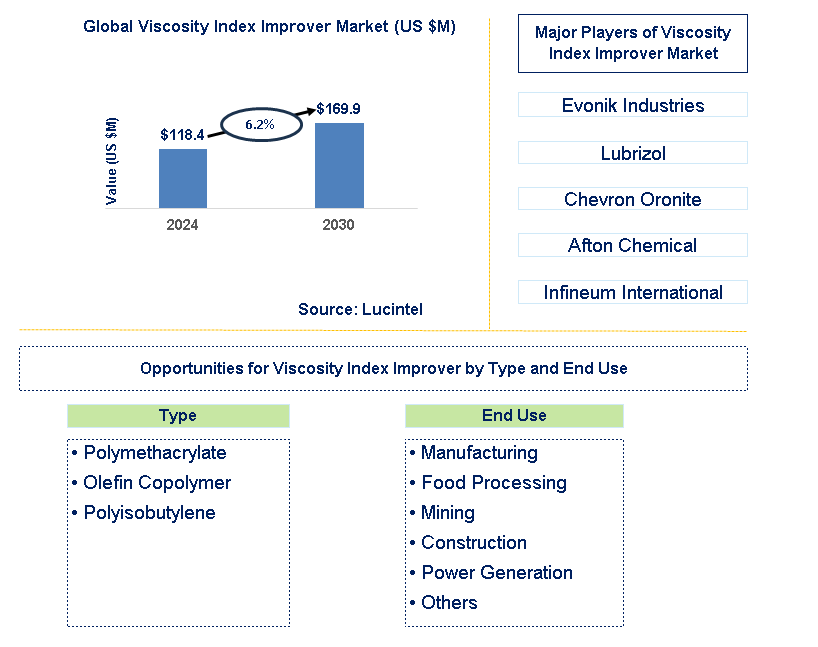
Viscosity Index Improver Market Trends and Forecast

Emerging Trends in the Viscosity Index Improver Market

New trends in the viscosity index improver industry mirror a wider move towards sustainability, cutting-edge technology, and changing consumer expectations. These trends are revolutionizing the way lubricants are developed, manufactured, and applied in different industries. The main drivers of these changes are growing environmental consciousness, the shift to electric mobility, and ongoing demands for improved efficiency and performance in equipment.
• Bio-based and Sustainable: The impetus for this trend comes from increased global environmental regulation as well as increased focus on sustainability. Bio-based VIIs, which are made from renewable materials, provide a greener solution to conventional petroleum-based options. Their use enables companies to lower their carbon footprint as well as meet emerging regulations. This revolution is also paving the way for a new competitive environment, with manufacturers investing in R&D for producing high-performance bio-based products capable of matching or even surpassing the performance of traditional VIIs, especially with regard to shear stability and thermal resistance.
• Increasing Demand for High-Performance Lubricants: Today’s engines and industrial equipment run in more arduous conditions, such as increased temperatures and pressures. This requires lubricants that are capable of offering better performance and wear life. This trend drives the need for high-performance VIIs with better shear stability and thermal durability, which can keep lubricants effective for longer periods.
• Expansion of the Electric Vehicle Market: The sudden growth of the EV sector has a large new application area for VIIs. Although EVs do not need conventional engine lubricants, their drivetrain and thermal management systems require specific fluids. These fluids, or e-fluids, require very good thermal stability as well as electrical characteristics, and VIIs are important for making them work at their best viscosity.
• Polymer Technology Advancements: Continued breakthroughs in polymer chemistry are resulting in new VIIs with improved performance attributes. These innovations are leading to more economical formulations that need lower treat rates to produce the desired viscosity profile. Improved polymer structures are enhancing shear stability and lessening the lubricant’s tendency to thin during high stress. This makes it possible to design new high-performance, multi-grade oils that deliver improved fuel economy and engine protection.
• Growing Emphasis on Regulation Compliance: Governments and regulatory agencies globally are putting in place more stringent requirements for lubricant performance and environmental contribution. Such regulations, including those for fuel economy and emissions, are a major force behind the VII market. Companies have to keep innovating to develop products that not only comply with but surpass these regulations. This emphasis on compliance incentivizes the production of more effective and ecologically friendly VIIs, propelling the industry toward a greener future.
The trends described above are as a whole reconfiguring the viscosity index improver market. The pull of sustainability, fueled by environmental and regulatory imperatives, is spurring growth in bio-based and green products. At the same time, the emerging trend toward advanced engine technologies and EVs is driving new requirements for highly specialized, high-performance VIIs. This dynamic marketplace is compelling producers to direct significant investment in R&D, develop new product offerings, and change business models to take advantage of these opportunities.
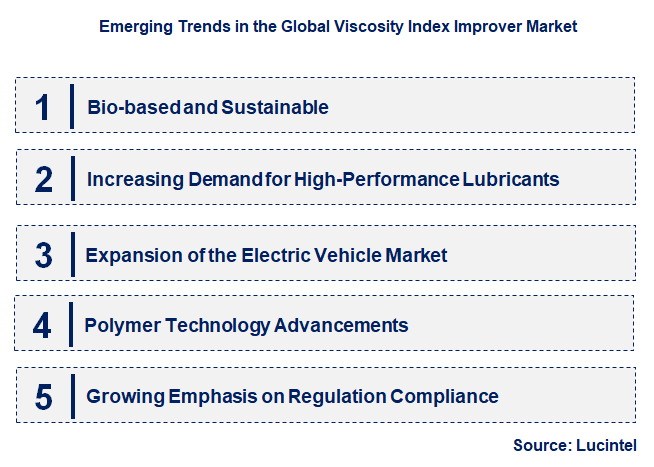
Emerging Trends in the Viscosity Index Improver Market

Recent Development in the Viscosity Index Improver Market

Current trends in the viscosity index improver business are a direct consequence of the most significant trends and challenges confronted by the global lubricant industry. Trends, triggered by technological advancements and changing market conditions, are shaping a new environment for producers and consumers. The emphasis lies on enhancing product performance, compliance with high environmental standards, and adjustment to the evolving demands of the automobile and industrial industries.
• Upgrade of Olefin Copolymer Manufacturing: In recent years, a considerable upgrade in production capacity for olefin copolymer (OCP) VIIs has been witnessed. This innovation is driven by the increasing demand for high-performance lubricants due to the fact that OCPs have good shear stability and efficiency in thickening. This growth is most pronounced in the Asia-Pacific, specifically China and India, to serve their rapidly growing automotive and industrial markets.
• Strategic Collaborations and Partnerships: Giant VII industry players like Chevron Orgonite and Infineum International are creating strategic collaborations and partnerships with manufacturers of lubricants and other chemical players. This move is to co-develop new, high-end VII formulations and broaden their market penetration. The collaborations enable the sharing of resources and expertise to speed up the innovation process.
• R&D Investment in New Polymer Formulations: Investment in R&D by major market participants to create next-generation polymer formulations has witnessed a sharp increase. This innovation aims to develop VIIs that are superior in performance with regards to thermal stability, shear stability, and compatibility with new base oils like Group IV and V synthetic oils. The aim is to make highly effective additives that can be applied at lower treat rates while maintaining the stringent performance demands of latest lubricants.
• Emphasis on Sustainable and Biodegradable Solutions: The industry is going all out to develop and sell sustainable and biodegradable VIIs. This move is in retaliation to growing environmental regulations and customers’ demand for environmentally friendly products. Businesses are seeking out new bio-based raw materials and production technologies to minimize the environmental impact of their products. The move serves not only to ensure regulatory compliance but also to create new market opportunities in those industries where environment is a top priority, including marine and agricultural lubricants.
• Use of Digital and Smart Technologies: The market for viscosity index improvers is adopting digital and smart technologies to streamline production and supply chain management. The process entails the application of data analytics, IoT sensors, and AI-based systems to track and regulate manufacturing processes to ensure product consistency and quality. In addition, the combination of intelligent technologies with lubricants, like fluid condition sensors that provide real-time monitoring, is generating new value propositions.
These major developments are profoundly affecting the viscosity index improver market. The growth in OCP production and strategic alliances are building supply chain resilience and driving innovation. The enhanced R&D investment and emphasis on sustainable solutions are raising the performance level of the products and the environmental performance of the company. Meanwhile, the use of digital technologies is making operations more efficient and providing new opportunities for value-added services.

Strategic Growth Opportunities in the Viscosity Index Improver Market

Viscosity index improver market growth opportunities of a strategic nature are arising from multiple applications as industries undergo change and new technologies emerge. Lubricant demand is becoming increasingly specialized, where there is a need for customized solutions that provide improved performance in particular operating conditions. These opportunities are not only motivated by the necessity for improved efficiency and durability but also by the need to meet new regulations and adopt sustainability.
• Car Engine Oils: The vehicle industry continues to be the largest user of VIIs, and strong growth prospects are in the development of next-generation engine oils. The trend towards smaller turbocharged engines and extended oil drain intervals necessitates VIIs with superior shear stability and thermal tolerance. Companies can ride this trend by developing niche VIIs that help reduce fuel consumption and emissions, conforming to the latest API and ACEA specifications. The drive for performance in premium and synthetic motor oils offers an attractive market for innovative, high-performance VIIs that can guarantee engine longevity and maximum performance.
• Electric Vehicle Drivetrain Fluids: The rapidly unfolding global adoption of EVs offers a significant new growth opportunity. Although EVs have no need for engine oil, their drivetrains, transmissions, and thermal management systems use specialized e-fluids. These fluids require high viscosity stability, superior heat transfer, and electrical insulation. VII makers have a strategic role to create specialized polymer additives that blend with these new materials.
• Industrial Hydraulic Fluids: Industrial equipment, especially in industries such as construction, mining, and manufacturing, experiences high temperature and pressure and requires hydraulic fluids that have a stable viscosity. This application offers a market expansion opportunity to VIIs capable of improving the anti-wear properties and shear stability of hydraulic fluids. Formulating long-term and high-performance VIIs can assist end-users in lowering maintenance costs and increasing operational efficiency.
• Automatic Transmission Fluids: New automatic transmissions are more compact and complex in design, and thus there is a need for ATFs that can withstand extreme temperature conditions and shear forces. This is a key growth opportunity for VIIs with improved shear stability and cold fluidity. Manufacturers can emphasize producing additives that allow ATFs to offer smooth shifting and lower energy loss, thus enhancing fuel efficiency.
• Wind Turbine Gear Oils: The global renewable energy industry is growing, and wind turbines are one of the major uses for high-performance lubricants. Wind turbine gearboxes work under heavy loading and varying temperatures, necessitating the use of gear oils that provide viscosity stability and wear and corrosion protection. This provides a niche but high-growth market for VII manufacturers. Creating specialized VIIs capable of prolonging the working life of wind turbine gear oils, lowering downtime during maintenance, and enhancing overall efficiency becomes imperative.
These strategic growth opportunities are greatly influencing the viscosity index improver market. They’re forcing the industry to expand its product spectrum beyond conventional uses and innovate for novel, niche applications. High-performance and sustainability are increasingly emerging as a differentiator. By meeting the specific demands of nascent industries such as EVs and renewables while further enhancing offerings in traditional markets such as automotive engine oils, producers can bank on long-term market expansion and dominance.

Viscosity Index Improver Market Driver and Challenges

Viscosity index improver market is influenced by a multifaceted interaction of key drivers and issues. The rising need for high-performance lubricants and the global trend for sustainability are the key drivers pushing the growth in the market. But the industry also has considerable challenges, such as volatile raw material costs, trends toward extended oil drain intervals, and intense competition. These issues together shape market forces, technological advancements, and strategic directions for manufacturers.
The factors responsible for driving the viscosity index improver market include:
1. Increasing Need for High-Performance Lubricants: Contemporary engines and machinery are exposed to more stringent conditions, requiring lubricants with better performance features. The need for high-performance VIIs that will be able to provide optimal viscosity over a broad temperature spectrum, enhance fuel economy, minimize wear, and increase equipment life increases demand. The trend towards miniaturized, higher-performance engines and sophisticated industrial equipment creates this as an ongoing driver of growth.
2. Growing Automotive Sales and Production: The global automotive sector, especially in emerging markets, is a key driver of the VII market. With more passenger and commercial vehicles on the road, the demand for engine oils, transmission fluids, and other lubricants that have VIIs rises. This driver has special vigor in markets such as Asia-Pacific, where urbanization and disposable incomes are increasingly fueling new car purchases and fleet growth.
3. Tougher Environmental Laws: Governments across the globe are enacting tougher laws to lower the emissions of vehicles and industrial pollutants. This has spurred the creation of new lubricant specifications calling for low-volatility and high-performance additives. VIIs are key to making these new formulations possible, which are formulated to enhance fuel economy and reduce the environmental footprint of lubricants. This government pressure is one of the primary drivers propelling the industry towards greener and more efficient products.
4. Technological Developments in Lubricant Formulations: Ongoing R&D in lubricant technology is the key driver. New base oils and additive packages demand sophisticated VIIs that are compatible and can deliver synergistic benefits. Advances in polymer chemistry are helping to develop VIIs with improved shear stability, thickening efficiency, and low-temperature performance. These developments enable formulators to produce premium, multi-grade lubricants that meet the changing needs of the market.
5. Growth of Industrial and Manufacturing Industries: The rise in industrial and manufacturing operations, particularly in developing nations, is increasing the demand for industrial lubricants. The heavy equipment, hydraulic systems, and metalworking operations call for lubricants that can meet rigorous conditions. VIIs play a vital role in guaranteeing the performance and stability of such lubricants, and as such, are an indispensable factor to support operational effectiveness and decrease downtime in such industries.
Challenges in the viscosity index improver market are:
1. Unstable Raw Material Prices: Manufacture of VIIs, especially olefin copolymers (OCPs) and polymethacrylates (PMAs), is greatly dependent on petrochemical feedstocks. The price volatility of crude oil directly affects the raw material costs. Such volatility introduces unpredictability for manufacturers, and stable profit margins as well as pricing strategies become unviable. It also becomes challenging for long-term planning and investment as unexpected spikes in prices can upset the supply chain.
2. Extended Oil Drain Intervals: Developments in lubricant technology, such as application of high-performance VIIs, have increased the engine oil and industrial lubricant service life. Although a boon to consumers, this trend poses a challenge to market volume. With less frequent changes of oils, total consumption of lubricants, and hence VIIs, goes down.
3. Competition of Unorganized and Local Players: Having unorganized and local players in emerging markets is a very important challenge. They tend to sell products at low prices, using local supply chains and distribution networks. This makes it hard for large global makers to compete on price, constraining their market share and investment horizons in these markets. It calls for emphasis on product differentiation by means of better performance and quality.
Overall, the viscosity index improver market is fueled by the irrepressible demand for high-performance lubricants, driven by technology development and expansion in the automotive and industrial industries. These drivers are pushing the industry towards innovation and efficiency and sustainability. But the market is also faced with serious threats from outside forces such as fluctuating raw material prices and internal pressures such as increased oil drain intervals and aggressive moves from local competitors.

List of Viscosity Index Improver Companies

Companies in the market compete on the basis of product quality offered. Major players in this market focus on expanding their manufacturing facilities, R&D investments, infrastructural development, and leverage integration opportunities across the value chain. With these strategies viscosity index improver companies cater increasing demand, ensure competitive effectiveness, develop innovative products & technologies, reduce production costs, and expand their customer base. Some of the viscosity index improver companies profiled in this report include-
• Lubrizol
• Chevron Oronite
• Infineum
• Afton Chemical
• BASF
• Evonik
• Sanyo Chemical
• BRB International
• Shenyang Great Wall Lubricant
• Jinzhou Kangtai Lubricant Additives

Viscosity Index Improver Market by Segment

The study includes a forecast for the global viscosity index improver market by type, application, and region.

Viscosity Index Improver Market by Type [Value from 2019 to 2031]:


• Olefin Copolymers Based
• Polymethacrylate Based
• Others

Viscosity Index Improver Market by Application [Value from 2019 to 2031]:


• Engine Oils
• Transmission Fluids
• Hydraulic Fluids
• Gear Oils
• Others

Viscosity Index Improver Market by Region [Value from 2019 to 2031]:


• North America
• Europe
• Asia Pacific
• The Rest of the World

Country Wise Outlook for the Viscosity Index Improver Market

The market for viscosity index improver is witnessing vigorous growth, fueled by the worldwide demand for high-performance lubricants. VIIs are polymer additives used in lubricating oils to maintain stable viscosity over a broad spectrum of temperatures, providing optimal engine and machinery performance. This demand is especially strong in the automotive and industrial markets, where technological advancements necessitate lubricants that can survive harsh environments.
• United States: The United States market is the largest consumer of VIIs, with a mature automobile industry and high emphasis on high-performance lubricants. Current trends focus on satisfying more stringent emissions and fuel economy requirements. This has resulted in growing demand for better synthetic and semi-synthetic lubricants with high-quality VIIs. An emerging trend is the integration of VIIs into electric vehicle (EV) fluids at a higher level.
• China: The VII market of China is fueled by fast-paced industrialization and the globe’s largest automotive market. The nation is a core manufacturing hub that drives demand for both industrial and automotive lubricants. Recent trends involve a big drive towards local production and autonomy to lower dependence on imports in the face of geopolitical tensions. Moreover, China is leading the world EV revolution, and this is propelling the demand for new, high-performance lubricant formulations.
• Germany: Germany’s VII market is influenced by its global-famous automotive and engineering sectors. Its emphasis is on delivering high-quality, precision-engineered lubricants to improve performance and longevity. New trends are characterized by a bias towards innovation and compliance with regulations. Tight environmental controls in the European Union are challenging German producers to make more environmentally friendly, bio-based VIIs and to enhance the energy efficiency of their products.
• India: India is the third-largest consumer of lubricants in the world, and its market for VIIs is seeing tremendous growth. This is being driven by expanding industrialization, a fast-growing automotive market, and rising investments in infrastructure. Recent trends have seen an upsurge in demand for economy-high performance lubricants for passenger as well as commercial vehicles. The industry is also witnessing an increase in manufacturing and construction activity, enhancing the use of industrial lubricants.
• Japan: Japan’s VII market is dominated by technological advancement and emphasis on quality. The nation’s automotive sector, which boasts precision engineering and hybrid car technology, is one of the main customers for high-end lubricants. Current developments are stimulated by investment in research and development (R&D) to design state-of-the-art VIIs that enhance fuel efficiency and pass demanding performance tests. Like Germany, there is strong pressure to develop solutions for the expanding EV and hybrid car segments.

Lucintel Analytics Dashboard

Features of the Global Viscosity Index Improver Market

Market Size Estimates: Viscosity index improver market size estimation in terms of value ($B).
Trend and Forecast Analysis: Market trends (2019 to 2024) and forecast (2025 to 2031) by various segments and regions.
Segmentation Analysis: Viscosity index improver market size by type, application, and region in terms of value ($B).
Regional Analysis: Viscosity index improver market breakdown by North America, Europe, Asia Pacific, and Rest of the World.
Growth Opportunities: Analysis of growth opportunities in different types, applications, and regions for the viscosity index improver market.
Strategic Analysis: This includes M&A, new product development, and competitive landscape of the viscosity index improver market.
Analysis of competitive intensity of the industry based on Porter’s Five Forces model.

Lucintel Consulting Services

FAQ

Q1. What is the growth forecast for viscosity index improver market?
Answer: The global viscosity index improver market is expected to grow with a CAGR of 3.9% from 2025 to 2031.
Q2. What are the major drivers influencing the growth of the viscosity index improver market?
Answer: The major drivers for this market are the increasing demand for high-performance lubricants, the rising adoption of advanced automotive technologies, and the growing need for energy-efficient industrial solutions.
Q3. What are the major segments for viscosity index improver market?
Answer: The future of the viscosity index improver market looks promising with opportunities in the engine oil, transmission fluid, hydraulic fluid, and gear oil markets.
Q4. Who are the key viscosity index improver market companies?
Answer: Some of the key viscosity index improver companies are as follows:
• Lubrizol
• Chevron Oronite
• Infineum
• Afton Chemical
• BASF
• Evonik
• Sanyo Chemical
• BRB International
• Shenyang Great Wall Lubricant
• Jinzhou Kangtai Lubricant Additives
Q5. Which viscosity index improver market segment will be the largest in future?
Answer: Lucintel forecasts that, within the type category, olefin copolymers based is expected to witness higher growth over the forecast period.
Q6. In viscosity index improver market, which region is expected to be the largest in next 5 years?
Answer: In terms of region, APAC is expected to witness the highest growth over the forecast period.
Q7. Do we receive customization in this report?
Answer: Yes, Lucintel provides 10% customization without any additional cost.

This report answers following 11 key questions:

Q.1. What are some of the most promising, high-growth opportunities for the viscosity index improver market by type (olefin copolymers based, polymethacrylate based, and others), application (engine oils, transmission fluids, hydraulic fluids, gear oils, and others), and region (North America, Europe, Asia Pacific, and the Rest of the World)?
Q.2. Which segments will grow at a faster pace and why?
Q.3. Which region will grow at a faster pace and why?
Q.4. What are the key factors affecting market dynamics? What are the key challenges and business risks in this market?
Q.5. What are the business risks and competitive threats in this market?
Q.6. What are the emerging trends in this market and the reasons behind them?
Q.7. What are some of the changing demands of customers in the market?
Q.8. What are the new developments in the market? Which companies are leading these developments?
Q.9. Who are the major players in this market? What strategic initiatives are key players pursuing for business growth?
Q.10. What are some of the competing products in this market and how big of a threat do they pose for loss of market share by material or product substitution?
Q.11. What M&A activity has occurred in the last 5 years and what has its impact been on the industry?

For any questions related to Viscosity Index Improver Market, Viscosity Index Improver Market Size, Viscosity Index Improver Market Growth, Viscosity Index Improver Market Analysis, Viscosity Index Improver Market Report, Viscosity Index Improver Market Share, Viscosity Index Improver Market Trends, Viscosity Index Improver Market Forecast, Viscosity Index Improver Companies, write Lucintel analyst at email: helpdesk@lucintel.com. We will be glad to get back to you soon.
                                           Table of Contents

            1. Executive Summary

            2. Market Overview

                        2.1 Background and Classifications
                        2.2 Supply Chain

            3. Market Trends & Forecast Analysis

                        3.1 Macroeconomic Trends and Forecasts
                        3.2 Industry Drivers and Challenges
                        3.3 PESTLE Analysis
                        3.4 Patent Analysis
                        3.5 Regulatory Environment
                        3.6 Global Viscosity Index Improver Market Trends and Forecast

            4. Global Viscosity Index Improver Market by Type

                        4.1 Overview
                        4.2 Attractiveness Analysis by Type
                        4.3 Olefin Copolymers Based : Trends and Forecast 2025 to 2031
                        4.4 Polymethacrylate Based : Trends and Forecast 2025 to 2031
                        4.5 Others : Trends and Forecast 2025 to 2031

            5. Global Viscosity Index Improver Market by Application

                        5.1 Overview
                        5.2 Attractiveness Analysis by Application
                        5.3 Engine Oils : Trends and Forecast 2025 to 2031
                        5.4 Transmission Fluids : Trends and Forecast 2025 to 2031
                        5.5 Hydraulic Fluids : Trends and Forecast 2025 to 2031
                        5.6 Gear Oils : Trends and Forecast 2025 to 2031
                        5.7 Others : Trends and Forecast 2025 to 2031

            6. Regional Analysis

                        6.1 Overview
                        6.2 Global Viscosity Index Improver Market by Region

            7. North American Viscosity Index Improver Market

                        7.1 Overview
                        7.2 North American Viscosity Index Improver Market by Type
                        7.3 North American Viscosity Index Improver Market by Application
                        7.4 The United States Viscosity Index Improver Market
                        7.5 Canadian Viscosity Index Improver Market
                        7.6 Mexican Viscosity Index Improver Market

            8. European Viscosity Index Improver Market

                        8.1 Overview
                        8.2 European Viscosity Index Improver Market by Type
                        8.3 European Viscosity Index Improver Market by Application
                        8.4 German Viscosity Index Improver Market
                        8.5 French Viscosity Index Improver Market
                        8.6 Italian Viscosity Index Improver Market
                        8.7 Spanish Viscosity Index Improver Market
                        8.8 The United Kingdom Viscosity Index Improver Market

            9. APAC Viscosity Index Improver Market

                        9.1 Overview
                        9.2 APAC Viscosity Index Improver Market by Type
                        9.3 APAC Viscosity Index Improver Market by Application
                        9.4 Chinese Viscosity Index Improver Market
                        9.5 Indian Viscosity Index Improver Market
                        9.6 Japanese Viscosity Index Improver Market
                        9.7 South Korean Viscosity Index Improver Market
                        9.8 Indonesian Viscosity Index Improver Market

            10. ROW Viscosity Index Improver Market

                        10.1 Overview
                        10.2 ROW Viscosity Index Improver Market by Type
                        10.3 ROW Viscosity Index Improver Market by Application
                        10.4 Middle Eastern Viscosity Index Improver Market
                        10.5 South American Viscosity Index Improver Market
                        10.6 African Viscosity Index Improver Market

            11. Competitor Analysis

                        11.1 Product Portfolio Analysis
                        11.2 Operational Integration
                        11.3 Porter’s Five Forces Analysis
                                    • Competitive Rivalry
                                    • Bargaining Power of Buyers
                                    • Bargaining Power of Suppliers
                                    • Threat of Substitutes
                                    • Threat of New Entrants
                        11.4 Market Share Analysis

            12. Opportunities & Strategic Analysis

                        12.1 Value Chain Analysis
                        12.2 Growth Opportunity Analysis
                                    12.2.1 Growth Opportunity by Type
                                    12.2.2 Growth Opportunity by Application
                        12.3 Emerging Trends in the Global Viscosity Index Improver Market
                        12.4 Strategic Analysis
                                    12.4.1 New Product Development
                                    12.4.2 Certification and Licensing
                                    12.4.3 Mergers, Acquisitions, Agreements, Collaborations, and Joint Ventures

            13. Company Profiles of the Leading Players Across the Value Chain

                        13.1 Competitive Analysis
                        13.2 Lubrizol
                                    • Company Overview
                                    • Viscosity Index Improver Market Business Overview
                                    • New Product Development
                                    • Merger, Acquisition, and Collaboration
                                    • Certification and Licensing
                        13.3 Chevron Oronite
                                    • Company Overview
                                    • Viscosity Index Improver Market Business Overview
                                    • New Product Development
                                    • Merger, Acquisition, and Collaboration
                                    • Certification and Licensing
                        13.4 Infineum
                                    • Company Overview
                                    • Viscosity Index Improver Market Business Overview
                                    • New Product Development
                                    • Merger, Acquisition, and Collaboration
                                    • Certification and Licensing
                        13.5 Afton Chemical
                                    • Company Overview
                                    • Viscosity Index Improver Market Business Overview
                                    • New Product Development
                                    • Merger, Acquisition, and Collaboration
                                    • Certification and Licensing
                        13.6 BASF
                                    • Company Overview
                                    • Viscosity Index Improver Market Business Overview
                                    • New Product Development
                                    • Merger, Acquisition, and Collaboration
                                    • Certification and Licensing
                        13.7 Evonik
                                    • Company Overview
                                    • Viscosity Index Improver Market Business Overview
                                    • New Product Development
                                    • Merger, Acquisition, and Collaboration
                                    • Certification and Licensing
                        13.8 Sanyo Chemical
                                    • Company Overview
                                    • Viscosity Index Improver Market Business Overview
                                    • New Product Development
                                    • Merger, Acquisition, and Collaboration
                                    • Certification and Licensing
                        13.9 BRB International
                                    • Company Overview
                                    • Viscosity Index Improver Market Business Overview
                                    • New Product Development
                                    • Merger, Acquisition, and Collaboration
                                    • Certification and Licensing
                        13.10 Shenyang Great Wall Lubricant
                                    • Company Overview
                                    • Viscosity Index Improver Market Business Overview
                                    • New Product Development
                                    • Merger, Acquisition, and Collaboration
                                    • Certification and Licensing
                        13.11 Jinzhou Kangtai Lubricant Additives
                                    • Company Overview
                                    • Viscosity Index Improver Market Business Overview
                                    • New Product Development
                                    • Merger, Acquisition, and Collaboration
                                    • Certification and Licensing

            14. Appendix

                        14.1 List of Figures
                        14.2 List of Tables
                        14.3 Research Methodology
                        14.4 Disclaimer
                        14.5 Copyright
                        14.6 Abbreviations and Technical Units
                        14.7 About Us
                        14.8 Contact Us

                                               List of Figures


            Chapter 1

                        Figure 1.1: Trends and Forecast for the Global Viscosity Index Improver Market

            Chapter 2

                        Figure 2.1: Usage of Viscosity Index Improver Market
                        Figure 2.2: Classification of the Global Viscosity Index Improver Market
                        Figure 2.3: Supply Chain of the Global Viscosity Index Improver Market

            Chapter 3

                        Figure 3.1: Trends of the Global GDP Growth Rate
                        Figure 3.2: Trends of the Global Population Growth Rate
                        Figure 3.3: Trends of the Global Inflation Rate
                        Figure 3.4: Trends of the Global Unemployment Rate
                        Figure 3.5: Trends of the Regional GDP Growth Rate
                        Figure 3.6: Trends of the Regional Population Growth Rate
                        Figure 3.7: Trends of the Regional Inflation Rate
                        Figure 3.8: Trends of the Regional Unemployment Rate
                        Figure 3.9: Trends of Regional Per Capita Income
                        Figure 3.10: Forecast for the Global GDP Growth Rate
                        Figure 3.11: Forecast for the Global Population Growth Rate
                        Figure 3.12: Forecast for the Global Inflation Rate
                        Figure 3.13: Forecast for the Global Unemployment Rate
                        Figure 3.14: Forecast for the Regional GDP Growth Rate
                        Figure 3.15: Forecast for the Regional Population Growth Rate
                        Figure 3.16: Forecast for the Regional Inflation Rate
                        Figure 3.17: Forecast for the Regional Unemployment Rate
                        Figure 3.18: Forecast for Regional Per Capita Income
                        Figure 3.19: Driver and Challenges of the Viscosity Index Improver Market

            Chapter 4

                        Figure 4.1: Global Viscosity Index Improver Market by Type in 2019, 2024, and 2031
                        Figure 4.2: Trends of the Global Viscosity Index Improver Market ($B) by Type
                        Figure 4.3: Forecast for the Global Viscosity Index Improver Market ($B) by Type
                        Figure 4.4: Trends and Forecast for Olefin Copolymers Based in the Global Viscosity Index Improver Market (2019-2031)
                        Figure 4.5: Trends and Forecast for Polymethacrylate Based in the Global Viscosity Index Improver Market (2019-2031)
                        Figure 4.6: Trends and Forecast for Others in the Global Viscosity Index Improver Market (2019-2031)

            Chapter 5

                        Figure 5.1: Global Viscosity Index Improver Market by Application in 2019, 2024, and 2031
                        Figure 5.2: Trends of the Global Viscosity Index Improver Market ($B) by Application
                        Figure 5.3: Forecast for the Global Viscosity Index Improver Market ($B) by Application
                        Figure 5.4: Trends and Forecast for Engine Oils in the Global Viscosity Index Improver Market (2019-2031)
                        Figure 5.5: Trends and Forecast for Transmission Fluids in the Global Viscosity Index Improver Market (2019-2031)
                        Figure 5.6: Trends and Forecast for Hydraulic Fluids in the Global Viscosity Index Improver Market (2019-2031)
                        Figure 5.7: Trends and Forecast for Gear Oils in the Global Viscosity Index Improver Market (2019-2031)
                        Figure 5.8: Trends and Forecast for Others in the Global Viscosity Index Improver Market (2019-2031)

            Chapter 6

                        Figure 6.1: Trends of the Global Viscosity Index Improver Market ($B) by Region (2019-2024)
                        Figure 6.2: Forecast for the Global Viscosity Index Improver Market ($B) by Region (2025-2031)

            Chapter 7

                        Figure 7.1: Trends and Forecast for the North American Viscosity Index Improver Market (2019-2031)
                        Figure 7.2: North American Viscosity Index Improver Market by Type in 2019, 2024, and 2031
                        Figure 7.3: Trends of the North American Viscosity Index Improver Market ($B) by Type (2019-2024)
                        Figure 7.4: Forecast for the North American Viscosity Index Improver Market ($B) by Type (2025-2031)
                        Figure 7.5: North American Viscosity Index Improver Market by Application in 2019, 2024, and 2031
                        Figure 7.6: Trends of the North American Viscosity Index Improver Market ($B) by Application (2019-2024)
                        Figure 7.7: Forecast for the North American Viscosity Index Improver Market ($B) by Application (2025-2031)
                        Figure 7.8: Trends and Forecast for the United States Viscosity Index Improver Market ($B) (2019-2031)
                        Figure 7.9: Trends and Forecast for the Mexican Viscosity Index Improver Market ($B) (2019-2031)
                        Figure 7.10: Trends and Forecast for the Canadian Viscosity Index Improver Market ($B) (2019-2031)

            Chapter 8

                        Figure 8.1: Trends and Forecast for the European Viscosity Index Improver Market (2019-2031)
                        Figure 8.2: European Viscosity Index Improver Market by Type in 2019, 2024, and 2031
                        Figure 8.3: Trends of the European Viscosity Index Improver Market ($B) by Type (2019-2024)
                        Figure 8.4: Forecast for the European Viscosity Index Improver Market ($B) by Type (2025-2031)
                        Figure 8.5: European Viscosity Index Improver Market by Application in 2019, 2024, and 2031
                        Figure 8.6: Trends of the European Viscosity Index Improver Market ($B) by Application (2019-2024)
                        Figure 8.7: Forecast for the European Viscosity Index Improver Market ($B) by Application (2025-2031)
                        Figure 8.8: Trends and Forecast for the German Viscosity Index Improver Market ($B) (2019-2031)
                        Figure 8.9: Trends and Forecast for the French Viscosity Index Improver Market ($B) (2019-2031)
                        Figure 8.10: Trends and Forecast for the Spanish Viscosity Index Improver Market ($B) (2019-2031)
                        Figure 8.11: Trends and Forecast for the Italian Viscosity Index Improver Market ($B) (2019-2031)
                        Figure 8.12: Trends and Forecast for the United Kingdom Viscosity Index Improver Market ($B) (2019-2031)

            Chapter 9

                        Figure 9.1: Trends and Forecast for the APAC Viscosity Index Improver Market (2019-2031)
                        Figure 9.2: APAC Viscosity Index Improver Market by Type in 2019, 2024, and 2031
                        Figure 9.3: Trends of the APAC Viscosity Index Improver Market ($B) by Type (2019-2024)
                        Figure 9.4: Forecast for the APAC Viscosity Index Improver Market ($B) by Type (2025-2031)
                        Figure 9.5: APAC Viscosity Index Improver Market by Application in 2019, 2024, and 2031
                        Figure 9.6: Trends of the APAC Viscosity Index Improver Market ($B) by Application (2019-2024)
                        Figure 9.7: Forecast for the APAC Viscosity Index Improver Market ($B) by Application (2025-2031)
                        Figure 9.8: Trends and Forecast for the Japanese Viscosity Index Improver Market ($B) (2019-2031)
                        Figure 9.9: Trends and Forecast for the Indian Viscosity Index Improver Market ($B) (2019-2031)
                        Figure 9.10: Trends and Forecast for the Chinese Viscosity Index Improver Market ($B) (2019-2031)
                        Figure 9.11: Trends and Forecast for the South Korean Viscosity Index Improver Market ($B) (2019-2031)
                        Figure 9.12: Trends and Forecast for the Indonesian Viscosity Index Improver Market ($B) (2019-2031)

            Chapter 10

                        Figure 10.1: Trends and Forecast for the ROW Viscosity Index Improver Market (2019-2031)
                        Figure 10.2: ROW Viscosity Index Improver Market by Type in 2019, 2024, and 2031
                        Figure 10.3: Trends of the ROW Viscosity Index Improver Market ($B) by Type (2019-2024)
                        Figure 10.4: Forecast for the ROW Viscosity Index Improver Market ($B) by Type (2025-2031)
                        Figure 10.5: ROW Viscosity Index Improver Market by Application in 2019, 2024, and 2031
                        Figure 10.6: Trends of the ROW Viscosity Index Improver Market ($B) by Application (2019-2024)
                        Figure 10.7: Forecast for the ROW Viscosity Index Improver Market ($B) by Application (2025-2031)
                        Figure 10.8: Trends and Forecast for the Middle Eastern Viscosity Index Improver Market ($B) (2019-2031)
                        Figure 10.9: Trends and Forecast for the South American Viscosity Index Improver Market ($B) (2019-2031)
                        Figure 10.10: Trends and Forecast for the African Viscosity Index Improver Market ($B) (2019-2031)

            Chapter 11

                        Figure 11.1: Porter’s Five Forces Analysis of the Global Viscosity Index Improver Market
                        Figure 11.2: Market Share (%) of Top Players in the Global Viscosity Index Improver Market (2024)

            Chapter 12

                        Figure 12.1: Growth Opportunities for the Global Viscosity Index Improver Market by Type
                        Figure 12.2: Growth Opportunities for the Global Viscosity Index Improver Market by Application
                        Figure 12.3: Growth Opportunities for the Global Viscosity Index Improver Market by Region
                        Figure 12.4: Emerging Trends in the Global Viscosity Index Improver Market

                                               List of Tables


            Chapter 1

                        Table 1.1: Growth Rate (%, 2023-2024) and CAGR (%, 2025-2031) of the Viscosity Index Improver Market by Type and Application
                        Table 1.2: Attractiveness Analysis for the Viscosity Index Improver Market by Region
                        Table 1.3: Global Viscosity Index Improver Market Parameters and Attributes

            Chapter 3

                        Table 3.1: Trends of the Global Viscosity Index Improver Market (2019-2024)
                        Table 3.2: Forecast for the Global Viscosity Index Improver Market (2025-2031)

            Chapter 4

                        Table 4.1: Attractiveness Analysis for the Global Viscosity Index Improver Market by Type
                        Table 4.2: Market Size and CAGR of Various Type in the Global Viscosity Index Improver Market (2019-2024)
                        Table 4.3: Market Size and CAGR of Various Type in the Global Viscosity Index Improver Market (2025-2031)
                        Table 4.4: Trends of Olefin Copolymers Based in the Global Viscosity Index Improver Market (2019-2024)
                        Table 4.5: Forecast for Olefin Copolymers Based in the Global Viscosity Index Improver Market (2025-2031)
                        Table 4.6: Trends of Polymethacrylate Based in the Global Viscosity Index Improver Market (2019-2024)
                        Table 4.7: Forecast for Polymethacrylate Based in the Global Viscosity Index Improver Market (2025-2031)
                        Table 4.8: Trends of Others in the Global Viscosity Index Improver Market (2019-2024)
                        Table 4.9: Forecast for Others in the Global Viscosity Index Improver Market (2025-2031)

            Chapter 5

                        Table 5.1: Attractiveness Analysis for the Global Viscosity Index Improver Market by Application
                        Table 5.2: Market Size and CAGR of Various Application in the Global Viscosity Index Improver Market (2019-2024)
                        Table 5.3: Market Size and CAGR of Various Application in the Global Viscosity Index Improver Market (2025-2031)
                        Table 5.4: Trends of Engine Oils in the Global Viscosity Index Improver Market (2019-2024)
                        Table 5.5: Forecast for Engine Oils in the Global Viscosity Index Improver Market (2025-2031)
                        Table 5.6: Trends of Transmission Fluids in the Global Viscosity Index Improver Market (2019-2024)
                        Table 5.7: Forecast for Transmission Fluids in the Global Viscosity Index Improver Market (2025-2031)
                        Table 5.8: Trends of Hydraulic Fluids in the Global Viscosity Index Improver Market (2019-2024)
                        Table 5.9: Forecast for Hydraulic Fluids in the Global Viscosity Index Improver Market (2025-2031)
                        Table 5.10: Trends of Gear Oils in the Global Viscosity Index Improver Market (2019-2024)
                        Table 5.11: Forecast for Gear Oils in the Global Viscosity Index Improver Market (2025-2031)
                        Table 5.12: Trends of Others in the Global Viscosity Index Improver Market (2019-2024)
                        Table 5.13: Forecast for Others in the Global Viscosity Index Improver Market (2025-2031)

            Chapter 6

                        Table 6.1: Market Size and CAGR of Various Regions in the Global Viscosity Index Improver Market (2019-2024)
                        Table 6.2: Market Size and CAGR of Various Regions in the Global Viscosity Index Improver Market (2025-2031)

            Chapter 7

                        Table 7.1: Trends of the North American Viscosity Index Improver Market (2019-2024)
                        Table 7.2: Forecast for the North American Viscosity Index Improver Market (2025-2031)
                        Table 7.3: Market Size and CAGR of Various Type in the North American Viscosity Index Improver Market (2019-2024)
                        Table 7.4: Market Size and CAGR of Various Type in the North American Viscosity Index Improver Market (2025-2031)
                        Table 7.5: Market Size and CAGR of Various Application in the North American Viscosity Index Improver Market (2019-2024)
                        Table 7.6: Market Size and CAGR of Various Application in the North American Viscosity Index Improver Market (2025-2031)
                        Table 7.7: Trends and Forecast for the United States Viscosity Index Improver Market (2019-2031)
                        Table 7.8: Trends and Forecast for the Mexican Viscosity Index Improver Market (2019-2031)
                        Table 7.9: Trends and Forecast for the Canadian Viscosity Index Improver Market (2019-2031)

            Chapter 8

                        Table 8.1: Trends of the European Viscosity Index Improver Market (2019-2024)
                        Table 8.2: Forecast for the European Viscosity Index Improver Market (2025-2031)
                        Table 8.3: Market Size and CAGR of Various Type in the European Viscosity Index Improver Market (2019-2024)
                        Table 8.4: Market Size and CAGR of Various Type in the European Viscosity Index Improver Market (2025-2031)
                        Table 8.5: Market Size and CAGR of Various Application in the European Viscosity Index Improver Market (2019-2024)
                        Table 8.6: Market Size and CAGR of Various Application in the European Viscosity Index Improver Market (2025-2031)
                        Table 8.7: Trends and Forecast for the German Viscosity Index Improver Market (2019-2031)
                        Table 8.8: Trends and Forecast for the French Viscosity Index Improver Market (2019-2031)
                        Table 8.9: Trends and Forecast for the Spanish Viscosity Index Improver Market (2019-2031)
                        Table 8.10: Trends and Forecast for the Italian Viscosity Index Improver Market (2019-2031)
                        Table 8.11: Trends and Forecast for the United Kingdom Viscosity Index Improver Market (2019-2031)

            Chapter 9

                        Table 9.1: Trends of the APAC Viscosity Index Improver Market (2019-2024)
                        Table 9.2: Forecast for the APAC Viscosity Index Improver Market (2025-2031)
                        Table 9.3: Market Size and CAGR of Various Type in the APAC Viscosity Index Improver Market (2019-2024)
                        Table 9.4: Market Size and CAGR of Various Type in the APAC Viscosity Index Improver Market (2025-2031)
                        Table 9.5: Market Size and CAGR of Various Application in the APAC Viscosity Index Improver Market (2019-2024)
                        Table 9.6: Market Size and CAGR of Various Application in the APAC Viscosity Index Improver Market (2025-2031)
                        Table 9.7: Trends and Forecast for the Japanese Viscosity Index Improver Market (2019-2031)
                        Table 9.8: Trends and Forecast for the Indian Viscosity Index Improver Market (2019-2031)
                        Table 9.9: Trends and Forecast for the Chinese Viscosity Index Improver Market (2019-2031)
                        Table 9.10: Trends and Forecast for the South Korean Viscosity Index Improver Market (2019-2031)
                        Table 9.11: Trends and Forecast for the Indonesian Viscosity Index Improver Market (2019-2031)

            Chapter 10

                        Table 10.1: Trends of the ROW Viscosity Index Improver Market (2019-2024)
                        Table 10.2: Forecast for the ROW Viscosity Index Improver Market (2025-2031)
                        Table 10.3: Market Size and CAGR of Various Type in the ROW Viscosity Index Improver Market (2019-2024)
                        Table 10.4: Market Size and CAGR of Various Type in the ROW Viscosity Index Improver Market (2025-2031)
                        Table 10.5: Market Size and CAGR of Various Application in the ROW Viscosity Index Improver Market (2019-2024)
                        Table 10.6: Market Size and CAGR of Various Application in the ROW Viscosity Index Improver Market (2025-2031)
                        Table 10.7: Trends and Forecast for the Middle Eastern Viscosity Index Improver Market (2019-2031)
                        Table 10.8: Trends and Forecast for the South American Viscosity Index Improver Market (2019-2031)
                        Table 10.9: Trends and Forecast for the African Viscosity Index Improver Market (2019-2031)

            Chapter 11

                        Table 11.1: Product Mapping of Viscosity Index Improver Suppliers Based on Segments
                        Table 11.2: Operational Integration of Viscosity Index Improver Manufacturers
                        Table 11.3: Rankings of Suppliers Based on Viscosity Index Improver Revenue

            Chapter 12

                        Table 12.1: New Product Launches by Major Viscosity Index Improver Producers (2019-2024)
                        Table 12.2: Certification Acquired by Major Competitor in the Global Viscosity Index Improver Market

.

Buy full report or by chapter as follows

Limited Time Offer

Price by License Type:
[-] Hide Chapter Details
[Chapter Number] [Chapter Name] [Chapter Number Of Pages] [Chapter Price]
Title/Chapter Name Pages Price
Full Report: Viscosity Index Improver Market Report: Trends, Forecast and Competitive Analysis to 2031 Full Report $ 2,990
A 150 Page Report
Lucintel has been in the business of market research and management consulting since 2000 and has published over 1000 market intelligence reports in various markets / applications and served over 1,000 clients worldwide. This study is a culmination of four months of full-time effort performed by Lucintel's analyst team. The analysts used the following sources for the creation and completion of this valuable report:
  • In-depth interviews of the major players in this market
  • Detailed secondary research from competitors’ financial statements and published data 
  • Extensive searches of published works, market, and database information pertaining to industry news, company press releases, and customer intentions
  • A compilation of the experiences, judgments, and insights of Lucintel’s professionals, who have analyzed and tracked this market over the years.
Extensive research and interviews are conducted across the supply chain of this market to estimate market share, market size, trends, drivers, challenges, and forecasts. Below is a brief summary of the primary interviews that were conducted by job function for this report.
 
Thus, Lucintel compiles vast amounts of data from numerous sources, validates the integrity of that data, and performs a comprehensive analysis. Lucintel then organizes the data, its findings, and insights into a concise report designed to support the strategic decision-making process. The figure below is a graphical representation of Lucintel’s research process. 
 

Please sign in below to get report brochure - Viscosity Index Improver Market Report.

At Lucintel, we respect your privacy and maintain the confidentiality of information / data provided by you
(Please enter your corporate email. * These fields are mandatory )

Follow us on