
Market Report · May 18, 2026

This market report covers trends, opportunities, and forecasts in the global virtual firewalls market to 2031 by technology (bridge-mode and hypervisor-mode), application (bfsi, retail, healthcare, it and telecom, and others), and region (North America, Europe, Asia Pacific, and the Rest of the World)
We'll send your sample report shortly.
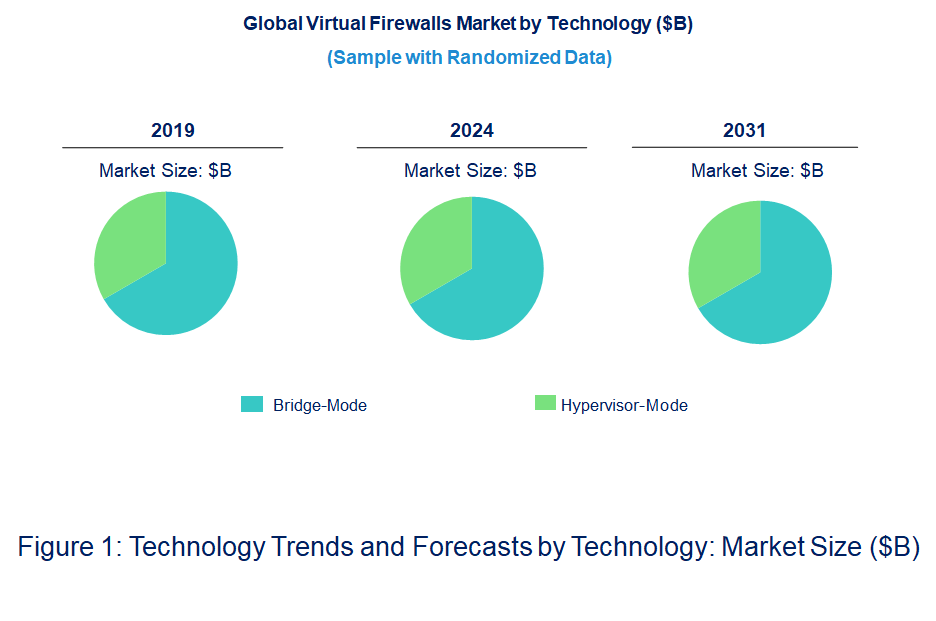
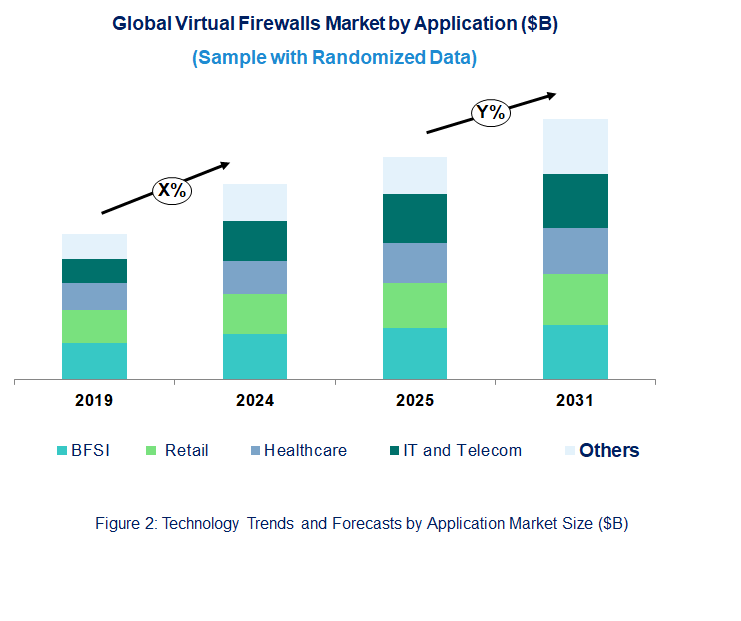
• Cloud-native Security Integration: Virtual firewalls are increasingly designed to integrate seamlessly with cloud platforms such as AWS, Azure, and Google Cloud. This trend is enabling organizations to embed security within cloud-native applications and workloads, ensuring consistent protection across dynamic cloud environments.
• Adoption of Zero Trust Architecture: The shift toward Zero Trust security models is driving the need for virtual firewalls that support identity-based access control and micro-segmentation. This approach reduces the attack surface by ensuring that no user or device is inherently trusted, enhancing network security in decentralized infrastructures.
• Automation and Orchestration: Enterprises are leveraging automation tools to manage virtual firewall policies and configurations across distributed networks. Automated threat detection and response reduce human error, improve incident response times, and ensure security policies are enforced consistently.
• Support for Multi-cloud and Hybrid Deployments: As organizations adopt multi-cloud strategies, virtual firewalls are evolving to provide unified security management across diverse cloud providers and on-premise systems. This trend addresses the growing demand for consistent policy enforcement and visibility in complex, hybrid IT environments.
• Integration with SD-WAN and SASE Architectures: Virtual firewalls are increasingly being embedded within Software-Defined Wide Area Network (SD-WAN) and Secure Access Service Edge (SASE) frameworks. This integration enhances performance, simplifies network management, and brings security closer to users and devices, regardless of location. In conclusion, these emerging trends are transforming the virtual firewalls market from a legacy, hardware-centric model into a flexible, software-defined security layer tailored for modern enterprise networks. As businesses prioritize cloud adoption and network agility, virtual firewalls are becoming a central component of next-generation cybersecurity strategies.
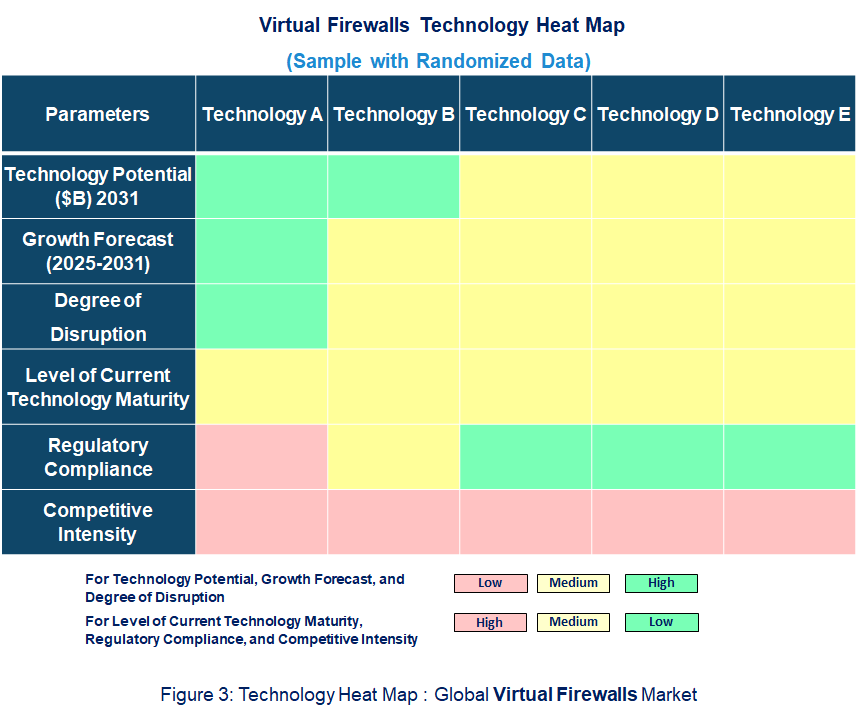
• Technology Potential: Virtual firewalls hold strong technology potential as they provide scalable, flexible, and software-based security solutions for increasingly virtualized and cloud-driven IT environments. Unlike traditional hardware firewalls, virtual firewalls can be deployed across on-premise, cloud, and hybrid infrastructures, offering dynamic security policies that adapt to workload movement. Their compatibility with modern technologies like microservices, containers, and virtual machines makes them essential in securing digital transformation initiatives.
• Degree of Disruption: The disruption caused by virtual firewalls is significant. They are reshaping the network security landscape by replacing static, perimeter-based models with agile, distributed security architectures.
• Current Technology Maturity Level: The rise of remote work, cloud adoption, and edge computing has accelerated this shift. Virtual firewalls enable key security models such as Zero Trust and micro-segmentation, disrupting how organizations traditionally manage access control, data protection, and threat prevention.
• Regulatory Compliance: Regulatory compliance is a core consideration for virtual firewall deployment. These solutions increasingly incorporate features to help meet regulations like GDPR, HIPAA, and PCI-DSS. Capabilities such as detailed logging, policy enforcement, data encryption, and audit trails ensure that organizations can meet compliance requirements while maintaining high levels of security in virtualized environments.
• Cisco Systems: Cisco has introduced the Secure Firewall 1200 Series, offering up to three times the performance of comparable competitive firewalls. This new family of SD-WAN-enabled, high-performing, compact firewall security appliances eliminates the need for multiple appliances for switches, routers, and firewalls at enterprise branch locations. Additionally, Cisco's Secure Firewall Threat Defense (FTD) 7.6 version enhances security by using AI to prevent zero-day threats and extends application control to over 70 generative AI apps to secure sensitive information. Cisco has also launched Cisco Security Cloud Control, an AI-native approach to proactively surface actionable insights and automate resolution across hybrid environments, simplifying policy management and enhancing security posture.
• Amazon Web Services (AWS): AWS has completed one of the largest migrations in its history by transitioning more than 10 Tbps of traffic and over 250 billion daily connections to AWS Network Firewall. This migration has resulted in a 90% reduction in networking tickets and has enabled AWS to scale firewalls faster and on demand, increasing resiliency and simplifying provisioning and management. The move to AWS Network Firewall has minimized operating costs while simultaneously increasing network resiliency, capacity, flexibility, and observability.
• Azure (Microsoft): Azure has introduced several enhancements to its firewall offerings, including the integration of Azure Firewall with Microsoft Copilot for Security. This integration allows users to retrieve the top IDPS signature hits for an Azure Firewall, enriching the threat profile of IDPS signatures with additional details. Users can perform fleet-wide searches for threats across all their firewalls and generate recommendations to secure their environment using Azure Firewall’s IDPS feature. These enhancements aim to streamline firewall management and improve security posture across Azure environments.
• Quick Heal Technologies: Quick Heal Technologies has focused on enhancing its firewall solutions to provide better protection against emerging cyber threats. The company has updated its firewall offerings to include advanced features such as intrusion detection and prevention systems (IDPS), application control, and enhanced VPN capabilities. These updates aim to provide comprehensive security solutions for small and medium-sized enterprises (SMEs) looking to safeguard their networks against evolving threats.
• Sentia Solutions: Sentia Solutions has been integrating advanced security features into its private cloud offerings, including virtual firewall solutions. By leveraging technologies such as micro-segmentation and AI-driven threat detection, Sentia aims to provide tailored security solutions that cater to the specific needs of its clients. These developments reflect Sentia's commitment to enhancing the security of its cloud infrastructure and meeting the growing demand for robust, scalable security solutions in the cloud space. In summary, these developments highlight a trend towards more integrated, scalable, and intelligent virtual firewall solutions. Key players are focusing on enhancing performance, leveraging AI for threat detection, and simplifying management to meet the evolving security needs of modern enterprises. These advancements are reshaping the Virtual Firewalls Market, driving innovation and setting new standards for network security.
• Growing Cloud and Virtualization Adoption: Increasing migration to cloud and virtual environments drives demand for scalable, software-based firewalls. Virtual firewalls offer flexibility and easier management across hybrid and multi-cloud setups, making them vital for securing modern IT architectures and supporting digital transformation initiatives.
• Escalating Cybersecurity Threats: The rise in sophisticated cyberattacks pushes organizations to adopt advanced virtual firewall solutions with AI-driven threat detection, real-time monitoring, and micro-segmentation. These features help reduce breach risks and enhance network defense capabilities across distributed environments.
• Stringent Regulatory Compliance: Compliance with regulations like GDPR, HIPAA, and PCI-DSS requires comprehensive security frameworks. Virtual firewalls enable organizations to meet these requirements by providing detailed logging, policy enforcement, and audit capabilities, driving adoption in heavily regulated sectors.
• Cost Efficiency and Operational Agility: Virtual firewalls reduce dependency on costly hardware, lowering capital expenditure. Their software-defined nature allows rapid deployment and updates, enabling organizations to respond quickly to changing security needs and optimize operational efficiency. Key Challenges:
• Integration Complexity: Integrating virtual firewalls with existing legacy systems and diverse cloud platforms can be challenging. Compatibility issues and complex configurations may cause deployment delays and operational disruptions, impacting user experience and slowing market growth.
• Skill Shortage: The shortage of skilled cybersecurity professionals with expertise in managing virtual firewall policies and threat analytics hampers efficient deployment and maintenance, limiting adoption particularly among smaller enterprises with constrained IT resources.
• Management and Scalability Issues: As networks grow in complexity, managing multiple virtual firewall instances across hybrid environments can become cumbersome. Inadequate tools for centralized management and automation can lead to inconsistent security policies and increased operational overhead. In conclusion, the virtual firewalls market benefits from strong drivers such as cloud adoption, rising threats, regulatory demands, and cost efficiencies, which collectively fuel its growth. However, overcoming integration challenges, skill shortages, and management complexities is critical for maximizing technology adoption and ensuring robust network security across evolving infrastructures.
• Cisco Systems
• Quick Heal Technologies
• Sentia Solutions
• Amazon Web Services
• Azure
• Technology readiness for Bridge-mode virtual firewalls is mature, given their straightforward deployment and compatibility with existing network infrastructures. They are widely adopted across enterprises needing non-intrusive security solutions, showing strong competitive positioning and regulatory compliance through comprehensive monitoring and policy enforcement. Hypervisor-mode firewalls, while slightly less mature, are rapidly advancing due to increasing virtualization adoption and demand for in-depth workload protection. Their competitive edge lies in tight integration with hypervisors and support for micro-segmentation, crucial for cloud-native applications and multi-tenant environments. Compliance features are embedded to satisfy rigorous industry standards. Both technologies serve key applications in sectors such as BFSI, healthcare, and IT, where data security and regulatory adherence are paramount. Continuous improvements in automation and AI integration boost their readiness for future challenges.
• Competitive intensity in the Virtual Firewalls Market among Bridge-mode and Hypervisor-mode technologies is high, with numerous vendors striving to differentiate through performance, integration capabilities, and feature sets. Bridge-mode solutions face competition for transparent, low-latency filtering that does not disrupt network flows. Hypervisor-mode firewalls compete on deep integration with virtualization platforms and advanced threat detection. Regulatory compliance remains critical, with both modes needing to support standards like GDPR, HIPAA, and PCI-DSS through robust logging, encryption, and access controls. Vendors continuously enhance compliance features to meet industry demands. The dynamic market pressures innovation in scalability, automation, and AI-based security analytics. Strategic partnerships with cloud providers bolster competitive positioning. Overall, market competition drives rapid feature evolution while emphasizing regulatory adherence.
• The disruption potential of Virtual Firewalls technologies such as Bridge-mode and Hypervisor-mode lies in their ability to transform network security architecture by enabling flexible, scalable, and software-defined protection. Bridge-mode firewalls provide transparent security by filtering traffic without altering network topology, making them ideal for seamless integration in existing environments. Hypervisor-mode firewalls embed security controls directly within virtual machine environments, offering granular visibility and control. Both technologies disrupt traditional hardware firewall reliance by supporting dynamic cloud and virtual infrastructure, driving innovation in threat prevention and network segmentation. As enterprises adopt hybrid and multi-cloud models, these modes enable faster deployment and improved resource utilization. The shift promotes enhanced automation and centralized management. Consequently, Bridge-mode and Hypervisor-mode firewalls are key enablers in advancing Zero Trust security frameworks. Their disruption fosters agile security postures that align with evolving business demands.
• Bridge-mode
• Hypervisor-mode
• BFSI
• Retail
• Healthcare
• IT and Telecom
• Others
• North America
• Europe
• Asia Pacific
• The Rest of the World
• Latest Developments and Innovations in the Virtual Firewalls Technologies
• Companies / Ecosystems
• Strategic Opportunities by Technology Type


Choose a license that fits your team. Instant PDF delivery.
Prices exclude taxes. Instant delivery. Custom licensing available on request.
Market Report · May 18, 2026
Market Report · May 18, 2026
Market Report · May 18, 2026
Trusted partner for strategic intelligence and business growth


Receive a complimentary market analysis tailored to your industry. Our analysts will identify key growth opportunities and competitive dynamics specific to your business.

Market size, growth rate, and key trend analysis for your specific sector.

Top competitor positioning and market share analysis.

Strategic recommendations backed by data-driven insights.
Get curated market intelligence and competitive moves straight to your inbox.
By subscribing, you agree to receive our monthly insights. Unsubscribe anytime.
Receive a complimentary market analysis tailored to your industry. Our analysts will identify key growth opportunities and competitive dynamics specific to your business.
Market size, growth rate, and key trend analysis for your specific sector.
Top competitor positioning and market share analysis.
Strategic recommendations backed by data-driven insights.
Get curated market intelligence, emerging trends, and competitive moves straight to your inbox each month.
By subscribing, you agree to receive our monthly insights. Unsubscribe anytime.
We'll send your sample report shortly.