
Report Feature
Vibratory Screed Market Trends and Forecast
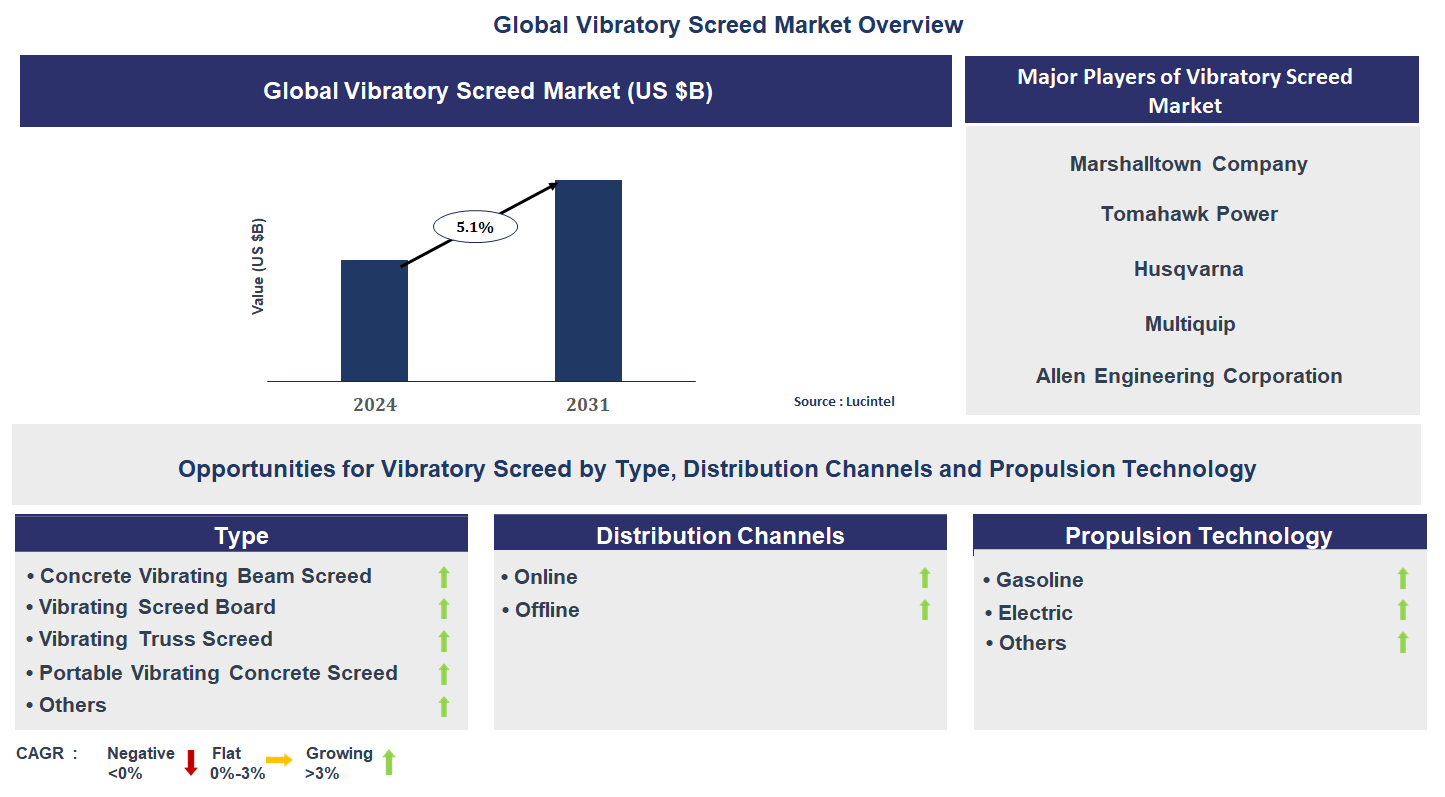
The future of the global vibratory screed market looks promising with opportunities in the concrete vibrating beam screed, vibrating screed board, vibrating truss screed, and portable vibrating concrete screed markets. The global vibratory screed market is expected to grow with a CAGR of 5.1% from 2025 to 2031. The major drivers for this market are the increasing demand for construction efficiency, the rising adoption of advanced concrete technologies, and the growing focus on high-quality surface finishes.• Lucintel forecasts that, within the propulsion technology category, electric is expected to witness the higher growth over the forecast period.
• Within the type category, portable vibrating concrete screed is expected to witness highest growth.
• In terms of region, APAC is expected to witness the highest growth over the forecast period. Gain valuable insights for your business decisions with our comprehensive 150+ page report. Sample figures with some insights are shown below.
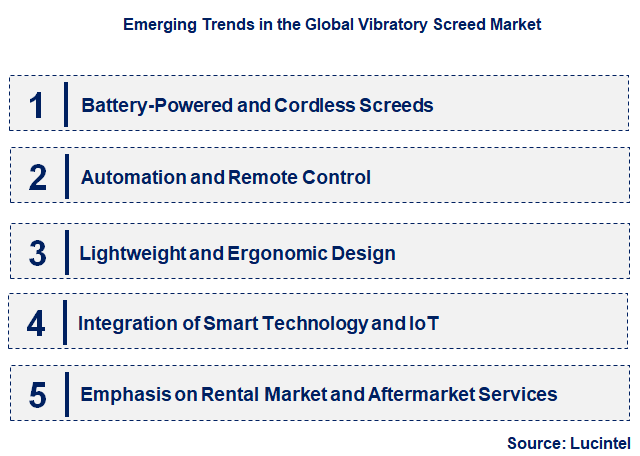
Emerging Trends in the Vibratory Screed Market
The vibratory screed market is experiencing a fundamental transformation, driven by technological development, changing industrial requirements, and worldwide emphasis on efficiency and performance. Such emerging trends are shifting the industry away from concern with minimal functionality to one based on smart, integrated, and highly specialized solutions. With industries looking to enhance the finish of concrete and save on labor, demand is increasing for machinery that can address these needs safely and effectively.• Battery-Powered and Cordless Screeds: The main trend is the evolution of battery-powered and cordless screeds. These products have a number of benefits over gas-powered varieties, such as less noise, zero emissions, and more freedom of movement on sites. They are best suited to indoor use and where noise and air pollution are an issue. This trend is driving the market by making companies look environmentally friendly.
• Automation and Remote Control: One of the major trends is growing automation and remote control. The manufacturers are creating screeds that can be remotely operated, which provides increased worker safety and enables one person to control more area. Not only does this make the operation more efficient, it also minimizes the potential for accidents. This trend is affecting the market by providing a more cost-saving and dependable solution for numerous applications.
• Lightweight and Ergonomic Design: There is a strong emerging trend towards lightweight and ergonomic design. Manufacturers are employing new materials and design concepts to develop screeds that are more convenient to handle and transport. This minimizes worker fatigue and maximizes productivity. This trend is affecting the market by providing a more consistent and cost-effective solution for a majority of projects.
• Integration of Smart Technology and IoT: Smart technology and Internet of Things (IoT) integration is a prominent trend in the market. Screeds are being provided with sensors that provide real-time data on parameters such as vibration frequency and leveling. This data is fed into a central platform for remote monitoring and predictive maintenance. This trend is making its mark on the market by enhancing operation efficiency and minimizing downtime.
• Emphasis on Rental Market and Aftermarket Services: One of the major trends is increasing emphasis on the rental market and aftermarket services. With the equipment cost rising all the time, more construction firms opt for rent over purchase. Manufacturers are taking advantage of this by providing integrated rental programs as well as after-sales services, which is a major competitive advantage. These new trends are cumulatively redefining the vibratory screed industry by converting it from an old-fashioned sector into a cutting-edge segment centered around intelligence, efficiency, and material innovation. The intersection of hardware innovation with software and data analysis is producing an integrated and complex value chain.
Recent Development in the Vibratory Screed Market
The vibratory screed industry is undergoing dynamic developments, spurred by the heightened sophistication of contemporary construction works and the world’s drive to enhance operating efficiency and safety. These new developments are affecting product design, production processes, and final user applications. The industry is seeing a drive towards sophisticated process controls and the application of intelligent technologies to improve operating efficiency.• High-Frequency Vibration Technology: Another major innovation is the development of high-frequency vibration technology. Businesses are introducing new screeds that employ high-frequency vibration to deliver a denser, more even concrete surface. This minimizes air voids and enhances the overall quality of the concrete. This is affecting the market by providing a safer, quicker, and less expensive solution compared to traditional methods.
• Development of Advanced Blade Geometries: One of the major developments is the development of advanced blade geometries. Improved geometries and materials are being used to design new blades so that efficiency and longevity are enhanced of the screeds. This minimizes internal wear and tear, thus it is possible to make the equipment last longer. This is having an impact in the market by enhancing product reliability and minimizing downtime.
• Aftermarket Service Expansion: Recent trends reflect a significant emphasis on aftermarket service expansion. With the growing installed base of vibratory screeds, there is a rising demand for sophisticated maintenance, repair, and training services. Companies are providing full-service contracts and predictive maintenance programs to guarantee long-term equipment reliability. This is affecting the market by developing a high-margin, recurring revenue stream.
• Strategic Collaborations and Partnerships: The industry is experiencing a major growth in strategic collaborations and partnerships. Industry leaders are aligning themselves with technology firms and research organizations to incorporate new competencies, including automated controls and data analytics, into their offerings. This is affecting the market by making the value chain more integrated and enabling firms to provide more complete solutions to their customers.
• New Material Development Focus: One key development is the fast expansion in new material development. The manufacturers are creating a variety of new materials, including carbon fiber and high-strength aluminum, specifically for screed applications. These materials provide increased durability along with reduced weight, which can enhance the performance and lifespan of the equipment. This is shaping the market by creating a new and high-value segment. These major developments are all contributing together to the vibratory screed market by facilitating a shift towards a more sophisticated, competitive, and customer-focused industry. The technology push and the emergence of digital solutions are opening up new avenues for growth, and the emphasis on safety and after-sales services is revolutionizing the market fundamentally.
Strategic Growth Opportunities in the Vibratory Screed Market
The vibratory screed market offers exciting strategic opportunity for growth fueled by changing industrial requirements, worldwide efficiency push, and growing demand for cutting-edge construction solutions. These opportunities lie beyond the scope of conventional concrete finishing and are available in niche, high-value applications across a number of industries. Market players need to be innovative, differentiate their products, and engage in strategic alliances to leverage these opportunities.• Venturing into the Road Construction Industry: The road construction industry is a great strategic growth opportunity. Construction of new roads, highways, and bridges involves large volumes of concrete paving and finishing. Vibratory screeds are perfect for these types of projects. This has an effect on the market by providing a high-margin application that is less exposed to ups and downs in the residential construction market.
• Targeting the Industrial Flooring Market: Industrial flooring presents a prime opportunity for growth. High-traffic industrial and commercial facilities need high-quality, heavy-duty floors that can handle a multitude of chemicals as well as heavy usage. Vibratory screeds play a vital role in such projects. It affects the market by creating a reliable source of demand from an essential industry.
• Taking Advantage of the Rental Market: The rental market is a huge growth potential. With the cost of equipment still going up, most construction companies, especially small and medium-sized businesses (SMEs), would rather rent than own. Having extensive rental programs in place, the companies are able to develop a high-margin, recurring income stream. This affects the market by making it a high-value opportunity that will not be as affected by the usual ups and downs of traditional manufacturing cycles.
• Building Solutions for Home Building: A strategic initiative is to address the residential construction market. With the housing market increasing, there is a greater demand for high-quality finishing tools for concrete used in foundations, patios, and sidewalks. This effects the market by generating a high-volume, ongoing revenue stream.
• Concentrating on Aftermarket Services and Retrofitting: One strategic area is the focus on the aftermarket services and retrofitting market. The more installed base of vibratory screeds, the higher the requirement for niche maintenance and repair. Through complete service packages with remote monitoring and predictive maintenance, firms can establish a high-margin, recurring revenue stream. This affects the market by establishing a high-value, recurring revenue stream. These strategic opportunities for growth are transforming the vibratory screed industry by compelling the industry to transition away from a bulk commodity business towards one of specialized, high-margin products and services. Through high-growth sector targeting and the movement towards sustainability, businesses can open up new sources of revenue, differentiate themselves from rivals, and gain a more secure market position for the future.
Vibratory Screed Market Driver and Challenges
The vibratory screed industry is influenced by the interaction of complex sets of top drivers and challenges, comprising a range of technological, economic, and regulatory factors. The growth of the market is fueled by an increasing global construction sector and high attention to efficiency and quality. Nevertheless, such growth is softened by major hurdles in terms of raw material price volatility, fierce competition, and the requirement for skilled labor. Understanding how these forces interact is key to understanding the present state of the market and predicting its future direction. The factors responsible for driving the vibratory screed market include: 1. Growth in Construction Sector: The main driver is the expansion in the construction sector. The worldwide requirement for new residential, commercial, and infrastructure projects is fueling an ongoing demand for high-quality concrete finishing equipment. With this sector growing, so does the demand for vibratory screeds, a major driver of growth in the market. 2. Increase in Emphasis on Construction Efficiency: The market is propelled by a high emphasis on construction efficiency. Vibratory screeds are capable of greatly enhancing the speed and quality of concrete leveling, which could assist in cutting back on project timelines as well as labor expenses. This is one of the key drivers of the use of vibratory screeds among construction companies globally. 3. Technological Developments: The market is fueled by constant technological developments. New technologies, including battery-driven motors, lightweight materials, and intelligent controls, are enhancing the performance, mobility, and convenience of vibratory screeds. This is one of the primary drivers of growth in the market, as it is creating a new and more efficient means of completing concrete. 4. Growing Demand for High-Strength Concrete Surfaces: The demand is fueled by an increased need for high-strength concrete surfaces. Vibratory screeds can assist in creating a denser, smoother surface with reduced air voids, which could enhance the general strength and longevity of the concrete. This is a significant driver for the use of vibratory screeds across a broad spectrum of companies and consumers. 5. Expansion into Niche Applications: The market is fueled by its potential to expand into niche applications. Vibratory screeds are finding applications in a broad spectrum of projects, ranging from small residential patios to industrial floors and airport runways. This has managed to open up the market into a new category of buyers. Challenges in the vibratory screed market are: 1. Volatile Raw Material Prices: Volatile raw material prices pose a great challenge to the market. Prices of materials such as aluminum and steel vary depending on a broad set of global economic and political issues. It may be challenging for manufacturers to predict their costs, and their profit margins can be affected. 2. Severe Competition: The market is challenged by severe competition. The market is filled with a huge number of international and domestic players with diverse product lines, which might end up in price wars and a reduction in the profit margin. This hinders some companies from competing with others. 3. Need for Skilled Labor: The market is challenged greatly by the demand for skilled and specialized labor. Technical competence is needed to operate complex vibratory screeds. A deficit in skilled personnel can delay projects and raise the cost of labor, which can discourage the growth of the market, especially in certain areas. In summary, the vibratory screed industry is at a crossroads, with strong drivers pushing it ahead and major challenges requiring strategic adjustment. The growth of the construction sector and increased emphasis on quality and efficiency are opening up new avenues for expansion. But the industry has to deal with fluctuating raw material costs, high competition, and the requirement of skilled employees. The ability of companies to innovate and provide high-value, cost-effective solutions while leveraging key drivers will be crucial for success in this evolving and dynamic market.List of Vibratory Screed Companies
Companies in the market compete on the basis of product quality offered. Major players in this market focus on expanding their manufacturing facilities, R&D investments, infrastructural development, and leverage integration opportunities across the value chain. With these strategies vibratory screed companies cater increasing demand, ensure competitive effectiveness, develop innovative products & technologies, reduce production costs, and expand their customer base. Some of the vibratory screed companies profiled in this report include-• Marshalltown Company
• Tomahawk Power
• Husqvarna
• Multiquip
• Allen Engineering Corporation
• Milwaukee Electric Tool Corporation
• Bartell Global
Vibratory Screed Market by Segment
The study includes a forecast for the global vibratory screed market by type, distribution channels, propulsion technology, and region.Vibratory Screed Market by Type [Value from 2019 to 2031]:
• Concrete Vibrating Beam Screed
• Vibrating Screed Board
• Vibrating Truss Screed
• Portable Vibrating Concrete Screed
• Others
Vibratory Screed Market by Distribution Channels [Value from 2019 to 2031]:
• Online
• Offline
Vibratory Screed Market by Propulsion Technology [Value from 2019 to 2031]:
• Gasoline
• Electric
• Others
Vibratory Screed Market by Region [Value from 2019 to 2031]:
• North America
• Europe
• Asia Pacific
• The Rest of the World
Country Wise Outlook for the Vibratory Screed Market
The market for vibratory screed is experiencing a major shift, fueled by the international construction boom and an increased demand for high-quality, efficient concrete finishing. Vibratory screeds are crucial machines employed to level, compact, and smooth concrete surfaces. New advancements focus on enhancing the efficiency, portability, and automation of these machines. The industry is also being influenced by an international trend towards increasingly sustainable and ergonomic equipment to minimize worker fatigue and increase site safety.• United States: In the United States, the vibratory screed industry is growing strongly as a result of significant investment in residential, commercial, and infrastructure projects. One major development is the extensive use of battery-powered vibratory screeds, which provide zero emissions and added mobility on job sites. Companies are also emphasizing the creation of lightweight, ergonomic machines that decrease worker fatigue and enhance productivity. Rental fleets are also influencing the market, and it is a major competitive differentiator for a diverse range of projects, ranging from new work to retrofitting.
• China: The Chinese vibratory screed market is the largest and most rapidly expanding in the world, driven by urbanization and huge infrastructure expansion. One of the most significant developments is the large-scale production of a comprehensive range of vibratory screeds to serve a booming domestic market. The emphasis is on high volume production alongside enhanced quality and technological advances, such as the utilization of computerized control systems for increased efficiency and convenience.
• Germany: Germany’s vibratory screed market is dominated by a strong emphasis on engineering excellence, reliability, and accuracy. Principal advancements involve the engineering and manufacturing of extremely specialized screeds designed specifically for specialist applications, including high-performance industrial flooring and highway construction. There is an increasing trend towards adopting lean manufacturing concepts to streamline production activities and minimize wastages. German manufacturers are at the forefront of making modular and flexible screeds that can be readily reorganized for various job locations.
• India: India’s vibratory screed market is at a nascent but high-growth stage, propelled by urbanization in the country and an increasing demand for fresh construction. One of the key trends is the increased awareness and usage of vibratory screeds over conventional, less effective manual procedures. The market is witnessing an introduction of high-grade, long-lasting equipment from both local and foreign suppliers. The demand for new road and bridge construction projects and the growth of domestic manufacturing are among the significant drivers of the market expansion.
• Japan: Japan’s vibratory screeds market is mature and characterized by a high focus on reliability, quality assurance, and automation. The latest advances are aimed at the manufacture of highly sophisticated, automated equipment that can conduct sophisticated leveling functions with minimal input from humans. The market is witnessing a shift towards usage of remote-controlled screeds in high-volume projects, for instance, airport runways and car parks. There is also a major emphasis on the application of sophisticated sensor technology to real-time monitoring and predictive maintenance.

Features of the Global Vibratory Screed Market
Market Size Estimates: Vibratory screed market size estimation in terms of value ($B). Trend and Forecast Analysis: Market trends (2019 to 2024) and forecast (2025 to 2031) by various segments and regions. Segmentation Analysis: Vibratory screed market size by type, distribution channels, propulsion technology, and region in terms of value ($B). Regional Analysis: Vibratory screed market breakdown by North America, Europe, Asia Pacific, and Rest of the World. Growth Opportunities: Analysis of growth opportunities in different types, distribution channels, propulsion technologies, and regions for the vibratory screed market. Strategic Analysis: This includes M&A, new product development, and competitive landscape of the vibratory screed market. Analysis of competitive intensity of the industry based on Porter’s Five Forces model.
FAQ
Q1. What is the growth forecast for vibratory screed market? Answer: The global vibratory screed market is expected to grow with a CAGR of 5.1% from 2025 to 2031. Q2. What are the major drivers influencing the growth of the vibratory screed market? Answer: The major drivers for this market are the increasing demand for construction efficiency, the rising adoption of advanced concrete technologies, and the growing focus on high-quality surface finishes. Q3. What are the major segments for vibratory screed market? Answer: The future of the vibratory screed market looks promising with opportunities in the concrete vibrating beam screed, vibrating screed board, vibrating truss screed, and portable vibrating concrete screed markets. Q4. Who are the key vibratory screed market companies? Answer: Some of the key vibratory screed companies are as follows:• Marshalltown Company
• Tomahawk Power
• Husqvarna
• Multiquip
• Allen Engineering Corporation
• Milwaukee Electric Tool Corporation
• Bartell Global Q5. Which vibratory screed market segment will be the largest in future? Answer: Lucintel forecasts that, within the propulsion technology category, electric is expected to witness the higher growth over the forecast period. Q6. In vibratory screed market, which region is expected to be the largest in next 5 years? Answer: In terms of region, APAC is expected to witness the highest growth over the forecast period. Q7. Do we receive customization in this report? Answer: Yes, Lucintel provides 10% customization without any additional cost.
Table of Contents
List of Figures
List of Tables
Methodology
- In-depth interviews of the major players in this market
- Detailed secondary research from competitors’ financial statements and published data
- Extensive searches of published works, market, and database information pertaining to industry news, company press releases, and customer intentions
- A compilation of the experiences, judgments, and insights of Lucintel’s professionals, who have analyzed and tracked this market over the years.


Buy Now
Choose a license that fits your team. Instant PDF delivery.
Prices exclude taxes. Instant delivery. Custom licensing available on request.
Key Questions
- • What are some of the most promising, high-growth opportunities for the vibratory screed market by type (concrete vibrating beam screed, vibrating screed board, vibrating truss screed, portable vibrating concrete screed, and others), distribution channels (online and offline), propulsion technology (gasoline, electric, and others), and region (North America, Europe, Asia Pacific, and the Rest of the World)?
- • Which segments will grow at a faster pace and why?
- • Which region will grow at a faster pace and why?
- • What are the key factors affecting market dynamics? What are the key challenges and business risks in this market?
- • What are the business risks and competitive threats in this market?
- • What are the emerging trends in this market and the reasons behind them?
- • What are some of the changing demands of customers in the market?
- • What are the new developments in the market? Which companies are leading these developments?
- • Who are the major players in this market? What strategic initiatives are key players pursuing for business growth?
- • What are some of the competing products in this market and how big of a threat do they pose for loss of market share by material or product substitution?
- • What M&A activity has occurred in the last 5 years and what has its impact been on the industry? For any questions related to Vibratory Screed Market, Vibratory Screed Market Size, Vibratory Screed Market Growth, Vibratory Screed Market Analysis, Vibratory Screed Market Report, Vibratory Screed Market Share, Vibratory Screed Market Trends, Vibratory Screed Market Forecast, Vibratory Screed Companies, write Lucintel analyst at email: helpdesk@lucintel.com. We will be glad to get back to you soon.


