
'
...

The Impact of COVID-19 is included in VHF Diode Market Report. Buy it today to get an advantage.

Request the impact of COVID-19 on your product or industry


VHF Diode Market Trends and Forecast

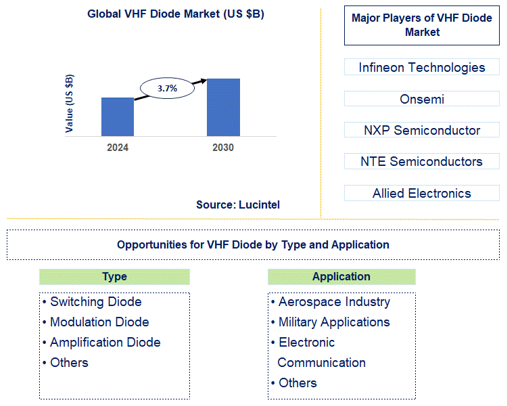
The future of the global VHF diode market looks promising with opportunities in the aerospace industry, military applications, and electronic communication markets. The global VHF diode market is expected to grow with a CAGR of 5.0% from 2025 to 2031. The major drivers for this market are the increasing demand for high-frequency communication and data transmission technologies and the expansion of 5g networks and satellite communication systems globally.

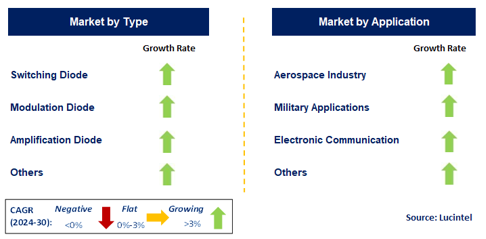
• Lucintel forecasts that, within the type category, amplification diodes are expected to witness the highest growth over the forecast period.
• Within the application category, electronic communication is expected to witness the highest growth.
• In terms of region, APAC is expected to witness the highest growth over the forecast period.
Gain valuable insights for your business decisions with our comprehensive 150+ page report. Sample figures with some insights are shown below.
VHF Diode Market Trends and Forecast

VHF Diode Market by Segment

Emerging Trends in the VHF Diode Market

The VHF diode market is being reshaped by emerging trends driven by technological innovation, evolving consumer needs, and industrial applications. These trends reflect a move towards smaller, more efficient components that cater to high-frequency communication, aerospace, and defense requirements. As demand for robust communication solutions and precision technologies increases, these trends are expected to guide market developments.
• Miniaturization of VHF Diodes: As applications require more compact, lighter, and efficient devices, manufacturers are focusing on miniaturizing VHF diodes without compromising performance. This trend is particularly prominent in consumer electronics, automotive, and telecommunications sectors, where size and power efficiency are critical for overall device functionality.
• Increased Demand for High-Frequency Components: The continuous demand for high-frequency communication technologies like 5G and beyond is driving innovation in VHF diode design. As telecommunication networks evolve and expand, there is an increasing need for diodes that can effectively handle higher frequencies, ensuring seamless communication and improved connectivity.
• Shift Toward Energy-Efficient Solutions: Growing concerns over energy consumption are pushing the demand for energy-efficient VHF diodes. With an emphasis on reducing power losses and increasing signal integrity, energy-efficient VHF diodes are becoming essential for industries such as telecommunications, automotive, and defense, where long-lasting, reliable performance is crucial.
• Integration with Emerging Materials (GaN, SiC): The incorporation of advanced materials like gallium nitride (GaN) and silicon carbide (SiC) into VHF diodes is gaining momentum. These materials offer superior performance at high frequencies, enabling higher efficiency, thermal conductivity, and power handling, especially in aerospace and military applications where performance under harsh conditions is essential.
• Growing Adoption in Military and Aerospace Sectors: With the increasing need for secure communication, radar systems, and satellite technologies, the military and aerospace industries are seeing strong demand for VHF diodes. These sectors are investing in next-generation technologies for improved signal processing, miniaturization, and system reliability in both commercial and defense applications.
These emerging trends highlight the growing importance of VHF diodes across various sectors. As manufacturers adopt new technologies, materials, and miniaturization techniques, the VHF diode market is evolving to meet the increasing demand for higher frequencies, more efficient energy usage, and advanced communication systems.
Emerging Trends in the VHF Diode Market

Recent Development in the VHF Diode Market

Recent developments in the global VHF diode market reflect the increasing demand for high-frequency, efficient, and miniaturized components. These developments are shaping the market's future and enhancing performance across a variety of industries, such as telecommunications, defense, and consumer electronics.
• Advancements in Semiconductor Materials (GaN, SiC): The adoption of gallium nitride (GaN) and silicon carbide (SiC) in VHF diodes is enabling higher frequency ranges and better thermal performance. This shift is crucial for aerospace, military, and telecommunications applications, where high power handling and low losses are essential for the functionality of advanced systems.
• Introduction of 5G Networks and Related Infrastructure: The rollout of 5G networks globally has led to a surge in demand for high-frequency components like VHF diodes. These diodes are critical for signal processing in 5G infrastructure, improving bandwidth, data transmission rates, and overall connectivity. The demand for reliable and efficient VHF diodes will continue to grow as 5G networks expand.
• Integration of VHF Diodes in Electric Vehicles (EVs): The automotive industry's focus on electric vehicles (EVs) and autonomous driving technologies has spurred demand for advanced communication systems, where VHF diodes play a key role in secure, high-speed data transmission. This development is pushing for greater innovation and reliability in VHF diode design, particularly in EV communication systems.
• Defense Industry Upgrades: The defense sector continues to invest in advanced radar systems, secure communication technologies, and satellite applications, all of which depend on high-quality VHF diodes. The market has seen significant growth due to the defense sector's adoption of VHF diodes for military communication and surveillance systems, ensuring high performance in critical operations.
• Consumer Electronics and IoT Growth: The expansion of Internet of Things (IoT) devices and consumer electronics is driving demand for small, power-efficient VHF diodes. These devices require high-frequency components for seamless connectivity, and as the IoT market grows, so too will the need for advanced VHF diodes that can ensure efficient communication between connected devices.
These developments are driving innovation and expansion in the VHF diode market. As industries continue to embrace advanced materials, new technologies, and efficient communication systems, the market for VHF diodes will experience continued growth, leading to better products and increased applications across multiple sectors.

Strategic Growth Opportunities in the VHF Diode Market

The global VHF diode market is ripe with strategic growth opportunities driven by advancements in communications, consumer electronics, and emerging technologies. Companies can leverage these opportunities to enhance their market positions and tap into new applications that are set to grow in the coming years.
• Telecommunication Infrastructure Expansion: The global rollout of 5G and the ongoing development of next-gen communication technologies represent significant growth opportunities for VHF diodes. With the need for high-frequency components in cellular towers and base stations, VHF diodes are critical for ensuring stable and high-speed data transmission in expanding networks.
• Defense and Aerospace Applications: VHF diodes are critical for military and aerospace applications, including radar systems, secure communications, and satellite technologies. As defense budgets grow and new technologies emerge, this sector continues to offer robust opportunities for growth, with an increasing need for high-performance VHF diodes in national security operations.
• Electric Vehicle (EV) and Autonomous Driving Technologies: The shift toward electric vehicles and autonomous driving systems presents an opportunity for VHF diodes, as these technologies rely heavily on communication and radar systems for safe operation. VHF diodes play a key role in enabling reliable data transmission for EVs, offering significant growth potential in this sector.
• Consumer Electronics and IoT Development: The growing adoption of the Internet of Things (IoT) and connected consumer devices is creating a demand for VHF diodes. From wearables to smart home devices, VHF diodes are integral for seamless communication, presenting an opportunity for manufacturers to innovate and expand their market presence.
• Industrial Automation and Robotics: As industries invest in automation and robotics, the demand for VHF diodes is increasing. These systems require efficient communication for coordination and real-time operations. The continued development of smart manufacturing technologies and robotic systems presents an opportunity for manufacturers to integrate advanced VHF diodes into automated platforms.
These strategic growth opportunities are shaping the future of the VHF diode market. As industries expand and adopt new technologies, the demand for advanced, high-frequency components will continue to drive innovation, leading to improved performance and new applications in telecommunications, defense, automotive, consumer electronics, and industrial sectors.

VHF Diode Market Driver and Challenges

The global VHF diode market is influenced by various drivers and challenges that impact growth and development. Technological advancements, regulatory pressures, and economic shifts play significant roles in shaping the market landscape. Understanding these factors is crucial for stakeholders looking to navigate the market successfully.
The factors responsible for driving the vhf diode market include:
1. Technological Advancements in Communication Systems: The ongoing development of high-speed, high-frequency communication systems is a key driver. Technologies like 5G and beyond require VHF diodes to enhance signal processing and ensure stable communication, boosting demand across telecommunications, defense, and consumer electronics sectors.
2. Increasing Demand for Miniaturized and Efficient Devices: As industries strive for smaller, more efficient devices, the demand for miniaturized VHF diodes continues to rise. Smaller diodes are essential for applications in portable electronics, wearables, and automotive systems, where space and energy efficiency are paramount.
3. Government Investments in Defense and Aerospace: Increased government spending on defense and aerospace technologies is fueling demand for high-performance VHF diodes. These components are crucial for secure communication systems, radar technologies, and satellite systems used in military and defense applications, presenting a lucrative growth opportunity.
4. Rising Demand in Consumer Electronics and IoT: The expansion of the Internet of Things (IoT) and connected devices has created a need for VHF diodes in consumer electronics. These diodes are key to enabling communication between IoT devices, contributing to the growth of the consumer electronics market, and enhancing product functionality.
5. Rising Focus on Energy Efficiency: Global environmental concerns and the need for energy-efficient solutions are driving demand for VHF diodes with lower power consumption. This trend is especially significant in industries such as telecommunications, automotive, and consumer electronics, where energy efficiency is a growing priority.
Challenges in the vhf diode market are:
1. High Material Costs: The increasing cost of raw materials such as gallium and silicon is putting pressure on manufacturers to find cost-effective production methods for VHF diodes. These rising costs could impact profit margins, especially for smaller players in the market.
2. Supply Chain Disruptions: Global supply chain disruptions, especially following the COVID-19 pandemic, are hindering the availability of essential components. This has affected the production and delivery timelines of VHF diodes, posing challenges for manufacturers to meet growing demand.
3. Regulatory Challenges in Defense and Aerospace: Stricter regulatory standards and security concerns in the defense and aerospace sectors are creating hurdles for manufacturers. Compliance with these regulations is essential for companies to access lucrative government contracts but can add to operational complexity and costs.
The VHF diode market is being shaped by significant drivers, such as technological advancements and increasing demand for miniaturized, energy-efficient devices. However, challenges like rising material costs, supply chain issues, and regulatory complexities must be addressed for sustained market growth. Understanding these dynamics is crucial for businesses aiming to stay competitive in this evolving market.

List of VHF Diode Companies

Companies in the market compete on the basis of product quality offered. Major players in this market focus on expanding their manufacturing facilities, R&D investments, infrastructural development, and leverage integration opportunities across the value chain. With these strategies VHF diode companies cater increasing demand, ensure competitive effectiveness, develop innovative products & technologies, reduce production costs, and expand their customer base. Some of the VHF diode companies profiled in this report include-
• Infineon Technologies
• Onsemi
• NXP Semiconductor
• Mouser Electronics
• NTE Semiconductors
• Allied Electronics
• Nexperia
• Electronic Devices
• Macom
• American Microsemiconductor

VHF Diode Market by Segment

The study includes a forecast for the global VHF diode market by type, application, and region.

VHF Diode Market by Type [Value from 2019 to 2031]:


• Switching Diodes
• Modulation Diodes
• Amplification Diodes
• Others

VHF Diode Market by Application [Value from 2019 to 2031]:


• Aerospace Industry
• Military Applications
• Electronic Communication
• Others

VHF Diode Market by Region [Value from 2019 to 2031]:


• North America
• Europe
• Asia Pacific
• The Rest of the World

Country Wise Outlook for the VHF Diode Market

The global VHF diode market is undergoing significant advancements driven by technological innovations, evolving demand across key regions, and increasing adoption in various industrial sectors. This market is witnessing growth in the United States, China, Germany, India, and Japan, driven by advancements in communication, consumer electronics, and defense sectors. Key players are investing in R&D to enhance performance, reduce costs, and meet the growing demands for higher-frequency applications in the VHF range.
• United States: In the U.S., the VHF diode market is experiencing rapid growth, especially in the communication and defense sectors. The military's growing need for advanced radar systems and secure communication equipment is a primary driver. Additionally, advancements in aerospace technologies are pushing demand for high-performance VHF diodes. Manufacturers are focusing on miniaturization and cost-effectiveness to meet the needs of these high-demand industries. Collaborations between tech companies and defense contractors are further enhancing innovation in the sector.
• China: China is one of the largest markets for VHF diodes, primarily driven by its booming telecommunications and consumer electronics industries. The shift toward 5G technology has significantly increased the demand for high-frequency components like VHF diodes, which are crucial for efficient signal processing. Furthermore, Chinese manufacturers are focusing on improving the energy efficiency of their VHF diode products. The government’s heavy investments in smart city projects and wireless infrastructure are also expected to continue driving market growth in the coming years.
• Germany: The German VHF diode market is seeing significant growth, with a particular emphasis on automotive and industrial applications. The automotive industry’s move toward electric vehicles (EVs) and autonomous driving technologies is pushing the need for robust VHF diode solutions for communication systems. Industrial automation also requires high-frequency diodes for efficient operation of equipment. Additionally, German companies are integrating advanced materials and technologies, such as silicon carbide and gallium nitride, into their VHF diodes to improve performance.
• India: The Indian VHF diode market is expanding due to a strong focus on telecommunications, aerospace, and defense. The country’s rapidly growing telecom industry, particularly with the rollout of 4G and upcoming 5G services, is driving demand for VHF diodes. India’s aerospace sector, driven by increasing space exploration missions and military developments, is also creating significant demand for high-performance VHF components. Government initiatives to improve defense capabilities are expected to further boost the market.
• Japan: Japan is a leading player in the VHF diode market, with a strong emphasis on wireless communication, robotics, and consumer electronics. The country’s technological advancements in wireless communication systems are driving demand for more efficient and high-performing VHF diodes. Japan’s robotics industry, particularly in industrial automation and healthcare, is also a growing market for VHF diodes. Companies are focused on integrating VHF diodes into cutting-edge products to maintain leadership in global markets.
Lucintel Analytics Dashboard

Features of the Global VHF Diode Market

Market Size Estimates: Vhf diode market size estimation in terms of value ($B).
Trend and Forecast Analysis: Market trends (2019 to 2024) and forecast (2025 to 2031) by various segments and regions.
Segmentation Analysis: Vhf diode market size by type, application, and region in terms of value ($B).
Regional Analysis: Vhf diode market breakdown by North America, Europe, Asia Pacific, and Rest of the World.
Growth Opportunities: Analysis of growth opportunities in different types, applications, and regions for the VHF diode market.
Strategic Analysis: This includes M&A, new product development, and competitive landscape of the VHF diode market.
Analysis of competitive intensity of the industry based on Porter’s Five Forces model.

Lucintel Consulting Services

FAQ

Q1. What is the growth forecast for VHF diode market?
Answer: The global VHF diode market is expected to grow with a CAGR of 5.0% from 2025 to 2031.
Q2. What are the major drivers influencing the growth of the VHF diode market?
Answer: The major drivers for this market are the increasing demand for high-frequency communication and data transmission technologies and the expansion of 5g networks and satellite communication systems globally.
Q3. What are the major segments for VHF diode market?
Answer: The future of the VHF diode market looks promising with opportunities in the aerospace industry, military applications, and electronic communication markets.
Q4. Who are the key VHF diode market companies?
Answer: Some of the key VHF diode companies are as follows:
• Infineon Technologies
• Onsemi
• NXP Semiconductor
• Mouser Electronics
• NTE Semiconductors
• Allied Electronics
• Nexperia
• Electronic Devices
• Macom
• American Microsemiconductor
Q5. Which VHF diode market segment will be the largest in future?
Answer: Lucintel forecasts that, within the type category, amplification diodes are expected to witness the highest growth over the forecast period.
Q6. In VHF diode market, which region is expected to be the largest in next 5 years?
Answer: In terms of region, APAC is expected to witness the highest growth over the forecast period.
Q7. Do we receive customization in this report?
Answer: Yes, Lucintel provides 10% customization without any additional cost.

This report answers following 11 key questions:

Q.1. What are some of the most promising, high-growth opportunities for the VHF diode market by type (switching diodes, modulation diodes, amplification diodes, and others), application (aerospace industry, military applications, electronic communication, and others), and region (North America, Europe, Asia Pacific, and the Rest of the World)?
Q.2. Which segments will grow at a faster pace and why?
Q.3. Which region will grow at a faster pace and why?
Q.4. What are the key factors affecting market dynamics? What are the key challenges and business risks in this market?
Q.5. What are the business risks and competitive threats in this market?
Q.6. What are the emerging trends in this market and the reasons behind them?
Q.7. What are some of the changing demands of customers in the market?
Q.8. What are the new developments in the market? Which companies are leading these developments?
Q.9. Who are the major players in this market? What strategic initiatives are key players pursuing for business growth?
Q.10. What are some of the competing products in this market and how big of a threat do they pose for loss of market share by material or product substitution?
Q.11. What M&A activity has occurred in the last 5 years and what has its impact been on the industry?

For any questions related to VHF Diode Market, VHF Diode Market Size, VHF Diode Market Growth, VHF Diode Market Analysis, VHF Diode Market Report, VHF Diode Market Share, VHF Diode Market Trends, VHF Diode Market Forecast, VHF Diode Companies, write Lucintel analyst at email: helpdesk@lucintel.com. We will be glad to get back to you soon.
                                                            Table of Contents

            1. Executive Summary

            2. Global VHF Diode Market : Market Dynamics
                        2.1: Introduction, Background, and Classifications
                        2.2: Supply Chain
                        2.3: Industry Drivers and Challenges

            3. Market Trends and Forecast Analysis from 2019 to 2031
                        3.1. Macroeconomic Trends (2019-2024) and Forecast (2025-2031)
                        3.2. Global VHF Diode Market Trends (2019-2024) and Forecast (2025-2031)
                        3.3: Global VHF Diode Market by Type
                                    3.3.1: Switching Diodes
                                    3.3.2: Modulation Diodes
                                    3.3.3: Amplification Diodes
                                    3.3.4: Others
                        3.4: Global VHF Diode Market by Application
                                    3.4.1: Aerospace Industry
                                    3.4.2: Military Applications
                                    3.4.3: Electronic Communication
                                    3.4.4: Others

            4. Market Trends and Forecast Analysis by Region from 2019 to 2031
                        4.1: Global VHF Diode Market by Region
                        4.2: North American VHF Diode Market
                                    4.2.1: North American Market by Type: Switching Diodes, Modulation Diodes, Amplification Diodes, and Others
                                    4.2.2: North American Market by Application: Aerospace Industry, Military Applications, Electronic Communication, and Others
                        4.3: European VHF Diode Market
                                    4.3.1: European Market by Type: Switching Diodes, Modulation Diodes, Amplification Diodes, and Others
                                    4.3.2: European Market by Application: Aerospace Industry, Military Applications, Electronic Communication, and Others
                        4.4: APAC VHF Diode Market
                                    4.4.1: APAC Market by Type: Switching Diodes, Modulation Diodes, Amplification Diodes, and Others
                                    4.4.2: APAC Market by Application: Aerospace Industry, Military Applications, Electronic Communication, and Others
                        4.5: ROW VHF Diode Market
                                    4.5.1: ROW Market by Type: Switching Diodes, Modulation Diodes, Amplification Diodes, and Others
                                    4.5.2: ROW Market by Application: Aerospace Industry, Military Applications, Electronic Communication, and Others

            5. Competitor Analysis
                        5.1: Product Portfolio Analysis
                        5.2: Operational Integration
                        5.3: Porter’s Five Forces Analysis

            6. Growth Opportunities and Strategic Analysis
                        6.1: Growth Opportunity Analysis
                                    6.1.1: Growth Opportunities for the Global VHF Diode Market by Type
                                    6.1.2: Growth Opportunities for the Global VHF Diode Market by Application
                                    6.1.3: Growth Opportunities for the Global VHF Diode Market by Region
                        6.2: Emerging Trends in the Global VHF Diode Market
                        6.3: Strategic Analysis
                                    6.3.1: New Product Development
                                    6.3.2: Capacity Expansion of the Global VHF Diode Market
                                    6.3.3: Mergers, Acquisitions, and Joint Ventures in the Global VHF Diode Market
                                    6.3.4: Certification and Licensing

            7. Company Profiles of Leading Players
                        7.1: Infineon Technologies
                        7.2: Onsemi
                        7.3: NXP Semiconductor
                        7.4: Mouser Electronics
                        7.5: NTE Semiconductors
                        7.6: Allied Electronics
                        7.7: Nexperia
                        7.8: Electronic Devices
                        7.9: Macom
                        7.10: American Microsemiconductor
.

Buy full report or by chapter as follows

Price by License Type:
[-] Hide Chapter Details
[Chapter Number] [Chapter Name] [Chapter Number Of Pages] [Chapter Price]
Title/Chapter Name Pages Price
Full Report: VHF Diode Market Report: Trends, Forecast and Competitive Analysis to 2031 Full Report $ 4,850
A 150 Page Report
Lucintel has been in the business of market research and management consulting since 2000 and has published over 1000 market intelligence reports in various markets / applications and served over 1,000 clients worldwide. This study is a culmination of four months of full-time effort performed by Lucintel's analyst team. The analysts used the following sources for the creation and completion of this valuable report:
  • In-depth interviews of the major players in this market
  • Detailed secondary research from competitors’ financial statements and published data 
  • Extensive searches of published works, market, and database information pertaining to industry news, company press releases, and customer intentions
  • A compilation of the experiences, judgments, and insights of Lucintel’s professionals, who have analyzed and tracked this market over the years.
Extensive research and interviews are conducted across the supply chain of this market to estimate market share, market size, trends, drivers, challenges, and forecasts. Below is a brief summary of the primary interviews that were conducted by job function for this report.
 
Thus, Lucintel compiles vast amounts of data from numerous sources, validates the integrity of that data, and performs a comprehensive analysis. Lucintel then organizes the data, its findings, and insights into a concise report designed to support the strategic decision-making process. The figure below is a graphical representation of Lucintel’s research process. 
 

Please sign in below to get report brochure - VHF Diode Market Report.

At Lucintel, we respect your privacy and maintain the confidentiality of information / data provided by you
(Please enter your corporate email. * These fields are mandatory )

Follow us on