
Report Feature
Veterinary X-ray Market Trends and Forecast
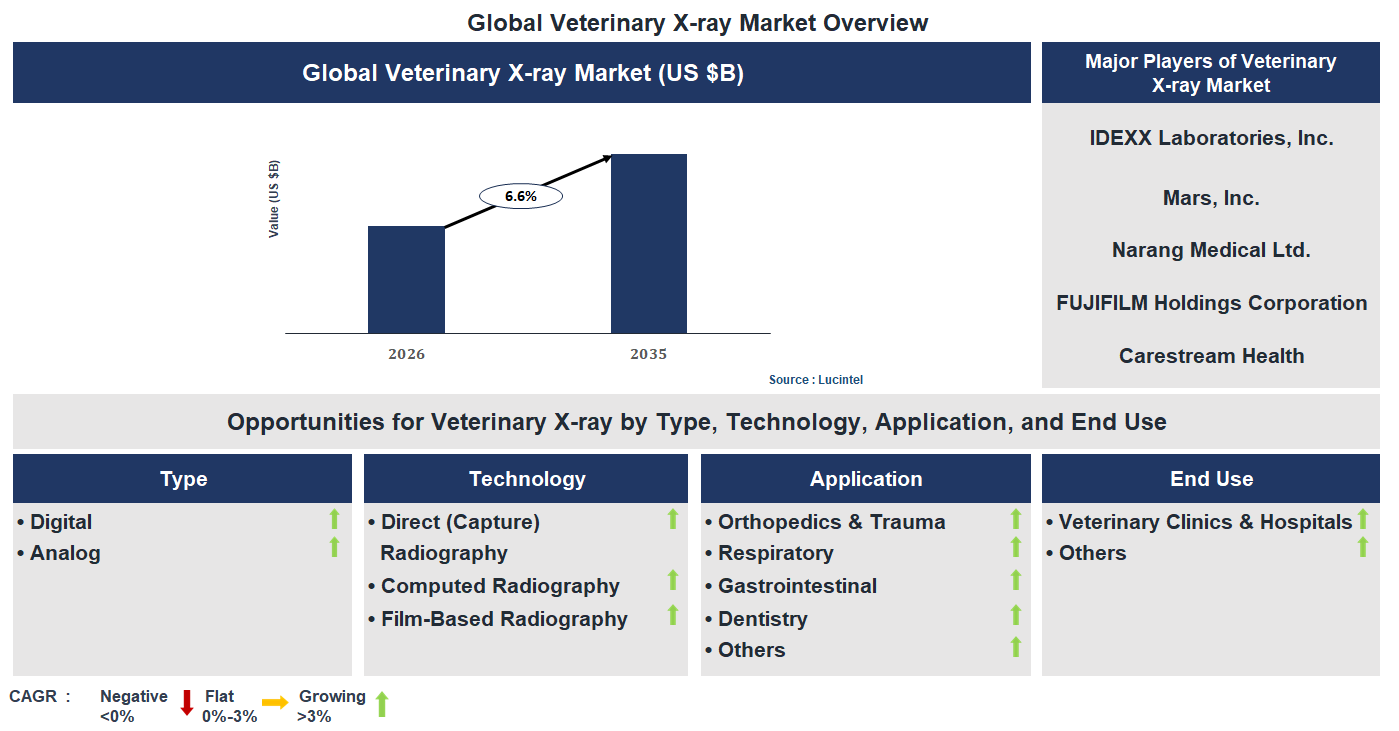
The future of the global veterinary X-ray market looks promising with opportunities in the orthopedics & trauma, respiratory, gastrointestinal, and dentistry markets. The global veterinary X-ray market is expected to reach an estimated $1,466 million by 2035 with a CAGR of 7% from 2026 to 2035. The major drivers for this market are the increasing demand for accurate diagnostics, the rising adoption of advanced imaging technology, and the growing prevalence of pet healthcare concerns.• Lucintel forecasts that, within the type category, digital is expected to witness higher growth over the forecast period.
• Within the application category, orthopedics & trauma is expected to witness the highest growth.
• In terms of region, North America is expected to witness the highest growth over the forecast period. Gain valuable insights for your business decisions with our comprehensive 150+ page report. Sample figures with some insights are shown below.
Emerging Trends in the Veterinary X-ray Market
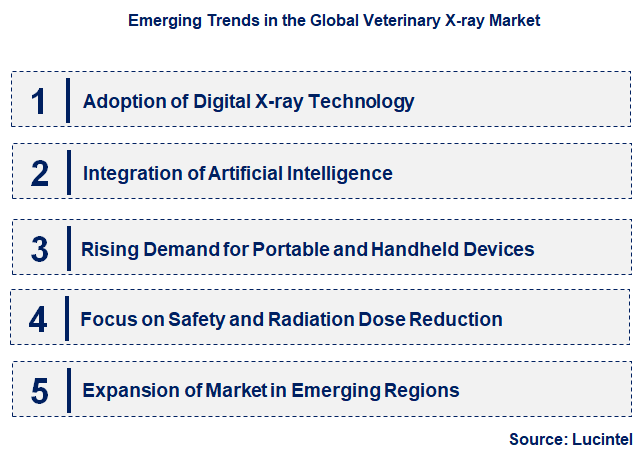
The veterinary X-ray market is experiencing rapid growth driven by technological advancements, increasing pet ownership, and a rising focus on animal healthcare. As veterinary practices adopt more sophisticated diagnostic tools, the market is evolving to meet the demands for accuracy, efficiency, and safety. Emerging trends are shaping the future landscape, influencing product development, service delivery, and market dynamics. These developments are not only improving diagnostic capabilities but also expanding access to veterinary imaging services worldwide. Understanding these key trends is essential for stakeholders aiming to capitalize on the markets growth potential and improve animal healthcare outcomes.• Adoption of Digital X-ray Technology: Digital X-ray systems are replacing traditional film-based methods, offering faster imaging, enhanced image quality, and easier storage and sharing. This shift improves diagnostic accuracy and workflow efficiency in veterinary clinics. Digital systems also reduce environmental impact by eliminating chemical processing. As technology advances, more clinics are investing in high-resolution, portable, and user-friendly digital X-ray devices, making diagnostics more accessible and efficient. This trend is expected to continue, driving market growth and innovation.
• Integration of Artificial Intelligence: AI-powered diagnostic tools are increasingly being integrated into veterinary X-ray systems to assist in image analysis. These tools enhance accuracy by detecting subtle abnormalities that may be missed by the human eye, reducing diagnostic errors. AI algorithms can also automate routine tasks, speeding up workflows and enabling quicker decision-making. The adoption of AI is transforming veterinary radiology, making diagnostics more precise and accessible, especially in remote or under-resourced areas. This trend is set to revolutionize veterinary imaging practices globally.
• Rising Demand for Portable and Handheld Devices: The need for mobile diagnostic solutions is growing, especially in rural and emergency settings. Portable and handheld X-ray devices enable veterinarians to perform on-site imaging without the need for bulky equipment or transportation to specialized facilities. These devices improve access to diagnostic services in remote locations, enhance emergency response, and facilitate fieldwork in large animal practices. Technological improvements have made portable X-ray units more affordable, durable, and capable of delivering high-quality images, thus expanding their adoption across various veterinary settings.
• Focus on Safety and Radiation Dose Reduction: As awareness of radiation safety increases, manufacturers are developing X-ray systems with advanced dose reduction technologies. These innovations aim to minimize radiation exposure for both animals and veterinary staff without compromising image quality. Features such as automatic exposure control and shielding enhancements are becoming standard. This trend is driven by regulatory requirements and the ethical responsibility to ensure safety. It is fostering the development of safer, more efficient X-ray systems that support sustainable veterinary practices and protect health.
• Expansion of Market in Emerging Regions: Growing pet ownership, increasing awareness of animal health, and expanding veterinary infrastructure are driving market growth in emerging regions such as Asia-Pacific, Latin America, and Africa. These regions are witnessing increased investments in veterinary healthcare and diagnostic facilities. Local manufacturers are entering the market, offering affordable and tailored solutions to meet regional needs. This expansion is creating new opportunities for market players and is expected to significantly boost the global market size. The trend underscores the importance of regional adaptation and the potential for substantial growth in underserved markets. In summary, these emerging trends are fundamentally reshaping the veterinary X-ray market by enhancing diagnostic accuracy, improving safety, increasing accessibility, and expanding geographical reach. They are fostering innovation, driving market growth, and ultimately contributing to better animal health outcomes worldwide.
Recent Development in the Veterinary X-ray Market
The veterinary X-ray market is experiencing rapid growth driven by technological advancements, increasing pet ownership, and rising awareness of animal health. As pet owners seek better diagnostic tools, veterinary clinics are adopting innovative imaging solutions to improve treatment outcomes. This evolving landscape presents significant opportunities for manufacturers and service providers to expand their reach and enhance animal healthcare services globally. The following developments highlight key areas shaping the future of this market.• Technological Innovations in Imaging Equipment: The integration of digital radiography and portable X-ray devices is transforming veterinary diagnostics. These advancements enable faster, clearer imaging with reduced radiation exposure, improving diagnostic accuracy and patient safety. Veterinary clinics benefit from increased efficiency and ease of use, leading to better treatment planning. As technology continues to evolve, market players are investing heavily in R&D to develop more sophisticated, user-friendly, and cost-effective solutions, driving market expansion.
• Rising Adoption of AI and Software Solutions: Artificial intelligence and advanced software are increasingly being incorporated into veterinary X-ray systems. These tools assist in image analysis, anomaly detection, and diagnostic decision-making, reducing human error and increasing accuracy. AI-driven solutions streamline workflows, save time, and enhance diagnostic confidence, especially in complex cases. The integration of AI is expected to revolutionize veterinary radiology, making diagnostics more accessible and reliable, thereby expanding market opportunities and improving animal health outcomes.
• Growing Pet Ownership and Awareness of Animal Health: The surge in pet ownership worldwide, coupled with heightened awareness of animal health issues, is fueling demand for advanced diagnostic tools like X-ray systems. Pet owners are more willing to invest in comprehensive healthcare, prompting veterinary clinics to upgrade their imaging capabilities. This trend is particularly prominent in emerging markets, where increasing disposable income and urbanization contribute to higher veterinary service utilization. Consequently, market growth is driven by the need for accurate, timely diagnoses to ensure animal well-being.
• Expansion of Veterinary Clinics and Hospitals: The proliferation of veterinary clinics and hospitals, especially in developing regions, is creating a substantial demand for X-ray equipment. Modern clinics require reliable, high-quality imaging solutions to diagnose a wide range of conditions. Investments in infrastructure and the rising number of veterinary professionals are further propelling market growth. Additionally, government initiatives and private sector investments are supporting the expansion of veterinary healthcare facilities, which in turn boosts demand for advanced X-ray systems.
• Focus on Portable and Wireless X-ray Devices: The demand for portable and wireless veterinary X-ray devices is increasing due to their convenience and flexibility in various clinical settings. These devices facilitate on-site imaging, especially in large animals or remote locations, improving access to diagnostic services. Wireless technology reduces clutter and enhances workflow efficiency. As veterinary practices seek more adaptable solutions, manufacturers are focusing on developing lightweight, durable, and high-performance portable X-ray systems, significantly impacting the market by broadening service capabilities. These developments are collectively transforming the veterinary X-ray market by enhancing diagnostic accuracy, expanding access, and improving workflow efficiency. Technological innovations, AI integration, rising pet ownership, clinic expansion, and portable device adoption are driving market growth and competitiveness. As these trends continue, the market is poised for sustained expansion, ultimately leading to better animal healthcare services and increased adoption of advanced diagnostic solutions worldwide.
Strategic Growth Opportunities in the Veterinary X-ray Market
The veterinary X-ray market is experiencing significant growth driven by increasing pet ownership, technological advancements, and rising awareness of animal health. The demand for accurate diagnostics and minimally invasive procedures is fueling market expansion across various regions. Key applications such as companion animal diagnostics and livestock health management are expanding rapidly. Strategic investments, innovations, and partnerships are further accelerating growth, creating new opportunities for industry players to enhance service offerings and improve animal healthcare outcomes globally.• Growing Adoption of Digital X-ray Systems in Veterinary Clinics: The shift from traditional to digital X-ray technology offers faster imaging, enhanced image quality, and easier storage and sharing. This transition improves diagnostic accuracy and workflow efficiency, encouraging veterinary practices to upgrade their equipment. As digital systems become more affordable and accessible, adoption rates are increasing, especially in urban areas, driving overall market growth and expanding the scope of veterinary diagnostics.
• Increasing Focus on Livestock Health Management and Disease Control: The rising demand for efficient disease detection in livestock is a key growth driver. X-ray imaging helps identify internal injuries, infections, and abnormalities, enabling early intervention. Governments and organizations are investing in livestock health programs, promoting the use of veterinary X-ray systems. This focus on disease prevention and management enhances productivity, reduces economic losses, and expands the market for veterinary X-ray solutions in agricultural sectors.
• Technological Innovations Improving Imaging Capabilities and Portability: Advances such as portable, wireless, and high-resolution X-ray devices are transforming veterinary diagnostics. These innovations facilitate on-site imaging in remote or difficult-to-access locations, improving animal care. Enhanced imaging software and AI integration further improve diagnostic precision. The development of compact, user-friendly systems is expanding market reach, especially in rural and field settings, thereby broadening application areas and increasing market penetration.
• Rising Awareness and Investments in Pet Healthcare and Diagnostics: Increasing pet ownership and humanization of pets are driving demand for advanced veterinary diagnostics. Owners and veterinarians seek accurate, quick, and non-invasive diagnostic tools. Investments by private and public sectors in pet healthcare infrastructure and services are boosting market growth. This trend encourages the adoption of X-ray systems in veterinary clinics, specialty hospitals, and mobile units, expanding the market and improving overall animal health management.
• Strategic Collaborations and Partnerships Fostering Market Expansion: Industry players are forming alliances with technology providers, research institutions, and veterinary clinics to develop innovative solutions. These collaborations facilitate product development, clinical validation, and market penetration. Joint ventures and strategic acquisitions enable companies to expand their product portfolios and geographic presence. Such partnerships accelerate technological advancements and distribution channels, ultimately driving growth and competitiveness in the veterinary X-ray market. The overall impact of these opportunities is a robust expansion of the veterinary X-ray market, driven by technological progress, increased awareness, and strategic collaborations. These factors collectively enhance diagnostic capabilities, improve animal healthcare outcomes, and open new avenues for market players. As the industry continues to evolve, these growth opportunities will shape a more efficient, accessible, and innovative veterinary diagnostic landscape worldwide.
Veterinary X-ray Market Driver and Challenges
The veterinary X-ray market is influenced by a variety of technological, economic, and regulatory factors that shape its growth and development. Advances in imaging technology, increasing pet ownership, and rising awareness of animal health are key drivers. Simultaneously, regulatory standards and concerns about radiation safety pose challenges. Economic factors such as the affordability of veterinary services and the cost of advanced imaging equipment also impact market dynamics. Understanding these drivers and challenges is essential for stakeholders to navigate the evolving landscape, capitalize on opportunities, and address potential barriers effectively. The factors responsible for driving the veterinary X-ray market include:• Technological Advancements: The development of digital radiography and portable X-ray devices has revolutionized veterinary diagnostics. These innovations offer high-resolution images, faster processing times, and enhanced ease of use, enabling veterinarians to diagnose conditions more accurately and efficiently. The integration of AI and 3D imaging further improves diagnostic capabilities, leading to better treatment outcomes. As technology continues to evolve, the market is expected to expand, driven by the demand for more sophisticated and user-friendly imaging solutions.
• Rising Pet Ownership and Animal Healthcare Awareness: Increasing pet ownership worldwide, especially in developing regions, has led to a higher demand for advanced veterinary care. Pet owners are more willing to invest in diagnostic procedures like X-rays to ensure their animals health. Additionally, growing awareness about animal health and welfare encourages veterinary clinics to adopt modern diagnostic tools, fueling market growth. This trend is particularly prominent in urban areas where veterinary services are more accessible, and pet owners are more informed.
• Economic Growth and Veterinary Spending: Economic development in various regions has resulted in increased disposable income, allowing pet owners to spend more on veterinary services. Veterinary clinics and hospitals are investing in advanced diagnostic equipment, including X-ray systems, to attract clients and improve service quality. The expansion of veterinary insurance schemes also supports higher expenditure on diagnostic procedures, contributing to market growth. As economies continue to grow, the demand for sophisticated veterinary imaging solutions is expected to rise correspondingly.
• Regulatory and Safety Standards: Stringent regulations regarding radiation safety and equipment standards influence the adoption of veterinary X-ray systems. Manufacturers must comply with international safety protocols, which can drive innovation in safer, more efficient imaging devices. These regulations also ensure high-quality imaging and patient safety, fostering trust among veterinary practitioners and pet owners. While compliance can be costly, it ultimately promotes the development of advanced, safer X-ray technologies, positively impacting the market.
• Growing Adoption of Digital and Portable X-ray Systems: The shift from traditional film-based X-ray systems to digital and portable solutions is a significant market driver. Digital systems offer advantages such as immediate image viewing, easy storage, and enhanced image quality. Portable X-ray devices enable veterinarians to perform diagnostics in various settings, including field conditions and emergencies. This flexibility improves diagnostic efficiency and expands service reach, especially in rural or underserved areas. The increasing adoption of these systems is expected to continue, further propelling market growth. The challenges facing the veterinary X-ray market include:
• High Cost of Advanced Equipment: The expense associated with acquiring and maintaining digital and portable X-ray systems can be prohibitive for small veterinary clinics and practices. The high initial investment, along with ongoing maintenance and software updates, limits adoption, especially in developing regions. This financial barrier restricts market growth and creates disparities in access to advanced diagnostic tools, impacting overall industry expansion.
• Radiation Safety and Regulatory Compliance: Ensuring safety standards and regulatory compliance remains a significant challenge. Veterinary clinics must adhere to strict radiation safety protocols, which require specialized training and equipment calibration. Non-compliance can lead to legal issues and safety hazards. Balancing the need for effective imaging with safety concerns often complicates equipment selection and usage, potentially hindering market growth and innovation.
• Limited Awareness and Training: Despite technological advancements, there is still a lack of awareness and training among veterinary professionals regarding the optimal use of X-ray systems. Insufficient training can lead to improper usage, poor image quality, and misdiagnosis. This challenge underscores the need for educational initiatives and technical support, which are essential for maximizing the benefits of advanced imaging technologies and expanding market penetration. In summary, the veterinary X-ray market is driven by technological innovations, increasing pet ownership, economic growth, regulatory standards, and the adoption of digital and portable systems. However, high equipment costs, safety compliance issues, and limited professional training pose significant challenges. These factors collectively influence the markets trajectory, requiring stakeholders to focus on affordability, safety, and education to foster sustainable growth. Addressing these challenges while leveraging technological advancements will be crucial for expanding access and improving veterinary diagnostic services worldwide.
List of Veterinary X-ray Companies
Companies in the market compete on the basis of product quality offered. Major players in this market focus on expanding their manufacturing facilities, R&D investments, infrastructural development, and leverage integration opportunities across the value chain. With these strategies veterinary X-ray companies cater increasing demand, ensure competitive effectiveness, develop innovative products & technologies, reduce production costs, and expand their customer base. Some of the veterinary X-ray companies profiled in this report include-• IDEXX Laboratories, Inc.
• Mars, Inc.
• Narang Medical Ltd.
• FUJIFILM Holdings Corporation
• Carestream Health
• Mindray Bio-Medical Electronics Co., Ltd.
• Midmark Corporation
• Canon Medical Systems Corporation
• Agfa-Gevaert Group
• SEDECAL
Veterinary X-ray Market by Segment
The study includes a forecast for the global veterinary X-ray market by type, technology, application, end use, and region.Veterinary X-ray Market by Type [Value from 2019 to 2035]:
• Digital
• Analog
Veterinary X-ray Market by Technology [Value from 2019 to 2035]:
• Direct (Capture) Radiography
• Computed Radiography
• Film-Based Radiography
Veterinary X-ray Market by Application [Value from 2019 to 2035]:
• Orthopedics & Trauma
• Respiratory
• Gastrointestinal
• Dentistry
• Others
Veterinary X-ray Market by End Use [Value from 2019 to 2035]:
• Veterinary Clinics & Hospitals
• Others
Veterinary X-ray Market by Region [Value from 2019 to 2035]:
• North America
• Europe
• Asia Pacific
• The Rest of the World
Country Wise Outlook for the Veterinary X-ray Market
The veterinary X-ray market has experienced significant growth driven by technological advancements, increasing pet ownership, and a rising focus on animal health worldwide. Countries are adopting innovative imaging solutions to improve diagnostic accuracy and treatment outcomes for animals. The markets evolution reflects a broader trend toward integrating digital technologies and expanding veterinary healthcare services. Regulatory changes and increased investment in veterinary infrastructure further propel this growth, making the market highly competitive and dynamic. As awareness of animal health issues rises globally, key players are focusing on product innovation, strategic collaborations, and expanding their geographic presence to meet rising demand.• United States: The US veterinary X-ray market has seen rapid technological adoption, including digital radiography and portable imaging devices. Growing pet ownership and awareness of animal health have increased demand for advanced diagnostic tools. Major veterinary hospitals and clinics are investing heavily in high-resolution imaging systems to improve diagnostic accuracy. Regulatory standards are evolving to ensure safety and efficacy, encouraging innovation. The market also benefits from a well-established veterinary healthcare infrastructure and increasing funding for veterinary research. Additionally, telemedicine integration is enhancing remote diagnostics, further boosting market growth.
• China: Chinas veterinary X-ray market is expanding due to rising pet ownership and urbanization. The government’s focus on animal health and welfare has led to increased investments in veterinary infrastructure. Technological adoption is accelerating, with a shift toward digital and portable X-ray systems to cater to diverse veterinary settings. The market is driven by a growing middle class willing to spend on pet healthcare. Local manufacturers are emerging, offering cost-effective solutions, while international players are expanding their presence. Regulatory frameworks are gradually strengthening, supporting product quality and safety. The market is poised for rapid growth as awareness and veterinary services improve across the country.
• Germany: Germanys veterinary X-ray market is characterized by high technological sophistication and stringent regulatory standards. The country emphasizes quality and safety, leading to widespread adoption of digital radiography and advanced imaging systems. Veterinary clinics and hospitals are increasingly integrating AI and software solutions to enhance diagnostic precision. The market benefits from Germany’s strong veterinary healthcare infrastructure and focus on animal welfare. Additionally, research collaborations and innovation hubs are fostering new product development. The rising trend of pet humanization and increased veterinary expenditure are further fueling market growth, making Germany a key player in the European veterinary imaging sector.
• India: The Indian veterinary X-ray market is witnessing rapid growth driven by increasing awareness of animal health and expanding veterinary infrastructure. The rise in pet ownership, especially among the middle class, is boosting demand for advanced diagnostic tools. Digital and portable X-ray systems are gaining popularity due to their affordability and ease of use in rural and urban clinics. Government initiatives to improve veterinary services and animal health are also contributing to market expansion. Local manufacturers are entering the market with cost-effective solutions, while international companies are establishing partnerships. The market is expected to grow significantly as veterinary healthcare becomes more accessible and affordable.
• Japan: Japan's veterinary X-ray market is characterized by technological innovation and high standards of animal healthcare. The country has a mature market with widespread adoption of digital radiography and advanced imaging technologies. Veterinary clinics and hospitals are increasingly utilizing AI and cloud-based solutions for diagnostics and record-keeping. Japan’s focus on animal welfare and aging pet populations is driving demand for precise and non-invasive imaging techniques. Regulatory compliance and quality standards are strict, ensuring high product standards. The market benefits from strong research and development activities, and collaborations between veterinary institutions and tech companies are fostering innovation, supporting sustained growth in the sector.

Features of the Global Veterinary X-ray Market
Market Size Estimates: Veterinary X-ray market size estimation in terms of value ($M). Trend and Forecast Analysis: Market trends (2019 to 2025) and forecast (2026 to 2035) by various segments and regions. Segmentation Analysis: Veterinary X-ray market size by various segments, such as by type, technology, application, end use, and region in terms of value ($M). Regional Analysis: Veterinary X-ray market breakdown by North America, Europe, Asia Pacific, and Rest of the World. Growth Opportunities: Analysis of growth opportunities in different types, technologies, applications, end uses, and regions for the veterinary X-ray market. Strategic Analysis: This includes M&A, new product development, and competitive landscape of the veterinary X-ray market. Analysis of competitive intensity of the industry based on Porter’s Five Forces model.
FAQ
Q1. What is the market size and growth forecast for veterinary X-ray market? Answer: The global veterinary X-ray market is expected to reach an estimated $1,466 million by 2035 and grow with a CAGR of 7% from 2026 to 2035. Q2. What are the major drivers influencing the growth of the veterinary X-ray market? Answer: The major drivers for this market are the increasing demand for accurate diagnostics, the rising adoption of advanced imaging technology, and the growing prevalence of pet healthcare concerns. Q3. What are the major segments for veterinary X-ray market? Answer: The future of the veterinary X-ray market looks promising with opportunities in the orthopedics & trauma, respiratory, gastrointestinal, and dentistry markets. Q4. Who are the key veterinary X-ray market companies? Answer: Some of the key veterinary X-ray companies are as follows:• IDEXX Laboratories, Inc.
• Mars, Inc.
• Narang Medical Ltd.
• FUJIFILM Holdings Corporation
• Carestream Health
• Mindray Bio-Medical Electronics Co., Ltd.
• Midmark Corporation
• Canon Medical Systems Corporation
• Agfa-Gevaert Group
• SEDECAL Q5. Which veterinary X-ray market segment will be the largest in future? Answer: Lucintel forecasts that, within the type category, digital is expected to witness higher growth over the forecast period. Q6. In veterinary X-ray market, which region is expected to be the largest in next 5 years? Answer: In terms of region, North America is expected to witness the highest growth over the forecast period. Q7. Do we receive customization in this report? Answer: Yes, Lucintel provides 10% customization without any additional cost.
Table of Contents
List of Figures
List of Tables
Methodology
- In-depth interviews of the major players in this market
- Detailed secondary research from competitors’ financial statements and published data
- Extensive searches of published works, market, and database information pertaining to industry news, company press releases, and customer intentions
- A compilation of the experiences, judgments, and insights of Lucintel’s professionals, who have analyzed and tracked this market over the years.


Buy Now
Choose a license that fits your team. Instant PDF delivery.
Prices exclude taxes. Instant delivery. Custom licensing available on request.
Key Questions
- • What are some of the most promising, high-growth opportunities for the veterinary X-ray market by type (digital and analog), technology (direct (capture) radiography, computed radiography, and film-based radiography), application (orthopedics & trauma, respiratory, gastrointestinal, dentistry, and others), end use (veterinary clinics & hospitals and others), and region (North America, Europe, Asia Pacific, and the Rest of the World)?
- • Which segments will grow at a faster pace and why?
- • Which region will grow at a faster pace and why?
- • What are the key factors affecting market dynamics? What are the key challenges and business risks in this market?
- • What are the business risks and competitive threats in this market?
- • What are the emerging trends in this market and the reasons behind them?
- • What are some of the changing demands of customers in the market?
- • What are the new developments in the market? Which companies are leading these developments?
- • Who are the major players in this market? What strategic initiatives are key players pursuing for business growth?
- • What are some of the competing products in this market and how big of a threat do they pose for loss of market share by material or product substitution?
- • What M&A activity has occurred in the last 7 years and what has its impact been on the industry? For any questions related to Veterinary X-ray Market, Veterinary X-ray Market Size, Veterinary X-ray Market Growth, Veterinary X-ray Market Analysis, Veterinary X-ray Market Report, Veterinary X-ray Market Share, Veterinary X-ray Market Trends, Veterinary X-ray Market Forecast, Veterinary X-ray Companies, write Lucintel analyst at email: helpdesk@lucintel.com. We will be glad to get back to you soon.


