
Market Report · July 29, 2026

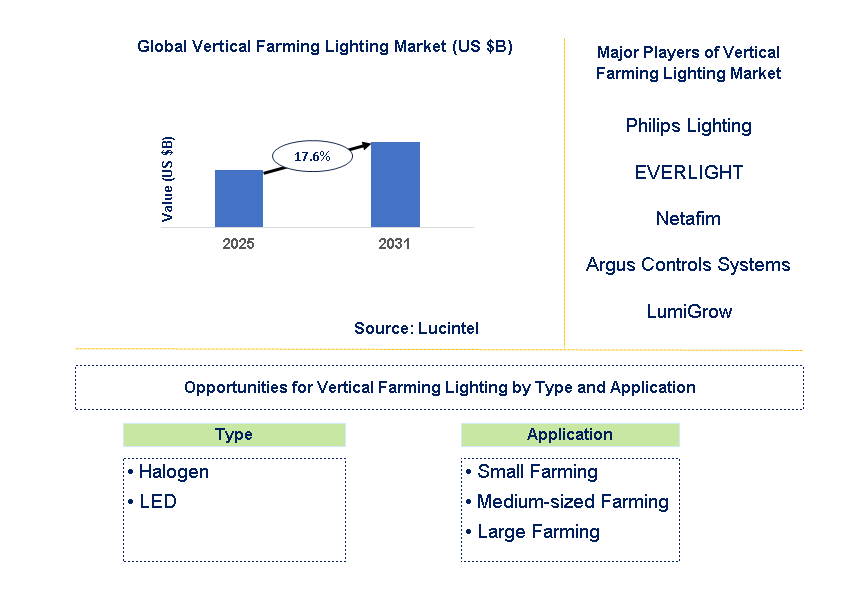
Key data points: The growth forecast = 17.6% annually for the next 7 years. Scroll below to get more insights. This market report covers Trends, opportunities and forecasts in vertical farming lighting market to 2031 by type (halogen and LED), application (small farming, medium-sized farming, and large farming), and region (North America, Europe, Asia Pacific, and the Rest of the World)
We'll send your sample report shortly.
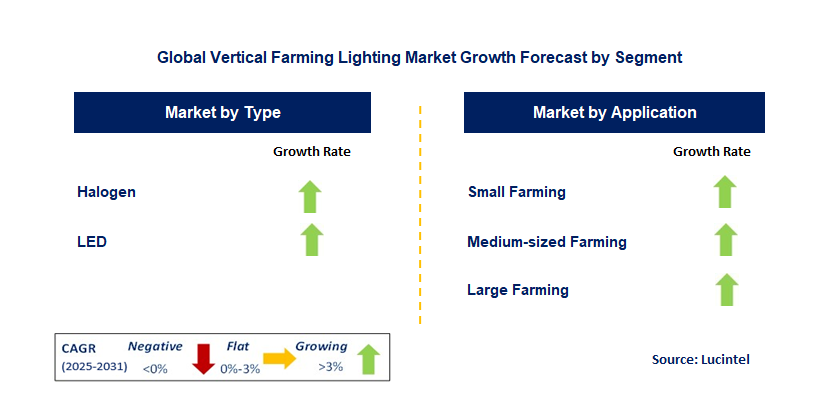
• Lucintel forecasts that, within the type category, led is expected to witness higher growth over the forecast period due to its energy efficiency.
• Within the application category, medium-sized farming is expected to witness the highest growth.
• In terms of region, APAC is expected to witness the highest growth over the forecast period.
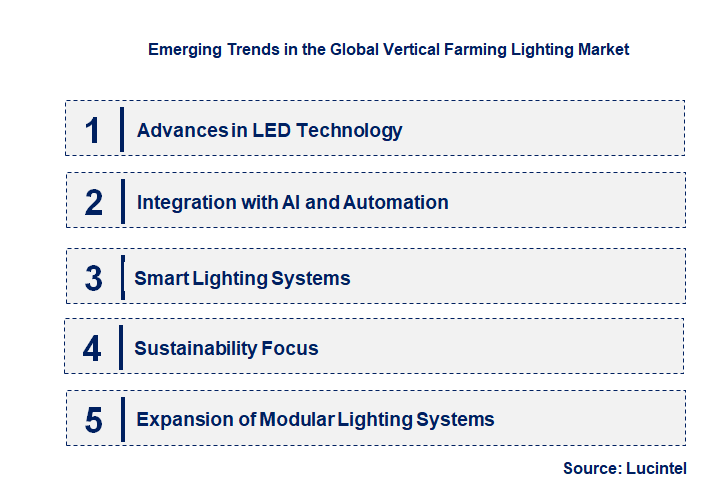
• Advances in LED Technology: LED remains to be at the forefront in vertical farming for its energy-efficient capabilities and susceptibility to customization in support of different stages of growth. Advances involve increasing light intensities and furthering the improvement of the spectrum for particular plants for enhanced production and energy reduction.
• Integration with AI and Automation: Artificial intelligence and automation are revolutionizing vertical farming lighting systems. These technologies allow real-time light intensity and spectrum adjustments depending on environmental and plant growth, resulting in improved crop yields and lower energy consumption.
• Smart Lighting Systems: Smart lighting systems are increasingly being developed in vertical farming. The system employs sensors and data analysis to track plant growth and adjust the light based on it, providing plants with the most suitable light conditions for optimal growth and health.
• Sustainability Focus: Sustainability is a key driver in vertical farming lighting. Companies are creating energy-efficient LED lights with longer lifetimes, minimizing waste and reducing energy use. These developments are consistent with worldwide trends toward more environmentally friendly agricultural practices.
• Expansion of Modular Lighting Systems: Modular lighting systems are increasingly becoming popular since they provide flexibility and scalability. They can be modified with ease to suit the precise lighting requirements of various crops or agriculture environments, thus being suitable for the dynamic nature of vertical farming businesses. These developments indicate the current innovation within the vertical farming lighting industry, ensuring efficient energy utilization and plant output to accommodate increased demand for environmentally friendly agriculture options.
• AI-Based Lighting Systems: Firms are creating lighting systems that come equipped with AI, which regulates light intensity and spectrum in real-time. By doing so, plants get the best possible lighting for photosynthesis, resulting in accelerated growth and increased yields.
• Energy-Efficient LED Technology: LED lighting technology is progressively improving, with companies launching increasingly energy-efficient systems. These LEDs offer greater luminosity with decreased power consumption, lowering the operation costs of vertical farms and increasing sustainability.
• Integration with Environmental Controls: New lighting solutions are being coupled with environmental control systems, like temperature and humidity regulators. Such integration enables an integrated approach towards farming, with lighting and climatic control co-operating together to achieve plant growth optimization.
• Adjustable Light Spectra: LED technology advancements enable adjustable light spectra to address the unique requirements of various crops. Vertical farms are embracing this technology to maximize growth rates and enhance crop quality, especially for herbs, leafy greens, and other high-value crops.
• Wireless and Remote-Control Lighting: Wireless and remote-controlled lighting systems are being developed, which are facilitating the operation of vertical farms with ease. The settings can be remotely controlled by the operators, energy consumption monitored, and the amount of light provided to plants can be assured, thus improving operating efficiency. These technologies are giving rise to more efficient, scalable, and sustainable light solutions for vertical farming and driving the growth and optimization of the industry.
• Smart Cities: With accelerated urbanization, vertical farming lighting systems provide smart cities with the opportunity to incorporate sustainable food production in their infrastructure. The systems provide effective food production within cities at less transportation cost and lesser food wastage.
• Sustainable Agriculture: Vertical Farm Lighting Solutions are increasingly contributing to sustainable agriculture by diminishing the ecological footprint of food farming. Energy-conserving lighting optimizes power efficiency and facilitates eco-friendlier farming methods.
• Indoor Farming: Development of indoor farming, such as urban farming and greenhouse production, provides an important opportunity for vertical farming lighting solutions. The systems allow for year-round production irrespective of outdoor weather conditions, contributing to food security and local food supply networks.
• Research and Development: Continued study of the unique lighting requirements for crops provides scope for the development of more specialized and effective lighting systems. Investing in R&D to maximize the lighting for a particular plant can result in greater yields and greater resource efficiency.
• Export to Emerging Markets: With global expansion of vertical farming, increasing demand for cutting-edge lighting technologies in emerging markets such as nations in Africa, South America, and Southeast Asia is being observed. These emerging markets offer opportunities for businesses to enter the developing agricultural technology industry. These expansion opportunities indicate the potential of vertical farming lighting in promoting sustainable agricultural practices and enhancing food production in urban and distant locations.
• Philips Lighting
• EVERLIGHT
• Netafim
• Argus Controls Systems
• LumiGrow
• Illumitex
• Vertical Farm Systems
• Halogen
• LED
• Small Farming
• Medium-sized Farming
• Large Farming
• North America
• Europe
• Asia Pacific
• The Rest of the World
• United States: The US is leading in innovation in the use of lighting for vertical farms, with a new emphasis on energy-efficient LEDs that can be tailored to plant varieties. Big ag tech companies are partnering with research institutions to create lighting solutions that mimic outdoor sunlight, enhancing yields and energy efficiency. Vertical farms throughout the US are adopting these new-fangled solutions for greater productivity.
• China: China is fast expanding its vertical farming operations, especially in urban areas where space is scarce. China is making huge investments in intelligent lighting solutions for vertical farms, such as automated, AI-based systems that regulate light intensity and spectrum in real-time plant requirements. This technological transformation is improving crop yield and quality and lowering environmental footprints, which is making China a major force in the market.
• Germany: Germany is emphasizing sustainable agriculture, and vertical farming lighting solutions are part of the plan. The nation is investing in high-tech LED systems combined with sensor technology to track plant development and maximize light use. These technologies align with Germany's mission to minimize food waste and maximize urban farming efficiency in high-density areas.
• India: India's vertical farming lighting industry is expanding, fueled by the imperative to meet food security and environmental issues. Urban vertical farms are using energy-efficient lighting systems to grow crops in indoor environments. Indian startups and agricultural technology firms are leading the development of cost-effective LED lighting, making vertical farming more sustainable and affordable, particularly in areas with scarce arable land.
• Japan: Japan is at the forefront of combining vertical farming with automation and robotics, and lighting systems are a key part. The nation is creating sophisticated LED lights that not only maximize plant growth but also minimize energy usage. Vertical farming in Japan is being used more and more by cities and big companies to produce local food and support sustainability initiatives.


• Philips Lighting
• EVERLIGHT
• Netafim
• Argus Controls Systems
• LumiGrow
• Illumitex
• Vertical Farm Systems Q5. Which vertical farming lighting market segment will be the largest in future? Answer: Lucintel forecasts that, within the type category, led is expected to witness higher growth over the forecast period due to its energy efficiency. Q6. In vertical farming lighting market, which region is expected to be the largest in next 5 years? Answer: In terms of region, APAC is expected to witness the highest growth over the forecast period. Q7. Do we receive customization in this report? Answer: Yes, Lucintel provides 10% customization without any additional cost.


Choose a license that fits your team. Instant PDF delivery.
Prices exclude taxes. Instant delivery. Custom licensing available on request.
Market Report · July 29, 2026
Market Report · July 20, 2026
Market Report · July 20, 2026
Trusted partner for strategic intelligence and business growth


Receive a complimentary market analysis tailored to your industry. Our analysts will identify key growth opportunities and competitive dynamics specific to your business.

Market size, growth rate, and key trend analysis for your specific sector.

Top competitor positioning and market share analysis.

Strategic recommendations backed by data-driven insights.
Get curated market intelligence and competitive moves straight to your inbox.
By subscribing, you agree to receive our monthly insights. Unsubscribe anytime.
Receive a complimentary market analysis tailored to your industry. Our analysts will identify key growth opportunities and competitive dynamics specific to your business.
Market size, growth rate, and key trend analysis for your specific sector.
Top competitor positioning and market share analysis.
Strategic recommendations backed by data-driven insights.
Get curated market intelligence, emerging trends, and competitive moves straight to your inbox each month.
By subscribing, you agree to receive our monthly insights. Unsubscribe anytime.
We'll send your sample report shortly.