
Report Feature
Vein Finder Market Trends and Forecast
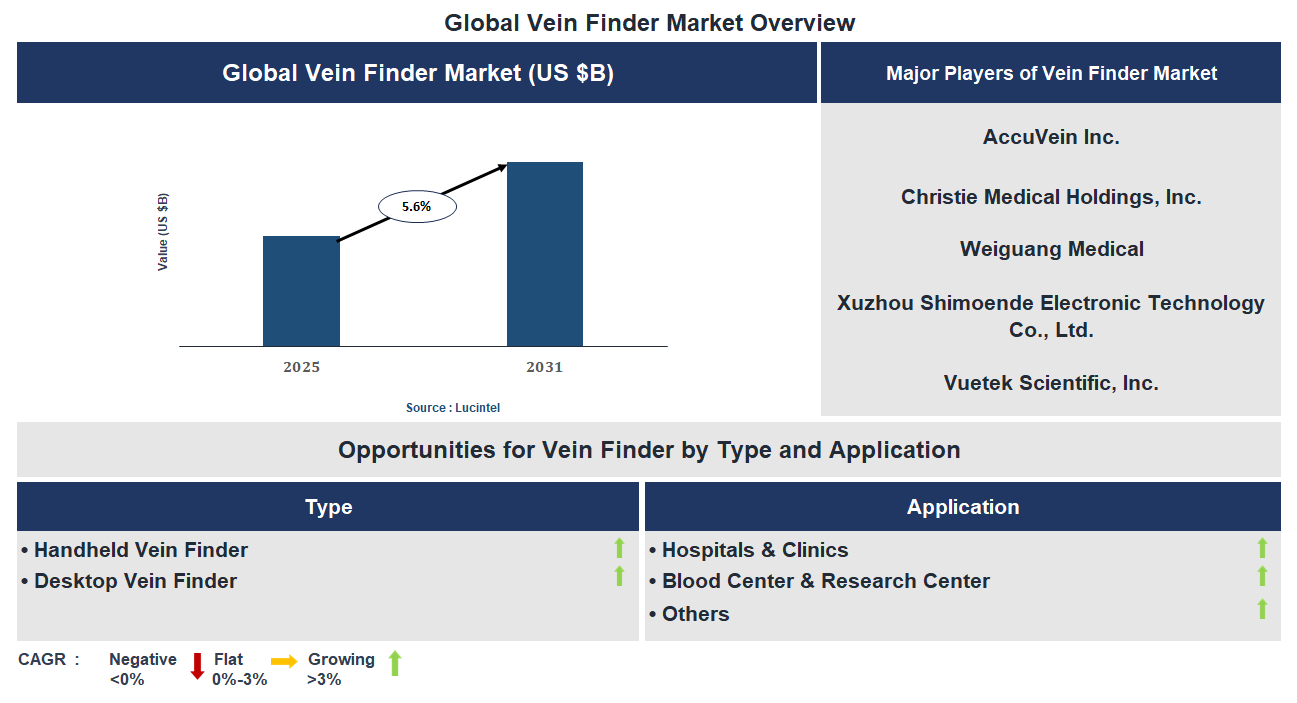
The future of the global vein finder market looks promising with opportunities in the hospital & clinic and blood center & research center markets. The global vein finder market is expected to grow with a CAGR of 5.6% from 2025 to 2031. The major drivers for this market are the increasing demand for accurate vein detection, the rising adoption of non-invasive medical devices, and the growing focus on patient safety during procedures.• Lucintel forecasts that, within the type category, handheld vein finder is expected to witness higher growth over the forecast period.
• Within the application category, hospital & clinic is expected to witness higher growth.
• In terms of region, APAC is expected to witness the highest growth over the forecast period. Gain valuable insights for your business decisions with our comprehensive 150+ page report. Sample figures with some insights are shown below.
Emerging Trends in the Vein Finder Market
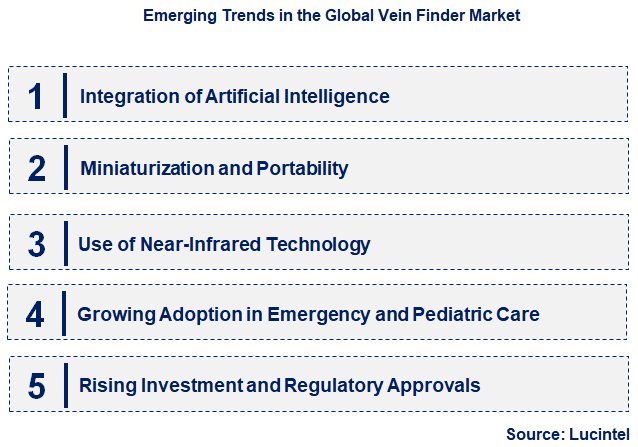
The vein finder market is experiencing rapid growth driven by technological advancements, increasing healthcare needs, and a focus on minimally invasive procedures. As medical professionals seek more accurate and efficient tools for vein detection, innovative solutions are emerging to improve patient outcomes and streamline clinical workflows. These developments are transforming the landscape of vein visualization, making procedures safer and more comfortable for patients. The market is also influenced by rising investments in healthcare infrastructure and a growing awareness of the benefits of advanced vein detection devices. Understanding these trends is essential for stakeholders aiming to capitalize on the evolving opportunities within this sector.• Integration of Artificial Intelligence: AI-powered vein finders are enhancing accuracy by analyzing real-time data, reducing the risk of failed insertions, and improving patient comfort. These devices utilize machine learning algorithms to adapt to individual patient anatomy, making vein detection faster and more reliable. The integration of AI is also enabling predictive analytics, which can assist clinicians in planning procedures more effectively. As AI technology advances, it is expected to further personalize vein detection, leading to higher success rates and better clinical outcomes.
• Miniaturization and Portability: The trend toward smaller, portable vein finders is gaining momentum, driven by the need for point-of-care diagnostics and mobile healthcare services. Compact devices facilitate bedside procedures, emergency settings, and home healthcare, expanding access to vein visualization tools. Portability also reduces equipment costs and enhances workflow efficiency. Manufacturers are focusing on developing lightweight, battery-operated devices with user-friendly interfaces, making vein detection more accessible across diverse healthcare environments. This trend is particularly impactful in rural and resource-limited settings.
• Use of Near-Infrared Technology: NIR technology remains a cornerstone in vein detection, offering non-invasive, real-time visualization of veins beneath the skin. Advances in NIR imaging have improved depth penetration and image clarity, enabling clinicians to locate veins more accurately, even in patients with difficult venous access. The development of enhanced sensors and imaging algorithms has further refined this technology, making it suitable for a broader range of clinical applications. As NIR technology evolves, it is expected to become more integrated with other imaging modalities, broadening its utility.
• Growing Adoption in Emergency and Pediatric Care: The demand for vein finders is increasing in emergency medicine and pediatric care, where quick and accurate vein access is critical. These devices help reduce procedure time, minimize patient discomfort, and improve success rates in challenging cases. The market is witnessing increased adoption due to the rising prevalence of chronic diseases, pediatric conditions, and the need for rapid vascular access in emergencies. Manufacturers are developing specialized devices tailored for these settings, emphasizing ease of use, safety, and minimal invasiveness, thereby expanding their market reach.
• Rising Investment and Regulatory Approvals: Increased investments from healthcare providers, venture capitalists, and device manufacturers are fueling innovation and market expansion. Regulatory approvals for new and improved vein finder devices are streamlining market entry and boosting confidence among clinicians. This influx of funding and regulatory support is accelerating product development cycles, leading to the launch of advanced, compliant devices. As a result, the market is witnessing a surge in high-quality, innovative solutions that meet stringent safety and efficacy standards, ultimately driving broader adoption and market growth. In summary, these emerging trends are significantly reshaping the vein finder market by enhancing device accuracy, portability, and usability across various healthcare settings. The integration of AI, technological advancements, and increased investment is fostering innovation, improving patient care, and expanding market reach. As these trends continue to evolve, they will likely lead to more personalized, efficient, and accessible vein detection solutions, transforming clinical practices worldwide.
Recent Development in the Vein Finder Market
The vein finder market has experienced significant growth driven by technological advancements, increasing healthcare needs, and a rising focus on minimally invasive procedures. As medical facilities seek more accurate and efficient tools for vein detection, innovations are transforming how healthcare providers approach vascular access. The markets evolution is also influenced by the rising prevalence of chronic diseases, aging populations, and the demand for improved patient comfort. These factors collectively foster a dynamic environment for new product development and market expansion. The following key developments highlight the recent trends shaping this markets trajectory and its future outlook.• Technological Advancements: Integration of near-infrared (NIR) imaging and ultrasound technology has enhanced vein visualization accuracy, leading to better patient outcomes and reduced procedure times. These innovations have expanded the usability of vein finders across various clinical settings, including pediatrics and emergency care, thereby increasing market adoption and driving growth.
• Increasing Adoption in Emergency and Pediatric Care: The demand for non-invasive, quick, and reliable vein detection tools has surged in emergency rooms and pediatric units. This trend has prompted manufacturers to develop specialized, portable vein finders tailored for these settings, significantly improving success rates and patient comfort, and consequently expanding market reach.
• Rising Prevalence of Chronic Diseases and Aging Population: The growing incidence of conditions like diabetes and vascular diseases, coupled with an aging demographic, has increased the need for reliable vascular access devices. This demographic shift has stimulated demand for advanced vein finders, fostering market expansion and encouraging innovation in device design.
• Regulatory Approvals and Product Launches: Recent approvals from health authorities and the launch of new, technologically advanced vein finders have bolstered market confidence. These developments facilitate wider adoption in hospitals and clinics, enhance product credibility, and stimulate competitive growth within the industry.
• Market Expansion in Emerging Economies: Increasing healthcare infrastructure investments and rising awareness about minimally invasive procedures in developing countries have opened new markets. Companies are focusing on local partnerships and affordable solutions, which are driving market penetration and contributing to global growth. In summary, recent developments in the vein finder market—spanning technological innovations, increased clinical adoption, demographic shifts, regulatory progress, and market expansion—are collectively propelling the industry forward. These trends are improving procedural success rates, enhancing patient comfort, and broadening access to advanced vascular detection tools, thereby shaping a promising future for the market.
Strategic Growth Opportunities in the Vein Finder Market
The vein finder market is experiencing rapid growth driven by technological advancements, increasing demand for minimally invasive procedures, and rising healthcare awareness. As medical facilities seek more accurate and efficient vein visualization tools, key applications are emerging as significant growth drivers. These opportunities are transforming patient care, improving procedural success rates, and expanding market reach across various healthcare settings. Understanding these growth avenues is essential for stakeholders aiming to capitalize on the evolving landscape and enhance clinical outcomes.• Enhanced Patient Care and Procedural Efficiency: Vein finders are increasingly used in emergency settings to quickly locate veins in critical situations, reducing procedure time and improving success rates. This application is vital for administering emergency medications, blood draws, and IV placements, especially in patients with difficult veins, such as children or obese individuals. The rapid deployment of vein finders in emergency departments enhances patient outcomes, minimizes complications, and streamlines workflow, making it a crucial growth area. As emergency care demands grow, the adoption of vein finders is expected to expand significantly, driven by the need for speed and accuracy in life-saving procedures.
• Improved Chemotherapy Administration: In oncology, vein finders facilitate precise vein localization for chemotherapy and other treatments, reducing patient discomfort and procedure failures. Cancer patients often have fragile or difficult veins, making repeated attempts challenging and painful. The use of vein finders ensures accurate placement of IV lines, decreasing procedure time and enhancing patient comfort. This application also reduces the risk of infiltration and extravasation, leading to better treatment outcomes. As the number of cancer cases rises globally, the demand for reliable vein visualization tools in oncology clinics and hospitals is expected to grow, positioning this as a key growth opportunity.
• Minimally Invasive and Pain-free Procedures: Pediatric applications benefit from vein finders by enabling less invasive, pain-free procedures for children. Difficult veins in pediatric patients often lead to multiple attempts, distress, and complications. Vein finders improve first-attempt success rates, reduce procedure time, and enhance patient comfort. This technology supports minimally invasive practices, which are increasingly preferred in pediatric care. The rising pediatric population and awareness about pain management are driving adoption. As healthcare providers focus on patient-centered care, the demand for advanced vein visualization tools in pediatrics is set to expand, making it a significant growth segment.
• Reliable Vascular Access Management: Vein finders play a crucial role in establishing and maintaining vascular access for dialysis patients. Accurate vein localization reduces complications, improves fistula success rates, and minimizes procedure time. Chronic care settings require repeated access, making precision vital for patient safety and comfort. The growing prevalence of chronic kidney disease and the increasing number of dialysis centers worldwide are fueling demand for vein finders. This application enhances clinical efficiency and patient outcomes, positioning it as a prominent growth opportunity in the market.
• Precision in Vein-related Treatments: In cosmetic procedures, vein finders assist in precise vein visualization for treatments like sclerotherapy and vein removal. Accurate targeting minimizes complications and improves aesthetic results. The rising popularity of minimally invasive aesthetic treatments and increasing awareness about vein health are driving adoption. Vein finders enable practitioners to perform procedures more confidently and efficiently, expanding their use in outpatient clinics and specialized aesthetic centers. As the cosmetic industry grows, the integration of vein visualization technology is expected to become a standard practice, representing a lucrative growth opportunity. In summary, these key applications are significantly impacting the Vein Finder Market by expanding its scope, improving procedural success, and enhancing patient outcomes. The integration of vein visualization technology across emergency, oncology, pediatrics, chronic care, and aesthetic procedures is driving market growth, fostering innovation, and meeting the increasing demand for minimally invasive, accurate, and patient-friendly healthcare solutions.
Vein Finder Market Driver and Challenges
The vein finder market is influenced by a variety of technological, economic, and regulatory factors that shape its growth and development. Advances in imaging technology and increased demand for minimally invasive procedures are key drivers. Economic factors such as rising healthcare costs and the need for efficient patient care also play a significant role. Additionally, regulatory standards and approvals impact product development and market entry. These elements collectively determine the markets trajectory, presenting both opportunities and challenges for stakeholders. Understanding these drivers and challenges is essential for strategic planning and sustainable growth in this evolving sector. The factors responsible for driving the vein finder market include:-• Technological Advancements: The development of high-resolution imaging and portable devices has significantly improved vein visualization, making procedures faster and more accurate. Innovations like near-infrared (NIR) technology enable non-invasive, real-time vein detection, reducing patient discomfort and procedure time. These technological improvements have expanded the application scope, especially in pediatric and geriatric care, boosting market demand. Continuous R&D efforts are expected to further enhance device capabilities, fostering market growth and adoption across healthcare settings worldwide.
• Increasing Prevalence of Chronic Diseases: The rising incidence of chronic conditions such as diabetes and obesity has led to a higher demand for vascular access procedures. Difficult venous access in these patient populations necessitates advanced vein visualization tools, driving the adoption of vein finders. Hospitals and clinics are investing in these devices to improve success rates and reduce procedure-related complications. This trend is particularly prominent in aging populations, where fragile veins are common, thereby expanding the market scope and encouraging manufacturers to innovate.
• Growing Preference for Minimally Invasive Procedures: The healthcare industry’s shift towards minimally invasive techniques is a major driver for the vein finder market. These devices facilitate quick, accurate vein localization, enabling less painful and more efficient procedures. This trend aligns with patient preferences for less invasive treatments and shorter recovery times. Healthcare providers are increasingly adopting vein finders to enhance procedural success and patient satisfaction, which in turn propels market growth. The emphasis on outpatient and bedside procedures further amplifies the demand for portable, user-friendly vein visualization devices.
• Rising Healthcare Expenditure and Infrastructure Development: Increasing healthcare spending globally, especially in emerging economies, supports the adoption of advanced medical devices like vein finders. Investments in healthcare infrastructure and training programs improve access to modern diagnostic tools. Hospitals and clinics are upgrading their facilities to include vein visualization technology, recognizing its benefits in improving procedural outcomes. Government initiatives and funding for healthcare modernization also contribute to market expansion, creating a conducive environment for product innovation and wider adoption.
• Regulatory Approvals and Reimbursement Policies: Favorable regulatory approvals and reimbursement frameworks significantly influence market growth. Clear guidelines and fast-track approvals for innovative vein finder devices encourage manufacturers to invest in product development. Reimbursement policies that cover the cost of these devices make them more accessible to healthcare providers and patients, boosting adoption rates. Conversely, stringent regulations and a lack of reimbursement can hinder market expansion, emphasizing the importance of supportive regulatory environments for sustained growth. The challenges facing this vein finder market include:-
• High Cost of Advanced Devices: The cost of sophisticated vein finder systems, especially those utilizing near-infrared technology, remains high. This limits adoption in cost-sensitive regions and smaller healthcare facilities. The high initial investment and maintenance expenses can deter hospitals from upgrading their existing infrastructure, impacting market penetration. Additionally, price competition among manufacturers can lead to compromises on device quality, affecting overall market stability and growth prospects.
• Limited Awareness and Training: Despite technological advancements, there is a lack of awareness and trained personnel in many regions. Healthcare providers may be unfamiliar with the benefits and operation of vein finders, leading to underutilization. Insufficient training programs hinder effective device use, reducing procedural success rates and patient outcomes. Addressing this challenge requires targeted education and training initiatives, which can be resource-intensive but are essential for expanding market reach.
• Regulatory and Reimbursement Barriers: Complex regulatory processes and inconsistent reimbursement policies across countries pose significant hurdles. Lengthy approval procedures delay product launches, while a lack of reimbursement discourages healthcare providers from investing in new technology. These barriers can slow market growth and limit access to advanced vein visualization devices, especially in developing regions. Overcoming these challenges necessitates collaborative efforts between manufacturers, regulators, and payers to streamline approval and reimbursement pathways. In summary, the vein finder market is driven by technological innovations, increasing disease prevalence, a shift towards minimally invasive procedures, and supportive healthcare investments. However, high device costs, limited awareness, and regulatory hurdles present notable challenges. These factors collectively influence market dynamics, requiring strategic approaches to maximize opportunities while addressing barriers. The overall impact suggests a promising growth trajectory, provided stakeholders focus on affordability, education, and regulatory facilitation to ensure widespread adoption and sustained development.
List of Vein Finder Companies
Companies in the market compete on the basis of product quality offered. Major players in this market focus on expanding their manufacturing facilities, R&D investments, infrastructural development, and leverage integration opportunities across the value chain. With these strategies vein finder companies cater increasing demand, ensure competitive effectiveness, develop innovative products & technologies, reduce production costs, and expand their customer base. Some of the vein finder companies profiled in this report include-• AccuVein Inc.
• Christie Medical Holdings, Inc.
• Weiguang Medical
• Xuzhou Shimoende Electronic Technology Co., Ltd.
• Vuetek Scientific, Inc.
• TransLite LLC
• Zhiding Medical Technology Co., Ltd.
• Qingdao Optoelectronic Medical Co., Ltd.
• Bolian Zh
Vein Finder Market by Segment
The study includes a forecast for the global vein finder market by type, application, and region.Vein Finder Market by Type [Value from 2019 to 2031]:
• Handheld Vein Finder
• Desktop Vein Finder
Vein Finder Market by Application [Value from 2019 to 2031]:
• Hospitals & Clinics
• Blood Center & Research Center
• Others
Vein Finder Market by Region [Value from 2019 to 2031]:
• North America
• Europe
• Asia Pacific
• The Rest of the World
Country Wise Outlook for the Vein Finder Market
The vein finder market has experienced significant growth driven by technological advancements, increasing healthcare needs, and rising awareness of minimally invasive procedures worldwide. Countries are adopting innovative imaging technologies to improve patient outcomes and reduce procedure times. The markets expansion is also fueled by the rising prevalence of chronic diseases, aging populations, and the demand for efficient vascular access devices. As healthcare systems evolve, key players are investing in research and development to introduce more accurate, portable, and user-friendly vein detection solutions. These developments reflect a global shift towards enhancing diagnostic accuracy and patient comfort in vascular procedures.• United States: The US market for vein finders has seen rapid adoption of advanced imaging technologies, including near-infrared (NIR) and ultrasound-based devices. Major healthcare providers are integrating vein finders into routine clinical practice to improve success rates in difficult venipunctures. The government’s focus on healthcare innovation and increased funding for medical device research have further propelled market growth. Additionally, rising demand for minimally invasive procedures and the presence of key market players have contributed to technological advancements and product launches.
• China: Chinas vein finder market is expanding due to increasing healthcare infrastructure and a growing geriatric population. The adoption of portable and cost-effective vein detection devices is rising, especially in rural and semi-urban healthcare settings. The government’s initiatives to improve healthcare access and the rising prevalence of chronic diseases like diabetes are driving demand. Local manufacturers are investing in R&D to develop affordable, high-precision vein finders, which are increasingly being integrated into hospitals and clinics across the country.
• Germany: Germanys market is characterized by high adoption of technologically advanced vein detection systems, driven by a well-established healthcare infrastructure. The focus on patient safety and comfort has led to the integration of innovative imaging solutions, such as infrared and ultrasound-based devices. The country’s emphasis on research and development, along with stringent regulatory standards, has resulted in the availability of high-quality, reliable vein finders. Moreover, Germany’s aging population and the rise in chronic conditions requiring vascular access are further fueling market growth.
• India: The Indian vein finder market is witnessing rapid growth due to increasing healthcare expenditure and rising awareness about minimally invasive procedures. The demand for affordable and portable vein detection devices is high, especially in rural and semi-urban areas where healthcare access is limited. Local manufacturers are developing cost-effective solutions to cater to the large population base. The government’s initiatives to improve healthcare infrastructure and the increasing prevalence of diseases like diabetes and cardiovascular conditions are also contributing to market expansion.
• Japan: Japan’s vein finder market is driven by an aging population and the need for efficient vascular access in elderly patients. The adoption of advanced imaging technologies, including infrared and ultrasound systems, is increasing in hospitals and clinics. Japan’s focus on healthcare innovation and the presence of leading medical device companies have led to the development of high-precision, user-friendly vein detection solutions. The government’s support for medical technology research and the rising prevalence of chronic vascular diseases are key factors supporting market growth.

Features of the Global Vein Finder Market
Market Size Estimates: Vein finder market size estimation in terms of value ($B). Trend and Forecast Analysis: Market trends (2019 to 2024) and forecast (2025 to 2031) by various segments and regions. Segmentation Analysis: Vein finder market size by type, application, and region in terms of value ($B). Regional Analysis: Vein finder market breakdown by North America, Europe, Asia Pacific, and Rest of the World. Growth Opportunities: Analysis of growth opportunities in different types, applications, and regions for the vein finder market. Strategic Analysis: This includes M&A, new product development, and competitive landscape of the vein finder market. Analysis of competitive intensity of the industry based on Porter’s Five Forces model.
FAQ
Q1. What is the growth forecast for vein finder market? Answer: The global vein finder market is expected to grow with a CAGR of 5.6% from 2025 to 2031. Q2. What are the major drivers influencing the growth of the vein finder market? Answer: The major drivers for this market are the increasing demand for accurate vein detection, the rising adoption of non-invasive medical devices, and the growing focus on patient safety during procedures. Q3. What are the major segments for vein finder market? Answer: The future of the vein finder market looks promising with opportunities in the hospital & clinic and blood center & research center markets. Q4. Who are the key vein finder market companies? Answer: Some of the key vein finder companies are as follows:• AccuVein Inc.
• Christie Medical Holdings, Inc.
• Weiguang Medical
• Xuzhou Shimoende Electronic Technology Co., Ltd.
• Vuetek Scientific, Inc.
• TransLite LLC
• Zhiding Medical Technology Co., Ltd.
• Qingdao Optoelectronic Medical Co., Ltd.
• Bolian Zhongke
• Near Infrared Imaging, Inc. Q5. Which vein finder market segment will be the largest in future? Answer: Lucintel forecasts that, within the type category, handheld vein finder is expected to witness higher growth over the forecast period. Q6. In vein finder market, which region is expected to be the largest in next 5 years? Answer: In terms of region, APAC is expected to witness the highest growth over the forecast period. Q7. Do we receive customization in this report? Answer: Yes, Lucintel provides 10% customization without any additional cost.
Table of Contents
List of Figures
List of Tables
Methodology
- In-depth interviews of the major players in this market
- Detailed secondary research from competitors’ financial statements and published data
- Extensive searches of published works, market, and database information pertaining to industry news, company press releases, and customer intentions
- A compilation of the experiences, judgments, and insights of Lucintel’s professionals, who have analyzed and tracked this market over the years.


Buy Now
Choose a license that fits your team. Instant PDF delivery.
Prices exclude taxes. Instant delivery. Custom licensing available on request.
Key Questions
- • What are some of the most promising, high-growth opportunities for the vein finder market by type (handheld vein finder and desktop vein finder), application (hospitals & clinics, blood center & research center, and others), and region (North America, Europe, Asia Pacific, and the Rest of the World)?
- • Which segments will grow at a faster pace and why?
- • Which region will grow at a faster pace and why?
- • What are the key factors affecting market dynamics? What are the key challenges and business risks in this market?
- • What are the business risks and competitive threats in this market?
- • What are the emerging trends in this market and the reasons behind them?
- • What are some of the changing demands of customers in the market?
- • What are the new developments in the market? Which companies are leading these developments?
- • Who are the major players in this market? What strategic initiatives are key players pursuing for business growth?
- • What are some of the competing products in this market and how big of a threat do they pose for loss of market share by material or product substitution?
- • What M&A activity has occurred in the last 5 years and what has its impact been on the industry? For any questions related to Vein Finder Market, Vein Finder Market Size, Vein Finder Market Growth, Vein Finder Market Analysis, Vein Finder Market Report, Vein Finder Market Share, Vein Finder Market Trends, Vein Finder Market Forecast, Vein Finder Companies, write Lucintel analyst at email: helpdesk@lucintel.com. We will be glad to get back to you soon.


