
Market Report · July 29, 2026

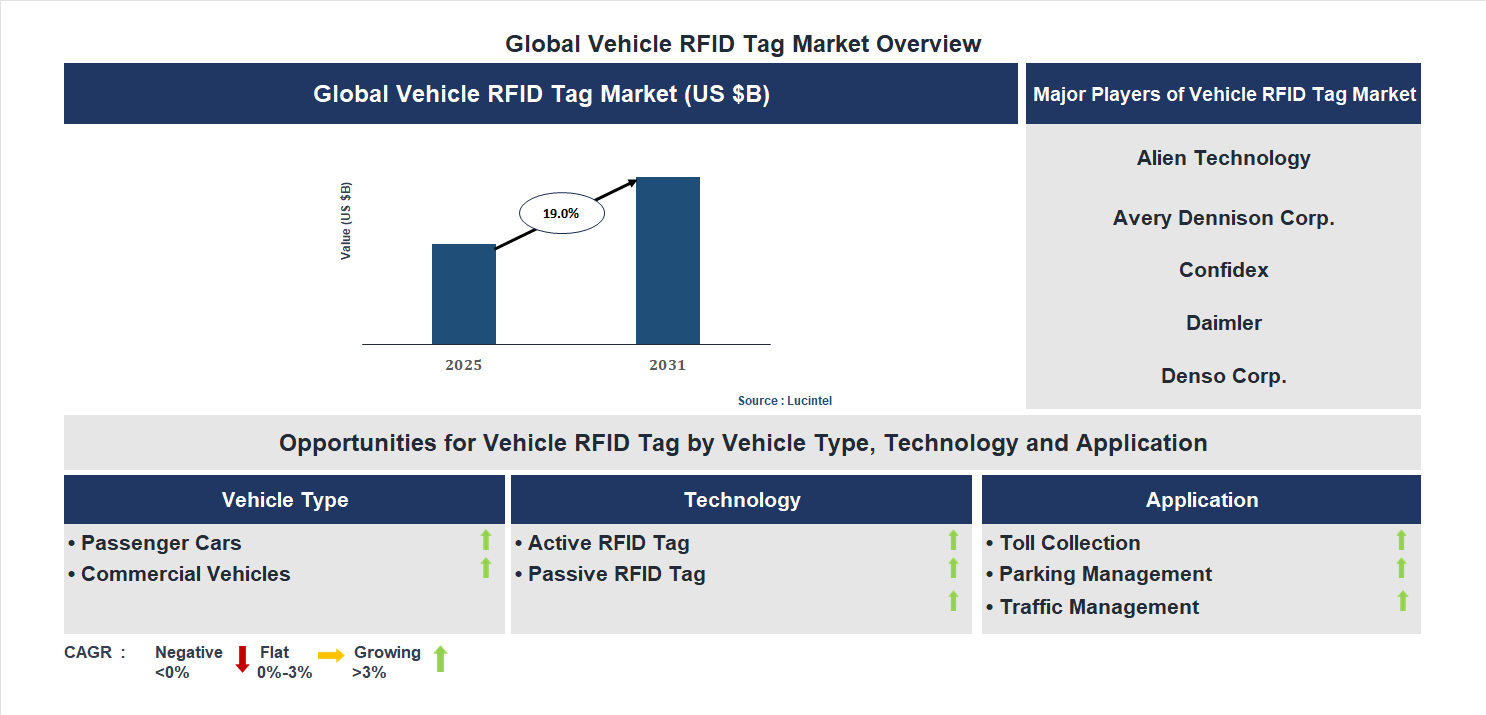
Key data points: The growth forecast = 19.0% annually for the next 7 years. Scroll below to get more insights. This market report covers trends, opportunities and forecasts in vehicle RFID tag market to 2031 by vehicle type (passenger cars and commercial vehicles), technology (active RFID tag and passive RFID tag), application (toll collection, parking management, and traffic management), and region (North America, Europe, Asia Pacific, and the Rest of the World)
We'll send your sample report shortly.
• Lucintel forecasts that, within the vehicle type category, passenger car is expected to witness higher growth over the forecast period.
• Within the application category, toll collection is expected to witness the highest growth.
• In terms of region, APAC is expected to witness the highest growth over the forecast period. Gain valuable insights for your business decisions with our comprehensive 150+ page report. Sample figures with some insights are shown below.
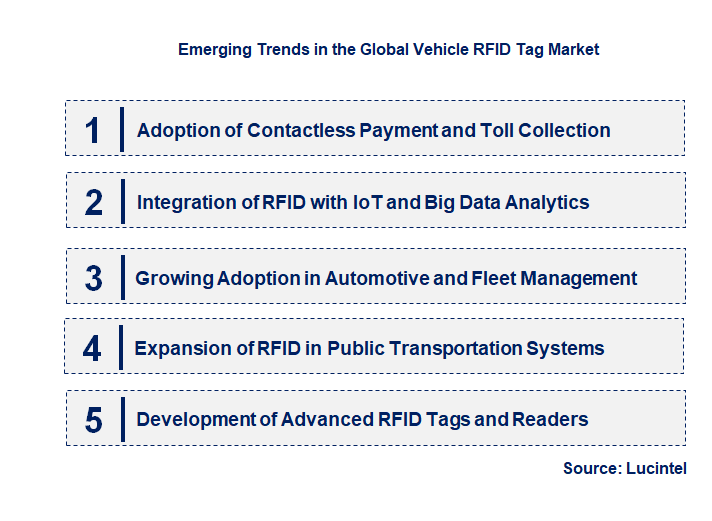
• Adoption of Contactless Payment and Toll Collection: The increasing deployment of RFID tags for contactless toll payments enhances traffic flow and reduces congestion. This trend is driven by government initiatives to modernize transportation infrastructure and improve user convenience. RFID-based toll systems enable quick, seamless transactions, minimizing delays and operational costs. As urban areas expand and traffic volumes grow, the demand for efficient toll collection solutions accelerates, making RFID technology a vital component in smart city development. This trend is transforming traditional toll booths into automated, cashless systems, significantly improving overall transportation efficiency.
• Integration of RFID with IoT and Big Data Analytics: The convergence of RFID technology with Internet of Things (IoT) and big data analytics is creating smarter vehicle management systems. RFID tags provide real-time data on vehicle location, status, and usage, which can be analyzed to optimize fleet operations, maintenance schedules, and security protocols. This integration enables predictive analytics, reducing downtime and operational costs. Industries are leveraging these insights to enhance decision-making processes, improve customer service, and develop innovative business models. The impact is a more connected, efficient, and data-driven vehicle ecosystem that supports the growth of smart transportation networks.
• Growing Adoption in Automotive and Fleet Management: RFID tags are increasingly used in automotive manufacturing for inventory control, anti-theft, and vehicle tracking. Fleet management companies utilize RFID for real-time vehicle monitoring, route optimization, and maintenance tracking. This trend improves operational efficiency, reduces theft, and enhances safety. As vehicle production becomes more automated, RFID integration is essential for supply chain visibility and quality control. The automotive sector’s adoption of RFID is also driven by regulatory standards for vehicle security and tracking, making RFID a critical component in modern vehicle lifecycle management.
• Expansion of RFID in Public Transportation Systems: Public transit authorities are adopting RFID for fare collection, passenger tracking, and security purposes. Contactless RFID cards streamline boarding processes, reduce wait times, and improve passenger experience. Additionally, RFID helps in managing capacity and ensuring safety during peak hours or emergencies. The technology also supports data collection for transit planning and service optimization. As cities focus on sustainable and efficient transportation solutions, RFID’s role in public transit is expected to grow, facilitating smarter, more responsive urban mobility systems that benefit both operators and commuters.
• Development of Advanced RFID Tags and Readers: Innovations in RFID technology include the creation of more durable, high-performance tags and sophisticated readers capable of operating in challenging environments. These advancements enable RFID applications in harsh conditions such as extreme temperatures, dirt, and moisture, expanding their usability across various sectors. Enhanced tags with longer read ranges and better security features improve reliability and data integrity. The development of miniaturized, cost-effective RFID components also facilitates widespread adoption. These technological improvements are critical for supporting large-scale deployment in vehicle tracking, toll collection, and security systems, thereby driving market growth and innovation. In summary, these emerging trends are fundamentally reshaping the vehicle RFID tag market by fostering greater efficiency, connectivity, and security. The integration with IoT and data analytics is creating smarter transportation systems, while innovations in RFID hardware are expanding application possibilities. The adoption in public transit and automotive sectors is streamlining operations and enhancing user experiences. Collectively, these developments are driving market expansion, encouraging sustainable urban mobility, and positioning RFID technology as a cornerstone of future transportation infrastructure.
• Adoption of Contactless Toll Collection Systems: The shift towards contactless tolling has accelerated, with many countries implementing RFID-based systems to reduce congestion and improve efficiency. This development enhances user convenience, decreases wait times, and minimizes manual toll collection errors. It also supports the push for cashless transactions, aligning with digital payment trends. The impact is a broader adoption of RFID tags in daily commuting, leading to increased market demand and technological innovation.
• Integration with Smart City Infrastructure: RFID technology is increasingly integrated into broader smart city initiatives, enabling seamless vehicle tracking, parking management, and traffic monitoring. This integration improves urban mobility, reduces congestion, and enhances security. It also facilitates data collection for urban planning and policy-making. The impact is a more interconnected transportation ecosystem, driving growth in RFID deployment and fostering collaboration between technology providers and city authorities.
• Development of Advanced RFID Tags with Enhanced Durability: Manufacturers are introducing RFID tags with improved durability, including resistance to extreme weather, vandalism, and wear and tear. These robust tags are suitable for long-term outdoor use and harsh environments, expanding their application scope. The impact is increased reliability and reduced replacement costs, encouraging wider adoption across commercial fleets, logistics, and public transportation sectors.
• Rising Use of Biometric and Multi-Modal RFID Systems: The integration of biometric authentication with RFID tags is gaining traction for enhanced security and access control. Multi-modal systems combining RFID with other identification methods are also emerging, providing higher accuracy and security levels. This development impacts the market by offering more secure and versatile solutions for vehicle access, fleet management, and border control, thereby expanding market opportunities.
• Expansion of RFID in Electric and Autonomous Vehicles: The rise of electric and autonomous vehicles is driving the adoption of RFID tags for vehicle identification, charging station access, and autonomous navigation. RFID technology supports the seamless operation of these advanced vehicles by enabling efficient communication and control. The impact is a significant boost in RFID market growth, aligning with the future of transportation and fostering innovation in vehicle management systems. In summary, these recent developments are transforming the vehicle RFID tag market by enhancing system efficiency, security, and integration with emerging transportation technologies. The market is experiencing rapid growth driven by technological innovation, infrastructure modernization, and the increasing need for smart, connected transportation solutions. This evolution promises a more efficient, secure, and intelligent vehicle management landscape in the coming years.
• Toll Collection: Streamlined and contactless toll payments are revolutionizing transportation infrastructure. RFID tags enable quick vehicle identification, reducing congestion and wait times at toll booths. This improves traffic flow, decreases emissions, and enhances user convenience, making it a vital growth area for the market.
• Vehicle Access Control: RFID technology enhances security by providing reliable access control for parking lots, gated communities, and corporate premises. It ensures only authorized vehicles enter restricted areas, reducing theft and unauthorized access, thereby increasing safety and operational efficiency.
• Fleet Management: RFID tags facilitate real-time tracking and monitoring of commercial vehicles. This improves route optimization, reduces fuel consumption, and enhances maintenance scheduling. The efficiency gains support logistics companies in reducing costs and improving service delivery.
• Public Transportation: RFID tags are increasingly used in transit systems for fare collection and passenger management. Contactless ticketing improves passenger experience, reduces operational costs, and enables seamless integration across transportation networks, fostering smarter cities.
• Vehicle Maintenance and Service: RFID tags assist in tracking vehicle history, maintenance schedules, and parts inventory. This ensures timely servicing, reduces downtime, and extends vehicle lifespan, contributing to cost savings and operational reliability. In summary, these growth opportunities are significantly impacting the vehicle RFID tag market by driving innovation, improving operational efficiencies, and enhancing security across various applications. As adoption accelerates, the market is poised for sustained expansion, supporting smarter, safer, and more efficient transportation systems worldwide.
• Technological Advancements: Rapid innovations in RFID technology, including improved read ranges, miniaturization, and integration with IoT, have enhanced the functionality and reliability of vehicle RFID tags. These advancements enable real-time vehicle tracking, automated toll collection, and seamless access control, making RFID solutions more attractive to transportation agencies and private operators. As technology continues to evolve, costs are decreasing, and performance is improving, which further accelerates market adoption. The integration with emerging technologies like AI and big data analytics also opens new avenues for vehicle management and security, fostering market growth.
• Increasing Demand for Vehicle Security and Access Control: Growing concerns over vehicle theft, unauthorized access, and security breaches are driving the adoption of RFID tags for vehicle identification and access control. RFID systems provide a quick, contactless, and reliable method to authenticate vehicles at entry points, parking lots, and toll booths. This demand is particularly prominent in urban areas, commercial fleets, and government facilities, where security is paramount. The ability to automate access and monitor vehicle movements enhances operational efficiency and safety, making RFID tags an essential component of modern vehicle security systems.
• Government Initiatives and Regulatory Support: Governments worldwide are promoting smart transportation and intelligent vehicle management through policies and regulations. Initiatives such as electronic toll collection, vehicle tracking mandates, and smart city projects encourage the deployment of RFID technology. Regulatory frameworks that support data sharing, interoperability, and standardization further facilitate market growth. These policies not only incentivize adoption but also ensure that RFID systems meet safety, privacy, and security standards, fostering a conducive environment for market expansion.
• Growing Adoption of Automated Toll Collection Systems: The shift towards cashless and automated toll collection is a significant driver for RFID tags in vehicles. RFID-based toll systems offer quick, contactless transactions, reducing congestion and wait times on highways and urban roads. The convenience and efficiency of RFID tolling systems have led to widespread adoption across countries, especially in regions with high traffic volumes. This trend is expected to continue as governments and private operators seek to improve transportation infrastructure, reduce operational costs, and enhance user experience, thereby propelling the market forward.
• Expansion of Fleet Management and Logistics Operations: The logistics and transportation sectors are increasingly adopting RFID tags for fleet management, asset tracking, and supply chain visibility. RFID technology enables real-time monitoring of vehicle locations, maintenance schedules, and cargo conditions, improving operational efficiency and reducing costs. The rise of e-commerce and global trade further amplifies the need for efficient vehicle tracking solutions. As companies seek to optimize their logistics operations, the demand for vehicle RFID tags is expected to grow substantially, supporting market expansion and technological innovation. The challenges facing this vehicle RFID tag market include:
• High Implementation and Maintenance Costs: Despite the benefits, the initial investment required for RFID infrastructure, including tags, readers, and backend systems, can be substantial. Small and medium-sized enterprises may find these costs prohibitive, limiting widespread adoption. Additionally, ongoing maintenance, system upgrades, and data management incur further expenses. These financial barriers can slow market growth, especially in regions with limited budgets or competing priorities. Overcoming cost-related challenges requires technological innovations to reduce prices and the development of scalable, cost-effective solutions.
• Privacy and Data Security Concerns: The deployment of RFID tags raises significant privacy issues, as vehicle tracking and data collection can potentially infringe on individual rights. Unauthorized access to vehicle data or hacking of RFID systems pose security risks, threatening user trust and regulatory compliance. Ensuring data privacy and implementing robust cybersecurity measures are critical challenges for market players. Failure to address these concerns could lead to legal complications, reduced adoption, and reputational damage, hindering market progress.
• Regulatory and Standardization Barriers: The lack of uniform standards and regulatory frameworks across different regions complicates the deployment of RFID systems. Variations in frequency bands, data formats, and interoperability standards can hinder cross-border vehicle identification and management. Regulatory uncertainties and delays in approval processes can slow down market expansion. Establishing global standards and harmonizing regulations are essential to facilitate seamless integration, reduce costs, and promote widespread adoption of RFID technology in vehicles. In summary, the vehicle RFID tag market is driven by technological innovations, security needs, government support, and infrastructure development, which collectively foster growth. However, high costs, privacy issues, and regulatory complexities pose significant challenges. Addressing these obstacles through technological advancements, policy harmonization, and security enhancements will be crucial for sustainable market expansion. The overall impact of these drivers and challenges will shape the future landscape, influencing adoption rates, technological evolution, and the global reach of RFID solutions in vehicle management.
• Alien Technology
• Avery Dennison Corp.
• Confidex
• Daimler
• Denso Corp.
• HID Global Corp.
• Honeywell International
• Impinj
• Invengo Technology
• NXP Semiconductors
• Passenger Cars
• Commercial Vehicles
• Active RFID Tag
• Passive RFID Tag
• Toll Collection
• Parking Management
• Traffic Management
• North America
• Europe
• Asia Pacific
• The Rest of the World
• United States: The US market has seen rapid adoption of RFID tags for toll collection, vehicle tracking, and security. Major infrastructure projects include the deployment of RFID-based toll systems like E-ZPass, expanding to support autonomous vehicle integration. Innovations focus on enhancing data security and interoperability across states. The government promotes smart city initiatives, encouraging RFID use for traffic management and parking solutions. Private companies are investing in R&D to develop more durable, long-range RFID tags suitable for various vehicle types. The market is also driven by increasing demand for fleet management and logistics solutions.
• China: China leads in RFID adoption for vehicle management, with extensive deployment in toll systems and traffic monitoring. The government’s smart transportation initiatives aim to improve urban mobility and reduce congestion through RFID technology. Major cities are integrating RFID with AI and IoT for real-time traffic analysis and vehicle tracking. The market is characterized by rapid technological advancements and large-scale infrastructure investments. Chinese companies are developing cost-effective RFID tags to support the country’s vast transportation network. The focus is also on integrating RFID with emerging technologies like 5G to enhance connectivity and data processing capabilities.
• Germany: Germany’s RFID market is driven by its strong automotive industry and emphasis on vehicle security and logistics. The country is adopting RFID for supply chain management, vehicle identification, and toll collection. Innovations include high-frequency RFID tags with enhanced durability for harsh environments. Germany’s focus on sustainability and smart mobility is encouraging the integration of RFID with electric vehicle charging stations and traffic management systems. Regulatory frameworks support data security and privacy, fostering trust in RFID applications. The market also benefits from collaborations between automotive manufacturers and RFID technology providers to develop tailored solutions.
• India: India is witnessing rapid growth in RFID adoption for vehicle tracking, toll collection, and traffic management, supported by government initiatives like the National Urban Transport Policy. The push for smart cities and digital infrastructure is accelerating RFID deployment across urban areas. Cost-effective RFID tags are being developed to suit the diverse vehicle fleet, including two-wheelers and commercial vehicles. The market is also driven by the expansion of logistics and supply chain sectors, requiring efficient vehicle identification systems. Additionally, public-private partnerships are fostering innovation and infrastructure development, making RFID a key component of India’s transportation modernization efforts.
• Japan: Japan’s RFID market is characterized by advanced technological integration in vehicle security, toll systems, and fleet management. The country emphasizes high-precision RFID tags capable of operating in extreme weather conditions. Japan is also exploring RFID applications in autonomous vehicles and smart transportation networks. The focus on safety, efficiency, and environmental sustainability drives innovation. Regulatory standards ensure data security and privacy, supporting widespread adoption. Collaborations between automotive companies and RFID providers are common, aiming to develop customized solutions for Japan’s sophisticated transportation infrastructure. The market continues to evolve with a focus on integrating RFID with IoT and AI technologies.


• Alien Technology
• Avery Dennison Corp.
• Confidex
• Daimler
• Denso Corp.
• HID Global Corp.
• Honeywell International
• Impinj
• Invengo Technology
• NXP Semiconductors Q5. Which vehicle RFID tag market segment will be the largest in future? Answer: Lucintel forecasts that, within the vehicle type category, passenger car is expected to witness higher growth over the forecast period. Q6. In vehicle RFID tag market, which region is expected to be the largest in next 5 years? Answer: In terms of region, APAC is expected to witness the highest growth over the forecast period. Q7. Do we receive customization in this report? Answer: Yes, Lucintel provides 10% customization without any additional cost.


Choose a license that fits your team. Instant PDF delivery.
Prices exclude taxes. Instant delivery. Custom licensing available on request.
Market Report · July 29, 2026
Market Report · July 20, 2026
Market Report · July 20, 2026
Trusted partner for strategic intelligence and business growth


Receive a complimentary market analysis tailored to your industry. Our analysts will identify key growth opportunities and competitive dynamics specific to your business.

Market size, growth rate, and key trend analysis for your specific sector.

Top competitor positioning and market share analysis.

Strategic recommendations backed by data-driven insights.
Get curated market intelligence and competitive moves straight to your inbox.
By subscribing, you agree to receive our monthly insights. Unsubscribe anytime.
Receive a complimentary market analysis tailored to your industry. Our analysts will identify key growth opportunities and competitive dynamics specific to your business.
Market size, growth rate, and key trend analysis for your specific sector.
Top competitor positioning and market share analysis.
Strategic recommendations backed by data-driven insights.
Get curated market intelligence, emerging trends, and competitive moves straight to your inbox each month.
By subscribing, you agree to receive our monthly insights. Unsubscribe anytime.
We'll send your sample report shortly.