
Market Report · July 31, 2026

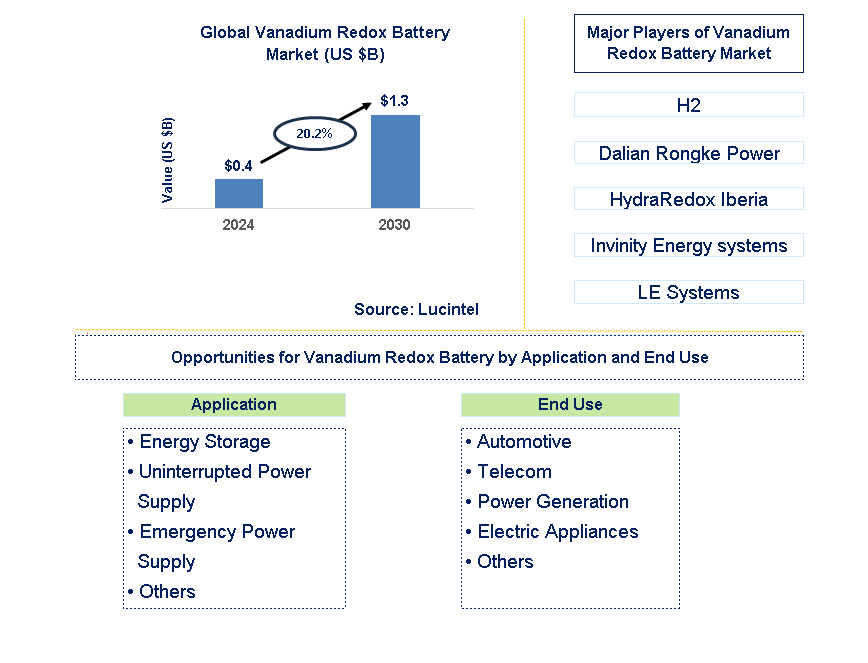
Key data points: The market size in 2030 = $1.3 billion, growth forecast = 20.2% annually next 6 years. Scroll below to get more insights. This market report covers trends, opportunities, and forecast in the global vanadium redox battery market to 2030 by application (energy storage, uninterrupted power supply, emergency power supply, and others), end use (automotive, telecom, power generation, electric appliances, and others), and region (North America, Europe, Asia Pacific, and the Rest of the World)
We'll send your sample report shortly.
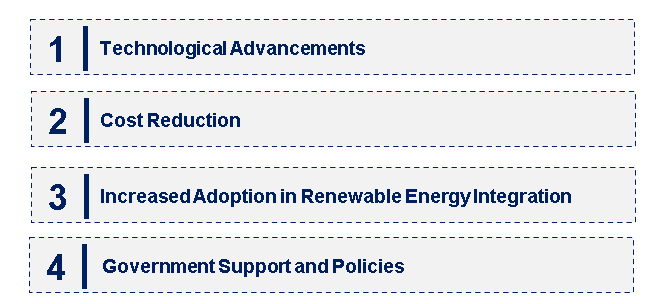
• Technological Advancements: Unceasingly conducted research in terms of VRB improvement on efficiency, higher energy density and lifetime. Innovations in battery performance by electrolyte formulations and membrane technology. These improvements are aimed at increasing the energy density of VRBs for them to become competitive with other forms of energy storage devices while at the same time reducing costs so as to increase their uptake for large-scale and commercial purposes.
• Cost Reduction: Efforts to bring down the cost of VRBs through technological advancements and economies of scale are gaining momentum. Lower production costs are being facilitated by developments in manufacturing technologies and materials. VRBs need to be made more affordable if they are going be used for various applications including grid storage and renewable integration.
• Increased Adoption in Renewable Energy Integration: VRBs are currently being increasingly used for integrating renewable energy such as solar and wind power. Inconsistency balancing intermittent renewables make them ideal for long duration reliable energy storage. As a result, incorporating VRBs into renewable energy systems is seen as a way forward towards cleaner sources of power which can guarantee an improved stability level within the networked grids.
• Government Support and Policies: Policies from governments that may seem encouraging have significantly contributed to adoption rates associated with VRBs today. Factors such as supportive legal frameworks, R&D financing plus subsidies especially for such projects like power banks have stimulated market expansion. There has been increased investment in this area as governments begin to realize just how important these batteries could be towards making their countries achieve both national security goals alongside sustainability objectives. The emergent trends in the market of VRB show that there is a dynamic shift towards more advanced and scalable energy storage solutions. Technological advancements, cost reduction efforts, and increased adoption in renewable energy integration are reshaping the market. Government support and expansion into emerging markets further drive growth and innovation. These trends highlight the evolving landscape of energy storage, emphasizing the role of VRBs in meeting future energy demands and supporting the transition to sustainable energy systems.
• Technological Enhancements: Energy density improvement, efficiency increase and lifespan elongation have formed the main thrusts of development towards VRB technology. As a result, battery performance has gone down as it has been accompanied by innovations in terms of electrolyte formulations and membrane technologies. Therefore, these technological improvements could boost competitiveness by enabling higher efficiencies as well as more cost-effective solutions that would widen their scope for application into large-scale energy storage systems.
• Cost Reduction Initiatives: Several strides are being made towards cutting VRB costs through improved manufacturing processes and economies of scale. For instance, production techniques alongside materials breakthroughs are helping to bring down prices for VRB systems. Hence, lower costs enable its wider use in commercial and industrial energy storage applications.
• Expansion of Commercial Applications: Business establishments now utilize VRBs to fulfill their power requirements for instance consistent power supply from intermittent renewable sources. Thus, when entering commercial sector it boosts market growth as well as universalizing its applicability across various industries.
• Increased Government Support: Governments worldwide are recognizing the prospects offered by VRBs hence incentivizing them through policies funding or subsidies. For example, VRB adoption is being encouraged through governmental initiatives that support green tech infrastructure projects like solar or wind farms among others globally. In addition supportive regulatory environments coupled with government incentives can attract investors’ interest while boosting further growth of this technology. Recent developments have had significant impact on the growth of the vanadium redox battery market. Technological enhancements, cost reduction initiatives, and the expansion of commercial applications make VRBs highly competitive and versatile. Also, these developments include increased government support as well as growing investment in R&D that propel this market.
• Utility-Scale Energy Storage: Due to their long duration storage capability and grid stability support, VRBs are well suited for utility-scale energy storage. The need for large scale energy storage solutions that can incorporate renewable energy sources is increasing offering an opportunity for VRBs. With scalability and reliability, they have become attractive options to utilities looking at enhancing grid resilience as well as managing supply and demand of electricity.
• Renewable Energy Integration: Strategic growth opportunity arises from the association between solar power, wind power and VRBs. By storing the extra renewable energy generated in a time when generation is low, this type of batteries ensures that there is always stable power. This means less dependence on fossil fuels and addresses intermittency issues of renewables.
• Commercial and Industrial Applications: More companies are adopting VRBs within commercial and industrial environments as businesses seek out reliable cost-effective ways of storing energy. For commercial facilities, VRBs may be used to shave peak loads, offer backup power or perform load leveling among other processes necessary for efficient operations during a production run. This approach represents significant scale-up potential, given rising emphasis on efficiency and sustainability in industry.
• Remote and Off-Grid Applications: VRBs are ideal for remote and off-grid applications which cannot be served by traditional forms of grid-connected storage systems. They have long cycle life and are easy to maintain making them suitable for recondite places which lack any kind of access towards the main electrical network system. Penetrating into these markets creates opportunities for the technology using VRB to solve energy problems in areas that lack sufficient supply. The identified strategic growth opportunities in the vanadium redox battery market show that technology can provide solutions to energy storage and renewable energy transition challenges. Such areas are utility-scale storage, integration of renewables, commercial and industrial applications as well as remote and off-grid use and emerging markets. Capitalizing on these will not only bring about innovation but also make VRB sector grow thus making it more relevant for meeting global energy storage demands in an eco-friendly way.
• H2
• Dalian Rongke Power
• HydraRedox Iberia
• Invinity Energy systems
• LE Systems
• Pinflow Energy Storage
• StorEn Technologies
• Storion energy
• Sumitomo Industries
• UniEnergy tech.
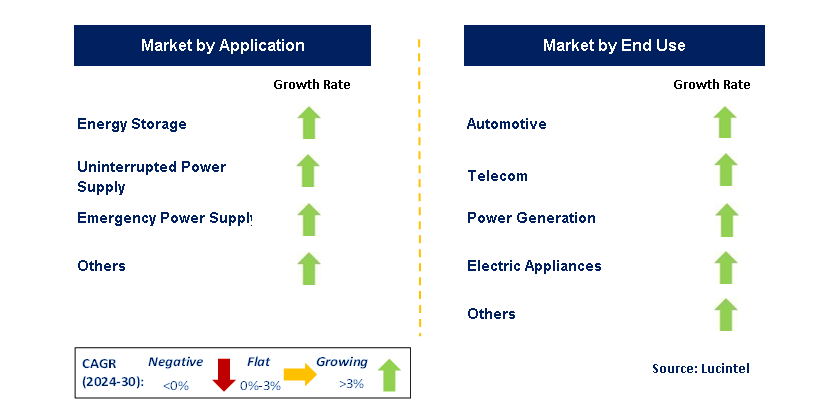
• Energy Storage
• Uninterrupted Power Supply
• Emergency Power Supply
• Others
• Automotive
• Telecom
• Power Generation
• Electric Appliances
• Others
• North America
• Europe
• Asia Pacific
• The Rest of the World
• United States: The U.S.A.’s market for vanadium redox batteries (VRBs) has seen encouraging developments with increased investments on large-scale energy storage projects. Efforts are aimed at improving efficiency so as to lower costs. Strong government incentives encouraging new grid storage options that are reliable due to high demand have resulted into this growth. These players are working on innovations that would address matters such as system integration and energy density so as to facilitate easy transition from non-renewable sources of power.
• China: China has become a major player in the VRB market through significant support by the Chinese Government which has invested massively in infrastructure for storing energy. It is leading globally in manufacturing high-capacity vanadium redox flow batteries (VRFBs). Innovations in electrolyte handling and implementation at scale within renewable project installations have also taken place recently. The main goal of China’s pursuit is to improve its national strategy relating to VRB technology considering the need for better energy security.
• Germany: In Germany, there are ongoing R&D efforts aimed at improving efficiency while reducing material use-related costs of the VRB sector further today. Intermittency issues associated with renewable power grids call for German adoption of VRBs for their intermittent supply needs. This could mean huge improvements being made regarding battery designs alongside differing materials used during production processes. German green-energy-transition policy is driving deployment of VRBs across various applications including industrial and utility-scale storage.
• India: The surge in the VRB market is attributed to India’s increasing energy needs as well as its development towards renewable sources. There have been pilot projects and initiatives aimed at enhancing VRB technology and reducing costs. The Indian government has been encouraging regional energy storage projects through sustainable energy solutions and grid stability programs, leading to a rise in the adoption of VRBs. Consequently, efforts to improve local manufacturing capacity and promote changes for batteries are ongoing.
• Japan: VRB performance has significantly changed with technological improvements that have led to their wide uptake for power applications in Japan. Battery life enhancements are among the most recent developments where technology companies partnered with research institutions to better batteries’ operational parameters. For purposes of disaster preparedness or ensuring the continuity of energy supply, Japan has incorporated VRBs into its national electric power system policies. This will go a long way in boosting capability in terms of energy storage due to both private sector investments and government polices which support it.
• H2
• Dalian Rongke Power
• HydraRedox Iberia
• Invinity Energy systems
• LE Systems
• Pinflow Energy Storage
• StorEn Technologies
• Storion energy
• Sumitomo Industries
• UniEnergy tech. Q6. Which vanadium redox battery market segment will be the largest in future? Answer: Lucintel forecasts that energy storage is expected to witness the highest growth over the forecast period. Q7. In vanadium redox battery market, which region is expected to be the largest in next 5 years? Answer: APAC is expected to witness highest growth over the forecast period. Q.8. Do we receive customization in this report? Answer: Yes, Lucintel provides 10% customization without any additional cost.


Choose a license that fits your team. Instant PDF delivery.
Prices exclude taxes. Instant delivery. Custom licensing available on request.
Market Report · July 31, 2026
Market Report · July 31, 2026
Market Report · July 31, 2026
Trusted partner for strategic intelligence and business growth


Receive a complimentary market analysis tailored to your industry. Our analysts will identify key growth opportunities and competitive dynamics specific to your business.

Market size, growth rate, and key trend analysis for your specific sector.

Top competitor positioning and market share analysis.

Strategic recommendations backed by data-driven insights.
Get curated market intelligence and competitive moves straight to your inbox.
By subscribing, you agree to receive our monthly insights. Unsubscribe anytime.
Receive a complimentary market analysis tailored to your industry. Our analysts will identify key growth opportunities and competitive dynamics specific to your business.
Market size, growth rate, and key trend analysis for your specific sector.
Top competitor positioning and market share analysis.
Strategic recommendations backed by data-driven insights.
Get curated market intelligence, emerging trends, and competitive moves straight to your inbox each month.
By subscribing, you agree to receive our monthly insights. Unsubscribe anytime.
We'll send your sample report shortly.