
Report Feature
V2X Communication Chips Market Trends and Forecast
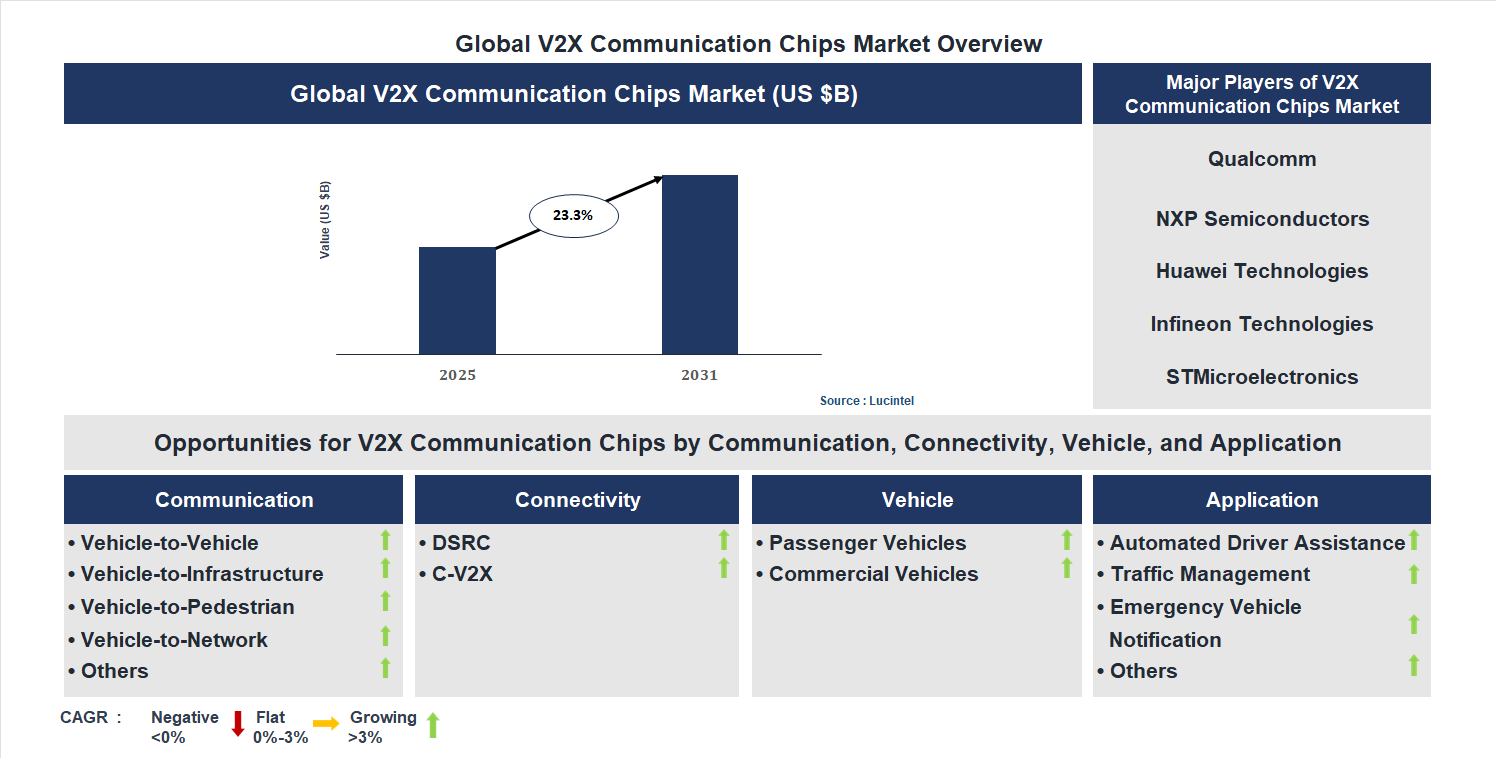
The future of the global V2X communication chips market looks promising with opportunities in the automated driver assistance, traffic management, and emergency vehicle notification markets. The global V2X communication chips market is expected to grow with a CAGR of 23.3% from 2025 to 2031. The major drivers for this market are the increasing demand for connected vehicle technologies, the rising focus on road safety solutions, and the growing deployment of intelligent transportation systems.• Lucintel forecasts that, within the communication category, vehicle-to-vehicle is expected to witness the highest growth over the forecast period.
• Within the application category, automated driver assistance is expected to witness the highest growth.
• In terms of region, APAC is expected to witness the highest growth over the forecast period. Gain valuable insights for your business decisions with our comprehensive 150+ page report. Sample figures with some insights are shown below.
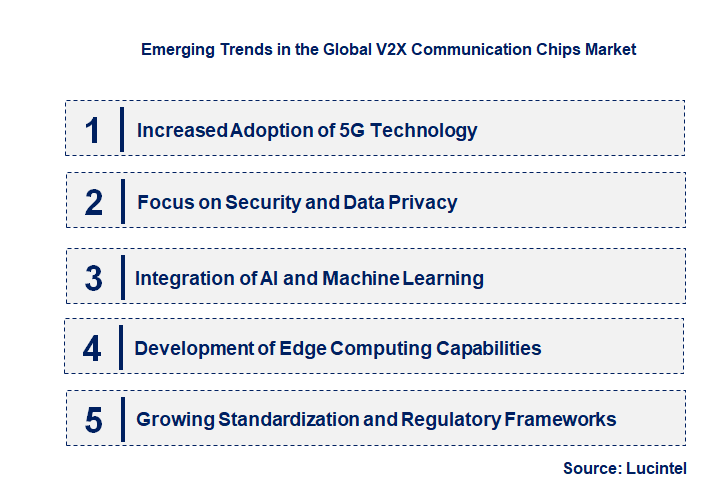
Emerging Trends in the V2X Communication Chips Market
The V2X communication chips market is experiencing rapid growth driven by advancements in connected vehicle technology, smart infrastructure, and the push toward autonomous driving. As vehicles become more interconnected, the demand for reliable, high-speed communication chips increases, fostering safer, more efficient transportation systems. Emerging trends are shaping the market landscape, influencing product development, industry standards, and consumer adoption. These developments are not only transforming automotive safety and traffic management but also creating new opportunities for manufacturers and technology providers. Understanding these key trends is essential for stakeholders aiming to capitalize on the evolving V2X ecosystem.• Increased Adoption of 5G Technology: The integration of 5G networks into V2X communication chips is accelerating, providing ultra-reliable, low-latency connectivity essential for real-time vehicle communication. This trend enhances safety features, traffic management, and autonomous driving capabilities by enabling faster data exchange between vehicles and infrastructure. The widespread deployment of 5G infrastructure is expected to significantly boost V2X market growth, encouraging automakers and chip manufacturers to develop compatible solutions. As 5G becomes more accessible, the market will see improved performance, reduced latency, and expanded use cases, making connected vehicles more efficient and safer.
• Focus on Security and Data Privacy: As V2X communication involves transmitting sensitive data, there is a growing emphasis on cybersecurity measures within chip design. Manufacturers are prioritizing secure communication protocols, encryption, and authentication to prevent hacking and data breaches. This trend is driven by increasing regulatory requirements and consumer demand for privacy protection. Enhanced security features are becoming a key differentiator among V2X chips, fostering trust and wider adoption. The focus on security is crucial for ensuring the integrity of connected vehicle systems and maintaining the safety and privacy of users.
• Integration of AI and Machine Learning: The incorporation of AI and machine learning algorithms into V2X chips is transforming vehicle communication systems. These technologies enable predictive analytics, anomaly detection, and adaptive decision-making, improving traffic flow and safety. AI-powered chips can process vast amounts of data in real-time, facilitating smarter routing, collision avoidance, and autonomous driving functions. This trend is expected to lead to more intelligent, autonomous vehicles and smarter infrastructure, ultimately enhancing overall transportation efficiency. The integration of AI is a significant driver of innovation, making V2X systems more responsive and capable.
• Development of Edge Computing Capabilities: Edge computing is becoming a vital component of V2X communication chips, allowing data processing closer to the source rather than relying solely on cloud infrastructure. This reduces latency, improves response times, and enhances system reliability. Edge-enabled chips facilitate real-time decision-making critical for safety applications like collision avoidance and traffic management. The trend supports the deployment of more sophisticated V2X applications, especially in areas with limited connectivity. As edge computing becomes more prevalent, it will enable more scalable, efficient, and resilient connected vehicle ecosystems.
• Growing Standardization and Regulatory Frameworks: The market is witnessing increased efforts toward establishing global standards and regulations for V2X communication. Standardization ensures interoperability between different manufacturers and systems, fostering broader adoption and integration. Governments and industry bodies are working on policies to regulate data sharing, security, and privacy, which influence chip design and deployment strategies. This trend promotes a cohesive ecosystem, reduces technical barriers, and accelerates market growth. Clear regulatory frameworks will also build consumer confidence and facilitate international collaboration, shaping the future landscape of V2X communication technology. In summary, these emerging trends are collectively reshaping the V2X communication chips market by enhancing connectivity, security, intelligence, and interoperability. They are driving innovation, expanding application scope, and fostering a safer, more efficient transportation environment. As these trends evolve, they will unlock new opportunities and challenges, fundamentally transforming the future of connected mobility.
Recent Development in the V2X Communication Chips Market
The V2X communication chips market has experienced significant growth driven by advancements in connected vehicle technology, increasing safety regulations, and the push toward autonomous driving. As vehicles become more interconnected, the demand for reliable, high-speed communication chips has surged. Recent developments reflect innovations in chip design, integration, and deployment strategies, shaping the future landscape of intelligent transportation systems. These changes are not only enhancing vehicle safety and efficiency but also influencing automotive manufacturing and infrastructure investments. The markets evolution is poised to accelerate with technological breakthroughs and regulatory support, creating new opportunities and challenges for industry stakeholders.• Technological Advancements in Chip Design: New V2X chips now feature enhanced processing power and lower latency, enabling real-time data exchange. This improvement boosts vehicle safety and traffic management efficiency, fostering greater adoption of connected vehicle solutions.
• Integration of 5G Technology: The incorporation of 5G connectivity into V2X chips has significantly increased data transmission speeds and reliability. This development supports more complex applications like autonomous driving and smart city infrastructure, expanding market potential.
• Strategic Collaborations and Partnerships: Major automotive and semiconductor companies are forming alliances to develop standardized V2X chips. These collaborations accelerate deployment, reduce costs, and promote interoperability across different vehicle brands and infrastructure.
• Regulatory Frameworks and Standards: Governments worldwide are establishing regulations and standards for V2X communication, encouraging manufacturers to adopt compliant chips. This regulatory push ensures safety, security, and compatibility, fostering market growth.
• Deployment in Commercial and Public Transport: Increasing adoption of V2X chips in commercial fleets and public transportation systems improves operational efficiency and safety. This trend broadens the market scope beyond passenger vehicles, creating new revenue streams. In summary, recent developments in the V2X communication chips market are driving technological innovation, fostering strategic collaborations, and aligning with regulatory standards. These factors are collectively enhancing vehicle safety, enabling autonomous driving, and expanding market applications. As a result, the market is experiencing rapid growth, with increased adoption across various transportation sectors, shaping the future of connected mobility.
Strategic Growth Opportunities in the V2X Communication Chips Market
The V2X communication chips market is experiencing rapid growth driven by advancements in connected vehicle technology, increasing safety regulations, and the push toward autonomous driving. As vehicles become more interconnected, the demand for reliable, low-latency communication chips is surging across various applications. This evolution is transforming the automotive landscape, enabling smarter transportation systems, improved safety, and enhanced user experiences. Key growth opportunities are emerging across different sectors, each contributing to the overall expansion of the V2X chips market. These opportunities are shaping the future of intelligent transportation and redefining mobility standards worldwide.• Connected Vehicles: Market expansion through integration of V2X chips in passenger cars enhances safety and navigation, leading to increased adoption of smart vehicle features and fostering a safer driving environment.
• Commercial Vehicles: Deployment of V2X communication chips in trucks and buses improves fleet management, reduces operational costs, and enhances safety, driving growth in commercial transportation sectors.
• Public Transportation: Implementation of V2X technology in buses and transit systems facilitates real-time communication, improves route efficiency, and enhances passenger safety, supporting urban mobility initiatives.
• Infrastructure & Smart Cities: V2X chips enable vehicle-to-infrastructure communication, promoting intelligent traffic management, reducing congestion, and supporting the development of smart city ecosystems.
• Autonomous Vehicles: The integration of V2X chips is critical for autonomous vehicle operation, providing real-time data exchange for navigation, safety, and coordination, thus accelerating the deployment of self-driving cars. In summary, these growth opportunities are significantly impacting the V2X communication chips market by expanding its application scope, fostering innovation, and supporting the development of safer, smarter transportation systems worldwide.
V2X Communication Chips Market Driver and Challenges
The V2X communication chips market is influenced by a variety of technological, economic, and regulatory factors. Rapid advancements in automotive technology, increasing demand for connected vehicles, and stringent safety regulations are key drivers. Economic growth in automotive sectors worldwide fuels market expansion, while evolving standards and policies shape industry dynamics. However, the market also faces challenges such as high development costs, cybersecurity concerns, and regulatory uncertainties that could hinder growth. Understanding these drivers and challenges is essential for stakeholders to navigate the evolving landscape and capitalize on emerging opportunities effectively. The factors responsible for driving the V2X communication chips market include:-• Technological Innovation: The continuous development of advanced V2X communication protocols and chipsets enhances vehicle safety, traffic management, and autonomous driving capabilities. Innovations such as 5G integration and edge computing improve data processing speed and reliability, making connected vehicle ecosystems more efficient. This technological evolution attracts automakers and suppliers, fostering market growth and encouraging investment in R&D to develop smarter, more secure chips.
• Growing Adoption of Connected Vehicles: Increasing consumer demand for connected and autonomous vehicles drives the need for V2X communication chips. Automakers are integrating these chips to enable vehicle-to-vehicle and vehicle-to-infrastructure communication, improving safety and traffic efficiency. The rise in smart city initiatives and infrastructure development further accelerates adoption, creating a substantial market opportunity for chip manufacturers.
• Regulatory Support and Standards Development: Governments worldwide are implementing policies and standards to promote vehicle safety and reduce traffic accidents. Regulations mandating V2X communication systems in new vehicles and standards like IEEE 802.11p and 3GPP enhance interoperability and safety compliance. Such regulatory frameworks incentivize automakers to incorporate V2X chips, thereby expanding the market.
• Economic Growth and Automotive Industry Expansion: The expanding automotive industry, especially in emerging economies, boosts demand for V2X communication chips. Increased vehicle production, coupled with investments in smart transportation infrastructure, supports market growth. Economic incentives and government funding for smart mobility projects further stimulate the deployment of V2X technology. The challenges facing this V2X communication chips market include:-
• High Development and Implementation Costs: Developing advanced V2X chips involves significant R&D investments, complex manufacturing processes, and integration costs. These high expenses can limit market entry for smaller players and slow down widespread adoption, especially in cost-sensitive markets. Additionally, the costs associated with upgrading existing infrastructure to support V2X communication pose financial challenges for governments and industry stakeholders.
• Cybersecurity and Data Privacy Concerns: V2X communication involves transmitting sensitive data between vehicles and infrastructure, making it vulnerable to cyberattacks and hacking. Ensuring data security and privacy is critical to gaining consumer trust and regulatory approval. Addressing these concerns requires robust encryption, cybersecurity protocols, and continuous monitoring, which can increase costs and complicate deployment.
• Regulatory Uncertainty and Lack of Standardization: The absence of unified global standards and evolving regulations creates uncertainty for market players. Differing regional policies and standards can hinder interoperability and slow down deployment. Companies face challenges in ensuring compliance across markets, which can delay product launches and increase costs, ultimately impacting market growth. In summary, the V2X communication chips market is driven by technological advancements, increasing vehicle connectivity, supportive regulations, and expanding automotive markets. However, high development costs, cybersecurity issues, and regulatory uncertainties pose significant challenges. These factors collectively influence the pace and direction of market growth, requiring stakeholders to innovate and adapt strategically. Successful navigation of these drivers and challenges will determine the markets future trajectory, with opportunities for growth balanced by the need to address critical barriers.
List of V2X Communication Chips Companies
Companies in the market compete on the basis of product quality offered. Major players in this market focus on expanding their manufacturing facilities, R&D investments, infrastructural development, and leverage integration opportunities across the value chain. With these strategies V2X communication chips companies cater increasing demand, ensure competitive effectiveness, develop innovative products & technologies, reduce production costs, and expand their customer base. Some of the V2X communication chips companies profiled in this report include-• Qualcomm
• NXP Semiconductors
• Huawei Technologies
• Infineon Technologies
• STMicroelectronics
• Continental
• Robert Bosch
• Denso Corporation
• Harman
• Intel Corporation
V2X Communication Chips Market by Segment
The study includes a forecast for the global V2X communication chips market by communication, connectivity, vehicle, application, and region.V2X Communication Chips Market by Communication [Value from 2019 to 2031]:
• Vehicle-to-Vehicle
• Vehicle-to-Infrastructure
• Vehicle-to-Pedestrian
• Vehicle-to-Network
• Others
V2X Communication Chips Market by Connectivity [Value from 2019 to 2031]:
• DSRC
• C-V2X
V2X Communication Chips Market by Vehicle [Value from 2019 to 2031]:
• Passenger Vehicles
• Commercial Vehicles
V2X Communication Chips Market by Application [Value from 2019 to 2031]:
• Automated Driver Assistance
• Traffic Management
• Emergency Vehicle Notification
• Others
V2X Communication Chips Market by Region [Value from 2019 to 2031]:
• North America
• Europe
• Asia Pacific
• The Rest of the World
Country Wise Outlook for the V2X Communication Chips Market
The V2X communication chips market is experiencing rapid growth driven by advancements in connected vehicle technology, increasing safety regulations, and the push toward autonomous driving. Countries are investing heavily in infrastructure and technology to enhance vehicle communication systems, aiming to improve road safety, traffic management, and driver experience. The market is characterized by innovation in chip design, integration with 5G networks, and collaborations between automotive and tech companies. As the industry evolves, regional developments reflect varying levels of adoption, regulatory support, and technological focus, shaping the global landscape of V2X communication chips.• United States: The US market is leading in V2X chip development, with major automakers and tech firms investing in 5G-enabled communication solutions. Regulatory initiatives, such as the Department of Transportations efforts to promote connected vehicle standards, are accelerating deployment. Companies like Qualcomm and Intel are launching advanced chips supporting high-speed data transfer and low latency. The US also sees significant investments in smart infrastructure to support V2X technology, fostering innovation in autonomous vehicle testing and deployment.
• China: China is rapidly advancing its V2X communication ecosystem, driven by government policies promoting smart transportation and urban mobility. Major tech giants and automotive manufacturers are collaborating to develop 5G-compatible chips and infrastructure. The country’s focus on integrating V2X with its extensive 5G network infrastructure aims to enhance traffic safety and efficiency. Pilot projects in cities like Beijing and Shanghai demonstrate the deployment of V2X-enabled vehicles, with substantial government funding supporting research and commercialization efforts.
• Germany: Germany, as a leader in automotive engineering, is emphasizing the integration of V2X chips into its automotive supply chain. The focus is on enhancing vehicle safety and supporting the transition to autonomous driving. Collaborations between automotive OEMs and chip manufacturers are resulting in high-performance, secure communication modules. The German government is also investing in research projects to develop standardized V2X solutions aligned with European Union regulations, fostering cross-border interoperability and innovation.
• India: India is gradually adopting V2X communication technology, primarily driven by government initiatives to improve urban mobility and road safety. The focus is on deploying cost-effective chips suitable for dense traffic environments and developing infrastructure to support connected vehicles. Several pilot projects are underway in major cities like Delhi and Bengaluru, aiming to demonstrate the benefits of V2X for traffic management and accident reduction. The market is also witnessing increased collaboration between local startups and global technology providers.
• Japan: Japan is actively advancing its V2X communication capabilities, leveraging its expertise in automotive technology and infrastructure development. The country is focusing on integrating V2X chips with existing intelligent transportation systems to enhance safety and traffic flow. Japanese automakers are testing V2X-enabled vehicles equipped with advanced chips supporting vehicle platooning and autonomous driving features. Government initiatives aim to establish standards and promote nationwide deployment, positioning Japan as a key player in the global V2X ecosystem.

Features of the Global V2X Communication Chips Market
Market Size Estimates: V2X communication chips market size estimation in terms of value ($B). Trend and Forecast Analysis: Market trends (2019 to 2024) and forecast (2025 to 2031) by various segments and regions. Segmentation Analysis: V2X communication chips market size by various segments, such as by communication, connectivity, vehicle, application, and region in terms of value ($B). Regional Analysis: V2X communication chips market breakdown by North America, Europe, Asia Pacific, and Rest of the World. Growth Opportunities: Analysis of growth opportunities in different communications, connectivity, vehicles, applications, and regions for the V2X communication chips market. Strategic Analysis: This includes M&A, new product development, and competitive landscape of the V2X communication chips market. Analysis of competitive intensity of the industry based on Porter’s Five Forces model.
FAQ
Q1. What is the growth forecast for V2X communication chips market? Answer: The global V2X communication chips market is expected to grow with a CAGR of 23.3% from 2025 to 2031. Q2. What are the major drivers influencing the growth of the V2X communication chips market? Answer: The major drivers for this market are the increasing demand for connected vehicle technologies, the rising focus on road safety solutions, and the growing deployment of intelligent transportation systems. Q3. What are the major segments for V2X communication chips market? Answer: The future of the V2X communication chips market looks promising with opportunities in the automated driver assistance, traffic management, and emergency vehicle notification markets. Q4. Who are the key V2X communication chips market companies? Answer: Some of the key V2X communication chips companies are as follows:• Qualcomm
• NXP Semiconductors
• Huawei Technologies
• Infineon Technologies
• STMicroelectronics
• Continental
• Robert Bosch
• Denso Corporation
• Harman
• Intel Corporation Q5. Which V2X communication chips market segment will be the largest in future? Answer: Lucintel forecasts that, within the communication category, vehicle-to-vehicle is expected to witness the highest growth over the forecast period. Q6. In V2X communication chips market, which region is expected to be the largest in next 5 years? Answer: In terms of region, APAC is expected to witness the highest growth over the forecast period. Q7. Do we receive customization in this report? Answer: Yes, Lucintel provides 10% customization without any additional cost.
Table of Contents
List of Figures
List of Tables
Methodology
- In-depth interviews of the major players in this market
- Detailed secondary research from competitors’ financial statements and published data
- Extensive searches of published works, market, and database information pertaining to industry news, company press releases, and customer intentions
- A compilation of the experiences, judgments, and insights of Lucintel’s professionals, who have analyzed and tracked this market over the years.


Buy Now
Choose a license that fits your team. Instant PDF delivery.
Prices exclude taxes. Instant delivery. Custom licensing available on request.
Key Questions
- • What are some of the most promising, high-growth opportunities for the V2X communication chips market by communication (vehicle-to-vehicle, vehicle-to-infrastructure, vehicle-to-pedestrian, vehicle-to-network, and others), connectivity (DSRC and C-V2X), vehicle (passenger vehicles and commercial vehicles), application (automated driver assistance, traffic management, emergency vehicle notification, and others), and region (North America, Europe, Asia Pacific, and the Rest of the World)?
- • Which segments will grow at a faster pace and why?
- • Which region will grow at a faster pace and why?
- • What are the key factors affecting market dynamics? What are the key challenges and business risks in this market?
- • What are the business risks and competitive threats in this market?
- • What are the emerging trends in this market and the reasons behind them?
- • What are some of the changing demands of customers in the market?
- • What are the new developments in the market? Which companies are leading these developments?
- • Who are the major players in this market? What strategic initiatives are key players pursuing for business growth?
- • What are some of the competing products in this market and how big of a threat do they pose for loss of market share by material or product substitution?
- • What M&A activity has occurred in the last 5 years and what has its impact been on the industry? For any questions related to V2X Communication Chips Market, V2X Communication Chips Market Size, V2X Communication Chips Market Growth, V2X Communication Chips Market Analysis, V2X Communication Chips Market Report, V2X Communication Chips Market Share, V2X Communication Chips Market Trends, V2X Communication Chips Market Forecast, V2X Communication Chips Companies, write Lucintel analyst at email: helpdesk@lucintel.com. We will be glad to get back to you soon.


