
Market Report · July 29, 2026

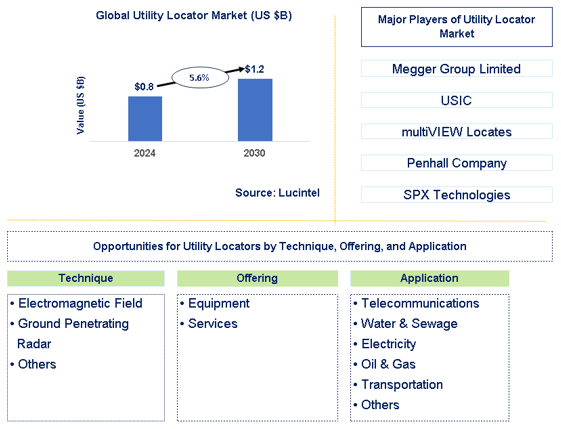
Key data points: The market size in 2030 = $1.2 billion, growth forecast = 5.6% annually next 6 years. Scroll below to get more insights. This market report covers trends, opportunities, and forecast in the global utility locator market to 2030 by technique (electromagnetic field, ground penetrating radar, and others), offering (equipment and services), application (telecommunications, water & sewage, electricity, oil & gas, transportation, and others), and region (North America, Europe, Asia Pacific, and the Rest of the World)
We'll send your sample report shortly.
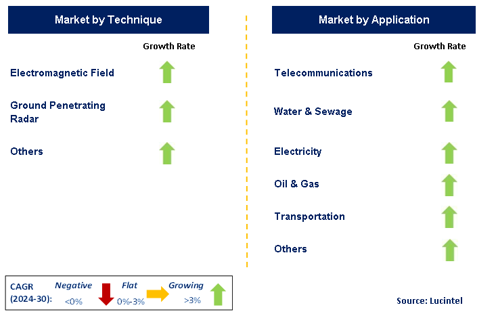
• Integration of IoT and Smart Technologies: The integration of Internet of Things (IoT) and smart technologies is revolutionizing utility locating by providing real-time data and remote monitoring capabilities. IoT sensors enable continuous tracking of utility conditions and infrastructure, offering valuable insights for proactive maintenance and quicker response to issues. This trend enhances the accuracy of utility detection and management, reduces downtime, and improves overall operational efficiency by integrating utility data with broader infrastructure management systems.
• Advancements in Ground Penetrating Radar (GPR): Ground Penetrating Radar (GPR) technology is advancing with improved resolution and deeper penetration capabilities. New developments in GPR offer higher accuracy and more detailed imaging of subsurface utilities. This allows for better detection of complex utility networks and reduces the risk of accidental damage during excavation. Enhanced GPR systems support more precise utility mapping, which is essential for large-scale infrastructure projects and complex urban environments.
• Adoption of AI and Machine Learning: Artificial Intelligence (AI) and machine learning are increasingly being adopted in utility locating to enhance predictive maintenance and automate data analysis. AI-driven systems analyze large volumes of data to predict potential utility issues and optimize maintenance schedules. Machine learning algorithms improve the accuracy of utility detection and provide actionable insights, leading to more efficient and cost-effective utility management. This trend helps in managing complex utility networks and reducing operational disruptions.
• Enhanced Geographic Information Systems (GIS): Geographic Information Systems (GIS) are being integrated with utility locating technologies to improve spatial analysis and mapping of utility networks. Enhanced GIS capabilities offer detailed visualization and better management of utility assets, supporting effective planning and maintenance. This trend helps in creating comprehensive utility maps, facilitates better decision-making, and ensures accurate representation of utility infrastructure for ongoing management and future development.
• Focus on Environmental and Safety Regulations: There is a growing emphasis on complying with environmental and safety regulations in utility locating practices. New technologies and methods are being developed to minimize environmental impact and enhance safety during utility detection and excavation. This includes the use of less invasive techniques and advanced sensors that reduce disturbances. Compliance with stringent regulations promotes sustainable practices and ensures safer operations, aligning with broader industry goals of reducing environmental impact and improving safety standards. These emerging trends in the utility locator market highlight a significant shift towards more advanced, efficient, and environmentally conscious practices. The integration of IoT, AI, and improved technologies such as GPR and GIS is driving innovation and enhancing the accuracy and effectiveness of utility management. As the industry continues to evolve, these trends will play a crucial role in addressing the growing demands of infrastructure development and maintenance, ensuring safer and more efficient utility operations.
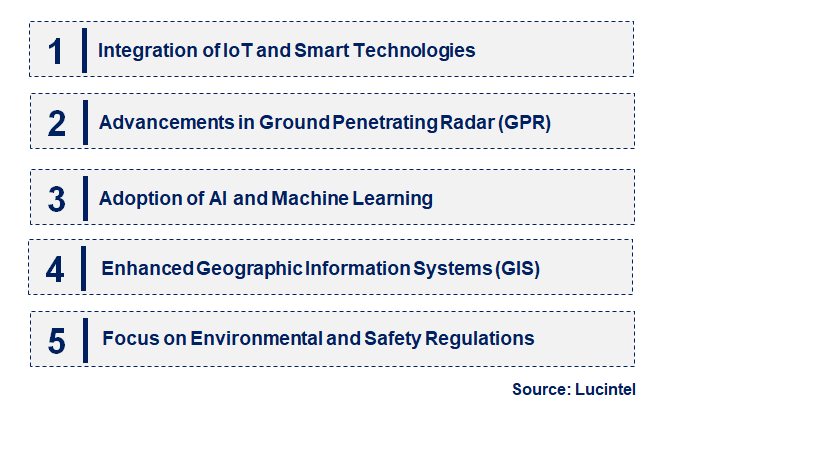
• Enhanced Ground Penetrating Radar (GPR) Technologies: Ground Penetrating Radar (GPR) technologies have seen substantial improvements in resolution and depth penetration. Modern GPR systems now offer higher accuracy and more detailed imaging of subsurface utilities. This advancement allows for better detection of complex utility networks and reduces the risk of accidental damage during excavation. Enhanced GPR capabilities are critical for urban planning and large-scale construction projects, providing clearer insights into underground infrastructure.
• Integration of IoT for Real-Time Monitoring: The integration of Internet of Things (IoT) technology into utility locating systems has revolutionized real-time monitoring and data collection. IoT sensors provide continuous tracking of utility conditions and infrastructure, enabling proactive maintenance and quick issue resolution. This development enhances the accuracy of utility mapping and helps prevent potential failures by providing timely data, thus improving overall operational efficiency and safety.
• AI-Powered Data Analysis and Predictive Maintenance: Artificial Intelligence (AI) and machine learning are increasingly being employed to analyze large datasets from utility locating systems. AI-driven solutions can predict potential issues and optimize maintenance schedules by analyzing patterns and trends. This predictive capability leads to more efficient management of utility assets and reduces unplanned outages or failures. AI-powered data analysis supports more informed decision-making and enhances the reliability of utility systems.
• Advanced Geographic Information Systems (GIS) Integration: Geographic Information Systems (GIS) integration has advanced, providing enhanced spatial analysis and mapping of utility networks. Modern GIS systems offer detailed visualizations and improved management of utility assets. This integration supports effective planning, maintenance, and management of utilities by creating comprehensive and accurate utility maps. The enhanced GIS capabilities facilitate better decision-making and infrastructure management.
• Focus on Environmental and Safety Regulations: There is an increased focus on adhering to environmental and safety regulations in utility locating practices. New technologies and methods are being developed to minimize environmental impact and enhance safety during utility detection and excavation. These advancements include less invasive techniques and advanced sensors that reduce disturbances. Compliance with regulations promotes sustainable practices and ensures safer operations, aligning with industry goals of reducing environmental impact and improving safety standards. Recent developments in the utility locator market, including advancements in GPR technologies, IoT integration, AI-powered analytics, GIS enhancements, and a focus on regulations, are significantly transforming the industry. These improvements are leading to more accurate, efficient, and environmentally responsible utility management. By adopting these new technologies and practices, the industry is enhancing its ability to detect and manage underground utilities effectively, reducing risks, and improving overall operational efficiency.
• Smart City Infrastructure: The rise of smart cities represents a significant growth opportunity for utility locators. Integrating advanced utility locating technologies with smart city infrastructure enables real-time monitoring and management of underground utilities. IoT sensors and GIS technologies can enhance the precision of utility maps, improving urban planning and operational efficiency. As smart cities evolve, the demand for sophisticated utility locating solutions that support infrastructure management and smart grids will grow, creating a substantial market for advanced locating technologies.
• Utility Damage Prevention: The need for preventing utility damage during construction and excavation activities is driving growth in utility locating applications. Advanced technologies, such as enhanced GPR and electromagnetic methods, can reduce the risk of accidental utility strikes by providing accurate and detailed subsurface information. This growth opportunity is particularly relevant for industries involved in construction, mining, and infrastructure maintenance, where accurate utility detection is critical for preventing costly and hazardous accidents.
• Emergency Response and Disaster Management: Effective emergency response and disaster management require rapid and accurate utility location to prevent further damage and ensure safety. Specialized utility locating technologies that offer quick and precise identification of subsurface utilities can significantly enhance response efforts during emergencies. Innovations in portable and real-time locating solutions cater to this need, supporting first responders and disaster management teams in efficiently managing utility-related challenges during crises.
• Aging Infrastructure Rehabilitation: As infrastructure ages, there is a growing need for accurate utility mapping to support rehabilitation and modernization efforts. Utility locating technologies can assist in identifying and assessing the condition of existing utilities, guiding repairs, and replacements. This growth opportunity involves applying advanced locating methods to support infrastructure assessment, maintenance planning, and upgrades, ensuring the continued reliability and safety of aging utility systems.
• Environmental and Regulatory Compliance: Increased focus on environmental and regulatory compliance presents growth opportunities for utility locators. Technologies that minimize environmental impact and adhere to regulatory standards are in demand. This includes less invasive locating methods and solutions that reduce soil disruption and ecological impact. By developing and adopting technologies that align with environmental regulations, utility locating companies can meet compliance requirements and appeal to environmentally conscious clients. The utility locator market is experiencing dynamic growth opportunities driven by advancements in technology and increasing infrastructure needs. Key applications such as smart city infrastructure, utility damage prevention, emergency response, aging infrastructure rehabilitation, and environmental compliance are presenting new avenues for development. By leveraging these opportunities, companies can enhance their offerings, improve utility management practices, and meet the evolving demands of the market.
• Megger Group Limited
• USIC
• Multiview Locates
• Penhall Company
• SPX Technologies
• Emerson Electric
• Hexagon
• Electromagnetic Field
• Ground Penetrating Radar
• Others
• Equipment
• Services
• Telecommunications
• Water & Sewage
• Electricity
• Oil & Gas
• Transportation
• Others
• North America
• Europe
• Asia Pacific
• The Rest of the World
• United States: In the U.S., recent developments in the utility locator market include the integration of advanced technologies such as Ground Penetrating Radar (GPR) and electromagnetic sensors. The adoption of Geographic Information Systems (GIS) and Internet of Things (IoT) has further improved accuracy and real-time monitoring. Enhanced regulatory requirements and safety standards have prompted utility companies to invest in more sophisticated locator systems, thus reducing risks and improving project efficiency.
• China: China has seen significant progress in utility locating technologies with the increased use of digital mapping and 3D imaging techniques. The government’s push towards smart city initiatives has accelerated the adoption of advanced utility locator systems. Companies are focusing on integrating AI and machine learning for predictive maintenance and more accurate utility detection. The expansion of urban infrastructure projects and emphasis on safety compliance are driving these advancements in China’s utility locator market.
• Germany: Germany utility locator market is benefiting from the country’s commitment to smart infrastructure and sustainable development. Recent developments include the use of advanced electromagnetic and acoustic methods for utility detection, as well as the incorporation of high-precision GPS technologies. The focus is on improving the efficiency of utility management and maintenance. Additionally, German companies are exploring innovative solutions for reducing the environmental impact of excavation and construction activities.
• India: In India, recent advancements in utility locator technology are driven by rapid urbanization and infrastructure development. The introduction of portable and cost-effective utility detection tools has enhanced the capabilities of small and medium-sized enterprises. The Indian market is witnessing increased adoption of GPR and electromagnetic systems, driven by government initiatives to improve infrastructure quality and safety. Training and capacity-building programs are also being implemented to boost the effectiveness of utility locating operations.
• Japan: Japan is advancing in utility locator technology with a focus on precision and disaster preparedness. Recent developments include the integration of robotics and remote sensing technologies for enhanced accuracy in utility mapping. The emphasis is on earthquake-prone areas where accurate utility mapping is crucial for disaster response and infrastructure maintenance. Japanese companies are also investing in AI and big data analytics to improve predictive capabilities and operational efficiency in utility management.


• Megger Group Limited
• USIC
• Multiview Locates
• Penhall Company
• SPX Technologies
• Emerson Electric
• Hexagon Q6. Which utility locator market segment will be the largest in future? Answer: Lucintel forecasts that electromagnetic field is expected to witness higher growth over the forecast period. Q7. In utility locator market, which region is expected to be the largest in next 5 years? Answer: APAC is expected to witness the highest growth over the forecast period. Q.8 Do we receive customization in this report? Answer: Yes, Lucintel provides 10% customization without any additional cost.


Choose a license that fits your team. Instant PDF delivery.
Prices exclude taxes. Instant delivery. Custom licensing available on request.
Market Report · July 29, 2026
Market Report · July 20, 2026
Market Report · July 20, 2026
Trusted partner for strategic intelligence and business growth


Receive a complimentary market analysis tailored to your industry. Our analysts will identify key growth opportunities and competitive dynamics specific to your business.

Market size, growth rate, and key trend analysis for your specific sector.

Top competitor positioning and market share analysis.

Strategic recommendations backed by data-driven insights.
Get curated market intelligence and competitive moves straight to your inbox.
By subscribing, you agree to receive our monthly insights. Unsubscribe anytime.
Receive a complimentary market analysis tailored to your industry. Our analysts will identify key growth opportunities and competitive dynamics specific to your business.
Market size, growth rate, and key trend analysis for your specific sector.
Top competitor positioning and market share analysis.
Strategic recommendations backed by data-driven insights.
Get curated market intelligence, emerging trends, and competitive moves straight to your inbox each month.
By subscribing, you agree to receive our monthly insights. Unsubscribe anytime.
We'll send your sample report shortly.