
Upcycled Ingredient Market Report: Trends, Forecast and Competitive Analysis to 2035

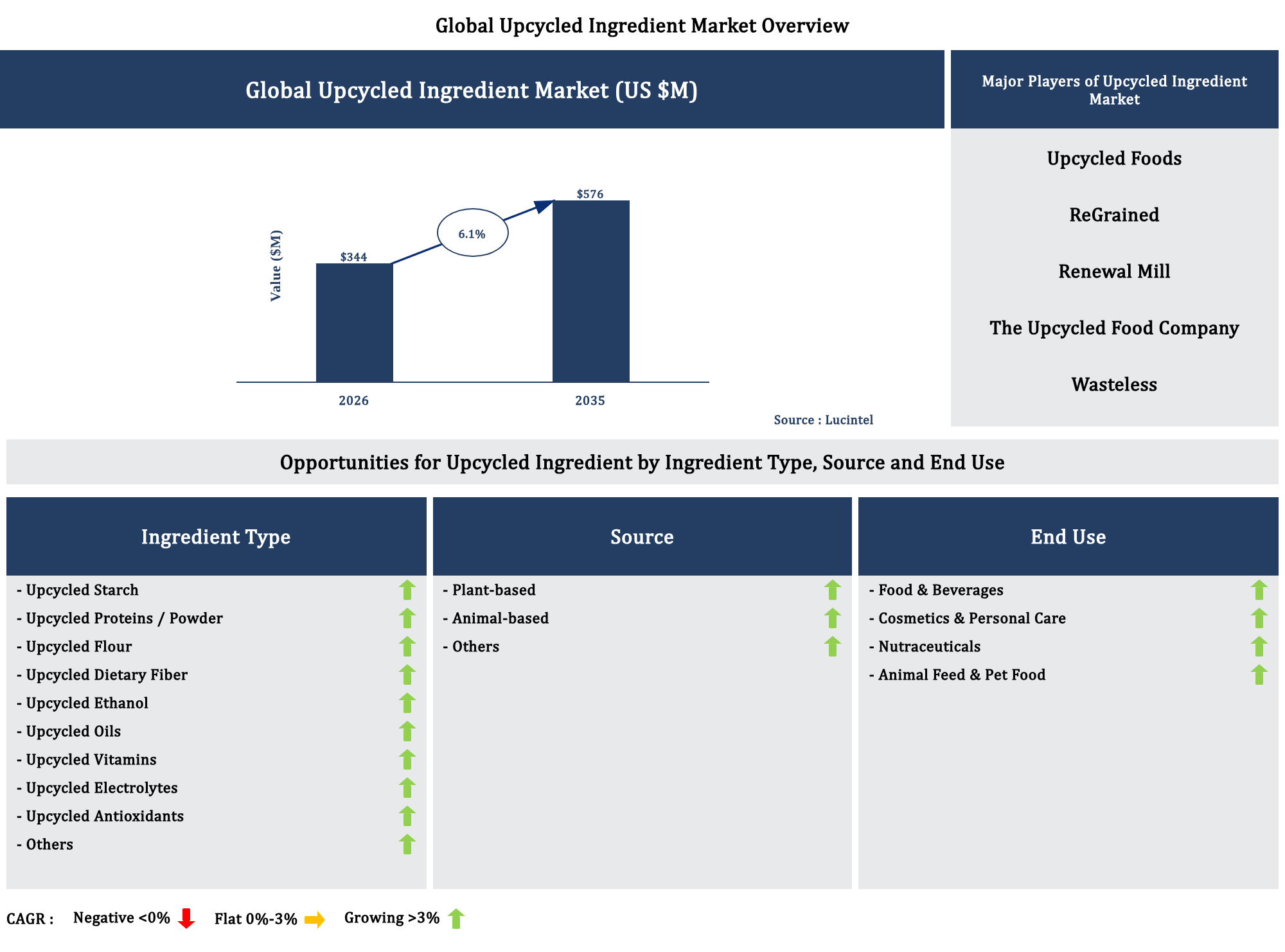
Key data points: The market size in 2035 = $576 million, growth forecast = 6.1% annually for the next 9 years. Scroll below to get more insights. This market report covers trends, opportunities and forecasts in upcycled ingredient market to 2035 by ingredient type (upcycled starch, upcycled proteins / powder, upcycled flour, upcycled dietary fiber, upcycled ethanol, upcycled oils, upcycled vitamins, upcycled electrolytes, upcycled antioxidants, and others), source (plant-based, animal-based, and others), end use (food & beverages, cosmetics & personal care, nutraceuticals, and animal feed & pet food), and region (North America, Europe, Asia Pacific, and the Rest of the World)

Publisher: Lucintel Last Updated: July 2026
See Pricing

Download Sample Report

| ✨ New Download Sample report — Get instant insights! | ✨ New Download Sample report — Get instant insights!

Upcycled Ingredient Market Report: Trends, Forecast and Competitive Analysis to 2035

Upcycled Ingredient Market

The future of the global upcycled ingredient market looks promising with opportunities in the food & beverage, cosmetics & personal care, nutraceutical, and animal feed & pet food markets. The global upcycled ingredient market is expected to reach an estimated $576 million by 2035 with a CAGR of 6.1% from 2026 to 2035. The major drivers for this market are the increasing demand for sustainable food ingredients, the rising focus on food waste reduction, and the growing adoption of circular economy practices.

  • Lucintel forecasts that, within the ingredient type category, upcycled starch is expected to witness the highest growth over the forecast period due to the increasing demand for sustainable food ingredients.
  • Within the end use category, food & beverage will remain the largest segment due to the rising adoption of food beverage applications.
  • In terms of regions, North America will remain the largest region over the forecast period due to the growing focus on circular economy solutions.

Gain valuable insights for your business decisions with our comprehensive 150+ page report. Sample figures with some insights are shown below.
Upcycled Ingredient Market

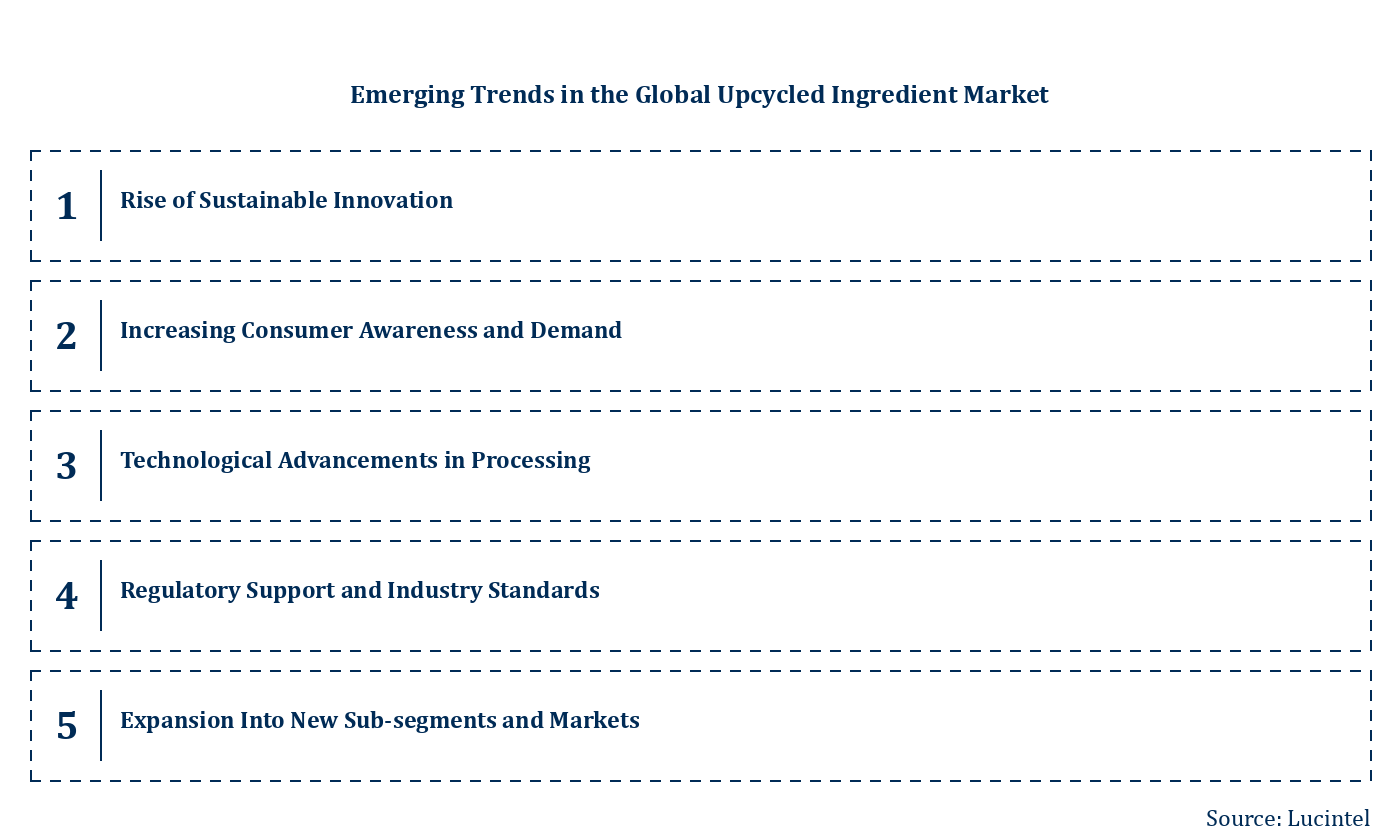
Emerging Trends in the Upcycled Ingredient Market

The upcycled ingredient market is experiencing rapid growth driven by increasing consumer demand for sustainable and environmentally friendly products. As the food and beverage industry shifts towards eco-conscious practices, innovative solutions are emerging to reduce waste and promote circular economy principles. This market is characterized by the integration of waste materials into new, high-quality ingredients, offering both environmental benefits and unique product offerings. The following trends highlight the key developments shaping this evolving landscape, reflecting technological advancements, consumer preferences, and regulatory support that are collectively transforming the industry.

  • Rise of Sustainable Innovation: Companies are investing in research to transform food waste into valuable ingredients such as protein powders, fibers, and flavor enhancers. This trend is driven by consumer demand for eco-friendly products and regulatory pressures to reduce waste. Innovations include using by-products from breweries, fruit peels, and vegetable scraps, which are processed into functional ingredients. This not only minimizes environmental impact but also creates new revenue streams for producers. The trend is fostering a circular economy, reducing reliance on traditional raw materials, and promoting sustainability across the supply chain.
  • Increasing Consumer Awareness and Demand: Consumers are becoming more conscious of the environmental impact of their food choices. This awareness is fueling demand for upcycled ingredients that are marketed as sustainable, natural, and health-promoting. Brands are leveraging transparency and storytelling to educate consumers about the benefits of upcycled products, which enhances brand loyalty. The trend is also encouraging product innovation, with companies launching snacks, beverages, and meal solutions featuring upcycled ingredients, thus expanding market reach and consumer engagement.
  • Technological Advancements in Processing: Cutting-edge processing technologies such as enzymatic treatments, fermentation, and advanced drying methods are improving the efficiency and quality of upcycled ingredients. These innovations enable the extraction of high-value compounds from waste streams while maintaining nutritional integrity. Enhanced processing techniques reduce costs and increase scalability, making upcycled ingredients more commercially viable. This technological progress is crucial for meeting the growing demand and ensuring consistent quality, thereby accelerating adoption across various food and beverage sectors.
  • Regulatory Support and Industry Standards: Governments and industry bodies are establishing guidelines and standards to promote the use of upcycled ingredients. Policies incentivize sustainable practices, provide funding for research, and facilitate certification processes that verify the environmental benefits of upcycled products. This regulatory framework builds consumer trust and encourages industry participation. As standards become more defined, companies are more confident in integrating upcycled ingredients into their offerings, which further accelerates market growth and mainstream acceptance.
  • Expansion Into New Sub-Segments and Markets: The upcycled ingredient market is diversifying beyond traditional food applications into cosmetics, animal feed, and functional foods. For example, upcycled plant proteins are gaining popularity in plant-based meat alternatives, while upcycled oils are used in skincare products. This expansion opens new revenue streams and broadens the market scope. Additionally, emerging markets in Asia and Latin America are adopting upcycled ingredients, driven by local waste management challenges and sustainability initiatives. This diversification enhances market resilience and fosters innovation across multiple sectors.

These trends are collectively reshaping the upcycled ingredient market by fostering innovation, increasing consumer engagement, and establishing supportive regulatory frameworks. The shift towards sustainable practices is not only reducing environmental impact but also creating new business opportunities. Technological advancements are improving product quality and scalability, while expanding into new sub-segments broadens market potential. As these developments continue, the market is poised for significant growth, driven by a global commitment to sustainability and resource efficiency. This evolution is transforming waste into valuable resources, redefining industry standards, and paving the way for a more sustainable future.
Upcycled Ingredient Market by country

Recent Developments in the Upcycled Ingredient Market

The upcycled ingredient market is experiencing rapid growth driven by increasing consumer demand for sustainable products and innovative food solutions. Companies are focusing on transforming food by-products into valuable ingredients, reducing waste, and promoting environmental responsibility. This shift is creating new opportunities across various sectors, including food manufacturing, cosmetics, and nutraceuticals. As awareness about sustainability rises, market players are investing in research and development to expand product offerings and meet evolving consumer preferences.

  • Expanding Food Industry Applications: Upcycled ingredients are increasingly used in snacks, beverages, and bakery products, enhancing nutritional value and sustainability. This diversification boosts product appeal and reduces waste, attracting eco-conscious consumers. The integration of these ingredients improves shelf life, flavor, and texture, creating new market segments and driving sales growth across the food sector.
  • Advancements in Cosmetic and Personal Care Products: The cosmetic industry is adopting upcycled ingredients for eco-friendly formulations. These ingredients offer natural benefits, appeal to environmentally conscious consumers, and support brand sustainability claims. The use of upcycled components in skincare and haircare products enhances product differentiation, expands market share, and encourages innovation in green beauty solutions.
  • Rising Demand in Nutraceuticals and Dietary Supplements: Upcycled ingredients are gaining popularity in health supplements due to their high nutritional content and sustainability credentials. They provide functional benefits such as antioxidants, fiber, and protein, catering to health-conscious consumers. This trend supports the development of new supplement lines, boosts sales, and aligns with global health and sustainability goals.
  • Technological Innovations in Upcycling Processes: Advances in extraction and processing technologies improve the efficiency and quality of upcycled ingredients. These innovations reduce costs, enhance product purity, and enable the development of novel ingredients with specific functional properties. Improved technology accelerates market adoption, broadens application scope, and fosters competitive advantages for industry players.
  • Increasing Regulatory Support and Certification Standards: Governments and industry bodies are establishing guidelines and certifications for sustainable ingredients. These standards promote transparency, build consumer trust, and facilitate market entry for upcycled products. Regulatory support encourages investment, innovation, and wider adoption of upcycled ingredients across multiple sectors.

These developments are significantly transforming the upcycled ingredient market by expanding application areas, fostering technological innovation, and strengthening regulatory frameworks. The combined effect is driving market growth, encouraging sustainable practices, and meeting the rising consumer demand for eco-friendly, health-oriented products. As a result, the market is poised for continued expansion and increased competitiveness.

Strategic Growth Opportunities in the Upcycled Ingredient Market

The upcycled ingredient market is experiencing rapid growth driven by increasing consumer demand for sustainable products and environmental consciousness. Innovations in food processing and waste reduction are creating new opportunities for manufacturers to develop eco-friendly ingredients. As industries seek to minimize waste and improve resource efficiency, upcycled ingredients are becoming integral to product formulations across food, beverage, and cosmetic sectors. This evolving landscape offers significant potential for market expansion, driven by regulatory support, consumer preferences, and technological advancements.

  • Sustainable Food Production: Expanding use of upcycled ingredients in food manufacturing offers eco-friendly solutions that reduce waste and lower environmental impact. Companies are developing upcycled grains, fruit, and vegetable by-products into functional ingredients, catering to health-conscious and environmentally aware consumers. This trend supports circular economy principles, enhances brand reputation, and meets regulatory pressures for sustainability, opening new markets for innovative, eco-friendly food products.
  • Upcycled Ingredients in Beverages: The beverage industry is increasingly incorporating upcycled ingredients such as fruit pulp, coffee grounds, and vegetable extracts to create unique, sustainable products. These ingredients add nutritional value and flavor while reducing waste. Craft breweries, juice brands, and functional drink producers are leveraging upcycled components to appeal to eco-conscious consumers, driving growth in specialty beverages and functional drinks segments.
  • Cosmetic and Personal Care Applications: The cosmetic industry is adopting upcycled ingredients like coffee grounds, fruit extracts, and plant fibers for formulations that emphasize sustainability and natural benefits. These ingredients are used in scrubs, masks, and skincare products, appealing to consumers seeking eco-friendly and ethically sourced options. The trend supports brand differentiation and aligns with global sustainability initiatives, expanding the market for upcycled cosmetic ingredients.
  • Technological Innovations Enabling Upcycling: Advances in processing technologies, such as enzymatic treatment and extraction methods, facilitate the transformation of food waste into valuable ingredients. These innovations improve yield, purity, and functionality of upcycled components, making them more viable for commercial use. Enhanced processing capabilities enable manufacturers to scale up production, diversify product offerings, and meet increasing demand for sustainable ingredients across various sectors.
  • Regulatory and Certification Support: Governments and industry bodies are implementing policies and standards that promote upcycled ingredients, providing credibility and consumer trust. Certifications like "Upcycled Food" labels and sustainability standards encourage adoption by brands seeking to demonstrate environmental responsibility. Regulatory support accelerates market growth by reducing barriers, fostering innovation, and encouraging investment in upcycling technologies and supply chains.

The overall impact of these growth opportunities is a dynamic, expanding market that aligns sustainability with consumer preferences. As technological, regulatory, and industry collaborations strengthen, the upcycled ingredient market is poised for substantial growth, offering innovative solutions that benefit the environment, manufacturers, and consumers alike.

Upcycled Ingredient Market Drivers and Challenges

The upcycled ingredient market is influenced by a variety of technological, economic, and regulatory factors that shape its growth trajectory. Innovations in food processing and sustainable practices drive demand for upcycled ingredients, while economic shifts such as rising consumer awareness and environmental concerns further propel market expansion. Regulatory frameworks aimed at reducing food waste and promoting sustainability also play a crucial role. However, challenges such as high production costs, lack of consumer awareness, and regulatory hurdles can impede growth. Understanding these drivers and challenges is essential for stakeholders to navigate the evolving landscape and capitalize on emerging opportunities within the market.

The factors responsible for driving the upcycled ingredient market include:-

  • Technological Innovation: The development of advanced processing techniques enables the transformation of food by-products into valuable ingredients, reducing waste and creating new revenue streams. Innovations in extraction, preservation, and formulation improve product quality and scalability, making upcycled ingredients more viable for mainstream adoption. As technology advances, costs decrease, and product diversity increases, fueling market growth and encouraging food manufacturers to incorporate sustainable ingredients into their offerings.
  • Rising Consumer Demand for Sustainability: Consumers are increasingly prioritizing environmentally friendly and ethically sourced products. This shift in consumer preferences drives food companies to incorporate upcycled ingredients to meet sustainability goals and enhance brand reputation. The demand for clean-label, natural, and eco-friendly products encourages manufacturers to innovate with upcycled ingredients, which also aligns with global efforts to reduce food waste and promote circular economy practices.
  • Regulatory Support and Government Initiatives: Governments worldwide are implementing policies and regulations aimed at reducing food waste and promoting sustainable practices. Incentives, subsidies, and awareness campaigns encourage food producers to adopt upcycling techniques. Regulatory frameworks that endorse transparency and safety standards further facilitate market growth by building consumer trust and ensuring product quality, thus fostering a conducive environment for market expansion.
  • Increasing Investment and R&D Activities: Significant investments by private and public entities in research and development are driving innovation in upcycled ingredients. These investments lead to the discovery of new sources, improved processing methods, and novel applications, broadening the scope of the market. R&D efforts also help address challenges related to scalability and cost-effectiveness, making upcycled ingredients more accessible and appealing to a wider range of food manufacturers.
  • Expansion of Food Processing Industry: The growth of the global food processing sector creates a larger base for upcycled ingredient utilization. As processed food demand rises, manufacturers seek sustainable and cost-efficient ingredients, boosting the adoption of upcycled options. The expansion also encourages collaborations and partnerships, fostering innovation and increasing the availability of diverse upcycled ingredients across various food categories.

The challenges facing the upcycled ingredient market include:-

  • High Production Costs: Developing upcycled ingredients often involves complex processing techniques, specialized equipment, and quality control measures, which can significantly increase production costs. These expenses may hinder the competitiveness of upcycled ingredients compared to conventional ingredients, limiting their adoption, especially among small and medium-sized food manufacturers. Overcoming cost barriers through technological advancements and economies of scale is essential for broader market penetration.
  • Lack of Consumer Awareness and Acceptance: Despite growing interest in sustainability, many consumers remain unaware of upcycled ingredients or skeptical about their safety and quality. This lack of awareness hampers demand and limits market growth. Educating consumers about the benefits and safety of upcycled ingredients is crucial to increasing acceptance and encouraging mainstream adoption, which requires targeted marketing and transparent communication.
  • Regulatory and Standardization Challenges: The absence of clear regulatory guidelines and standardized definitions for upcycled ingredients creates uncertainty for manufacturers and consumers. Regulatory hurdles can delay product approvals and market entry, while inconsistent standards may affect product quality and safety perceptions. Establishing comprehensive regulations and standards is vital to building trust, ensuring safety, and facilitating international trade within the market.

The upcycled ingredient market is driven by technological advancements, consumer sustainability preferences, supportive regulations, increased R&D investments, and industry expansion. However, high costs, consumer awareness gaps, and regulatory uncertainties pose significant challenges. Addressing these issues through innovation, education, and policy development will be critical for sustainable growth. Overall, the market holds substantial potential for contributing to food waste reduction and promoting sustainable food systems, provided these drivers and challenges are effectively managed.

List of Upcycled Ingredient Market Companies

Companies in the market compete on the basis of product quality offered. Major players in this market focus on expanding their manufacturing facilities, R&D investments, infrastructural development, and leverage integration opportunities across the value chain. Through these strategies upcycled ingredient market companies cater increasing demand, ensure competitive effectiveness, develop innovative products & technologies, reduce production costs, and expand their customer base. Some of the upcycled ingredient market companies profiled in this report include-

  • Upcycled Foods
  • ReGrained
  • Renewal Mill
  • The Upcycled Food Company
  • Wasteless
  • Karma
  • FoodLoop

Upcycled Ingredient Market by Segment

The study includes a forecast for the global upcycled ingredient market by ingredient type, source, end use, and region.

  • Upcycled Ingredient Market by Ingredient Type [Value from 2019 to 2035]:
    • Upcycled Starch
    • Upcycled Proteins / Powder
    • Upcycled Flour
    • Upcycled Dietary Fiber
    • Upcycled Ethanol
    • Upcycled Oils
    • Upcycled Vitamins
    • Upcycled Electrolytes
    • Upcycled Antioxidants
    • Others
  • Upcycled Ingredient Market by Source [Value from 2019 to 2035]:
    • Plant-based
    • Animal-based
    • Others
  • Upcycled Ingredient Market by End Use [Value from 2019 to 2035]:
    • Food & Beverages
    • Cosmetics & Personal Care
    • Nutraceuticals
    • Animal Feed & Pet Food
  • Upcycled Ingredient Market by Region [Value ($M) from 2019 to 2035]:
    • North America
    • Europe
    • Asia Pacific
    • The Rest of the World

Country Wise Outlook for the Upcycled Ingredient Market

The upcycled ingredient market has experienced significant growth driven by increasing consumer demand for sustainable and eco-friendly food options, regulatory support, and innovations in food processing technologies. As sustainability becomes a central focus globally, countries are adopting new strategies to incorporate upcycled ingredients into their food systems, reducing waste and promoting circular economy principles. This trend is particularly prominent in major economies with advanced food industries, where technological advancements and consumer awareness are accelerating market expansion. The following summarizes recent developments in the United States, China, Germany, India, and Japan within this evolving market landscape.

  • United States: The U.S. has seen rapid growth in upcycled ingredients, driven by consumer demand for sustainable products and strong regulatory support. Major food companies are investing in upcycling technologies, and startups are emerging with innovative solutions to reduce food waste. The government’s initiatives promoting sustainability and waste reduction have further boosted market confidence. Retailers are increasingly incorporating upcycled ingredients into their product lines, emphasizing transparency and eco-friendly practices. Additionally, research institutions are collaborating with industry players to develop new upcycling methods, expanding the market scope.
  • China: China is rapidly adopting upcycled ingredients as part of its broader sustainability goals. The government’s policies aimed at reducing food waste and promoting circular economy practices are encouraging industry participation. Chinese companies are investing in advanced processing technologies to convert food by-products into valuable ingredients. The market is also driven by rising consumer awareness of environmental issues and a growing demand for eco-conscious products. E-commerce platforms are facilitating the distribution of upcycled food products, making them more accessible to consumers. Local startups are innovating in this space, contributing to market diversification and growth.
  • Germany: Germany is a leader in sustainable food practices within Europe, with a strong focus on upcycled ingredients. The country’s strict food safety regulations and environmental policies support market development. German companies are pioneering in developing upcycled ingredients from food processing by-products, with a focus on quality and safety. Consumer awareness campaigns and eco-labeling initiatives are boosting demand for upcycled products. The food industry is collaborating with research institutions to improve upcycling techniques and scale production. Additionally, Germany’s commitment to reducing food waste aligns with the broader European Union sustainability objectives, fostering a conducive environment for market expansion.
  • India: India is witnessing a growing interest in upcycled ingredients as part of its efforts to reduce food waste and promote sustainability. The government’s initiatives to minimize food loss and support circular economy practices are encouraging industry adoption. Local startups and food manufacturers are exploring innovative ways to utilize food by-products, especially in the snack and beverage sectors. The increasing consumer awareness about environmental issues and health benefits is driving demand for upcycled products. Additionally, rural and semi-urban markets are emerging as key areas for market expansion, supported by government programs and NGO initiatives aimed at reducing food waste and promoting sustainable practices.
  • Japan: Japan’s market for upcycled ingredients is expanding due to its strong focus on sustainability and waste reduction. The country’s advanced food processing technologies enable efficient upcycling of food by-products. Japanese companies are developing innovative products that emphasize quality, safety, and environmental benefits. Consumer awareness campaigns and eco-labeling are increasing demand for upcycled ingredients. The government’s policies promoting sustainable development and waste management are further supporting market growth. Collaboration between industry and academia is fostering technological advancements, and the market is seeing a rise in premium and niche products that cater to environmentally conscious consumers.

Features of the Upcycled Ingredient Market

  • Market Size Estimates: Upcycled ingredient market size estimation in terms of value ($M).
  • Trend and Forecast Analysis: Market trends (2019 to 2025) and forecast (2026 to 2035) by various segments and regions.
  • Segmentation Analysis: Upcycled ingredient market size by ingredient type, source, end use, and region in terms of value ($M).
  • Regional Analysis: Upcycled ingredient market breakdown by North America, Europe, Asia Pacific, and Rest of the World.
  • Growth Opportunities: Analysis of growth opportunities in different ingredient types, sources, end uses, and regions for the upcycled ingredient market.
  • Strategic Analysis: This includes M&A, new product development, and competitive landscape of the upcycled ingredient market.
  • Analysis of competitive intensity of the industry based on Porter’s Five Forces model.

Top 5 Companies

  • Upcycled Foods
  • ReGrained
  • Renewal Mill
  • The Upcycled Food Company
  • Wasteless

Table of Contents

1. Executive Summary

List of Figures

List of Tables

Table 4.1: Attractiveness Analysis for the Global Upcycled Ingredient Market by Ingredient Type Table 4.2: Market Size and CAGR of Various Ingredient Type in the Global Upcycled Ingredient Market (2019-2025) Table 4.3: Market Size and CAGR of Various Ingredient Type in the Global Upcycled Ingredient Market (2026-2035) Table 4.4: Trends of Upcycled Starch in the Global Upcycled Ingredient Market (2019-2025) Table 4.5: Forecast for Upcycled Starch in the Global Upcycled Ingredient Market (2026-2035) Table 4.6: Trends of Upcycled Proteins / Powder in the Global Upcycled Ingredient Market (2019-2025) Table 4.7: Forecast for Upcycled Proteins / Powder in the Global Upcycled Ingredient Market (2026-2035) Table 4.8: Trends of Upcycled Flour in the Global Upcycled Ingredient Market (2019-2025) Table 4.9: Forecast for Upcycled Flour in the Global Upcycled Ingredient Market (2026-2035) Table 4.10: Trends of Upcycled Dietary Fiber in the Global Upcycled Ingredient Market (2019-2025) Table 4.11: Forecast for Upcycled Dietary Fiber in the Global Upcycled Ingredient Market (2026-2035) Table 4.12: Trends of Upcycled Ethanol in the Global Upcycled Ingredient Market (2019-2025) Table 4.13: Forecast for Upcycled Ethanol in the Global Upcycled Ingredient Market (2026-2035) Table 4.14: Trends of Upcycled Oils in the Global Upcycled Ingredient Market (2019-2025) Table 4.15: Forecast for Upcycled Oils in the Global Upcycled Ingredient Market (2026-2035) Table 4.16: Trends of Upcycled Vitamins in the Global Upcycled Ingredient Market (2019-2025) Table 4.17: Forecast for Upcycled Vitamins in the Global Upcycled Ingredient Market (2026-2035) Table 4.18: Trends of Upcycled Electrolytes in the Global Upcycled Ingredient Market (2019-2025) Table 4.19: Forecast for Upcycled Electrolytes in the Global Upcycled Ingredient Market (2026-2035) Table 4.20: Trends of Upcycled Antioxidants in the Global Upcycled Ingredient Market (2019-2025) Table 4.21: Forecast for Upcycled Antioxidants in the Global Upcycled Ingredient Market (2026-2035) Table 4.22: Trends of Others in the Global Upcycled Ingredient Market (2019-2025) Table 4.23: Forecast for Others in the Global Upcycled Ingredient Market (2026-2035)

Methodology

Lucintel has been in the business of market research and management consulting since 2000 and has published over 1000 market intelligence reports in various markets / applications and served over 1,000 clients worldwide. This study is a culmination of four months of full-time effort performed by Lucintel's analyst team. The analysts used the following sources for the creation and completion of this valuable report:

  • In-depth interviews of the major players in this market
  • Detailed secondary research from competitors' financial statements and published data
  • Extensive searches of published works, market, and database information pertaining to industry news, company press releases, and customer intentions
  • A compilation of the experiences, judgments, and insights of Lucintel's professionals, who have analyzed and tracked this market over the years.

Extensive research and interviews are conducted across the supply chain of this market to estimate market share, market size, trends, drivers, challenges, and forecasts. Below is a brief summary of the primary interviews that were conducted by job function for this report.

Lucintel's methodology for market research

Thus, Lucintel compiles vast amounts of data from numerous sources, validates the integrity of that data, and performs a comprehensive analysis. Lucintel then organizes the data, its findings, and insights into a concise report designed to support the strategic decision-making process. The figure below is a graphical representation of Lucintel's research process.

Primary interviews by job function

Buy Now

Choose a license that fits your team. Instant PDF delivery.

Market Report

1 User PDF

$4,850
Buy Now

Market Report

2-5 Users PDF

$6,700
Buy Now

Market Report

Corporate PDF

$8,850
Buy Now

Market Report

Global PDF

$10,000
Buy Now

Prices exclude taxes. Instant delivery. Custom licensing available on request.

Frequently Asked Questions

What is the upcycled ingredient market size?
The global upcycled ingredient market is expected to reach an estimated $576 million by 2035.
What is the growth forecast for upcycled ingredient market?
The global upcycled ingredient market is expected to grow with a CAGR of 6.1% from 2026 to 2035.
What are the major drivers influencing the growth of the upcycled ingredient market?
The major drivers for this market are the increasing demand for sustainable food ingredients, the rising focus on food waste reduction, and the growing adoption of circular economy practices.
What are the major segments for upcycled ingredient market?
The future of the upcycled ingredient market looks promising with opportunities in the food & beverage, cosmetics & personal care, nutraceutical, and animal feed & pet food markets.
Who are the key upcycled ingredient market companies?

Some of the key upcycled ingredient companies are as follows:

  • Upcycled Foods
  • ReGrained
  • Renewal Mill
  • The Upcycled Food Company
  • Wasteless
  • Karma
  • FoodLoop
Which upcycled ingredient market segment will be the largest in future?
Lucintel forecasts that, within the ingredient type category, upcycled starch is expected to witness the highest growth over the forecast period.
In upcycled ingredient market, which region is expected to be the largest in next 9 years?
In terms of region, North America will remain the largest region over the forecast period.
Do we receive customization in this report?
Yes, Lucintel provides 10% customization without any additional cost.

Key Questions

  • What are some of the most promising, high-growth opportunities for the upcycled ingredient market by ingredient type (upcycled starch, upcycled proteins / powder, upcycled flour, upcycled dietary fiber, upcycled ethanol, upcycled oils, upcycled vitamins, upcycled electrolytes, upcycled antioxidants, and others), source (plant-based, animal-based, and others), end use (food & beverages, cosmetics & personal care, nutraceuticals, and animal feed & pet food), and region (North America, Europe, Asia Pacific, and the Rest of the World)?
  • Which segments will grow at a faster pace and why?
  • Which region will grow at a faster pace and why?
  • What are the key factors affecting market dynamics? What are the key challenges and business risks in this market?
  • What are the business risks and competitive threats in this market?
  • What are the emerging trends in this market and the reasons behind them?
  • What are some of the changing demands of customers in the market?
  • What are the new developments in the market? Which companies are leading these developments?
  • Who are the major players in this market? What strategic initiatives are key players pursuing for business growth?
  • What are some of the competing products in this market and how big of a threat do they pose for loss of market share by material or product substitution?
  • What M&A activity has occurred in the last 6 years and what has its impact been on the industry?
Why Choose Us

The Lucintel Advantage

Trusted partner for strategic intelligence and business growth

25+ Years Excellence

25+ Years Excellence

Quarter century of proven expertise in management consulting and market research across global markets.
Game-Changer Ideas

Game-Changer Ideas

Innovative strategies and actionable insights that help clients become the smartest in their industry.
Global Reach

Global Reach

Extensive coverage across 50+ industries and markets worldwide with localized expertise.
Start Your Growth Journey

Get Your Free
Market Intelligence
Briefing

Receive a complimentary market analysis tailored to your industry. Our analysts will identify key growth opportunities and competitive dynamics specific to your business.

Custom Market Snapshot

Market size, growth rate, and key trend analysis for your specific sector.

Competitive Landscape Overview

Top competitor positioning and market share analysis.

Growth Opportunity Identification

Strategic recommendations backed by data-driven insights.

Subscribe

Subscribe to our Newsletter

Get curated market intelligence and competitive moves straight to your inbox.

By subscribing, you agree to receive our monthly insights. Unsubscribe anytime.

Industry Trends Market Signals Opportunities Competitor Moves